Empires of Mesopotamia:
First Dynasty of Ur
Élite Burial in the Cemetery of Ur (II)
First Dynasty of Ur: Élite Burials (I) First Dynasty of Ur: Élite Burials (II)


Empires of Mesopotamia:
First Dynasty of Ur
Élite Burial in the Cemetery of Ur (II)
First Dynasty of Ur: Élite Burials (I) First Dynasty of Ur: Élite Burials (II)
Introduction
As discussed in my page on the First Dynasty of Ur: Royal Cemetery, Leonard Woolley (referenced below, 1934a, at p. 33) applied the adjective ‘royal’ to 16 graves in the cemetery at Ur:
✴10 that each had a built structure that served as the primary burial chamber:
PG 777; PG 779; PG 789; PG 80o; PG 1050
PG 1054; PG 1236; PG 1618; PG 1631; PG 1648
✴6 (which he labelled ‘death pits’) that arguably ‘housed‘ the bodies of a number of victims of human sacrifice (albeit that evidence for an associated burial chamber was absent in these cases):
PG 337; PG 580; PG 1157; PG 1232; PG 1237; PG 1332
Following a re-evaluation of the archeological evidence by Paul Zimmerman (referenced below, at pp. 16-21):
✴Woolley’s 10 burial chambers became 12, which are discussed in my page First Dynasty of Ur: Élite Burials (I); and,
✴Woolley’s 6 death pits became 8 (with the addition of PG 800a and PG 1618b, which Woolley had incorrectly associated with burial chambers PG 800b and PG 1618a respectively).
Before looking at these 9 death pits (plus the death pit associated with the burial chamber PG 789) individually, it is worth revisiting a key passage in Woolley’s final report on his excavations (see Leonard Woolley, 1934a, at p. 33), in which he summarised the hypothesis that governed his view on how the élite of Ur were buried in the Early Dynastic Period: the élite person (the ‘primary burial) was:
“... always [sic] laid inside the tomb chamber, accompanied as a rule by a few attendants. Then, a place had to be provided for the bodies of the other victims [= the sacrificed attendants who had served the élite person in life]. This problem [was] solved in various ways:
✴sometimes the [victims’] bodies were placed in separate chambers of the stone buildings [housing the primary burials, as in PG 1236 and PG 779, discussed in my previous page]; but
✴more often they were:
•[placed] in a ‘death pit’, a sunken court open to the sky, which might be part of the pit in which the chamber was constructed ... or contiguous to it ... ; or ...
•buried in the filling of the tomb shaft [as in PG 1050 and PG 1054, discussed in the previous page].
The number of [attendants] sacrificed in a single [burial] might vary from a mere half-dozen to between 70 and 80”.
The 9 burials under discussion here all belong to the middle group, in which ‘victims’ were apparently ritually buried with their grave goods in a ‘sunken court open to the sky’ before the pit was closed, usually with a layer of matting and then loose soil.
In the previous page, I was able to discuss the burials in built structure in rough date order, as established by Paul Zimmerman using architectural evidence. Of course, this convenience is not available for most of the nine ‘open air‘ burials here. I will therefore order them in terms of the (necessarily approximate) number of bodies and discuss them in two groups:
✴in the present page: PG 1237 (74); PG 789 (63); PG 1157 (58); PG 1332 (43); PG 800a (22); and
✴in the following page (First Dynasty of Ur: Élite Burials (III)): PG 1618b (5); PG 337 (3); PG 1232 (2); PG 580 (0).
PG 1237
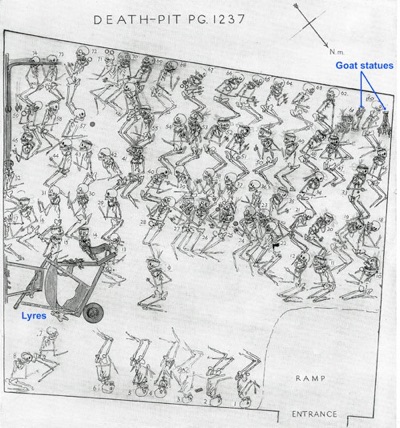
Plan of PG 1237: from Leonard Woolley (referenced below, 1934b,Plate 71)
My additions in blue (objects mentioned in the text below)
Leonard Woolley (referenced below, 1934a, at p. 113) characterised PG 1237 as the ‘Great Pit’:
“... for the very good reason that it consisted of a death pit and little else.”
In other words, this important burial did not actually fit into any of his categories:
✴it was ‘royal’ because it apparently contained the bodies of ritually murdered ‘attendants’ of a recently-deceased ‘royal’ person; but
✴there was nothing to suggest that it was associated with the burial chamber that contained the body of the ‘royal’ person in question.
He resorted (at pp. 113-4) to the argument that there must have been:
“... no fixed relation of place between the two essential features of the royal tomb, and it cannot be claimed that no chamber existed because none was found inside the [death] pit itself.”
Woolley presumably (and reasonably) assigned adjective ‘great’ to this pit because (as he recorded at it contained the remains of 74 human bodies, He described (at p. 116) their distribution across the pit as follows:
✴those of 5 ‘men-servants’ carrying knives or axes lay against the northeast wall and a 6th lay a little in front of the platform edge (numbers 1-6);
✴those of another 6 six women (numbers 7-9 and 13-15):
“... kept rather apart in the southern corner, where were the remains of a canopy (?)”; and
✴those of 62 women lay in [four] rows across the pit from the north west to southeast.
See the plans below, for the locations of the individual bodies in the first two groups.
West Corner of the Pit
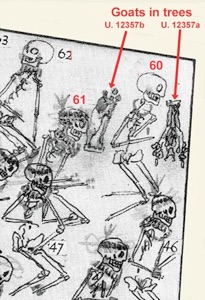
Plan of the west corner of PG 1237: adapted from Leonard Woolley (referenced below, 1934b, Plate 71)
My additions in red
This section addresses the apparent association between:
✴the famous pair of statuettes, each of which depicts a goat in a tree, which were found in this corner; and
✴the two bodies (numbers 60 and 61) that lay close to them.
Statuettes of Goats in Trees
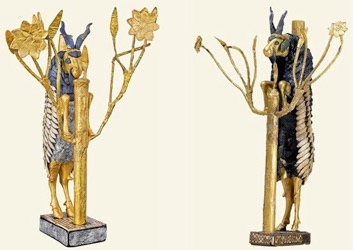
Two restored statuettes, each depicting a male goat in a flowering tree from the west corner of the pit
Left: U. 12357B, from the Penn Museum (30-12-702) Right: U. 12357A, from the British Museum (BM 122200)
Adapted from images from the respective museums
These magnificent statuettes were clearly designed as a pair. Each of them had been constructed on a wooden core that had rotted away, but Woolley was able to reconstruct them from the indentation in the surrounding soil and surviving remains of gold foil, lapis, shell, copper, silver and red limestone. As Naomi Miller et al. (referenced below, at p. 28) observed:
“Though not identical, the goat and tree representations are very similar to one another, as are the bases, ... [and, furthermore, the] primary iconography is the same in both objects.”
These authors also pointed out (at p. 31) that
✴the face and legs of both goats are covered with gold leaf;
✴their eyes, horns, and beard have lapis inlay;
✴their coats are made of carved plates of lapis and shell;
✴their ears are made of copper; and
✴the belly of the smaller one was covered in silver.
These authors argued also observed (at p. 31) that:
✴each tree has one main trunk with two branches emerging symmetrically from it;
✴each branch has four stems that originally supported alternating rosettes and leaves;
✴three rosettes (two with 8 petals and one with 9) survive on U 12357b and two rosettes with 8 petals survive on U 12357a;
✴all of these part are either made from gold or covered in it; and
they noted (at p. 32) that the rosette motif used for the flowers of the trees is sometimes a symbol of the goddess Inanna.
Body 61
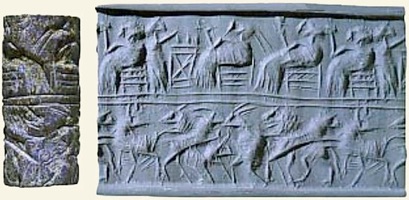
Lapis lazuli seal (U. 12380) of ‘Body 61’ and modern impression found with Body 61
Now in the Penn Museum (30-12-3): images from the museum website
As Richard Zettler (referenced below, 2020, at p. 26) observed, Body 61, which lay among other female bodies at the west corner of the pit, was the most elaborately dressed of the 68 that were laid out in this burial. Indeed, Amy Gansell (referenced bellow, at p, 15) characterised this as one of the 6 ‘exceptional bodies’ (in terms of its adornment) that have been found in the cemetery. According to the list provided by Leonard Woolley (referenced below, at p. 120, usefully summarised by Amy Gansell in her Table 1, at p. 6), the objects found with this body included:
✴what seems to have been an elaborate headdress made up of:
“... [a] gold hair-ribbon; gold leaf pendant wreath; wreath of gold triple willow-leaves; [and] wreath of gold rings set with lapis disks”;
✴a gold and lapis ‘dog-collar' and four necklaces:
“... necklace of gold and lapis tubular beads and carnelian rings; necklace of large gold and lapis fluted balls and carnelian rings; necklace of gold and carnelian and gold double conoids and carnelian rings, [and] necklace of gold balls, lapis double conoids and carnelian rings;
✴a silver comb with inlaid flowers (illustrated in the website of the British Museum: BM 122300) and ‘3 gold flower rosettes on silver stems’ (which may be the same thing);
✴smaller items of jewellery (gold ear-rings; 2 gold hair-rings; 6 gold finger rings (three of which are in the Penn Museum: 30-12- 553; 30-12-555A; and 30-12-555B); a bracelet of gold and lapis diamonds and carnelian rings; a bead cuff);
✴a silver tumbler (which, as Ricard Zettler observed, (at p. 27), was recorded elsewhere as a ‘ ‘ silver cup held to the mouth’; and
✴a lapis lazuli cylinder seal (U. 12380) (discussed below).
According to Léon Legrain (in Leonard Woolley, 1934a, entry 39, at p. 339):
✴in the upper register:
“... three women are seated, cup in hand [and] a maid stands by a board loaded with more cups”; and
✴in the lower register:
“... two crossed lions attack a herd of antelopes (goats ?) and put them to flight, [as is suggested by the fact that] they are jumping, kneeling and running with [their heads] turned”.
As Holly Pittman (referenced below, catalogue entry 27, at p. 83) observed:
“The combination of banquet and combat scenes is unusual but not unique on cylinder seals and other artefacts, [albeit that the] significance of the association is unknown.”
Body 60
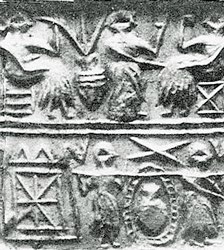
Modern impression made by the seal (U. 12387 ) found with Body 60: now in the Iraq Museum (IM 7270)
Image from Leonard Woolley (referenced below, 1934b, Plate 194 (23)
According to Leonard Woolley (referenced below, at p. 119) this seal was found with body 60. More specifically, he described the objects found by this body as follows:
“Gold ear-rings’ necklace of four rows of silver and lapis double conoid beads; silver pin ... with lapis head; lapis cylinder seal (U. 12387). [One] of the flowers broken off from [the statuette [U. 12357B - see above] lay one under the head and [another lay] by the hand of this [body].”
The relief that is carried by the seal is in two registers. According to Léon Legrain (in Leonard Woolley, 1934a, entry 23, at p. 338):
✴in the upper register, a man (on the left) and a woman (on the right) are seated on each side of wine jar, with the latter attended by one servant: the jar contains three pipes; the woman drinks from one of them; and the man raises a cup.; and
✴in the lower register, a richly loaded sideboard stands to the left, behind two servants who carry an apparently heavy jar in a net that swings from a pole across their shoulders.
Bodies 6o and 61: Conclusions
As Amy Gansell (referenced below, at p. 14) observed:
“... each [of these bodies] possessed a seal and [was] near goat sculptures: [Body] 61, wearing an elaborate variation of the gold head wreath-based assemblage, was positioned adjacent to [Body] 60, who was not ornamented with a gold wreath but was, nonetheless, relatively richly outfitted. [Body] 60 may have been a subordinate of [Body] 61 in whatever responsibility linked the pair in the custody of the statues.”
Richard Zettler (referenced below, 2020, at p. 26) went further: he reasonably argued (at pp. 27-8) that PG 1237, which was apparently laid out as a tableau mort of a banquet:
“... may, in fact, be an intact royal burial of a type that Woolley did not originally recognise, in which the principle (royal) figure and his/her attendants were buried together in an open pit.”
In support of this hypothesis, he pointed out that:
✴she was buried near the two magnificent statuettes of goats in trees;
✴she held a silver cup to her mouth (like the lady buried in burial chamber PG 1054b, who held a gold tumbler to her mouth); and
✴the clothes and jewellery with which she was buried resemble those of of Queen Pu-abum (in burial chamber PG 800b).
Unfortunately, as he pointed out, since the lapis lazuli seal with which she was buried is not inscribed:
“The specific identity of Body 61 remains to be determined.”
East Corner of the Pit
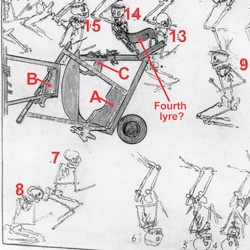
Plan of the east corner of PG 1237: adapted from Leonard Woolley (referenced below, 1934b, Plate 71)
My additions in red: numbers 7=9 and 13-15 = female bodies; A-C = lyres associated with the images below
This section addresses the apparent association between:
✴the two lyres that were found in this corner; and
✴two of the six female bodies (numbers 7 and 8) that lay close to them.
Lyres
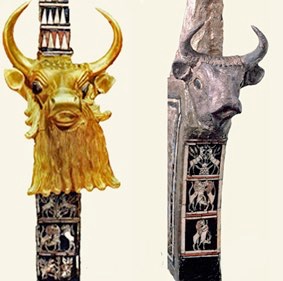
Left: Front of the reconstructed sound box of a lyre (U. 12353), marked A in the plan above
Now (?) in the Iraq Museum (IM 8694), image from Leonard Woolley (referenced below, 1934b, Plate 115)
Right: Front of the sound box of a restored silver lyre (U. 12354), , marked B in the plan above
Now in the British Museum (BM 121199), mage from the museum website
The images above depict the remains of two lyres that were found in tthis corner, at locations A and B respectively. They are obviously stylistically similar and there are also significant similarities between the iconography of the mosaic images that decorated the fronts of the respective sound boxes, as discussed in my page on lyres and my page on iconography. However:
✴the lyre on the left was made largely of unsheathed wood which decayed, leaving only two elements of the decoration of the soundbox:
•the bull’s head (which is made of thick gold on a wooden core); and
•the four mosaic plaques below it; while
✴the other lyre was made largely of wood sheathed in silver plate, a fact that facilitated its complete restoration.
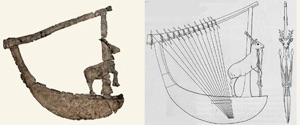
Left: Restored silver lyre (U. 12355), now in the Penn Museum (30-12-253): image from the museum website
Right: Sketch reconstruction of the original lyre: drawing (1997) by Veronica Socha;
reproduced by Maude de Schauensee (referenced below, Figure 11, at p. 28)
The smaller silver lyre depicted above was obviously very different from the two discussed aboev, although its boat-shaped sound box was made of the same material as that of U. 12354 (wood sheathed in thin silver plates). As Maude de Schauensee (referenced below, at pp 21-2) observed, the figure of a stag standing on the sound box can be:
“... identified as a roe deer, native to the northern grasslands rather than the southern alluvial plain of Ur. [It] stood with his front hooves supported by the branches of a copper tree ... [and] was flanked by two branches, with a central branch at his chin [as shown in the sketch].”
She highlighted similarities between this figure of a stag in a tree and that of a goat in a tree on two statuettes (discussed above) from in the opposite corner of the pit.
Leonard Woolley recorded the discovery of a putative fourth lyre near the other three (marked on the plan above). As Richard Zettler (referenced below, 2020, at p. 24) observed, his excavation notes contained a scale drawing of this statuette (which would have been 88 cm high) depicting a stag rampant in a tree. However, when he cleaned it up, he discovered that the ‘stag’ was actually a pair of stags collapsed on one another, at which point he surmised (probably incorrectly) that the two stags had decorated a wooden lyre. This object (U.12356) is now in the British Museum Museum number (BM 122610, not displayed: the museum notes simply describe it as:
“Copper alloy figure of a stag, standing on an oblong base; the eyes inlaid with shell and lapis lazuli; the head is double, being those of two similar figures crushed together.”
Body 7

‘Choker’ necklace found with Body 7, now in the Penn Museum (30-12-706): image from museum website
Amy Gansall (referenced below, Table 2, at p, 7) established that a number of the female bodies in this pit were found with a gold and lapis lazuli ‘choker’ necklace (Woolley’s ‘dog collar, see her first column) and a relatively predictable group of other items of jewellery (which she characterised as ‘Choker-based adornment sets’). Interestingly, as the table shows. all but one of the 15 bodies in this set were in PG 1237. As she showed in a plan pf the pit floor (see her Figure 4, at p. 3), most of the bodies in this group (marked with a triangle) were along the southeast wall. However, Amy Gansell pointed out (at p. 6) Body 7, which was the obly bidy from this ser in this corner of the pit:
“... was more lavishly provisioned [than the others] with gold hair rings, a gold garment pin, and gold finger rings.”
Importantly, the objects that were found with this body also included a lapis lazuli cylinder seal.
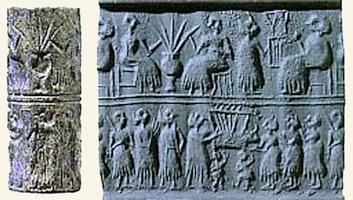
Lapis lazuli seal (U. 12374) found with Body 7 and modern impression, now in the Penn Museum (30-12-2)
Images from the museum website
The relief that is carried by the seal is in two registers. According to Léon Legrain (in Leonard Woolley, 1934a, entry 22, at p. 338), the upper register depicts three people at a banquet. More specifically, he:
✴described the two figures on the left as:
“Two men drinking] through pipes from a jar [that is] set on a stand and [contains] three extra pipes ...”; and.
✴assumed that the two figures to the right represent the hostess at the banquet (the figure at the extreme right, who holds a cup) and her maid.
He also identified an inscription between these last two figures, which he transliterated as dumu-kisal. However:
✴Holly Pittman (referenced below, catalogue entry 19, at p. 79) observed that it is curious that this putative inscription was placed between these two figures, where it interrupts the visual ‘narrative’; and
✴Eric Burrows (in Leonard Woolley, 1934a, note 4, at p. 316) argued that it is possible that the putative cuneiform actually depicts two pots on a table that is held by the maid.
Gianni Marchesi (referenced below, 2004, at pp. 174-5) noted that Burrows’ suggestion does not seem to be justified and argued that, in the context of a seal, dumu-kisal must have been a personal name (child of Kisal) rather than a title.
According to Holly Pittman (as above), the lower register contains an elaborate scene of dancing, singing and musical performance featuring (from the left):
✴a man carrying a staff over his shoulder;
✴2 women clapping cymbals;
✴a woman playing a lyre with a sound box in the form of a bull;
✴two diminutive figure dancing below the lyre; and
✴3 more women with cymbals who approach the lyre from the right.
The relative sizes of the lyre and the women approaching it indicate that it was meant to be played by a seated person (as was the case, for example, for the bull lyre depicted in the lower register of golden seal (U. 11904) from the burial chamber of PG 1054b).
As Amy Gansell observed:
“Body 7, with an exceptional version of the choker-based jewellery set, was found next to Body 8, whose unique jewellery assemblage mirrored [that of Body 7, but] on a reduced level, consisting solely of gold finger and hair rings [and not including a choker].
✴The similarities in adornment and their isolation from equivalently bedecked bodies imply their exclusive status as a pair.
✴Body 8, displaying less wealth, may have been subordinate to Body 7.”
PG 789 (Death Pit)
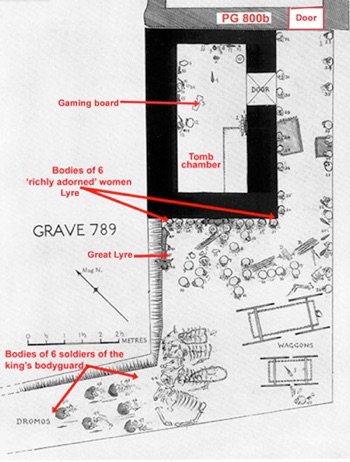
Plan of the burial chamber and death pit PG 789; from Leonard Woolley (referenced below, 1934b, Plate 29)
My additions in red
As we shall see, this is the only one of Woolley’s 16 royal graves that was made up of a burial chamber and a death pit on the same level and in the same burial shaft. The burial chamber abutted another (PG 800b, the grave of the famous Queen Pu-abum), which was at a slightly lower level, indicating that PG 789 was associated with, but slightly later than, PG 800b. (A death pit associated with PG 800b had never been found). Unfortunately, unlike PG 800b, the burial chamber of had been thoroughly looted long before its excavation. However, we might reasonably assume that its main occupant must have been closely associated with Queen Pu-abum.
Leonard Woolley (referenced below, 1934a, at p, 63) described the death pit (which he discovered before the burial chamber0 as:
“... a rectangle measuring 10 x 5 meters and lying NE-SW, entered by a slope dromos on the northwest side at the west corner, at the lower left in the plan above]”.
He recorded (at pp. 63-4) that:
“At the foot of the dromos lay the bodies of 6 soldiers [numbers 45-50, marked on the plan above] wearing copper helmets and carrying spears ... [Their] helmets were broken and crushed flat ..., [but] it is clear that they closely resemble those worn by the soldiers on the [Standard of Ur, found in PG 779], On the blade of each spear was engraved a bull's leg, apparently the badge of the king's bodyguard, ... In the shaft immediately in front of the entrance were the remains of two chariots or wagons, each drawn by three oxen.”
He then recorded (at p. 65) that:
“Northeast of the wagons, the whole floor of the open pit was covered with human bodies. [Since] most of the bones were so completely decayed, ... we had to content ourselves with noting the position of the skulls (in so far as the presence of the teeth or of bead necklaces, ear-rings, etc., betrayed their presence). Including the [6] soldiers at the entry, the total number of victims in the death-pit was 63.”.
Finally, he noted 6 corpses leaning against the southwest wall of the burial chamber (again marked out on the plan) were those of women whom he described as:
“... the most important, (or at least the most richly adorned) of all [the corpses that were found in the pit].”
Bodies 30 and 31
Body 31
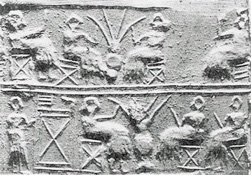
Modern impression of a lapis lazuli seal found with Body 31 (U. 10823), now in the Iraq Museum;
Image from Leonard Woolley, referenced below, 1934b Plate 194)
According to Leonard Woolley (referenced below, 1934a, at p. 66), Body 31, which lay just outside the door of the burial chamber, was found with a particularly large number of valuable objects that included:
✴a number of:
•gold and carnelian long date-shaped beads;
•gold and lapis barrels; and
•carnelian faceted double conoids;
that were ‘apparently three strings in disorder’;
✴16 silver rings which were distributed all round the body and:
“... must have been the ornaments of a belt, [with] a larger ring ... in the middle; and
✴a lapis lazuli cylinder seal (the impression of which is illustrated above).
According to Léon Legrain (in Leonard Woolley, 1934a, entry 29, at p. 333), the relief carried by the seal is in two registers:
✴in the upper register, two seated figures (a man and a woman) drink through pipes from a jar set on a stand and containing two extra pipes, and are flanked by two other seated figures, each of whom raises a cup; and
✴in the lower register, the same two ‘pipe drinkers’ occupy the centre of the field, between a ‘butler near the sideboard piled up with cakes and a leg of lamb’ on the left and a seated figure who raises a cup on the right.
Body 30
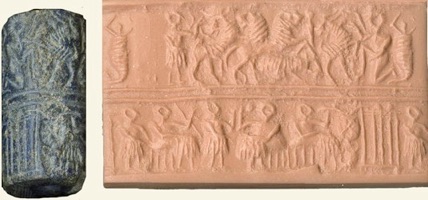
Seal of Body 30 (U. 10822), now in the British Museum (BM 121546); image from the museum website
According to Leonard Woolley (referenced below, 1934a, at p. 66), Body 30, which lay next to Body 31 (above) was found with far fewer objects, although one of them was the only other lapis lazuli seal found in this burial, The relief in the impression is in two registers: according to Léon Legrain (in Leonard Woolley, 1934a, entry 36, at p. 339):
✴the upper register contains a hunting scene in which two crossed lions attack three hairy goats (one of which has fallen to the ground) as two hunters try to catch the goats:
•one hunter (who wears a scalloped skirt ) stands on the left; and
•the other (who is nude) kneels in front of the scorpion on the right; and
✴the lower register depicts a symposium in which two seated figures, attended by two servants, raise a cup while a third drinks through a pipe from a jar in front of a tall sideboard with two small jars on it.
Bodies 30 and 31: Conclusions
Amy Gansell (referenced below, at p. 14) argued that:
“In PG 789, ... while Body 31 was adorned in a very elaborate variation of the hair ring-based jewellery set, Body 30’s had only select components of this set. Both were situated in front of the door to the principal burial chamber, wore unusual garment pins with gold heads, and possessed seals. Their relationship to the chamber entrance may result from their distinct rank and/or they may have required seals as officials charged with not only controlling the entry but also sealing it. While the co-operative responsibility of Bodies 30 and 31 is evidenced, differences of adornment may express a nuance of power.”
Lyres
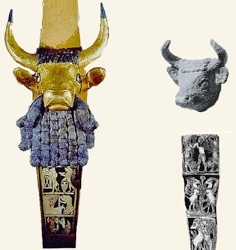
Left: Reconstruction of the sound box of the Great Lyre (U. 10556), now in the Penn Museum: (B17694B),
image from the museum website
Right: Remains of the sound box of a lyre (U. 10577), now in the British Museum (not displayed)
Image of bull’s head from Leonard Woolley (referenced below, 1934b, at Plates 120)
Image of plaque reliefs from Jack Cheng (referenced below, Figure 1, at p. 166)
Leonard Woolley (referenced below, 1934a, at pp. 69-70), the remains of two lyres were found in the death pit:
✴the Great Lyre (U. 10556), which had lain:
“... [against] the northwest side of the pit, standing over the top of the bodies there; and
✴a second lyre ((U. 10557), which had lain:
“... against the [nearby southwest] wall of the [burial] chamber, ... and actually standing on the skull of one of the [female corpses] ...”
I discuss these remains again in my page on lyres and my page on iconography.
PG 1157
As Leonard Woolley (referenced below, 1934a, at p. 170) recorded, this death pit, which he discovered 9.2 meters below ground level, measured about 5x6 meters and and contained 58 bodies. He commented that:
“Many of the dead had absolutely no objects with them, and all were very poor.”
He assumed that there must have been an associated burial chamber but (at p. 171) he acknowledged that it is unlikely that either of PG 1151 or PG 1156 (two coffin burials directly above it but above the surviving walls of the burial shaft) was the burial chamber in question and argued instead that:
“... it is more probable that the real royal tomb attached to PG. 157 has disappeared altogether, and that the two coffins in the [putative] upper part of the shaft are intrusive.”
However, it is also possible that this death pit never had an associated ‘royal tomb’: for example, it is possible that the 58 people who were buried here had all died of natural causes in an epidemic.
PG 1332
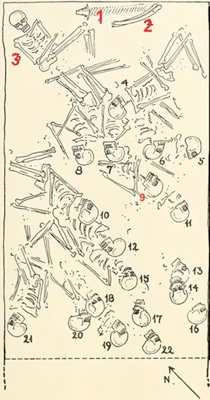
Plan of the burials on the floor of PG 1332,
from Leonard Woolley (referenced below, 1934a, Figure 20, at p. 125): my additions in red
According to Leonard Woolley (referenced below, 1934a, at p. 124):
“Of this tomb, only the 'death-pit' was found. The upper soil had been very much disturbed and ... no vestige could be traced of [the presumed higher part of the tomb shaft and the putative burial chamber]. It was only at a depth of 8 meters below the present surface that the outlines of a pit could be recognised, and this was followed down to its floor-level at 9 meters. The south limits of the pit were not found, but ... [it probably] measured 4.3 meters in length with a known width of 2,4 meters.”
He also recorded that the 43 corpses in this putative death pit were laid out in two layers:
✴20 on the floor of the pit; and
✴23 in a second layer 1 meter above it (an thus at the top of the surviving walls of the burial shaft).
However, as (referenced below, 1998. at p. 158) observed:
“Quite possibly, the upper layer of bodies, [which were, after all, a meter above the floor of the pit], belonged to a somewhat later second burial.”
In other words, we are quite possibly dealing here with a small death pit containing 20 corpses that was:
✴never associated with a burial chamber; and
✴laid out at the bottom of a burial shaft that had been reduced to only 1 meter in height at a later date, when a second burial of at least 20 people had taken place at a level of 1 meter above it.
Woolley (as above) also recorded that, while the bodies in the layer above were arranged fairly regularly in rows of five across with all of their heads to the north east, on the floor of the pit, the arrangement was less orderly:
✴a single body (number 3) lay in the north corner, with its head facing north; while
✴all of the other bodies (numbers 4-22) lay in a fairly disorderly manner across the rest of the pit, albeit that all of their heads faced south or south west.
He noted that the ornaments on the bodies in both layers were very poor. although, as he observed (at p. 126): “This lamentable poverty was, to some extent, relieved by the presence of a lyre [ see below] at the northeast end of the [floor of] the death pit.”
Lyre
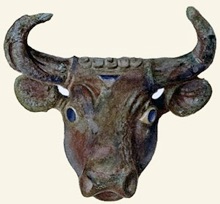
Left: Bull’s head from a lyre (U. 12435 ) from location 1 on the floor of death pit
now in the Penn Museum (30-12-696): image from the museum website
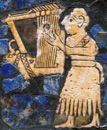
Right: Mosaic image of a lyre with similar bull’s head from the Standard of Ur (from PG 779).
The standard is now in the the British Museum website (BM 121201): image from the museum website
Leonard Woolley (as above) observed that this lyre (U. 12435):
“... was of a simple sort, [which had been] made of wood throughout and boasted] no other decoration than:
✴the admirable calf's head in copper which came at the front end of the sound box, and
✴the shell plaques f;see below] from immediately below it.”
The wood had, of course, completely decayed, but Donald Hansen (referenced below, 2003. at p. 107) observed that the original instrument was probably a smaller version of those carried by musicians on ‘relief plaques and seals’ (see for example the musician illustrated on the right above, in a detail from the ‘banqueting scene’ of the Standard or Ur.
Shell Plaques from the Lyre
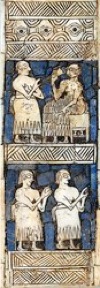
Left: shell plaques from a lyre (U. 12435 ) from location 1 on the floor of death pit Now in the Penn Museum (30-12-484)
Right:
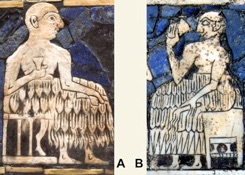
A: Image of a king at a banquet on the Standard of Ur: image from the British Museum website (BM 121201)
B: Enlarged image of the seated figure in the top register of U. 12435
Unlike all of the other lyre plaques discovered in the cemetery, the plaques from U. 12435 depict only humans (as opposed to mythological creatures) in a ‘real’ world setting: as Donald Hansen (referenced below, 1998, at p. 58) observed, the scene on the front of the lyre:
“... can be interpreted as a seated main figure with three acolytes standing before him in a line or a row.”
Perhaps more importantly, these two plaques are the only ones from the cemetery that use the same technique as the Standard of Ur (in which lapis lazuli tesserae are set in bitumen - see, for example, Leonard Woolley, referenced below 1934a, at p. 126, p. 263 and p. 583). Indeed, there is another similarity between these two works: the seated figure depicted on the lyre (illustrated again on the right above, as image B) is very similar to the king (illustrated above, as image A) who, (on the ‘peace side’ of the Standard of Ur) presides over the banquet at which the lyre mentioned above was played: each figure:
✴is the only one of the men depicted who a wears a ‘flounced’ skirt; and
✴holds a beaker in one had and a branch (probably a date branch, symbolising kingship - see Jerald Starr, in this page of his website ‘Sumerian Shakespeare’) in the other.
‘Castanets’
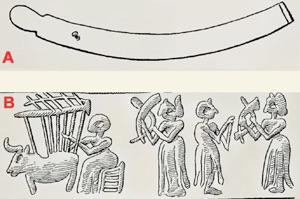
Image A: one of a pair of copper strips (U. 12436 ) from location 2 on the floor of death pit
From Leonard Woolley (referenced below, 1934a, Figure 21, at p. 127)
Image B: Left: ‘Sketch of the lower register of the impression made by seal (U. 11904) from the burial chamber of PG 1054b, location now unknown (?)
Image from Leonard Woolley (referenced below, 1934a, Figure 23, at p. 127)
Leonard Woolley (referenced below, 1934a, Figure 23, at pp. 126-7) recorded that:
“Lying [at location 2], beside the remains of the lyre [discussed above] were two objects unique in the cemetery. These are curved strips of thin copper, 3o cm long by 4 cm wide, with one end cut off squarely [and] the other lobe ‘’’ [The] two strips lay one on the top of the other, but sufficiently out of exact alinement to show that they ... [had not been fixed together].”
He noted that Ernest Mackay (referenced below, at p. 160-2) had described a number of pairs of similar objects in graves in Cemetery A at KIsh: he had:
✴described as ‘curved blades’; and
✴suggested (at p. 161) that they had been weapons that were the prototype of the scimitar.
However, Woolley noted that the lower register of the impression made by the golden seal (U. 11904) from the élite burial chamber of PG 1054b (illustrated as image B above and discussed on the previous page) depicted:
✴two dancing figures who:
“... hold curved objects that are unmistakably the same as the metal examples [U. 12436, found here at location 2]; and
✴a seated figure playing a lyre that is of the type found at the adjacent location 1.
He concluded (at p. 128) that:
“The musical connexion is manifest and the copper [‘blades’] can be none other than castanets, long clappers of metal mounted on wood ... and beaten together to emphasise the rhythm for the dancers.”
PG 800a
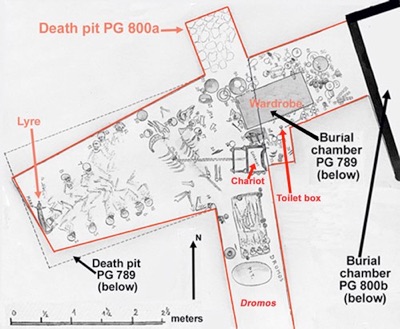
Plan of the death pit PG 800a, adapted from Leonard Woolley (referenced below, 1934b, Plate 36)
(My additions in red and black)
Description of PG 800a
Leonard Woolley (referenced below, 1934a, at p. 73) described this death pit as follows;
“[It is], roughly speaking, a rectangle measuring 11.75 x 4 meters ... A sloped dromos led into it from the southeast. ... The whole pit floor had been covered with mats, and matting had [also] been laid over the offerings in it.”
He discovered the remains of at least 22 people in the pit:
✴5 (who seemed to be men) at the top of the dromos, whom, he suggested:
“... correspond to the soldiers on guard at the entrance of [for example] PG 789 [above] ... and PG 1237 [below] “;
✴2 near the wardrobe;
✴5 (whom he assumed were men) near the chariot between the dromos and the wardrobe’ (see below); and
✴10 women at the southwest end of the shaft near the remains of a ‘harp’ (see below).
Lyre
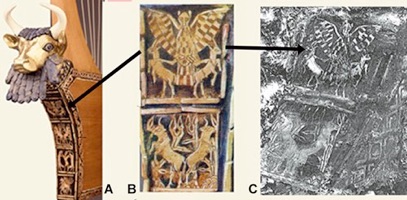
Part of the reconstructed sound box of a lyre (U. 10412), now in the British Museum (BM 121198)
Image A from the museum website
Image B from a painting by Mary Baker, reproduced by Leonard Woolley (referenced below, 1934b, Plate 110)
Image C: Top two plaques in situ: image from Leonard Woolley (referenced below, 1934b, Plate 108)
As Leonard Woolley (referenced below, 1934a, at p. 74) recorded:
“At the southwest end of the [pit] there lay a harp [= the lyre U. 10412] and the bodies of 10 women [numbers 1-10]. The ‘harp’ stood against the pit wall, and one woman [number 1] lay right against it with the bones of her hands actually in the place of the strings; she must have been the ‘harpist’ and was playing almost to the last. The other 9 women were ranged in two rows facing each other, 3 in one row and 6 in the other; all wore the rich head-dress of the court.”
The original object is often referred to as ‘the queen’s lyre’ because Leonard Woolley incorrectly associated this death pit with the burial chamber (PG 800b) of Queen Pu-abum. The wooden parts of the instrument had decayed, although its outline could still be recognised. The surviving elements were from its sound box. They comprised:
✴a bull’s head that had lost its horns, which was made of gold sheet over a wooden core, with the beard and hair made of lapis lazuli; and
✴four plaques made of lapis lazuli, shell and red limestone mosaic set in bitumen, which were arranged in four registers below it.
Given the facts that the remains of the lyre:
✴were found some way away from the wardrobe; and
✴were associated with a group of 10 female corpses that lay in what was almost certainly their original locations;
we might reasonably assume that the lyre had similarly formed part of the ritual that had accompanied the laying out of PG 800a.
Interestingly, while the images on all of the surviving plaques from the lyre except the top one used ‘standard’ iconography, that on top plaque is not found on any other surviving lyre from Ur: it depicts a lion-headed eagle (later known as the Anzu bird) grasping a pair of goats.
I discuss these remains again in my page on lyres and my page on iconography.
Smaller Death Pits
This analysis continues on my page First Dynasty of Ur: Élite Burials (III).
References
Miller et al., “A Sacred Landscape of Sumer: Statuettes from Ur Depicting a Goat on a Tree”, Journal of Ancient Near Eastern Religions”, 20 (2020) 27-47
Frame G. et al. (editors), “Ur in the Twenty-First Century CE”, (2020) University Park, PA, at pp. 7-34
Prell S., “Buckle Up and Fasten That Belt!' Metal Belts in the Early and Middle Bronze Age”, Egypt and the Levant, 29 (2019) 303-29
Vidale M., “PG 1237,: Royal Cemetery of Ur: Patterns in Death”, Cambridge Archaeological Journal, 21:3 (2011) 427–51
Frayne D. R., “The Royal Inscriptions of Mesopotamia, Vol. 1: Presargonic Period (2700-2350 BC)”, (2008) Toronto
Gansell A. R., “Identity and Adornment in the Third Millennium BC Mesopotamian ‘Royal Cemetery’ at Ur”, Cambridge Archaeological Journal, 17:1 (2006) 1-19
Hansen D. P., ”Great Lyre’ with Bull’s Head and Inlaid Front Panel”, in:
Aruz J. and Wallenfels R. (editors), “Art of the First Cities: The Third Millennium BC, from the Mediterranean to the Indus”, (2003) New York, at pp. 105-7
Hansen D. P., “Art of the Royal Tombs at Ur. A Brief Interpretation”, in:
Zettler R. L and Horne L. (editors), “Treasures from the Royal Tombs of Ur”, (1998) Philadelphia PA, at pp. 43-72
Pittman H., “Cylinder Seals”, in:
Zettler R. L and Horne L. (editors), “Treasures from the Royal Tombs of Ur”, (1998) Philadelphia PA, at pp. 75-84
de Schauensee M., “The ‘Boat-Shaped’ Lyre: Restudy of a Unique Musical Instrument from Ur”, Expedition Magazine, 40:2 (1998) 20-28
Zimmerman P. C., “A Critical Reexamination of the Early Dynastic ‘Royal Tomb’ Architecture from Ur”, (1998) thesis of the University of Pennsylvania
Woolley C. L. (1954), “Excavations At Ur - A Record Of Twelve Years Work”, (1954) London
Woolley C. L. (1934a), “Ur Excavations (Volume I): The Royal Cemetery (Text)”, (1934) London and Philadelphia PA
Woolley C. L. (1934b), “Ur Excavations (Volume II): The Royal Cemetery (Plates)”, (1934) London and Philadelphia PA
Mackay E., “A Sumerian Palace and the’A’ cemetery at Kish, Mesopotamia”, (1929) Cicago IL
First Dynasty of Ur: Élite Burials (I) First Dynasty of Ur: Élite Burials (II)