Empires of Mesopotamia:
First Dynasty of Ur
Élite Burial in the Cemetery of Ur (III)
First Dynasty of Ur: Élite Burials (I) First Dynasty of Ur: Élite Burials (II)


Empires of Mesopotamia:
First Dynasty of Ur
Élite Burial in the Cemetery of Ur (III)
First Dynasty of Ur: Élite Burials (I) First Dynasty of Ur: Élite Burials (II)
Smaller Death Pits
In the previous page (First Dynasty of Ur: Élite Burials (II)), I discussed the larger death pits in the cemetery) PG 1237 (74); PG 789 (63); PG 1157 (58); PG 1332 (43); PG 800a (22). In this page, I will start by discussing a group of what seem to be four much smaller death pits: PG 1618b (5); PG 337 (3); PG 1232 (2); PG 580 (0).
PG 1618b
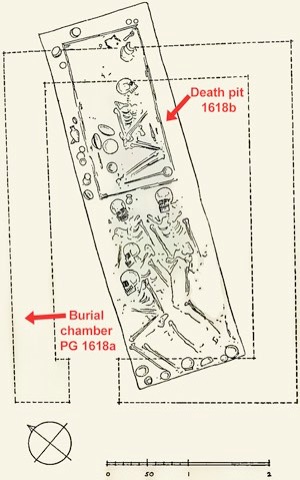
Plan of PG 1618. from Leonard Woolley (referenced below, 1034a, Figure 24, at p. 129)
Leonard Woolley (referenced below, 1934a, at p. 128) conceived of his PG 1618 as a burial chamber with an associated death pit 1,7 meters below it. However, as Paul Zimmerman (referenced below, at 21) pointed out, the evidence for any association between these two structures is weak, since the death pit (apart from being so far below the burial chamber):
✴projects to the northeast of it; and
✴is oriented differently.
In the absence of any evidence for an association between them, he reasonably argued that Woolley’s PG 1618 should I divide PG 1618 be regarded as two unassociated structures:
✴a burial chamber 1618a; and
✴a death pit PG 1618b.
Leonard Woolley (as above) recorded (at pp. 128-9) that this pit, which was about 4,5 meters long and ‘rather less than 2 meters’ wide, fell into two parts:
✴an unusually long wooden coffin wooden containing the remains of a man occupied most of its northeastern end; and
✴the rest of the space, which served as a death-pit and contained the remains of 4 more bodies, all in a very bad condition.
He also noted (at p. 128) that:
“It was clear that there had been a wall around the coffin, although [it] consisted of little else but clay; and the lumps of clay and fallen mud brick lying on the top of the coffin must have come from a vault. But the 'building' was of the most meagre description:
✴it can only have been constructed after the coffin was placed in the pit; and
✴the [putative] vault, starting almost at ground-level, can only just have covered the coffin.”
Headbands
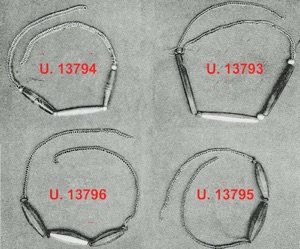
‘Brîm’ headdresses from the skull in the coffin, adapted from Leonard Woolley (referenced below, 1934b, Plate 146)
Note that, in the caption of Plate 146, the lower two objects are labelled U. 13796A and U. 13796B respectively
Leonard Woolley (as above) recorded (at p. 129) that there were 4 ‘brîm’ headdresses on the skull of the occupant of the coffin: as we shall see, he seems to have used the word ‘‘brîm’’ for a type of headband made up of a few elongated beads strung together and attached at each end to a thin chain. The presence of 4 such headbands on a single skull was unusual, but not unprecedented. These headbands, which are all now in the British Museum) are catalogued (at p. 588):
✴(U. 13793: BM 122714): 2 gold chains; 3 large tubular beads (1 gold, 2 [discoloured] lapis lazuli) square in section; and 4 small ribbed balls (2 gold and 2 [discoloured] lapis lazuli);
✴(U. 13794: BM 122712): 2 gold chains; 3 large tubular beads (1 gold and 2 carnelian); and 4 small gold balls;
✴(U. 13795: BM 122715): 2 gold chains; 3 faceted date-shaped beads (1 gold [now lost] and 2 [discoloured] lapis lazuli); and 4 carnelian rings; and
✴(U. 13796: BM 122713): 2 gold chains; 3 large faceted date-shaped beads (1 gold and 2 [discoloured] lapis lazuli; and 4 carnelian ring beads.
Text
Dagger

Restored dagger (U. 13788) from the coffin, now in the British Museum (BM 122701), image from the museum website
Leonard Woolley (referenced below, 1934a, at p. 129) recorded that the dagger U. 13788 )illustrated above) was found in front of the pelvis of the man in the coffin point upwards, with its original wooden handle completely decayed. The museum notes describe the dagger as now displayed as a:
“... gold dagger with: a plain blade; an up-curved oval guard with studs on either side; a gold tube as the hole for a lanyard; and a group of gold studs on top of handle (which is modern).
PG 337
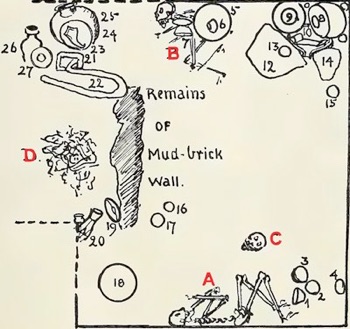
Plan of PG 337, from Leonard Woolley (referenced below, 1934a, Figure 1, at p. 43)
Leonard Woolley (referenced below, 1934a, at p. 43) recorded that PG 337:
“... was the first royal tomb found by us, [although] its character was only recognised later in the light of subsequent discoveries. It had been completely ruined by ancient plunderers. Of the tomb chamber, originally built of mud brick, only scanty traces remained.”
The death pit contained the remains of two adult humans (at locations A and B0 and what he judged to be the skull of a child (at location C).
Location D
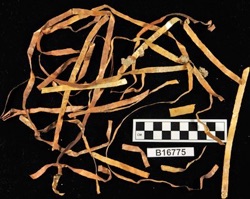
Gold hair ribbon (U. 8612) from location D, now in the Penn Museum (B16775): image from the museum website
The most interesting objects were at location D: as Woolley recorded (at pp. 44-5), here he found a tumbled mass of personal jewellery (but no trace of associated human remains). Among the most important of these objects is the gold hair ribbon (U. 8612, illustrated above), which Woolley described as being:
“... in such good order that it is difficult to believe that it was not originally attached to a skull that has decayed completely away ...”.
Although the rest of the jewellery was in some confusion, Woolley characterised it (at p. 44)) as being consistent with the hypothesis that PG 337 was:
“... a royal tomb, but a small and unimportant example of its kind.”
Holly Pittman (referenced below, catalogue entry 21, at p. 79) argued that it:
“... was essentially identical to [the jewellery] of the most elaborately adorned women found in tombs [in the cemetery that were] uncovered later.”
Seal from Location D
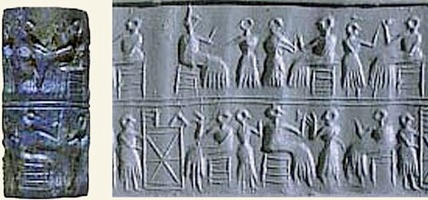

Above: Lapis lazuli seal (U. 12374) ffrom location Dand modern impression, now in the Penn Museum (B16828)
Below: 6 beads.(3 gold and 3 lapis lazuli: U. 8614), now in the Penn Museum (B16829)
Images from the museum website
The lapis lazuli seal and the 6 beads seal illustrated above were fall found at location D and it is likely that the beads were originally strung together as they are in the illustration and joined to the cylinder seal. The relief carried by the seal depictis a banquet scene in in two registers. Holly Pittman (referenced below, catalogue entry 21, at p. 79) observed that:
“Apart from the fineness of the carving, the virtually identical images in the two registers distinguish this seal, In both registers, seated male celebrants gesture with raised cups towards standing servants. Unique to the lower register is a tall table breads and a haunch of meat.”
PG 1232
According to Leonard Woolley (referenced below, 1934a, at pp. 107-8, this small death pit (about 4.5 x 3 meters) had no associated burial chamber. As he noted (at p,p. 198-109), the lower part of the dromos contained the remains of a chariot, beyond which:
“... lay the skeletons of the two asses which had drawn the car. ... Mixed up with the body of the leading ass were those of the groom ... [and in] front of where the body of the wagon should have been (and a little to the south east of the animals) was the body of a second man, presumably the driver.”
The pit contained no other human remains, although (as recorded on p. 110) he was able to identify the bones of four more animals (an ox and 3 sheep) nearby. He wondered (at pp. 110-1) whether PG 1232 had been art of PG 1237 (see above), since the two pits are contiguous, but he had no evidence that this had been the case. In fact, even had this been the case, there is nothing to suggest that PG 1232 itself was of any historical significance.
PG 580
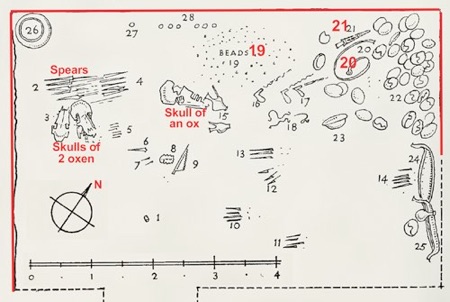
Plan of PG 580, adapted from Leonard Woolley (referenced below, 1934a, Figure 4, at p. 50)
Leonard Woolley (referenced below, 1934a, at p. 11) recorded that he began the excavation of what became his PG 580 at a late stage in the 1926/7 season (the first that he had devoted to the cemetery), and he was somewhat surprised when:
“.... small gold objects [began] turning up freely every day: on the last day of [the season], the gold dagger [see below] was found.“
He therefore secured the site and resumed the excavations here at the start of the following season. The result was that (as he recorded at p. 46) the ‘grave’ that he labelled PG 580 became:
“... the first to give us an idea of the riches that the predynastic cemetery might yield”.
However, as he also observed, despite the fact that some some of the objects that he found were ‘unsurpassed’ elsewhere in the cemetery, PG 580 was:
“... from the point of view of scientific excavation, the least satisfactory of all the royal tombs.”
The problem was that, despite the ‘unsurpassed’ nature of some of the objects that he found in PG 580, it did not actually meet his criteria for the designation ‘royal grave’ because he could not find certain evidence of an associated burial chamber and (as he noted at pp. 48-9):
“In the whole of [what he presumed to be a death pit associated with a royal burial], we could distinguish no human remains whatsoever. There were found the skulls of three ... oxen, [marked on the plan above, ... but], if there had been [human] bodies [here], all signs of them had vanished ... At the time, I [therefore] suggested that ... this was not a grave at all but [rather] some kind of offering-pit. [However], the subsequent discovery of royal tombs with 'death-pits' closely resembling this shaft caused me to abandon the suggestion, [albeit that] the difficulty remains.”
Form of the Putative Death Pit
As Woolley explained (at p. 46), he had approached the putative death pit from the south and southeast and:
“... could not detect the existence of the shaft until its contents came gradually to light: indeed, there was nothing to detect, and it was only by the disposition of the objects that we could estimate the area of the pit. This would seem to have measured approximately 6.5 x 4.5 meters ... [The] bottom of the shaft was [about 5 meters] below the modern surface, and the northwest side of the shaft was still preserved to a height of 2.7 meters.”
He then recorded (at p. 47) the presence of two layers of matting that had perhaps originally covered the area of the shaft:
✴one at about 5 meters below ground level; and
✴the other at a depth below it that varied from 0.3 - 0.5 meters.
He argued that:
“Between the two matting layers were found all the objects that could be described as in situ. For this, we have many analogies; it was quite a normal thing for the grave-shaft to be lined with mats, objects placed on them, and more mats spread over them as a covering before the earth was thrown in again to fill the pit. ”
In other words, the space that Woolley labelled PG 580 was essentially defined by a shaft that, judging by:
✴the position of its surviving walls (marked in red on the plan above); and
✴the disposition of ‘the objects’ between the two layers of matting that lay within them;
had a floor area of about 6.5 x 4.5 meters and a height that varied between 0.3 - 0.5 meters. However, things were not quite so simple: as he pointed out (at pp. 46-7):
“... whereas most of the important offerings were on what was clearly the floor of the pit:
✴... a great many beads and small objects were found at different points higher up in the filling; and
✴a few things (beads and the engraved shell U. 9907) were as much as 1.2 meters below the main level (and may not have belonged to the grave at all).”
Beads at Location 19
Woolley recorded (at p. 51) that, at location 19 (marked on the plan above):
“... the earth between the two layers of matting was full of an astonishing assortment of beads. They seemed to be in complete disorder, and there were single examples of types that normally only occur in groups (for example: ring and leaf pendants; and a triangular bead from a 'dog-collar'). Many [of the beads] were of gold [and] others were of lapis-lazuli and carnelian. One gold pendant was in the form of a disk containing a twelve-petalled rosette in filigree work.”
Silver Plated Leather Belt and Associated Objects
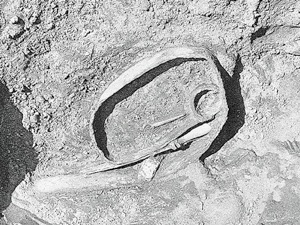
Coiled sliver plated leather belt and attached objects excavated in PG 580
from Leonard Woolley (referenced below, 1934b, Plate 13b)
Leonard Wolley (as above) then noted that, further towards the north corner lay:
“... a group of objects that put this grave in a category by itself”.
He referred here to the remains of a coiled belt or baldric of leather plated with silver (at location 20), to which had been attached:
✴the dagger mentioned above (U. 9361, at location 21);
✴a toilet-set (U. 9340); and
✴a cylinder seal (U. 9341).
Silvia Prell (referenced below, at p. 303) observed that:
✴this belt and dagger combination; and
✴that found in PG 755 (see below);
provide the earliest evidence of such belts and military equipment (in this case, daggers) in the early and middle bronze age, the occurrence of which:
“... is limited to tombs that featured several significant finds (including weapons) in their inventory. The grave goods highlight the importance, status and wealth of the interred deceased.”
Note, however, that, while the belt in PG 755 was associated with the corpse of the young mad who was interred in this grave, the belt in PG 580 was found in a location in which there was no surviving evidence of any human remains.
Dagger
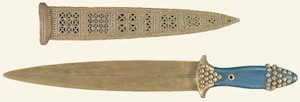
Electrotype copy of U. 9361 in the British Museum (BM 119296), image from the museum website
Original is in the Iraq Museum
According to Leonard Woolley (as above):
✴the hilt of this dagger is made of a single piece of lapis studded with gold and is pierced with a lanyard-hole lined with gold;
✴the blade is made of gold and is undecorated except for a roughly incised sign resembling a bird; and
✴the sheath, which is also made of gold, is plain at the back and the openwork on the front is done in a design derived from the woven grass sheaths that are common in less prestigious examples.
He observed that the workmanship involved in the making of these objects:
“... is admirable and, combined with the richness of the materials, makes the 'Ur dagger' one of the finest objects resulting from the excavations.
Toilet Set
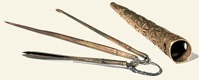
Electrotype copy of U. 9340 in the British Museum (C. 322), image from the museum website
Original is in the Iraq Museum
According to Leonard Woolley (as above):
“Side by side with the dagger there hung from the belt an object only less noteworthy; this was a toilet-set (U. 9340) consisting of the usual ear-scoop, stiletto, and tweezers, but of gold and in a gold case. The three instruments have loops at the top ... [and] hung on a silver ring. The case, [which] is grooved and pierced near the top for attachment to the belt, ... is of the usual triangular form ... [and] has been cast in one piece.”
Seal
According to Leonard Woolley (as above), also attached to the belt:
“... was a large cylinder seal of shell with lapis lazuli caps (U. 9341), unfortunately almost completely decayed, [although enough]... of the surface remained to show that it had had a design of fighting animals.”
In the catalogue of found objects (at p. 544), he noted that part of the design is:
“... reserved enough to show a lion, a stag and leopard in a bold style of cutting.”
This seal (like the other objects that were originally attached to the belt) is now in the Iraq Museum.
Rich Private Graves
PG 755
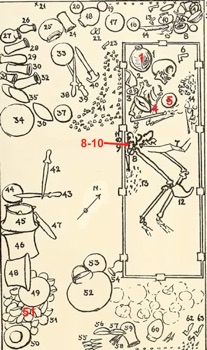
Plan of PG 755: from Leonard Woolley (referenced below, 1934a, Figure 55, at p. 157)
My additions in red (objects mentioned in the text below)
As Leonard Woolley (referenced below, 1954, at pp. 57-8) recorded, this grave had been:
“... dug down into the shaft of one of the largest of the ‘royal’ tombs [i.e., PG 779 - see above]. ... The first indication that we had of [its existence] was a copper spear head sticking straight up in the ground. Following it down, we found that it was attached to a golden haft, [below which] was the hole left by the decay of a wooden shaft. [This hole] continued] down to the corner of the grave, [which had not been violated. ... It] was in the form of] a plain earth pit, big enough to take a wooden coffin and to leave ... [enough] free space for offerings. [as illustrated above]. Along the head of the grave were struck spears in a row, the blades downwards .... ”
According to Sir Arthur Keith (in Leonard Woolley, referenced below, 1934a, at p. 403), the corpse that was laid out in the wooden coffin was that of:
“... a strongly built, powerful man , ... about [1.6 meters] in height, ... [and] under 30 years of age at the time of death.”
Leonard Woolley (referenced below, 1934a, at p.155) observed that:
“In all respects, ... this grave was exactly paralleled by many others in the cemetery, [albeit that] it stood out from all of them by the extraordinary richness of its furniture: both in the coffin and outside it in the shaft, there were such objects as elsewhere were found only in royal graves.”
He did not include it among his ‘royal’ graves because:
✴there was only a single corpse, which was clearly that of the young man for whom the grave had been dug; and
✴he had certainly not been given a built burial chamber.
However, most scholars (see, for example, Douglas Frayne (referenced below, at pp. 401-2) argue that he was probably a prince of the ruling house at the time of his death.
Helmet
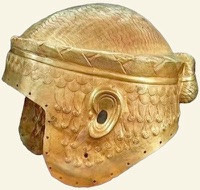
Electrum helmet from grave PG 755 (number 1 in the plan above); now in the Iraq Museum (IM. 8629)
Image (of a copy ?) from the website ‘Sumerian Shakespeare‘ of Jerald Jack Starr
Leonard Woolley (referenced below, 1954, at p. 58) noted that the corpse itself had almost completely disappeared, albeit that there were enough remains to indicate the way he had been placed in the coffin (see the plan illustration above), and that, when the earth was removed from the coffin:
“... the prevailing note was struck rather by the gold, clean as when it was put into the grave ... “
Importantly, a magnificent golden object that is usually characterised as a helmet (illustrated above), which was found behind the young man’s head (see number 1 in the plan above), still contained fragments of his skull, indicating that he had been wearing it when he had been placed in the coffin. He had also been wearing a silver belt around his waist, to which three objects had been attached:
✴a gold dagger (number 8, see below);
✴a whetstone of lapis lazuli on a golden ring (number 9), and
✴his cylinder seal (number 10), although this had deteriorated to the extent that neither the scene engraved on it nor the inscription could be used to identify him.
Belt and Dagger

Reproduction of the golden dagger (U,10014) mentioned above (original is now in the Iraq Museum)
Image from the website of the Penn Museum (29-22-3)
According to Leonard Woolley (referenced below, 1934a, at p. 156):
“... around the loins [of the corpse or perhaps] laid across them (for no trace of metal could be seen under the bones) was a silver belt or baldric, recognisable but in very bad condition ... . [from which was] suspended a dagger (U. 10014: see the reproduction illustrated above)), [which was] found with the blade leant against the body and the point upwards ... :
✴the blade was of gold,
✴the guard was of gold studded with gold studs,
✴the grip and pommel were of silver plated over wood, and the pommel was studded with gold; [and
✴the sheath was of silver
With the dagger was:
✴a whetstone of lapis lazuli hung on a gold ring (U. 10015};
✴a shell cylinder seal (U. 10011) in very bad condition; and
✴a silver tool hung also on a gold ring, but completely decayed and of unrecognisable form ([which] might have been a toilet reticule).
As noted above, there is a direct parallel between this belt/ dagger combination and that found in PG 580.
Epigraphic Evidence
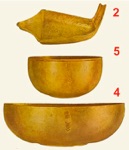

Left: Three gold bowls from PG 755 (numbers 2, 4 and 5 in the plan above):
Now in the Iraq Museum (IM: 8273, 8271 and 8270 respectively)
Image from Leonard Woolley (referenced below, 1934b, Plate 163): my additions in red
Right:Copper bowl from PG 755 (number 51 in the plan above): now in the British Museum (IBM 121661a)
Image from Leonard Woolley (referenced below, 1934b, Plate 190): my additions in red
Although the inscriptions on the young man’s seal was illegible, four other objects that were found in his grave all carry the same inscription (RIME 1.13.7.1, CDLI, P431212), which records a personal name:
Mes-KALAM-du10 (Meskalamdu.
These are recorded as follows:
✴three of them are on golden objects that were found near his body, all of which are now in the Ira Museum:
•the lamp at location 2 (U. 10004; CDLI: P222833; IM 8273);
•the bowl at location 4 (U. 10001: CDLI, P222831); IM 8270); and
•the bowl at location 5 (U. 10002; CDLI, P222832; IM 8271; and
✴a fifth is on one of the copper bowls that were found corroded together at location 51 (U. 10081a; CDLI, P222834), which is now in the British Museum (BM 121663a).
It is generally (and reasonably) accepted that Meskalamdu was the name of the young warrior who was buried here. Léon Legrain (in Leonard Woolley, referenced below, 1934a, entry 55, at p. 340) seems to have assumed that this Meskalamdu was the same person as the King Meskalamdu who owned the seal that was found in the royal burial PG 1054a (as described in my page Élite Burial in the Cemetery of Ur (I)), for which reason he referred to this young man as ‘the king of the golden helmet’. However, Leonard Woolley himself discounted this possibility: for example, in his book of 1954 (for example), he allowed (at p. 58) that:
“... the exceptional richness of [PG 755] may justify us in seeing in this Meskalamdu a prince ... [who] never occupied the throne ... ”
This hypothesis was accepted by (for example) Douglas Frayne (referenced below, at pp. 401-2).
Interestingly, another of the copper bowls at location 51 mentioned (above carries a different inscription U. 10081b; RIME 1.13.5.4: CDLI, P247686) which is now in the British Museum (BM 121663b); it refers to:
nin-tur nin (Nintur, the queen)
The same inscription is found on two clay sealings (U. 13678 and U. 13686 A and B) found in the stratum SIS 1-2 above the royal burials. Furthermore, a lapis lazuli seal (U. 8981) that was also found in in the stratum SIS 1-2, which is now in the Penn Museum (CBS 16852), carries an inscription RIME 1.13.5,3; CDLI, P247685) which refers to this queen as:
nin-tur nin/ dam mes-an-ne2-pa3-da (Nintur the queen, wife of Mesanepada)
This might suggest that the young Meskalamdu was the son of Queen Nintur and her husband, Mesanepada, who is known from other inscriptions to have used the titles King of Ur and King of Kish (although, as far as we know, not at the same time).
PG 1422
As it happens, a king of this name also appears in the inscription (RIME 1.13.5.1; CDLI, P431203) on a lapis lazuli bead that was discovered at Mari (discussed in my page of the first dynasty of Ur):
“For [DN]: Mesanepada, king of Ur, the son of Meskalamdu, king of Kish, has consecrated (this bead)”, (translation from Jean-Claude Margueron, referenced below, at p. 143).
As we shall see below, Mesanepada is named as king of Kish (rather than king of Ur) in a sealing that was found in SIS 1-2 (the stratum of debris that was deposited above the ED iii graves in the cemetery,
Thus, it seems likely that that the King Meskalamdu of this seal:
✴was the father of Mesanepada (see below); and
✴used the titles ‘king of Ur’ and ‘king of Kish’ (although, as far as we know, neither he nor his putative son used both titles at once).
It is usually assumed that:
✴the otherwise-unknown ‘Akalamdu, king of Ur’ was the older son and successor of King Meskalamdu (see, for example: Douglas Frayne, referenced below, at p. 389; and Gianni Marchesi, referenced below, 2015, at p. 144}; and
✴the seal under discussion here was that of his wife (see, for example: Douglas Frayne, referenced below, at p. 389; and Gianni Marchesi, referenced below, 2004, at p. 80).
References
Miller et al., “A Sacred Landscape of Sumer: Statuettes from Ur Depicting a Goat on a Tree”, Journal of Ancient Near Eastern Religions”, 20 (2020) 27-47
Frame G. et al. (editors), “Ur in the Twenty-First Century CE”, (2020) University Park, PA, at pp. 7-34
Prell S., “Buckle Up and Fasten That Belt!' Metal Belts in the Early and Middle Bronze Age”, Egypt and the Levant, 29 (2019) 303-29
Vidale M., “PG 1237,: Royal Cemetery of Ur: Patterns in Death”, Cambridge Archaeological Journal, 21:3 (2011) 427–51
Frayne D. R., “The Royal Inscriptions of Mesopotamia, Vol. 1: Presargonic Period (2700-2350 BC)”, (2008) Toronto
Gansell A. R., “Identity and Adornment in the Third Millennium BC Mesopotamian ‘Royal Cemetery’ at Ur”, Cambridge Archaeological Journal, 17:1 (2006) 1-19
Hansen D. P., ”Great Lyre’ with Bull’s Head and Inlaid Front Panel”, in:
Aruz J. and Wallenfels R. (editors), “Art of the First Cities: The Third Millennium BC, from the Mediterranean to the Indus”, (2003) New York, at pp. 105-7
Hansen D. P., “Art of the Royal Tombs at Ur. A Brief Interpretation”, in:
Zettler R. L and Horne L. (editors), “Treasures from the Royal Tombs of Ur”, (1998) Philadelphia PA, at pp. 43-72
Pittman H., “Cylinder Seals”, in:
Zettler R. L and Horne L. (editors), “Treasures from the Royal Tombs of Ur”, (1998) Philadelphia PA, at pp. 75-84
de Schauensee M., “The ‘Boat-Shaped’ Lyre: Restudy of a Unique Musical Instrument from Ur”, Expedition Magazine, 40:2 (1998) 20-28
Zimmerman P. C., “A Critical Reexamination of the Early Dynastic ‘Royal Tomb’ Architecture from Ur”, (1998) thesis of the University of Pennsylvania
Woolley C. L. (1954), “Excavations At Ur - A Record Of Twelve Years Work”, (1954) London
Woolley C. L. (1934a), “Ur Excavations (Volume I): The Royal Cemetery (Text)”, (1934) London and Philadelphia PA
Woolley C. L. (1934b), “Ur Excavations (Volume II): The Royal Cemetery (Plates)”, (1934) London and Philadelphia PA
Mackay E., “A Sumerian Palace and the’A’ cemetery at Kish, Mesopotamia”, (1929) Cicago IL
First Dynasty of Ur: Élite Burials (I) First Dynasty of Ur: Élite Burials (II)