Empires of Mesopotamia:
First Dynasty of Ur
Élite Burial in the Cemetery of Ur (I): Burial Chambers
First Dynasty of Ur: Élite Burials (I) First Dynasty of Ur: Élite Burials (II)


Empires of Mesopotamia:
First Dynasty of Ur
Élite Burial in the Cemetery of Ur (I): Burial Chambers
First Dynasty of Ur: Élite Burials (I) First Dynasty of Ur: Élite Burials (II)
Burial Chambers in the Cemetery of Ur
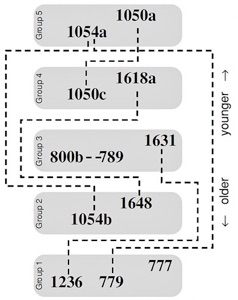
Seriation of the Burial Chambers in the Cemetery at Ur (with indications of stratigraphic relationships)
From Paul Zimmerman (referenced below, Table 6, at p. 49)
As Leonard Woolley (referenced below, 1934a, at p. 135) observed:
“Throughout the whole period covered by the cemetery [of Ur], the fashion of the private graves changes but little: always the custom was for inhumation, and though developments may be observed, yet these are always on the lines of old tradition and there are no sudden innovations. ... The [deceased] was laid at the bottom of the shaft, either wrapped in matting or enclosed in a coffin ... The typical grave consists of a rectangular shaft or pit sunk vertically into the ground with the body placed at the bottom of it.”
However, he noted (at p. 33) that, in a small number of cases in the Early Dynastic Period:
✴the burial chamber contained a stone or mud brick ‘burial chamber’ that housed a (presumably élite or, in Woolley’s view, ‘royal’) ‘principal body’, which was usually accompanied by the bodies of a few ‘sacrificed’ attendants; and
✴further unfortunate attendants were often ritually buried close by.
He claimed to have identified 16 cases of this type of burial, although he found clear evidence of a built chamber in only 10 of them (PG 777, PG 779, PG 789, PG 800, PG 1050, PG 1054, PG 1236, PG 1618, PG 1631, and PG 1648).
As discussed in my page on the First Dynasty of Ur: Royal Cemetery, Paul Zimmerman (referenced below, 1998, at pp. 28-9) established that four of these cases were more complicated thanWoolley had supposed:
✴Woolley’s PG 800 was actually made up of a burial chamber (PG 800b) and a later (and thus unassociated ‘death pit’ (PG 800a);
✴his PG 1618 was actually made up of a burial chamber (PG 1618a) and a later (and thus unassociated ‘death pit (PG 1618b);
✴his PG 1050 was actually made up of a burial chamber (1050b) and an unassociated ‘mausoleum’ (PG 1050c); and
✴his PG 1054 was similarly made up of a burial chamber (1054b) and an unassociated ‘mausoleum’ (PG 1054a).
He then used architectural analysis to assign each of his 12 burial chambers to one of five ‘temporal’ groups, as summarised in the table reproduced above, Starting from the earliest chambers:
✴PG 1236, PG 779 and PG 777 are large, mutli-room, stone-built structures;
✴PG 1054b and PG 1648 are single room, stone-built structures;
✴PG 800b (now ‘divorced’ from the death pit PG 800a) , PG 789 (which has a contiguous death pit on the same level) and PG 1631 are single room, stone-walled structures with brick roofs;
✴PG 1050c and PG 1618a are small, single room, mud brick structures; and
✴PG 1050a and PG 1054a are mud brick structures, subdivided internally, with multiple re-floorings (which, as noted above, he characterised as ‘mausolea’).
(The dotted lines in his Table 6 relate to the supporting stratigraphic evidence: for example, the structure PG 1054a must have post-dated PG 1054b because it was built above it).
Zimmerman observed (at p, 49) that this proposed seriation:
“... may paint a distorted picture of the chronological relationships between the tombs of the Royal Cemetery by overstating the case for a developmental typology. ... However, regardless of the specifics of the developmental sequence, the general trends presented above should withstand further scrutiny. Comparison with ... [the] seriation [of Susan Pollock, referenced below], for example, reveals points of similarity, despite the very different methods employed by her study and mine.”
Importantly, his conclusions in relation to the subdivision of Woolley’s PG 800 into a burial chamber PG 800b and an unrelated death pit PG 800a has been recently been endorsed in a paper (referenced below) by Zimmerman himself and Richard Zettler. In the analysis below, I will discuss these ‘royal’ burial chambers n this order.
PG 1236
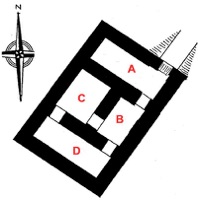
Plan of PG 1236: image adapted from Leonard Woolley (referenced below, 1934b, Plate 273)
As Leonard Woolley (referenced below, 1934a, at p. 111) observed, PG 1236 (a rectangular burial chamber that measured about 13 x 9 meters) was the largest of the stone-built tombs that he discovered in the cemetery. As is shown in the plan above, it was made up of four chambers:
✴an outer door leads onto a long entrance chamber (A), running along the entire width of the burial;
✴a second door in this chamber leads to two chambers (B and C), which are side by side in the middle; and
✴doors in each of these chambers lead to s second long chamber (D) at the end, which was probably the primary burial chamber.
Unfortunately, it had been thoroughly looted and, as Gianni Marchesi (referenced below, 2004, note 8, at p. 154) observed:
“... the remains of bodies were so scarce that the killing of retainers can be assumed to have happened only by analogy with other Royal Tombs.”
Having said that. Woolley recorded fragments of what must have been valuable grave goods on the floor which together with the surviving grave goods described below, suggest that this had been an élite burial.
Sceptre (?)

Reconstructed sceptre (U. 12442)) from Chamber A
Now in the British Museum (BM 122201); image from the museum website
Leonard Woolley (referenced below, 1934a, at p. 113) recorded that:
“The most interesting object [in chamber Ahamber] was found in fragments, but these fortunately lay together, many of them in position, and it was possible to reconstruct it [see the illustration above]. Small triangles of shell and lapis lazuli inlay, shell and pink limestone rings, and small curved lapis pieces making rings of the same diameter, and bands of very thin gold leaf with impressed designs together made up the decoration of a sceptre (or handle of a fly- whisk?); one end had a mushroom-shaped cap of white shell inlaid with a rosette in red and blue, the other end was plain.”
Seal of A’Anzu
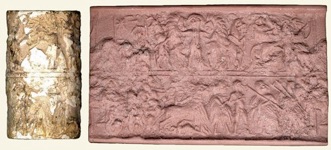
Seal of A’Anzu (U. 12461), probably from Chamber D: inscription (RIME 1.13.1.1. CDLI, P418046)
Now in the British Museum (BM 122538): image from the museum website
Leonard Woolley (referenced below, 1934a, at p. 113) recorded that this seal was discovered in Chamber A, although this might have been an error: later in this volume, both Eric Burrows (at p. 316) and Léon Legrain (in entry 54, at p, 340) recorded the find spot as Chamber D. It is inscribed with the personal name ‘a-(an)anzu2{muszen}’ (A’Anzu, followed by the ideogram ‘MUSHEN’, which indicates that Anzu is the name of a bird). Gianni Marchesi (referenced below, 2004, note 73, at p. 183) translated this name as:
“The father [of the owner of the seal ?] is (as mighty as) the thunderbird [=Anzu/ Indugud].”
The image carried by the seal is in two registers:
✴in the upper register, a nude hero stands between two lions crossed with a stag and a bull; and
✴in the lower register, there is a war scene that, according to Léon Legrain (as above), is:
“... directly borrowed from the famous [Standard of Ur - see PG 779 below], may help to identify the owner of the seal. He is probably the king buried in [PG 779].”
Finally, Legrain noted that:
“The chain of four crossed lions intertwined [depicted to the right in the upper register] is a new and bold motif. (It is found again on the seal of -King Mesanepada - see below], transformed into a chain of four armed men each catching the other's foot).”
I discuss this important iconography in my page on seals and sealings.
Seal of Gan-Enkiga(k)
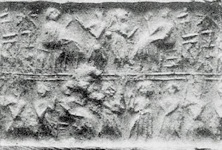
Shell cylinder seal inscribed with the female name Gan-Enkiga(k) (U. 12330)
Present location ?: image from Leonard Woolley (referenced below, 1934b) Plate 194 (32)
The shell cylinder seal that made this impression is inscribed with the name of a lady named Gan-Enkiga(k): see Gianni Marchesi (reference below, 2004, p. 182 and note 166) for the transliteration of this name. The impression also depicts a banqueting scene in two registers: according to Léon Legrain (in Leonard Woolley, referenced below, 1934a, entry 32, at p. 339):
✴in the upper register, a man and a woman, both of whom are seated, drink from cups that they were apparently given to them by two servants; and
✴in the lower register, a seated man faces what seems to be a group of three singers, two of whom face each other while clapping their hands, while a fourth man (a performer?) stands behind the throne.
PG 779
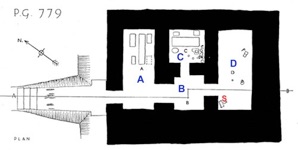
Plan of PG 779: from Leonard Woolley (referenced below, 1934b, Plate 24): my additions in red (S = Standard of Ur)
As noted above, PG 779 is stylistically linked to the larger PG 1236. As Leonard Woolley (referenced below, 1934a, at p. 59) recorded:
“On the slope below the steps [that led down to Chamber A], there were ten copper spears in a row ... and, below them (but so decayed as to be scarcely recognisable), were the bones of the soldiers of the guard; there seemed to be five bodies, but it was impossible to be sure.”
The chambers within had been looted, but Woolley noted that enough survived in Chamber A to suggest that it had:
“... apparently [been] a burial chamber, and an important one.”
Chambers B and C were also essentially destroyed, although Woolley guessed that a human skull in the latter had belonged to a female attendant. However:
“In Chamber D, there were the remains of at least four human bodies, [although] they were represented by very scanty fragments and even the skulls of two were lacking. Beads were, as usual scattered over the floor, [along with a number of precious objects, including] a gaming-board of engraved shell plaques with lapis lazuli borders, set in silver [U. 11162 - see below]. At the south-west end, there were remains of two more bodies, one very fragmentary; the better preserved had its head in the corner of the chamber, close to the south-west wall ... Above the man's head and slightly to the right of it, against the stones of the tomb wall, [were the remains of] the so-called Standard' of Ur, marked ‘S’ in the plan above].”
It seems that, although looters had effectively cleared thr grave, this corner of Chamber D had fortuitously escaped their depredations.
Standard of Ur
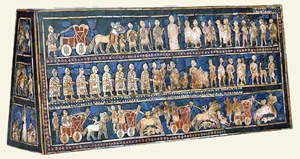
So-called Standard of Ur (U. 11164) from Chamber D, PG 779 (as reconstructed in 1973)
Now in the British Museum (BM 121201): images from the museum website
This object had originally been a wooden box with a rectangular base and two narrow, trapezoidal sides separating a pair of wide, rectangular panels. As Dorota Ławecka (referenced below, at p. 337) observed, in its original state, each of the four main faces of the box was:
“... covered with geometric and figurative mosaics made of pieces of shell, red limestone and lapis lazuli set in bitumen [in three horizontal registers].”
Leonard Woolley (referenced below, 1934a, at p. 61) recorded that:
“The wood which had been its core had vanished (traces of its grain could be distinguished on the bitumen afterwards) and the bitumen in which the tesserae were set had gone to powder, so that the tesserae were loose and kept in place only by the soil. With the decay of the wood, the main panels had been telescoped together, with the result that the triangular ends had been pushed out and broken ...”
He named the precious object the ‘Standard or Ur’ because it had apparently been located near the shoulder of the dead man, suggesting that he had carried it on his shoulder like a battle standard.
Woolley, having described the intricate way in which the excavators had preserved the mosaic designs that had once decorated the box, observed (at p. 62) that:
“Taken as a whole, the standard is unusually authentic and, considering how peculiarly liable to destruction it was, wonderfully perfect.”
The original decorated box was reconstructed in the British Museum, where it was first exhibited in 1928. However, it subsequently deteriorated and was completely dismantled and reassembled on a new mount in 1973.
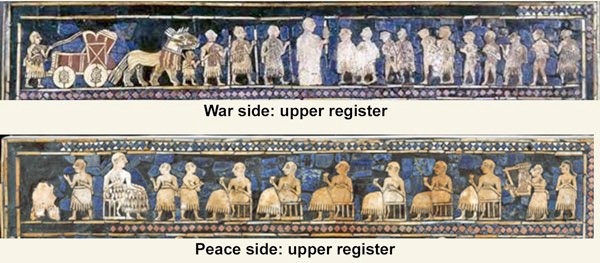
Details from the war and peace sides of the Standard of Ur: original images from British Museum (BM 121201)
Dorota Ławecka (referenced below, at pp. 337-8) summarised the visual imagery of the mosaics on this object as follows:
“One of the long sides (the ‘war’ side) shows a victorious battle of chariots and infantry (most probably belonging to an army of the city-state of Ur) and, in the upper [register], conquered enemy warriors as they are brought before [a figure that is usually identified as] the king [see below]. The other long side (the ‘peace’ side) shows men bringing animals and large bundles of various shapes [presumably to Ur]. In the [upper register on this side], we see a banquet scene typical for [the art of this period]: the ‘king’ himself and other participants, each holding a cup in hand, are entertained by a singer and a lyre player. Both trapezoid end sides were decorated ... [with] fantastic scenes not directly related with the main narrative. Following Woolley’s original usage, the object is still customarily labeled [the Standard of Ur], even though there are no clues as to its actual function.”
I discuss the imagery of the mosaics on the standard in detail on my page on the ‘Standard of Ur’. For the moment, I will simply observe that, although PG 779 was almost completely plundered long before its excavation, the survival of this extremely valuable and prestigious object makes it certain that it was the grave of a very important person. In my view, the person in question was almost certainly the man who was portrayed on each of the images above:
✴on the war of the standard, he stands at the centre of the upper register, having emerged from a war chariot in order to deal with a queue of recently-taken prisoners of war; and
✴on the peace side, he is the only seated figure facing right (and also distinguished by his flounced skirt) as he presides over what is almost certainly a banquet in celebration of this recent victory.
On both images, he is the the tallest figure depicted (as emphasised by the fact that, in each case, his head interrupts the upper decorative border), which strongly suggests that:
✴this had been a very important victory; and
✴he had commanded the victorious army of Ur, presumably as its king.
Gaming Board
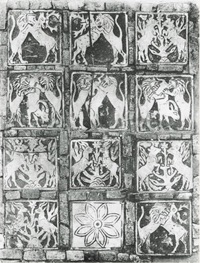
Gaming board (U. 11162) from Chamber D of PG 779), now in the Iraq Museum (?)
Image from Leonard Woolley (referenced below, 1934b, plates 97
text
(Link to page on iconography).
PG 777
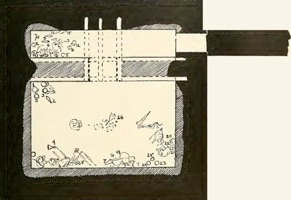
Plan of PG 777: image adapted from Leonard Woolley (referenced below, 1934a,Figure6, at p. 5)
As Leonard Woolley (referenced below, 1934a, at pp. 54-5) observed, this stone-built structure is made up of two chambers
✴an outer door leads into what is, in effect, an entrance passage, which runs along the entire width of the burial; and
✴a second door in this passage leads into the main chamber, which would have been the primary burial chamber.
Woolley (as above) noted that:
“While the tomb occupied the whole of the shaft proper, there was a narrow trench cut against its north-east wall in which were the bones of 3 men armed with spears; in the dromos was a fourth; these are probably the [sacrificed] soldiers of the guard.”
Unfortunately, the chamber had been looted and its roof had collapsed. He found four human skulls in the passage, but no objects of any value. The main chamber contained at least 4 more skulls, one of which (at location 26) was near a small collection of jewellery. This included the remains of a diadem resembling that of Queen Pu-abum (see below), which led Woolley to suggest that it might have belonged to the ‘primary burial’ (by which he meant the presumably royal; person for whom the chamber had been built), albeit that any other evidence of the existence of this person had been destroyed.
PG 1054b
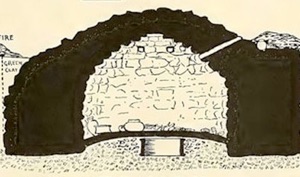
Section (SW-NE) of PG 1054b: adapted from from Leonard Woolley (referenced below, 1934a, Figure 16, at p. 103):
As noted above, Paul Zimmerman established that, pace Leonard Woolley, this burial chamber (PG 1054b), was almost certainly unrelated to the burial structure above it (which is discussed below as PG 1054a). Leonard Woolley (referenced below, 1954, at p. 76) described how, having reached the floor of this upper structure and a layer of hard clay and broken brick below it, he found (to his great delight):
“... a small dome that was absolutely in tact. It was particularly exciting because ... [there were] half a dozen holes in the roof through which one could glimpse parts of the interior... and catch the occasional glint of gold.”
In his earlier report (Leonard Woolley, 1934a, at p, 104), he explained that there was a gap between the walls of the chamber and those of the burial shaft that was filled in on three sides but:
“The wider space on the southeast of the dome represented the forecourt lying in front of the chamber door:
✴a human skeleton with a dagger by its side lay with its head against the earth slope on the southeast;
✴a second skull and remains of the body occupied the centre of the court, ... [beside] the skull and bones of a sheep;
✴the remains of another animal lay to the south east of the door's axis;
✴a skeleton, this time apparently of a goat, lay against the south west jamb of the door.”
These remains were presumably the result of the original burial ritual. He noted (at p. 104) that the floor of the chamber chamber measured 2.6x2;2 meters and from the floor the floor to the soffit of the dome was 1.7 meters. He then recorded (at p. 106) that:
“There were 5 bodies [inside] the chamber:
✴1 of a woman, lying approximately in the centre, on her right side, with her head south west;
✴3 of men, lying in a row with their heads inwards and their feet against the southeast wall; and
✴1 ... of a man [lying] along and facing the south west wall.”
The woman was clearly the ‘primary burial’ and the four male bodies were presumably those of sacrificed attendants.
In this ‘final’ report, albeit that he gave a detailed account of the regalia of the woman in the tomb, he concluded (at p.107) that it was ‘not rich’, at least in relation to some of his other ‘royal’ burials. However, in his later book (referenced below, 1954, at p. 76), having noted that the lady’s regalia included
✴the golden headdress of ‘one of high rank’;
✴a long curved golden pin ‘such as we had not seen before, [which] fastened her cloak’;
✴a fluted and engraved tumbler of gold that was still in her hands; and
✴a golden cylinder seal (U. 11904, see below) by her side, ‘the first we have ever found’.
he concluded that:
“This clearly was a queen.”
Gianni Marchesi (referenced below, 2004, at p. 162) was more circumspect: he described the main occupant of this burial as:
“... a high-ranking woman [who had been] buried together with four male attendants.”
Gold Cylinder Seal
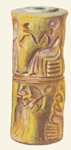
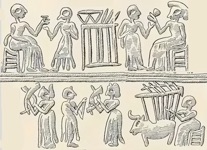
Left: ‘Gold’ seal (U. 11904) from the burial chamber of PG 1054b, location now unknown (?)
Image from Leonard Woolley (referenced below, 1934b, Plate 142)
Right: Sketch of seal impression:
Image adapted from Leonard Woolley (referenced below, 1934a, Figure 23, at p. 127)
As noted above, this cylinder seal was found by the side of the main occupant of this burial chamber, who was certainly a high-ranking lady, if not a queen. According to Julian Reade (referenced below, 2001, at p. 21), it is only 4 cm high and is made of gold foils with ‘shell’ caps over a core of some other material (which other authors assume to be bitumen). The impression that it makes depicts a banqueting scene in two registers:
✴in the upper register, a man and a woman, each of whom is seated, cup in hand, and attended by a servant, close to a table laden with two jars (presumably of beer) and three loaves; and
✴in the lower register, the banqueters are entertained by a musical quartet made up of:
•two female cymbalists flanking a female singer who seems to be clapping her hands; and
•a seated man who is playing a bull-shaped lyre.
The fact that this seal did not carry an inscription does not preclude the possibility that the lady who owned it was a queen: after all, as we shall see:
✴the three seals of Pu-abum that were found in her grave (PG 800b) all depict banqueting scenes in two registers:
✴all of them feature a similar banqueting table and one of them (B16728 in the Penn Museum) also features a musical performance; but
✴only one of them carries an inscription.
I discuss the iconography of this seal in my page on seals and sealings.
PG 1648
Leonard Woolley (referenced below, 1934a, at pp. 14) recorded that this single room, mud brick burial chamber is the smallest the royal tombs. Its interior space was almost entirely taken up by a wooden coffin that still contained the remains of its [apparently male] occupant, although:
✴the remains of three other people were found in the space between the coffin and the interior walls; and
✴the remains of a sheep or goat were found in the small forecourt in front of the door.
The roof had collapsed and there was evidence the chamber had been looted. Woolley commented (at p. 134) that:
“The poverty of the interior of the coffin is striking, ... [and there was no trace of objects usually associated with a ‘royal’ corpse, such as] the cup or bowl by the hands of the dead man and his weapons. The subsidiary burials had not been disturbed, but the evidence would perfectly well allow of the coffin itself having been opened from above and looted: [indeed, since the royal burial, PG 1618a] came immediately above (and actually touched the walls of} ... PG 1648, the chances of its having been desecrated by the later tomb-diggers were very great.”
PG 800b
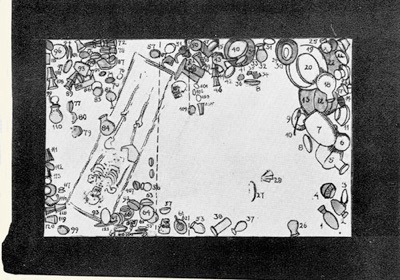
Plan of the burial chamber of Queen Pu-abum (PG 800b); from Leonard Woolley (referenced below, 1934b, Plate 36)
This is one of only two built burial structures that had escaped the attentions of looters before its excavation (the other one being PG 1054b, discussed above). Leonard Woolley associated it with a nearby death pit, but (as discussed in my page on the First Dynasty of Ur: Royal Cemetery), this association must be discounted. I describe the death pit in question (labelled PG 800a) in the following page.
When PG 8oob was discovered, its roof had already largely collapsed, but this did not preclude the thorough excavation of the chamber. Importantly, the remains of the main occupant remained in situ: as is shown in the plan above, the corpse was laid out on a bier that was placed diagonally across the northweste end of the chamber. According to Sir Arthur Keith (in Leonard Woolley, referenced below, 1934a, at p. 400), this corpse was that of a woman who had been aged about 40 at the time of her death. As we shall see, the inscription that was carried by a seal found by her body indicates that she was an otherwise unattested queen named Pu-abum.
Queen Pu-abum
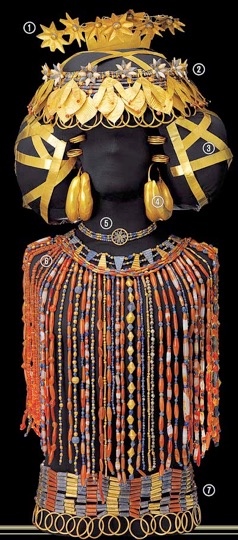
Reconstruction of the burial adornment of Pu-abum
Image from William Haffford (referenced below, at p 65)
Pu-abum’s corpse was famously dressed for burial in a manner that underlined her royal status (as illustrated above). As William Hafford (referenced below, at p.65) observed, the main elements of her adornment can be allocated to 7 groups (marked on the illustration above: all the linked pages below are in the website of the Penn Museum):
✴a large gold hair comb (1) decorated with flowers cut out of shet gold (B16699);
✴a number of wreaths (2) of gold poplar (B 17710) and willow (B17711) leaves, with shell flowers and beads made from lapis lazuli, carnelian, and agate;
✴about 12 meters of gold hair ribbon (3);
✴a pair large earrings made out of very thin gold (4);
✴a gold and lapis lazuli ‘choker’ necklace (5) with a central rosette (B16694);
✴a cloak (6) made up of over 50 strands of carnelian, agate, lapis, gold and silver beads; and
✴a belt (7) made from 10 strands of alternating lapis lazuli, carnelian, and gold beads, with gold wire rings below (B17063).
Amy Gansell (referenced below, Table 1, at p. 5) identified a number of bodies found in the cemetery with what she characterised as ‘vegetal wreath headdress-based adornment sets’ (indicating that they at least had gold hair ribbon and a gold poplar/beech leaf wreath), but she noted (at p. 4) that:
“... the set worn with an extravagant beaded ‘cape’ by [Pu-abum], the principal occupant of [PG 800b], was by far the most elaborate.”
Leonard Woolley (referenced below, 1934a, at p. 88) recorded that:
“Against [her] right upper arm ... were found three gold pins ... [that] probably secured the cloak, made open on this side, as was the usual fashion. With the pins were [a number of precious objects ... [that included] three lapis lazuli cylinder seals, ... [one of which bears the name of Pu-abum, as mentioned above]. The cylinders were perhaps tied to the pins to make toggles for securing the cloak.”
I discuss all three seals in my page on seals and sealings, but it is worth also louching on the one that names Pu-abum in the present context,.
Seal of Queen Pu-abum
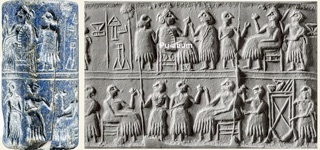
Seal of Queen Pu-abum (U. 10939), from PG 800b: inscription (RIME 1.13.3.3: CDLI, P247683)
Now in the British Museum (BM 121544); image from the website of the Morgan Library & Museum
As noted above, Woolley found three lapis lazuli seals near Pu-abum’s right arm, an suggested that they might have been tied to the nearby gold pins to make toggles for securing her cloak. As discussed in my page on seals and sealings, all three carried reliefs of banqueting scenes but only one (illustrated above) also carried an inscription: the inscription in question (RIME 1.13.3.3: CDLI, P247683), which is in the upper register of the seal, reads:
“Pu-abum, the queen”.
It is therefore generally accepted the main occupant of the burial chamber PG 800b was the otherwise unknown Queen Pu-abum. I discuss the iconography of this seal and the other two with which it was found in my page on seals and sealings.
Silver Bull’s Head and Plaques
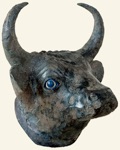
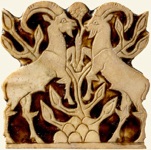
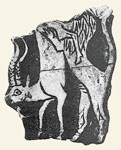
A B C
Objects found at the foot of the coffin of Pu-abum (location 51 and 52)
A: Text Silver bull’s head (U. 10916), now in the Penn Museum (B17065): image from the museum website
B: Shell plaque (U. 10917a), now in the British Museum (BM 121529): image from the museum website
C: Shell plaque (U. 10917b), now lost ?: image from Leonard Woolley (referenced below, 1934b, Plate 100)
Leonard Woolley (referenced below, 1934a, at p, 91) recorded the discovery of the objects illustrated at the foot of Pu-abum’s coffin (locations 51 and 52) and suggested that they had decorated the sound box of a lyre. It is generally accepted that the bull’s head probably did come from a lyre, although the original function of the two shell plaques is less clear [reference needed]. I discuss these objects further in my page on lyres and my page on iconography.
PG 789 (Burial Chamber)
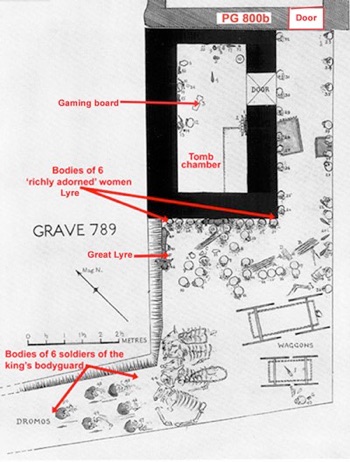
Plan of the burial chamber and death pit PG 789; from Leonard Woolley (referenced below, 1934b, Plate 29)
My additions in red
This burial chamber abutted PG 800b: these two structures are architecturally related but, since PG 789 is at a slightly higher level, it is almost certainly the later of the two . Unfortunately, unlike PG 800b, it had been thoroughly looted long before its excavation. Clearly, its main occupant must have been closely associated with Queen Pu-abum:
✴Woolley assumed that it was built for Pu-abum’s husband; but
✴as Peter Moorey (referenced below, at p. 31) observed:
“Without either a primary body or an inscribed seal, we shall never know whose burial this was. Nor may we be absolutely certain that this was a male primary burial ... ”
As shown in the plan above, two sides of the burial chamber PG 789 were contiguous with a large death pit that was laid out on the same level. Fortunately, it had escaped the attention of looters. I discuss this death pit on the following page. However, in this section, I discuss two objects that were found just outside the door that led to the burial chamber, because it seems likely that they were dropped here by the looters.
Gaming Board
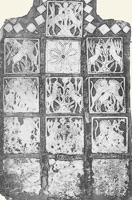
Gaming board (U. 10557), , now in the Iraq Museum (?)
Image from Leonard Woolley (referenced below, 1934b, plates 97)
According to Leonard Woolley (referenced below, 1934a, at p. 71):
“Opposite the door [of the chamber], flung on one side by thieves who were concerned only with things of intrinsic value, lay the splendid gaming-board, (U. 10557).”
This object is discussed in my page on iconography).
PG 800a (Death Pit)
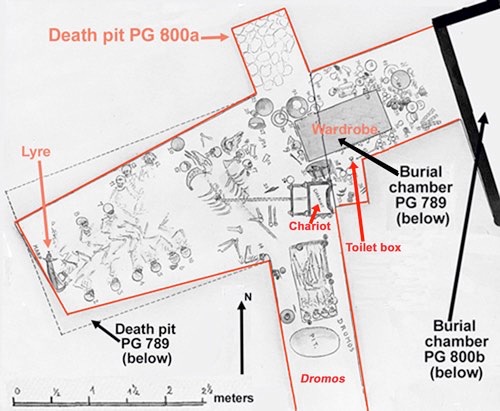
Plan of the death pit PG 800a, adapted from Leonard Woolley (referenced below, 1934b, Plate 36)
(My additions in red and black).
As noted above, Leonard Woolley began his excavation of this death pit before he discovered two burial chambers:
✴PG 789 and its associated death pit, which were directly below it; and
✴PG 800b (the burial chamber of Queen Pu-abum, as discussed above), which was at an even lower level to the northeast.
As Paul Zimmerman and Richard Zettler (referenced below, at p. 294) observed:
“... the tomb chamber originally associated with PG 800a, (f there ever was one) remains as elusive today as in 1927/8.”
However, there is an association between this death pit and the burial chamber PG 789: as discussed in my page on the Royal Cemetery:
✴this burial chamber had been looted from above (probably at the time that the death pit PG 800a was lid out; and
✴the ‘wardrobe‘ marked on the plan above covered the opening through which the looters had entered it.
As Paul Zimmerman and Richard Zettler (referenced below, at p. 294) observed, given these facts:
“It is perhaps also worth asking whether the large number of artefacts found at the northeastern end of the death pit [PG 800a] might have come originally from PG 789’s [burial] chamber ... ”
Since this seems to me to be likely, I discuss:
✴the wardrobe of two objects found near it in this page (since they might well have come from the burial chamber of PG 789); and
✴the death pit itself in the following page.
Wardrobe
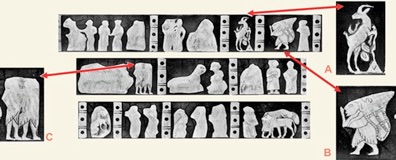
Sketches of the mostly ruined inlays from the ‘wardrobe-chest’ (U. 10441-2) found in PG 800a,
now in the British Museum (BM 121394, not exhibited)
Images from Leonard Woolley (referenced below, 1934b, Plate 94)
Leonard Woolley (referenced below, 1934a, at p. 74) recorded that:
“In the middle of the pit, just in front of the dromos, ... was a great [rectangular] wooden chest measuring 2.25 x 1.1 meters, [the height of which] could not be ascertained. Although the original wood and the contents of the wardrobe no longer survived, [it] had itself been an object of art: ... along its southeast side ran a band of mosaic in shell and lapis lazuli with a design of human and animal figures in the same technique as the Standard [of Ur - see above], but unfortunately in very bad condition [as can be seen in the illustration above. ...
Actually, three of the surviving reliefs (discussed in my page on Standard of Ur) are of some interest, because hey make direct reference to the mosaics on the standard:
✴my image A, which represents a mountain goat, appears in the top register of one of its end panels;
✴my image B, which shows a man wearing a wrapped-over short skirt and carrying a heavy backpack reflects two of the ‘foreign’ tribute bearers depicted in the bottom register of its peace side; and
✴my image C, which shows the lower part of two more men (presumably ‘foreigners’) wearing wrapped-over short skirts, a motif that is repeated on a number of occasions on both its peace and its war side.
In a later passage (at p. 80), he added that:
“All the woodwork [of the wardrobe] had perished, leaving only a twisted and warped imprint in the earth, and there were no mosaic borders to guide us. All the decoration had been on the southeast face, which was presumably the front, and all was fallen in disorder. Two narrow strips of gold with lapis lazuli between them had formed a frame or (since there was not enough of it to go round) a single border either above or below, to a long strip of mosaic executed in the technique of the Standard [of Ur] ... The fallen fragments of it lay all along the front of the box and all that could be done was to pick them up in the order in which they lay ... and try to reset them. [Unfortunately], something in the nature of the soil at this point had so attacked the shell that the surface was all gone and all the internal detail of the figures was therefore lost (and many were eaten right away and even their outlines were unrecognisable). Plate 94 [reproduced above], shows all that I could make out of the ruin, and it shows little.”
Given the facts that:
✴the decoration of the wardrobe had arguably been inspired by that of the Standard of Ur (from PG 779, which pre-dated PG 789); and
✴it was found at a level above PG 789 (which suggests that the death pit post-dated PG 800a, perhaps by a significant period of time)
✴it covered the opening via which PG 789 had been looted;
we might reasonably argue that it had been looted from PG 789 and ‘dumped’ in PG 800a in a location chosen to disguise the looters’ crime.
Objects Found near the Wardrobe
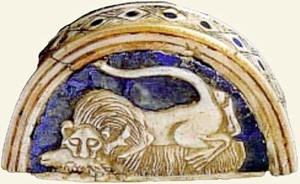
Inlaid lid of a silver box (U. 10436), now in the Penn Museum (B16744A); image from the museum website
Leonard Woolley (Referenced below, 1934a, at 81) observed that:
“By far the greater number of the objects deposited in [PG 800a] were placed round the [[‘wardrobe’] in the part of the pit lying to the north east of the entrance, and here they were bewildering in their abundance ...”
These included an object (number 41, U. 10436, marked on the plan at the start of this section and and illustrated above) that he described as:
“... the very exquisite little toilet-box of the queen [sic]. with its inlaid top of lapis and shell.”
The reference here to ‘the queen’ reflects his incorrect assumption that PG 800a was associated with PG 800b, the burial chamber of Queen Pu-abum. He described this object (at pp. 279-80) as follows:
“This semicircular lid of the silver toilet-box found in [PG 800a] is cut out of a piece of shell and the top [is] inlaid with shell and lapis [lazuli]. The lapis is the usual mosaic of small bits. [However], the figure of the lion tearing the throat of the bull it has brought to earth is not merely silhouetted but also carved in low relief ... It is the only example found in the cemetery of relief being employed to heighten the effect of inlay, and it anticipates the (much larger) wall friezes of [Tell Ubaid - link needed] , where again the two techniques are combined. ... [This] exquisite little object ... [is] the work of a real artist.”
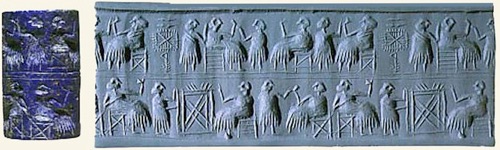
Seal of Abarge (U. 10448a), now in the Penn Museum (B16727): inscription (CDLI: P270168)
Image from the museum website
This inscribed lapis lazuli seal, which was found in loose soil on the floor of the death pit near the object above (at location 36), carries an inscription (CDLI: P270168) that records a personal name:
‘a-bar-gi’ (Abarge)
According to Léon Legrain (in Leonard Woolley, referenced below, 1934a, entry 19, at p. 337), the relief it carries depicts:
“... a banqueting scene in two registers:
✴Above, the [presumed hostess], attended by [two] maids, is facing a couple of guests (a man and a woman, with the latter attended by a maid]. All raise a cup, but their different seats may mark a difference in rank.
✴[Below], the scene is repeated ... [but] the three drinkers sit on either side of a board loaded with food.”
Holly Pittman (referenced below, catalogue entry 18, at pp. 78-9) observed that this scene differs from that on the inscribed seal of Queen Pu-abum (see above) in two respects:
✴both men and women take part in the banquet; and
✴no musical performance is depicted.
She also noted that we cannot be certain whether the the name Abarge is that of a man or a woman. It seems to me that the seal must have belonged to the lady who hosts the banquet, and that she was presumably called Abarge. Furthermore, it is tempting to see her as the lady who owned the nearby silver box, and that both were originally in the burial chamber of PG 789. I discuss this seal again in my page on seals and sealings.
PG 1631
This small, single room, stone-walled structure had been looted from above, and nothing of any historical significance escaped the attention of the looters.
PG 1050c
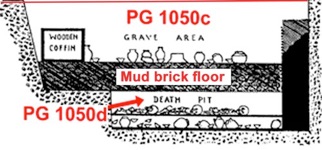
Section (SW-NE) through the lower part of Woolley’s PG 1050)
Image adapter from Leonard Woolley, referenced below, 1934a, Figure 14 at p p5: my additions in red
As noted above, Paul Zimmerman established that, pace Leonard Woolley, this burial chamber (PG 1054c) was almost certainly unassociated with:
✴the burial structure above it (which is discussed below as PG 1050a); and
✴the putative death pit below it.
In other words, we are dealing here simply with a single room, stone-built burial chamber and, unfortunately, it had been looted. Woolley expressed surprise (at pp. 96-7) that (unlike in the case of PG 1054b see above, which he considered to be a precedent):
“... no trace of any roof was found by us. ... [However, that], there was [originally a burial chamber here] seems to me certain.”
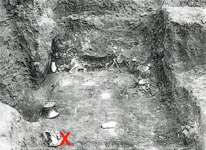
Plundered burial chamber PG 1050c - see below): image from Leonard Woolley (referenced below, 1934b. Plate 48)
My red ‘X’ indicates the distorted ‘copper cauldron’ above the seal of Queen Ashusikilam (see below)
Leonard Woolley (referenced below, 1934a, at p. 94) described how, having reached the floor of the upper structure (PG 1050a), he encountered a layer of filling, below which was a mud brick floor that extended across the entire area space between the walls: this was essentially all that survived of PG 1050c. Woolley described the contents of the chamber as follows:
“Against the southwest side were the remains of a wooden coffin ... [that] had been broken open and the bones inside it were in hopeless confusion ... On the body, which lay with the head northwest, there were some beads of gold, lapis lazuli and carnelian, and traces of silver. By the foot of the coffin were [two vases, along with] the broken skull of a second person, presumably one of the attendants. In the middle of the floor lay [two more vases] and to the northeast of this was a copper cauldron, ... [which had been] completely crushed and broken [marked ‘X’ in the illustration above]; below it were found a little clay vase in the form of a nut as well as the large lapis lazuli cylinder seal inscribed with the name Akalamdu [see below]. By the head of the coffin there were [various insignificant objects. ... The whole of the centre of the pit was empty except for the few scattered objects already described.”
As Gianni Marchesi (referenced below, 2004, note 8, at p. 154) observed, the remains of the bodies of attendants in PG 1054c were so scarce that their presence could be assumed only on the basis that there had been attendants in the similar but unviolated ‘royal’ structure PG 1054b (see above).
Seal of Queen Ashusikilam
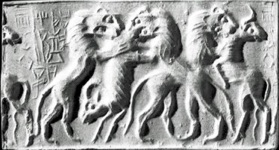
Seal of Queen Ashusikilam (U. 11825) from PG 1050: inscription (RIME 1.13.4.1; CDLI, P247682)
Now in the Penn Museum (CBS 17720): image from Leonard Woolley (referenced below, 1934b, Plate 198, no. 65)
The lapis lazuli seal (U. 11825) that made the modern impression illustrated above, which is now in the Penn Museum (CBS 17720), carries the following inscription (RIME 1.13.4.1; CDLI, P247682):
‘Akalamdu, king of Ur: Ashusikilam (is) his wife’
Although some scholars have assumed that this was the seal of King Akalamdu, Gianni Marchesi (referenced below, 2004, at p. 180) argued that:
“More probably, ... [it] simply bears a label inscription formulated in a ceremonial style, [with] the more important person ... written first). ...The owner of the seal was, of course, the last-named individual [i.e,, Ashusikilam, Akalamdu’s wife and presumably his queen]”.
According to Léon Legrain (in Leonard Woolley, referenced below, 1934a, entry 65, at p. 341), the image created by the seal depicts:
“Three crossed lions of royal style [attacking] an upturned ibex [on the left] and a bull.”
Thus, it seems that Queen Ashusikilam, instead off using the ‘usual’ banqueting scene on her seal, opted for a variant that was generally used by kings (see below). I discuss the iconography of this seal in my page on seals and sealings.
PG 1618a
According to Leonard Woolley (referenced below, 1934a, at p. 128), digging down from the modern ground level, here he:
“... first encountered a rectangular enclosure of mud brick measuring about 4.5x 3,75 meters, preserved in places up to a height of 1 meter. “
He had no more to say about this structure, concentrating instead on what he conceived as an associated death pit which he discovered some 1.7 meters below it. However, as noted above, Paul Zimmerman (referenced below, at p. 21) established that, pace Leonard Woolley, this single room, mud brick chamber PG 1618a was almost certainly unrelated to the death pit (PG 1618b). Zimmerman observed (at p. 15) that:
“This tomb is very poorly preserved, and little can be said about it.”
PG 1054a
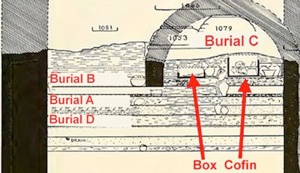
Section of PG 1054a: from Leonard Woolley (referenced below, 1934a, Figure 16, at p. 103): my additions in red
As noted above, PG 1054a is one of two mud brick structures (the other being PG 1050a) that are subdivided internally, with multiple re-floorings that Paul Zimmerman (referenced below, at p. 21) characterised as mausolea that:
“... were periodically reopened, re-floored, and prepared for the interment of additional bodies.”
As is shown in the illustration above, this mausoleum was used for at least four burials. However, only one of them, Burial C, is of particular interest here.
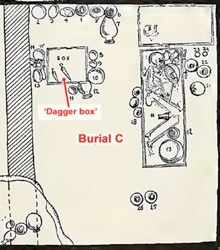
Plan of the chamber of PG 1054a that contains Burial C
Adapted from Leonard Woolley (referenced below, 1934a, Figure 15, at p. 99): my additions in red
Leonard Woolley (referenced below, 1954, at p. 75) recorded that he first became aware of the existence of PG 1054a when, having dug down along the face of a mud brick wall (the ‘hatched’ area on the left of the illustration above), when he came across:
✴a pair of daggers (U. 11513, see below), lying side by side, each of which had a gold blade and a hilt decorated with gold studs; and
✴a seal inscribed with the name ‘Meskalamdu, the king’ (U. 11751. see below), which lay between them.
These objects lay within the ‘footprint’ of what had been a wooden box (marked ‘dagger box’ in the plan above), next to which was a wooden coffin containing what he judged to be the body of a man: as he observed, despite the impression given by the ‘dagger box’, the grave goods in the coffin were:
“... by no means of the type that one would expect from a royal person ... [and further digging revealed that [the chamber of Burial C] occupied only a humble corner [of a large, square space]. We felt sure that we had not yet found the king’s grave.”
In his conclusion to the more detailed account in his final report (Leonard Woolley, referenced below, 1934a, at p. 107) of his PG 1054 (= PG 1054b discussed above and PG 1054a) he observed that:
“It is unfortunate that no name can be attached to [this burial]. The cylinder seal in the offering-box in PG 1054a gives the name of the king [Meskalamdu], but as the principal occupant of [PG 1054b. see above] is a woman, that seal cannot be hers: it must have been put here as an offering, and although we may suspect that it was her husband's we cannot assume that.”
However, since Paul Zimmerman has established that there is no surviving evidence of an association between his PG 1054a and PG 1054b, there is no reason to assume a relationship between King Meskalamdu and the putative queen in PG 1054b.
However, this leaves us with the question of how and why these precious (apparently royal) objects found their way into a wooden box that had been found in this very non-royal environment.
It certainly seems to me that:
✴King Meskalamdu must have owned the two golden daggers (given the care with which the daggers and the seal had been arranged in the wooden box); but
✴it is unlikely that their presence in PG 1054a had anything to do with the original burial in the nearby coffin.
I therefore suggest that:
✴they must have been moved here in the period in which the putative mausoleum was in use; and
✴since Woolley failed to discover a more salubrious original location for them during what seems to have been a thorough campaign of excavation here, they (and, perhaps the box that contained them) must have been brought here from a more distant location (possibly, but by no means certainly, from King Meskalamdu’s own grave).
Furthermore, it seems to me that they must have been moved here in order to hide them, presumably either:
✴by looters (in the vain hope that they could subsequently be recovered and sold); or
✴in order to protect them from looters (perhaps at the time of an invasion).
Daggers
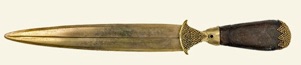
One of the two golden daggers (U. 11513) from the chamber of burial C: now in the Penn Museum (30-12-550)
Leonard Woolley (referenced below, 1934b, Plate 157) published a photograph of both of the daggers that had been placed, side by side, in the ‘dagger box’:
✴the smaller of the two (U. 11512) is now in the Iraq Museum; and
✴the other (U. 11513, illustrated above) is now in the Penn Museum (30-12-550).
According to Andreas Hauptmann and Sabine Klein (referenced below, at p. 87):
“The excellently burnished blade [of this second dagger] is fabricated [from a single] piece of a copper-rich gold-silver alloy.... Above the guard on the hilt and on the pommel, [some] 400 nails with spherical heads of pale greenish-yellow colour were inserted on gold sheets ... .”
Unfortunately, the first dagger (although similar in design) has not been investigated in this detail, and neither of them is inscribed.
Seal of King Meskalamdu
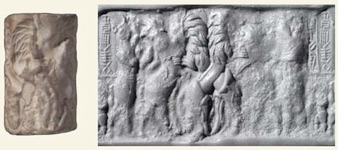
Seal of King Meskalamdu (U. 11751), with an inscription (RIME 1.13.3.1, CDLI, P247679)
From the chamber of Burial C of the mausoleum PG 1054a: now in the British Museum (exhibit BM 122536)
Image from Julian Reade (referenced below, 2003, figure 55a, at p. 103)
As noted above, the cylinder seal illustrated above, which was in the dagger box, carried an inscription (RIME 1.13.3.1, CDLI, P247679) identifying its owner as:
‘Mes-kalam-du10 lugal’ (Meskalamdu, the king).
It is usually (and reasonably) assumed that ‘Meskalamdu the king’, the owner of this seal, ruled at Ur. The face of the seal is very degraded but, according to Léon Legrain (in Leonard Woolley, referenced below, 1934a, entry 55, at p. 340), the impression that it made depicts:
“Two crossed lions [attacking] two bulls. [Two figures, which Legrain identified as Enkidu and a nude hunter in profile], take part in the fight. Both are probably armed with daggers. There is a small nude hunter, full face with wild locks, below the cartouche [at the edges in the impression as illustrated above].”
I discuss the iconography of this seal in my page on seals and sealings.
Seal from the Coffin in Burial C
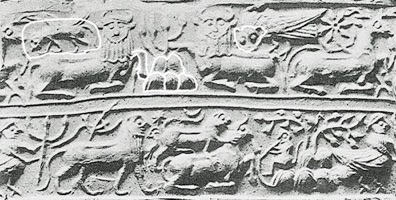
Impression produced by an un-inscribed seal (U. 11734) from the coffin in Burial
Was in the Iraq Museum: image from Leonard Woolley (Referenced below, 1934b, Plate 192), my additions in white
According to Leonard Woolley (referenced below, 1934a, at pp. 99-100), the lapis lazuli seal that made the impression above was found:
“... [at] the waist [of the male body in the wooden coffin in Burial C], where it must have hung from a belt ...”
I discuss the iconography of this seal in my page on seals and sealings.
PG 105oa
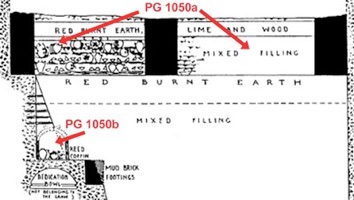
Section (SW-NE) through the upper part of Woolley’s PG 1050)
Image adapter from Leonard Woolley, referenced below, 1934a, Figure 14 at p p5: my additions in red
Paul Zimmerman (referenced below, at pp. 11-2) observed that:
✴PG 1050a, the upper part of Woolley’s PG 1050, is a roughly is a roughly square building with mud brick walls that is subdivided by cross walls into multiple rooms; and
✴the small reed coffin below it (marked PG 105b in the illustration above) was an unassociated burial that was inserted here without causing any significant disturbance to any pre-existing burials.
He also observed (at p. 11) that the interior of PG 1050a:
“... was filled with multiple layers of bodies, grave goods and debris down to the wall bottoms 1.2 meters below their tops. The uppermost layer consisted of burnt earth, ashes, charred wood, and small lumps of lime ... that Woolley concludes are the remains of a flat roof ...”
As we have seen, he argued that this structure (like PG 1054a) functioned as a mausoleum over a period of time before it was sealed. Unfortunately, the absence of any significant grave goods means that it is of little interest here.
Death Pits
This analysis continues on my page First Dynasty of Ur: Élite Burials (II).
References
Zimmerman P.C. and Zettler R.L., “Two Tombs or Three? PG 789 and PG 800 Again!”, in:
Altaweel M. and Hritz C. (editors), “From Sherds to Landscapes: Studies on the Ancient Near East in Honor of McGuire Gibson”, (2021) Chicago, at pp. 259-82
Hafford, W, B., "A Spectacular Discovery", Expedition Magazine, 60:1 (2018) 62-7
Lawecka D., “Who were the Tribute-Bearing People on the ‘Standard of Ur’?”, Journal of Near Eastern Studies, 76:2 (2017) 337-48
Hauptmann A, and Klein S., “Golden Artifacts from the Royal Tombs of Ur, Mesopotamia”, Metalla, 22:1 (2016) 84-8
Hafford W. B. and and Zettler R. L., “Magnificent with Jewels: Puabi, Queen of Ur”, in:
Chi J. Y. and Azara P. (editors), “From Ancient to Modern: Archaeology and Aesthetics”, (2015) New York, at pp. 84–115
Cheng J,, "A Review of Early Dynastic III Music: Man’s Animal Call”, Journal of Near Eastern Studies, 68:3 (2009) 163-78
Frayne D. R., “The Royal Inscriptions of Mesopotamia, Vol. 1: Presargonic Period (2700-2350 BC)”, (2008) Toronto
Marchesi G., “Who Was Buried in the Royal Tombs of Ur? The Epigraphic and Textual Data”, Orientalia, NS 73:2 (2004) 153-97
Reade J.,”The Royal Tombs of Ur”, in:
Aruz J. and Wallenfels R. (editors), “Art of the First Cities: The Third Millennium BC, from the Mediterranean to the Indus”, (2003) New York, at pp. 93-132
Reade J., “Assyrian King-lists, the Royal Tombs of Ur and Indus Origins”, Journal of Near Eastern
Studies, 60 (2001) 1–29
Pittman H., “Cylinder Seals”, in:
Zettler R. L and Horne L. (editors), “Treasures from the Royal Tombs of Ur”, (1998) Philadelphia PA, at pp. 75-84
Zimmerman P. C., “A Critical Reexamination of the Early Dynastic ‘Royal Tomb’ Architecture from Ur”, (1998) thesis of the University of Pennsylvania
Pollock S., "Chronology of the Royal Cemetery of Ur", Iraq 47 (1985) 129-58
Moorey P. R. S., “What Do We Know About the People Buried in the Royal Cemetery?”, 1 (1977) 24-40
Woolley C. L. (1954), “Excavations At Ur - A Record Of Twelve Years Work”, (1954) London
Woolley C. L. (1934a), “Ur Excavations (Volume I): The Royal Cemetery (Text)”, (1934) London and Philadelphia PA
Woolley C. L. (1934b), “Ur Excavations (Volume II): The Royal Cemetery (Plates)”, (1934) London and Philadelphia PA
First Dynasty of Ur: Élite Burials (I) First Dynasty of Ur: Élite Burials (II)