

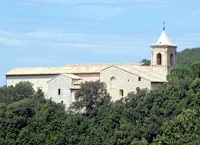
Abbot Mainardo left Santa Maria di Sitria, outside Gubbio in ca. 1077 to found a hermitage on land given to him by Ugolino and Oderisio, members of the family of the Conti di Uppello. The first church here, Santa Maria della Valle (or del Vecchio), was documented in 1082, when the ‘comites’ Gualterius and Odorisius, sons of Ugolino donated land ‘in Comitatu Fulgineato,in loco qui dicitur Agellum’ (in the county of Fulginia, in a place called agellus - presumably the place mentioned in the legend of St Felician as the place of his burial) to Mainardo, who was described as its provost. This original church was destroyed in the 13th century: its crypt survives, and is now known as the Cripta del Beato Alano (see below).
The church and monastery of Santa Croce di Sassovivo here was first documented in 1084, when Mainardo formally accepted the patronage and protection of the ‘comite’ Ugolino and two of his brothers. It enjoyed the patronage of this family for more that a century, during which time it accumulated a vast patrimony.
In 1138, Pope Innocent II took the complex into papal protection, exempted it from episcopal control, confirmed its possessions and defined the extent of the territory of the abbey and its boundaries with that of the diocese. At that time, it owned two monasteries (Sant’ Apollinare sul Sambro, near Bettona and SS Quattro Coronati in Rome, both of which had been confirmed by Pope Paschale II in 1116) and some 30 churches: a century later, its possessions included 97 monasteries, 41 churches and 7 hospitals.
The abbey passed to the Olivetans in 1436, and in 1467 Pope Paul II began the dispersal of many of its holdings.
The complex was suppressed in the Napoleonic era and when the monks returned in 1803, they found it beyond restoration. Pope Pius VII closed it in September of that year, and it was then abandoned. It was stripped of its remaining possessions in 1860. Part of the complex passed to the diocese and the rest into private hands.
A small group of monks from Prague found refuge here in 1951-7. Since 1979, the complex has belonged to the Piccoli Fratelli di Jesus Caritas.
Possessions of Sassovivo
Bishop Andrea of Foligno (died 1123) granted San Nicolò to Sassovivo, following which a monastery was also built here. Pope Clement III confirmed it as a possession of Sassovivo in 1188.
The church of Sant’ Apollinare, Spoleto was documented as possessions of Sassovivo in 1088, and Pope Innocent III confirmed this in 1213. The abbey seems to have made it available to the first Franciscan community in Spoleto soon after.
Two other churches in Spoleto were documented as possessions of Sassovivo in 1138:
-
✴San Lorenzo (see Walk I, Spoleto); and
San Fortunato, Montefalco, an important parish church that was responsible for about 50 other churches, was under the jurisdiction of the Abbazia di Sassovivo in the 11th century.
The church of San Venanzio, Spello was documented as possessions of Sassovivo in the 12th century.
In 1334, just before his death, Abbot Ruggero unilaterally united San Pietro in Bovara (outside Trevi) with Sassovivo and transferred all its goods and rights to this institution. The papal legate, Cardinal Giovanni Gaetano Orsini agreed, but the union could not be effected because of [Ghibeline opposition ??].
[More]
Cripta del Beato Alano (11th century)
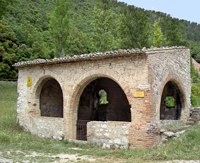
If you are walking from Pale, you will see this loggia (1442) on your left about 100 meters before you reach the abbey. Otherwise, after visiting the abbey, continue up the road and look out for it on the right.
The ruined crypt, which known as the Cripta del Beato Alano, is under the structure illustrated above. This is all that remains of the original church of Santa Maria della Valle.
The Blessed Alan of Sassovivo was an Austrian monk who joined the monastery after a visit to Rome in the Holy Year 1300. He left to become a hermit in 1311 and died two years later. His feast day is 18th July.
Church
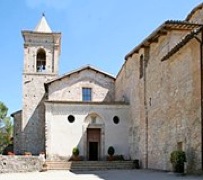
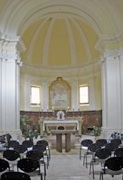
According to Ludovico Jacobilli (in the “Vite de' Santi e Beati di Foligno” of 1628), the 3rd century martyrs SS Carpophorus and Abundius had been buried future site of the abbey and translated into its church in 1180. They were apparently translated to the high altar there on 22nd July 1555. [Inscription? What happened to them?]
The church was largely rebuilt after the earthquake of 1832.
Fresco Fragment (14th century)
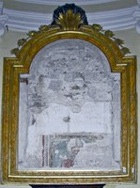
Annunciation of the Passion (1744)
This altarpiece, which is signed by Tommaso Nasini and dated by inscription, is [on which altar?] It depicts the Madonna and Child and an angel who points to putti above, one of whom holds a cross.
The cloister is reached from the atrium of the church.
Cloister (1229-32)
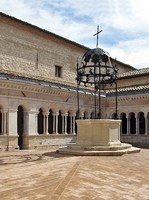
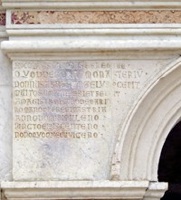
The cloister consist of 128 colonnettes in two orders supporting 58 Romanesque arches and a classical lintel made by coloured marble and mosaics from Rome.
An inscription on the central arch on the south side (to the left in this illustration) records that Abbot Angelo commissioned it from Maestro Pietro de Maria da Roma. He had built the cloister monastery of the Santi Quattro Coronati, Rome, which was subject to Sassovivo: he carried out the work for Sassovivo there and the components were transported by river to Orte and then overland.
-
✴The eastern wing was added in 1314.
-
✴The cistern dates to 1340 and was restored in 1623.
Maestà (13th century)
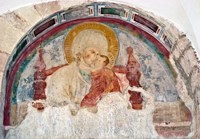
This fresco is in a niche in the eastern wall of the cloister.
Monastery
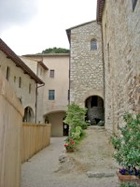
Loggia del Paradiso (early 15th century)
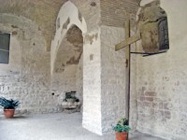
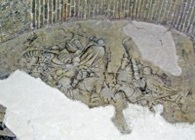
This loggia looks out onto the inner courtyard of the monastery. Its damaged nearly-monochrome frescoes are very similar to frescoes (ca. 1407) that Ugolino III Trinci commissioned for the corridor that links Palazzo Trinci to the Duomo. They are almost certainly by the same artist: he has traditionally been identified as to Giovanni di Corraduccio Mazzaforte, but Francesco Federico Mancini (referenced below) has recently suggested that he might be Paolo Nocchi.
The frescoes were probably commissioned by Giacomo Trinci, a nephew of Ugolino III Trinci, who was abbot at Sassovivo in 1411-39.
Continue to the Cripta di San Marone.
Cripta di San Marone
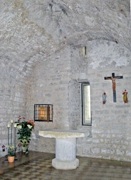
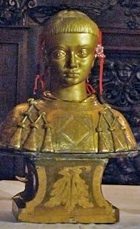
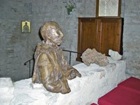
Bishop Luca Cibo translated the relic to the Duomo in 1490. It was subsequently encased in a reliquary (1499) that represents the tonsured and wounded head of a young deacon. This reliquary was translated from the Duomo to Sassovivo in 2000, when the Cripta di San Marone was re-opened after the damage done by the earthquake of 1997. It was stolen in 2005 but subsequently recovered and placed in the crypt of the Duomo.
Read more:
S. Zucchini, “San Pietro di Perugia e Sassovivo” in:
N. d’Acunto (Ed.), “Dinamiche Istituzionali delle Reti Monastiche e Canonicali nell' Italia dei Secoli X-XII”, (2007) Verona
Two articles that relate to the attribution of the frescoes of the Loggia di Paradiso are included in:
G. Benazzi and F. Mancini (Eds), “Il Palazzo Trinci di Foligno”, (2001) Perugia:
✴F. Mancini, “La Loggia delle Virtù: Allegoria di un Governo Illuminato”, p 334; and
✴G. Benazzi, “I Cicli Pittorici del Tempo di Ugolino e Corrado Trinci”, pp 470-1.
Return to the page on Monuments of Foligno.
Return to “Around Foligno”.