Empires of Mesopotamia
Akkadian Empire (ca. 2300 - 2200 BC)
Main Page: Akkadian Empire (2300-2200 BC)
Topics: Sargon’s Stele Sb 1 and Sb 2 Akkadian Conquest of Elam


Empires of Mesopotamia
Akkadian Empire (ca. 2300 - 2200 BC)
Main Page: Akkadian Empire (2300-2200 BC)
Topics: Sargon’s Stele Sb 1 and Sb 2 Akkadian Conquest of Elam
Stele Sb 1 and Sb 2 from Susa
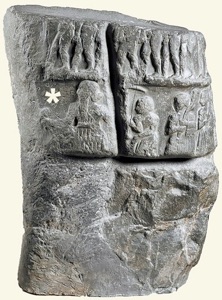
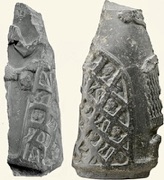
Left: Side A of a victory stele of Sargon from Susa, now in the Musée du Louvre (Sb 1)
asterisk marks the figure of Sargon, identified by inscription
Right: two views of the surviving fragment of a victory stele from Susa, now in the Musée du Louvre (Sb 2)
Images from the museum website
The two fragmentary victory steles illustrated above were excavated at the Elamite city of Susa in the early 20th century and are now in the Musée du Louvre:
✴the four-sided fragment (illustrated on the left above) is exhibited as Sb 1; and
✴the other fragment (illustrated on the right from two different angles) is exhibited as Sb 2.
Douglas Frayne (referenced below, 1993, at p. 310) noted that these steles were found about 50 meters apart. They are made from the same material (which is often given as diorite, although has apparently been identified as olivine gabbro) and they both carry a now-fragmentary Old Akkadian inscription:
✴The inscription (RIME 2:1:1:10; CDLI, P461936) on Sb 1 is in two parts::
•the caption on side A (at the location marked with an asterisk in the illustration above) identifies the adjacent figure as:
“Sargon, the king”; and
•a fragmentary inscription on the opposite side C, which is part of a curse formula, reads:
“[When Sargon conquered a now unknown the place in] battle ... [If anyone should violate this stele], may they [= two gods] ... tear out his foundations and pluck out his seed”.
✴The inscription (RIME 2.0.0.1002) of Sb 2, which is also part of a curse formula, reads:
“... [may the gods [DN] and Ilaba [tear out] his foundations”.
Douglas Frayne (as above) noted that, although the king's name is not preserved in this surviving fragment:
“... stylistic considerations ... suggest that it [= Sb 2] may have belonged to Sargon.”
Stele SB 1
Douglas Frayne (referenced below, 1993, at p. 26) observed that Sb 1:
“... which was deliberately defaced in antiquity:
✴may have been set up in Susa to commemorate Sargon's victory over Elam; or
✴alternatively, [as discussed below], may have been a piece of booty brought by the Elamites from Babylonia.”
This stele (as it now survives) is of rectangular section:
✴sides A-C carry reliefs in two registers, but the upper part of the reliefs in the upper registers are lost;
✴the curse formula on side C mentioned above is below the surviving lower relief; and
✴the original surface if side D has been lost.
Surviving Reliefs on Sided A and B
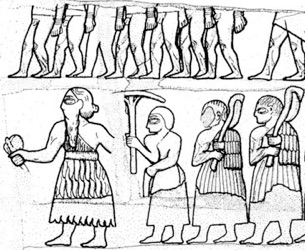
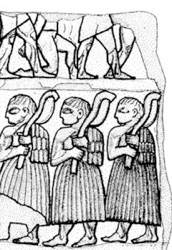
Side A Side B
Sketches of the reliefs on sides A and B of stele Sb 1 . from Lorenzo Nigro (referenced below, Figure 8, at p. 92
As mentioned above, the first figure depicted in the lower register of my side A represents Sargon (identified by inscription). According to Lorenzo Nigro (referenced below, at pp 94) he:
“... wears a flounced robe [that is] fixed at the waist by a wide belt and wields a mace in his right hand. [He has a long beard and] his hair is restricted by the pointed chignon, a typical royal Akkadian hair style.”
Although most scholars agree that Sargon holds a mace in his right hand, the surface of the stele here is damaged and alternative interpretations of the residual evidence are possible: for example, Benjamin Foster (referenced below, at p. 195 and note 37, at p. 221) argued that:
✴Sargon would not have held a mace just below the head; and
✴the putative mace head is more probably the fastener of a prisoner net (the shape and diagonal pattern of which are apparently ‘still visible on the stone and in good photographs’).
The figure following Sargon is usually described as a servant holding a parasol. However, I suggest that
✴the putative parasol in his right hand is actually a battle standard that he has just received from Sargon; and
✴he holds a downward facing weapon in his left hand.
Lorenzo Nigro (as above) characterised the 5 men (two on side A and 3 of side B) as ‘dignitaries’ and argued (at p. 96) that these:
“... represent members of the military class that benefited from the royal conquests. These commanders (whose rank is indicated by the crescent-like axe, the flounced shawl and the bold skirt with long fringes) were the political élite whom Sargon attracted through his promise of great rewards ... from his military success.”
According to Lorenzo Nigro (referenced below, Table 1, at p. 94):
✴the relief in the upper register of side A (his side B) depicts 7 bound prisoners under the control of an Akkadian soldier;
✴that in the upper register of side B (his side A) depicts 2 pairs of figures, each pair involving and an Akkadian and an enemy soldier:
•the first Akkadian subdues a kneeling enemy; and
•the second takes another into captivity.
I suggest that both of these enemies (who seem to be still alive) will soon join their compatriots in the procession on side A.
Surviving Reliefs on Side C
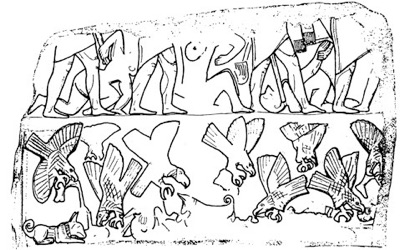
Sketch of the reliefs on sides C of stele Sb 1, from Lorenzo Nigro (referenced below, Figure 12, at p. 97)
According to Lorenzo Nigro (referenced below, at p. 98), the relief in the upper register of Side C depicts a series of four military engagements, each involving an Akkadian and an enemy soldier;
✴the Akkadians all face right and are depicted in a regular manner; but
✴there is nothing orderly about the way in which the three enemy soldiers whose images survive are depicted:
•the first has been struck in the side by a spear that he is trying to pull out;
•the second (who may well be dead) seems to be held up by his arms; and
•the third kneels with his head pinned to the ground.
He also observed (at p. 99) that, in the lower register, the reliefs depict the result of earlier brutal engagements of this kind, when:
“... enemy corpses are abandoned to vultures and dogs. ... Cruel details, such as the dog on the left devouring human limbs or the vulture on the right carrying off a [human] leg, increase the tragic climax of the imagery.”
As he also pointed out, this lower scene was adapted from the famous scene on the victory monument of Eanautum (who had ruled at Lagash about a century before Sargon’s conquest of Sumer), which modern scholars know as the ‘Stele of the Vultures’ (as discussed further below).
Purpose of Sb 1
If we start with side C, Lorenzo Nigro (referenced below, at p. 99) reasonably observed images of the corpses of mutilated enemies being devoured by dogs and vultures:
“... eloquently represent the destiny reserved for those who will not accept Sargon’s authority.”
However, he pointed out that
✴in Eanatum’s ‘Stele of the Vultures’, the corresponding image was placed in the top register on the ‘historical side’ where it would have represented the culmination of the victory that the stele itself commemorated; but
✴in Sb 1, this ‘destiny’ image was placed on the lowest register of the stele, suggesting that it commemorated much more that a single victory.
Unfortunately, since the upper part of Sb 1 is now lost, so we have no direct evidence of what this greater achievement might have been. However, he did point out (at pp. 97-8) that:
“In conflicts between city=states, [such as that commemorated in Eanatum’s ‘Stele of the Vultues’, in which Lagash defeated the neighbouring city-state of Umma], heaping up enemy corpses assured hegemony for a certain period ... [However], a regional Mesopotamian policy needed a much more integrated use of human and land resources. Hence, depicting squads of enslaved enemies brought from conquered regions [in the upper registers of sides A and B of stele Sb 1] would have been at once a noteworthy symbol of victory and ... a meaningful the delivering of workers to the members of Akkadian military aristocracy, who were ant landowners. Thus, the representation of rows of bound prisoners [on the upper registers of sides A and B] is to be seen, not only as a clear symbol of victory, but also as a rich visual message addressed to that social group upon which Sargon founded his power.”
In other words, the different placing of the ‘vulture motif in the Lagashite ‘Stele of the Vultures’ and the stele Sb 1 arguably reflected the very different political aims of Eanatum (in his border dispute with Umma) and Sargon (in his expansion across and beyond the the whole of Mesopotamia).
Lorenzo Nigro also found more direct evidence for the commemoration in Sb 1 of Sargon’s success in expanding his power. For example, he noted that the relief in the upper register of side C:
“... is marked at regular intervals by the [repetitive depiction] of Akkadian soldiers, with their well-muscled legs visible through their [angled] skirts. [This imagery] well portrays the resolute advance of the Akkadian army through the use of geometric patterns [made by their legs and the hems of their skirts. which] ... vigorously express a continuous movement. [This] feature seems to characterise a mature phase of Sargon's pictorial art ... [This] rhythmic dynamism ‘ represents a visual medium ... for conveying the ideology of expanding [Akkadian military and political] power as it was conceived during the third phase of Sargon's reign, when an imperialistic policy was definitely embraced.”
This image of relentless and unstoppable expansion also seems to characterise the reliefs on sides A and B: for example, as Lorenzo Nigro argued (at p. 96):
“Sargon is portrayed [on side A] in a resolute advance, indicating the Akkadian policy of military expansion. The king is shown as the real author of the victory: the regularly arrayed officials following him represent members of the military class that benefited from the royal conquests.”
Finally, he summarised his view on Sargon’s purpose in commissioning Sb 1 in his conclusions (at p. 100): it commemorated the successful:
“... imperialistic policy of the mature phase of Sargon's reign, when he extended his military enterprises far beyond Mesopotamia proper.”
While it is hard to disagree with most of this powerful analysis (and I doubt that I have done full justice to it), I am not sure that Sb 1 can be confidently placed in what Nigro characterised as ‘the third phase of Sargon's reign’: after all, his victories over:
✴a now-unknown king of Akkad and now-unknown king of Kish (traditionally King U-Zababa), which gave him control of northern Mesopotamia and initiated the first phase of his reign;
✴King Lugalzagsi of Uruk, which led to his conquest of Sumer and thus his control of southern Mesopotamia, which initiated the second phase of his reign;
must have felt similarly ‘game-changing’ at the time. I will return to this line of analysis after the discussion of the stele Sb 2 below.
Stele Sb 2
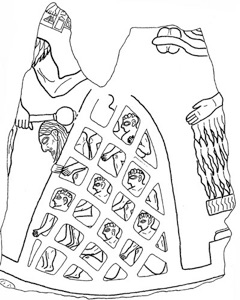
Sketch of the relief from Lorenzo Nigro (referenced below. Fig.1, at p. 86)
Lorenzo Nogro (referenced below, at p. 85) observed:
“The unique shape of the fragment suggests that it was the upper register of an ogival stele, since scant traces of a lower register are [also] present.”
This upper register would originally have been elliptical in section (see Nigro’s Figure 2, at p. 87), tapering towards the top. The surviving fragment preserves one of the thin ends of the ellipse (and the curvature here is such that it is impossible to show the entire surviving relief in a single photograph).
The sketch above presents a ‘flattened out’ view of the entire relief as it now survives on what was one of the thin ends of the original stele. In the central scene, 7 naked men are trapped in a prisoner net, with the head of one of them protruding from the upper left. As discussed in more detail below, this motif (like the motif depicted in the lower register of side C of Sb1, discussed above) derived from one used on Eanatum’s much earlier ‘Stele of the Vultures’ from Lagash. For the moment, we should merely note that, based on this earlier example, we know that these 7 unfortunates would have been prisoners of war (on this occasion, presumably those the victorious Sargon).
Before discussing this part of the relief in detail, I will look at the now-fragmentary figures that flankthe prisoner net:
✴a standing male figure on the left who:
•originally held the top of the net in his left hand; and
•still holds a mace in his right hand, which touches the head that protrudes from the net; and
✴a seated deity on the right.
Standing Figure on the Left
Lorenzo Nigro (referenced below, at p. 85) identified this now-fragmentary figure (whose left shoulder and arm survive) as Sargon, who:
✴wears a ‘royal cloak’ over his shoulder;
✴originally held the top of the net in his left hand; and
✴holds a mace in his right hand, with the mace head against the protruding head of the enemy commander.
This identification is generally accepted: see, for example:
✴Nicolò Marchetti (referenced below, at p. 301 and note 50); and
✴Renate van Dijk-Coombes (referenced below, at p. 157, citing Nigro).
Nigro observed (at p. 87) that the corresponding figure in Eanatum’s ‘Stele of the Vultures’ had been Ningirsu (the city god of Lagash) and commented that:
“From the iconological point of view, [this substitution of a mortal king for a city god] represents a meaningful variation, since the ideological significance of the imagery changes completely, ascribing to the king [rather than to a god] the primary merit of victory.”
However, it seems to me that this change might have been less dramatic than it seems at first sight, since:
✴as we have seen, two gods (one of which was Ialaba) feature in the now-fragmentary curse formula above Sargon’s outstretched arm;
✴as is shown in Nigro’s Figure 2 (at p. 87), there would have been room for the figure of a god on the now-lost part of the relief to the left of the figure of Sargon (and this putative god might well have been Ilaba, whom Sargon identified as his ‘personal god’ in the inscription RIME 2.1.1.3; CDLI, P461928); and/or
✴it is possible that the mace in Sargon’s left hand was ‘read’ as the ‘mace of Ilaba’, the weapon with which he had captured 50 ensi during his conquest of Sumer (as recorded in the inscription RIME 2.1.1.2; CDLI, P461927, at lines 16-18).
In other words, it is possible that the full relief on this side of the original stele (which was possibly accompanied by one or more inscriptions) had portrayed Sargon as a victorious ruler who had secured the victory in question as the agent of his personal god, Ilaba.
Seated Figure on the Right
As Lorenzo Nigro (referenced below, at p. 85) observed, all that survives of this seated figure is an outstretched hand, part of a foot, and part of a flounced skirt. However, he noted that:
“Three undulating rays [probably] rising from the shoulder of this figure are preserved on the top of the stele, one of [which] ends in a mace head. This detail has been convincingly interpreted as the attribute of a warrior deity, namely Ishtar, the Akkadian dynastic goddess.”
He also observed (at p. 87) that this full-sized enthroned figure would have dominated this side of the stele. Renate van Dijk-Coombes (referenced below, at p. 157, citing Gudrun Colbow, referenced below, at p. 107) agreed with this identification, observing that:
“... the relief [on Sb 2] is the earliest Akkadian depiction of Ishtar as ... a goddess of war. This scene recalls motifs found in the textual repertoire: it appears that [Sargon] has ... been victorious in battle with the support of the goddess.”
She also observed (at p. 147) that:
“Inana/Ishtar was the goddess of war, particularly from the Akkadian Period, when she was the imperial goddess of the Akkadian Empire. During this period, Ishtar in her warlike aspect was known as Ishtar-Annunītum ...”
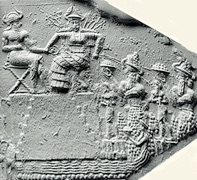
Left: Impression from a seal depicting Ishtar and the deified Naram-Sin
Now in private ownership; image from the website of the Morgan Library and Museum
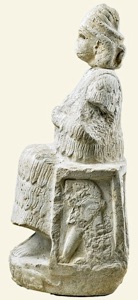
Right: Statue of Peltikalim (Ishtar) from Susa, commissioned by Puzur-Inshushinak, ensi of Susa
Now in the Musée du Louvre ( Sb 54 + Sb 6617): image from the museum website
Donald Hansen (referenced below, entry 133, at pp. 206-7) discussed a particularly good example of the iconography used for this warlike Ishtar, which is illustrated on the left above: as he pointed out, she is seated on a lion throne with weapons emerging from her shoulders, her right hand grasping the arm of the deified Naram Sin (Sargon’s grandson) and her left hand holding ropes that are attached to the noses of four of his captives (two of whom seem to be ‘foreign’ gods). This comparison arguably allows us to assume that, in Sb 2, Ishtar was similarly depicted on a lion throne.
More than a century after Naram-Sin, Puzur-Inshushinak, the ensi of Susa, commissioned a statue (illustrated above on the right) of an enthroned goddess on a lion throne (although her only other surviving attribute, as far as we know, is a headdress with horns over the hair. However, the throne bears a dual inscription:
✴one written in Akkadian (the language of the earlier Akkadian overlords of Susa); and
✴the other written in Linear Elamite (LE) script, which (as observed in the Hatamti-Linear Elamite Database):
“... has so far been used exclusively to record texts in the now-extinct and isolated Elamite (= Hatamtite) language.”
Neither inscription is without its problems:
✴as Javier Álvarez-Mon (referenced below 2018, at p. 181) observed, the Akkadian inscription is now fragmentary, although it does still record the name of ‘Puzur-Inshushinak, the ensi of Susa’; and
✴the LE text has yet to be completely deciphered, although, as François Desset (referenced below, 2021, at p. 76) noted, the enthroned goddess, who:
“... was previously wrongly identified as [Narundi], was [actually] designated in this inscription as ‘Peltikalim’, a by-name traditionally reserved in Susa for Inanna/Ishtar, ... [This] identification is confirmed by the lions carved on the throne of the goddess and on the platform under her feet”.
Javier Álvarez-Mon (referenced below 2020, at p. 150), when considering the relief of the eight-petaled rosette below the feet of this goddess, similarly observed that:
“One can hardly overlook the association of rosettes and lions with the [Sumerian/ Akkadian] Inanna/ Ishtar.”
Interestingly, we know from an inscription (RIME 3/2:1:1:29, CDLI, P432139, lines 15’-28’) of King Ur-Namma (the founder of the later Ur III dynasty) that he had ‘liberated’ Akkad from the control of Puzur-Inshushinak, which would explain why this Elamite ruler would have previously claimed the patronage of Peltikalim/Ishtar.
It is, in fact, unsurprising to find Ishtar is a prominent position on this relief: as Julia Asher-Greve and Joan Goodnick Westenholz (referenced below, at p. 62) pointed out:
“In the Old Akkadian period, Ishtar was the titulary goddess of Akkad, the capital of the Akkadian empire, and her fortunes and characteristics were intimately linked with the political aspirations of the Sargonic rulers. Sargon and his successors actively encouraged the syncretism between Ishar of Akkad and Inanna of Uruk in order to make the national Akkadian goddess acceptable to the Sumerians.”
She pointed out that, while:
✴Ishtar of Akkad was primarily a goddess of battle (Ishtar-Annunītum = Ishtar the skirmisher); and
✴the primary aspect of Inanna of Uruk was her personification of Venus [= the morning and the evening star];
the latter goddess had an Akkadian counterpart, whose name was written as ‛dINANA -kà-kà-bù’ (Istar the star). In short:
“... the qualities and functions of these two goddesses are essentially fused in the Old Akkadian period.”
Captives in the Prisoner Net
As Lorenzo Nigro (referenced below, at p. 89) observed, the net on Sb 2 (which survives in its entirety) contains 7 prisoners, all of whom are clearly still alive. Interestingly, his portrayal reflects the same policy as that reflected in Sb 1 (above), in which living prisoners of war are more highly valued than enemy corpses.
Lorenzo Nigro (as above) observed that six of these prisoners of war are depicted:
“... as [regularly-arranged], seated figures, stretching their right hands towards Sargon in a gesture of submission. ... [Furthermore, they are carefully and realistically depicted] with curly hair and well-formed muscles”.
Nigro (as above) argued (at note 14) that the hair style of these six prisoners:
“... is comparable with that of Sumerian soldiers carrying pieces of booty on the lower register of [the ‘peace side’ of the ‘Standard of Ur’, thus confirming the South Mesopotamian provenance of the prisoners in the net.”
Since this assertion is important for the analysis that follows, we need to look at the basis for it in some detail.
Ethnicity of the Six Curly-Haired Prisoners
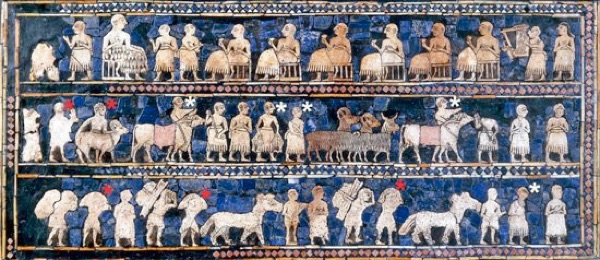
Peace side of the ‘Standard of Ur‘ , from the ‘Royal Cemetery of Ur
Now in the British Museum (BM 121201): image adapted from the museum website
Red asterisks: men who certainly have curly hair
White asterisks: men in the lower two registers who are certainly Sumeriam
The image above depicts the mosaics on the ‘peace side’ of the ‘Standard of Ur’, which was discovered in one of the graves of the so-called ‘Royal Cemetery of Ur’ and is broadly contemporary with Eanatum’s ‘Stele of the Vultures’. As Sarah Collins (referenced below, at pp. 27-30) observed:
✴the top register on this side of the standard depicts a traditional royal banquet that would have been held at Ur to celebrate the victory depicted on the other side of the standard; and
✴the men depicted in the two lower registers:
“... are evidently part of one long procession bringing animals and goods towards [this] banquet.”
Thus, there is actually no reason to think:
✴that any of the men depicted in these two lower registers were soldiers; or
✴that any of the objects that they carry were booty.
Collins also published (as her Figure 21, at p. 33) a photograph of the two lower registers of this side of the standard that had been taken in 1973, when the (often damaged) figures were easier to see, and the conclusions that she drew from this image included the following:
✴the four men in the middle register bringing the bulls goats and fish to the banquet (indicated above by white asterisks) are all bald and clean shaven and wear the ‘typically Sumerian’ fringed skirt (see pp. 31-2);
✴only one man in the bottom register (second from the right, also indicated above by a white asterisk) has the same appearance (including baldness) and clothing as these four men and other Sumerians depicted elsewhere on the standard (see p. 33);
✴at least two of the three men on the left in the middle register (indicated above by red asterisks) seem to be wearing a non-Sumerian style of skirt (= wrapped in a way that results in an angled hem) and curly hair (see p. 32); and
✴almost all of the men in the bottom register wear these non-Sumerian skirts and at least three of them (each of whom has a sack on his shoulders and is also indicated above by a red asterisk) probably has curly hair (see pp. 32-3).
In other words, if the curly hair of the prisoners depicted on Sb 2 tells us anything at all about their ethnicity, it tells us that they were probably not Sumerians. Interestingly, Jerold Starr, in this page on his website Sumerian Shakespeare (who drew attention to Nigro’s note 14 and who argued, like Collins, that the curly-haired men depicted in the standard were non-Sumerian), further suggested that they were Akkadians (meaning from northern Mesopotamia rather than from the city of Akkad).
Owner of the Protruding Head
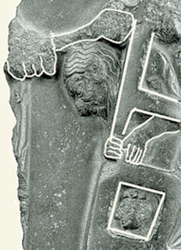
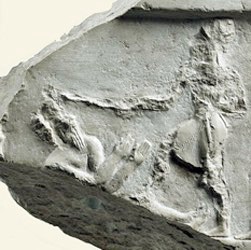
Left: Detail of the prisoner net in the victory stele Sb 2 (illustrated in full above)
Right: Detail of the middle register of side B of the so-called ‘Victory Stele of Rimush’ from Girsu
Now in the Musée du Louvre (AO 2678): image from the museum website
Lorenzo Nigrp (referenced below, at pp. 90-1) reasonably argued that, since this head protruding from the prisoner net (illustrated on the left above) is markedly larger than those of the other 6 captives in the net (one of which is also depicted in this image), it belonged to the defeated ‘enemy commander’. Pierre Amiet (referenced below, at p. 12) argued more specifically that this head:
“... must be that of the enemy king, who is distinguished (like Sargon [in Sb 1]) by his beard and long hair, which may have come undone at the moment of his capture > (my translation).”
Nigro (as above) compared this portrayal of the protruding head in Sb 2 with that of the ‘smitten rebel ruler’ in a victory stele (often attributed to Rimush, Sargon’s son) from Girsu. In the relevant relief (illustrated above on the right) a standing Akkadian commander (almost certainly a Sargonic king, usually but not securely identified as Rimush, Sargon’s son) this Sargonic king has planted his right leg on the helpless enemy and strikes his head with the mace that he holds in his right hand.with a mace. Ngro argued that the similarity of the heads of these two defeated commanders, (both of whom are apparently depicted at the moment that the submit to the victorious king):
“... [hints] at a southern Mesopotamian [= Sumerian] origin for the portrayed figure.”
I assume that, since AO 2678 came from Girsu, Nigro reasonably assumed that the defeated king was Sumerian. He acknowledged that it is surprising that Akkadian and Sumerian kings are (apparently) portrayed in the same way in Akkadian iconography, but assumed that this was the case. However, it seems to me that there is another possibility each of these two ‘rebels’ could have been an Akkadian-appointed governor (ensi) who had declared independence and assumed the kingship of his province; and, after his defeat, the king whom he had betrayed could have publicly relieved him of his beard and bun.
IN CONSTRUCTION BELOW
Nigro (at p. 93) supported his hypothesis in relation to Sb 2 by considering the fact that (as we have seen) the curse formula on this stele mentioned the god Ilaba. As he pointed out:
“This warrior deity occurs only three times in Sargon's [surviving] monumental inscriptions ... , always in association with the military enterprises in the south at the beginning of his reign. ... Since both [of the other two] inscriptions mentioning Ilaba belong to the initial phase of Sargon's reign, when [he] subdued the city-states of southern Mesopotamia and defeated their leader, Lugalzagesi, ... the dedication on Sb 2 can probably be ascribed to the same early phase.”
The other two inscriptions that mention Ilaba (both of which are on Old Babylonian copies from Nippur) do indeed relate to Sargon’s conquest of Sumer:
RIME 2.1.1.2; CDLI, P461927 records that, during this conquest, Sargon captured 50 ensi with ’the mace of Ilaba (see lines 16-18); and
RIME 2.1.1.3; CDLI, P461928):
records that Ilaba was Sargon’s personal god (see lines 1-2); and
contains the following caption (presumably originally under an image of the god):
“The god Ilaba, mighty one of the gods: the god Enlil gave to him (his) weapon(s)”.
However, this does not prove that Sargon only invoked Ilaba in his early inscriptions: as Stefan Nowicki (referenced below, at p. 68) pointed out:
“... Ilaba was an unknown god in earlier times (at least in Mesopotamia) and his worship [there] was established by Sargon: ... the cult of Ilaba emerged no earlier than Sargon, and it vanished immediately after the Akkadian dynasty had faded away.”
Furthermore, the fact that Sargon claimed that Ilaba had received his mace from Enlil suggests that, after his conquest of Sumer, he made a point of positioning Ilaba within the Sumerian pantheon under Enlil.
Of course, if the six curly-haired captives in the net were not Sumerians, then the protruding head of their ‘royal commander’ could not have been that of Lugalzagesi and there are other ‘royal’ candidates who should be considered, For example, Jerold Starr argued (in this page on his website Sumerian Shakespeare) that he was the king of Kish whom Sargon had defeated before his conquest of Sumer. Furthermore,it seems to me that he could )for example) have been ‘Hishibrasini, king of Elam’, who was recorded in an Old Babylonian copy of one of Sargon’s royal inscription (RIME, 2:1:1:9: CDLI, P461935) from Nippur. Interestingly, the surviving captions on this and a second copied inscription (RIME, 2:1:1:8: P461933), which is closely related to it, record (between them) the names of at least seven captured enemy commanders:
Hishibrasini, king of Elam (mentioned above);
Luhishan, son of Hishibrasini, king of Elam;
Sanam-Shimut, ensi of Elam;
Dagu, brother of the king of Parahshum; and
three generals (shagina) of Parahshum (Ulul, Sidga’u and Sanam-Shimut).
nose were restricted to Sargon (compare Fig. 9). Moreover, the clear difference between the enemy chief and the other captives (a difference not seen on the Stele of the Vultures) and the precise depiction of the iconographic emblems of Mesopotamian now Akkadian kingship seem to suggest that a distinguished personage of royal rank is here portrayed. The importance of the smitten figure is further underlined by the size of his head, which matches the dimensions of that of Sargon himself, so that it seems quite out of proportion in relation to the other captives
Furthermore, since he assumed that the 6 curly-haired prisoners were Sumerians, he argued that their royal commander was King Lugalzagesi of Uruk, who had been preeminent in Sumer at the time that this battle was fought. He supported this identification (at p. 93) by arguing that:
“Inscriptions copied from [Sargon’s] royal monuments show that [his] victory against Lugalzagesi was the pivotal event in Sargon's ascendance to Mesopotamian kingship, becoming a popular subject of visual propaganda. If these epigraphic and historical data are combined with the observations from the [earlier] analysis (especially those concerning the accuracy of the portraiture of the vanquished king and the unusual respect reserved to prisoners in the net), one may conclude that the defeated king, who bears the clearly distinguishable emblems of Mesopotamian kingship [= his beard and long hair], is Lugalzagesi of Uruk.”
In short, Nigro argued that Sb 2 commemorated Sargon’s defeat of Lugalzagesi and his conquest of Sumer. However, if (as I argue below) the curly-haired captives in the net were probably not from Sumer, then this hypothesis need to be reconsidered.
Relationship between Steles Sb 1 and Sb 2
The fact that these two victory monuments of Sargon were discovered only about 50 meters apart begs the question of whether or not they relate to the same victory.
Hypothesis of Lorenzo Nigro
Lorenzo Nigro (referenced below, at p. 100) argued that the reliefs on Sb 1 and Sb 2:
“... represent two different visual and ideological aspects of Akkadian royal relief art, which can be attributed to the different purposes for which they were erected:
✴[Sb 2] representing the celebration of the founding event of Sargon's power [= his conquest of Sumer]; and
✴[Sb 1] testifying to the imperialistic policy of the mature phase of Sargon's reign, when he [subsequently] extended his military enterprises far beyond Mesopotamia proper.”
In other words:
✴Sb 2 had celebrated Sargon’s conquest of Sumer; while
✴Sb 1 commemorated a victory that he secured thereafter outside Mesopotamia.
Conquest Commemorated in Sb 2
Conquest Commemorated in Sb 1
As we have seen, Lorenzo Nigro (referenced below, at p. 98) argued that the continuous and rhythmically regular scene of Akkadian soldiers marching right across the upper register of (my) side B and side C:
“... well portrays the resolute advance of the Akkadian army through the use of geometric patterns ... [that] vigorously express a continuous movement. The latter feature seems to characterise a mature phase of Sargon's pictorial art, especially if compared with the rather static composition of the [reliefs on Sb 2]. Rhythmic dynamism represents aa visual medium largely exploited by Sargonic artists for conveying the ideology of expanding power, as it was conceived during the third phase of Sargon's reign, when an imperialistic policy was definitely embraced.”
difference in style between the surviving reliefs on Sb 1 and Sb 2 can probably be explained by the fact the Sb 1 scenes are ‘historical’ while that on Sb 2 is ‘mythological’; and
Sargon’s earlier conquest of Sumer was arguably as important for his ‘imperialistic’ policy as his subsequent expansion ‘beyond Mesopotamia proper’.
However, it seems to me that this does not give sufficient weight to a number of similarities between them, which include the following:
they are made from the same material (usually said to be diorite, although the Musée has apparently identified this rock more precisely as gabbro);
they each carry a now-fragmentary inscription of part of a similar (and perhaps originally identical) curse; and
most importantly, they both carry reliefs that explicitly reference those on Eanatum’s ‘Stele of the Vultures’.
In my view, the really significant fact is that the very rare ‘vulture’ iconography that gave its modern name to Eanatum’s ‘Stele of the Vultures’ reappeared a century later on at least 2 of Sargon’s victory steles.
Original Locations of the Stele
The museum notes state that these stele were both brought to Susa in the 12th century BC by the Elamite king Shutruk-Nahhunte: the original location is given as:
Nippur (said to be from the temple of Enlil), for Sb 1; and
Sumer, for Sb 2.
Lorenzo Nigro (referenced below, note 1, at p. 85) seems to have accepted this provenience, observing that:
“Celebrative monuments were placed in the major sanctuaries of the country, such as Enlil's temple at Nippur and Shamash's temple at Sippar, from where they were plundered by the king of Elam Shutruk-Nahhunte I and brought to Susa.”
However, while Shutruk-Nahhunte certainly did bring a significant number of objects to Susa as booty following a successful campaign in northern Mesopotamia, there is no hard evidence to suggest that either of these stele of Sargon was among them.
However, it is possible that this was not their original location: as Douglas Frayne (referenced below, 1993, at p. 26) observed (in relation to Sb 1) that this stele, which had apparently been been ‘deliberately defaced in antiquity’, may have been:
set up in Susa to commemorate Sargon's victory over Elam; or
brought here from Babylonia as a piece of booty by ‘the Elamites’.
The museum webpages hold to the second hypothesis, naming the Elamite in question as King Shutruk-Nahunte (12th century BC). It seems to me that it is also possible that Puzur-Inshushinak, the ensi of Susa (who apparently took control of Akkad just before the start of the Ur III period) could have found them at Akkad and brought them back to Susa as booty.
Steles Sb 1 and Sb 2 and the Stele of the Vultures
Stele Sb 1 and the Stele of the Vultures
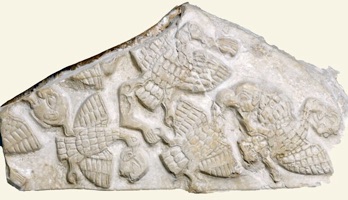
Fragment A (‘historical’ side) from the Lagashite Stele of the Vultures
Now in the Musée du Louvre (AO 50): image from the museum website
Eanatum’s ‘Stele of the Vultures’ is so-named by modern scholars in reference to the relief on the fragment illustrated above, which would have been in the top on the ‘historical’ side of the stele:
✴the reliefs below this one depicted scenes from the battle in which Eanatum defeated an army from neighbouring Umma that he accused of illegally crossing into land that belonged to Ningirsu, the city god of Lagash and its religious capital Girsu; and
✴this relief above them represents the culmination of this battle, as vultures swoop in to devour the remains of the enemy dead.
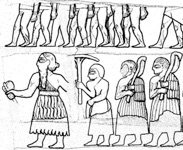
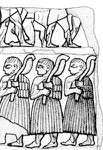
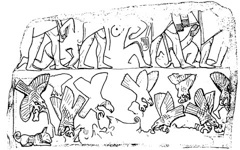
Sketches of the reliefs on sides A, B and C of the Stele Sb 1 (see above for details)
Nigro acknowledged (at p. 99), that the result of the battle depicted in the upper register of sides B and C was depicted in the lower register of side C, in which:
“... enemy corpses are abandoned to vultures are abandoned to vultures and dogs.”
He also acknowledged that this lower scene was inspired by the ‘vulture’ relief on the Lagashite stele, but he argued that, in Sb 1:
“... the vultures are more realistically portrayed, appearing in various flying poses. Cruel details, such as the dog on the left devouring human limbs or the vulture on the right carrying off a leg, increase the tragic climax of the imagery. In looking at the flock of vultures, a coherent use of space may be noticed. The different dimensions of the birds of prey, with the smallest birds at the top, give the illusion of spatial depth. ... [Thus, in Sb 1], a classic Early Dynastic iconography of victory has been reinterpreted according to the Akkadian ideological programme [in which] mutilated enemies eloquently represent the destiny reserved for those who will not accept Sargon’s authority.”
He also (at pp. 99-100) attached great significance to the fact that:
✴in the Lagashite stele, the vulture scene came in the top register of the history side, which traditionally represented the culmination of the battle below; while
✴in Sb 1, it came in the lowest register of side C, where it would play a different role.
Although he acknowledged (at pp. 99-100) that it is no longer possible to reconstruct the overall ‘story’ depicted on Sb 1, he suggested that:
“If we suppose that a representation of Sargon’s divine support was carved at the [now-lost] top of the stele (for instance [an image of Sargon] in front of patron deities), this would explain why its visual counterpart [= the vultures scene] was put, by opposition, of the bottom of the monument. “
I have to say that I find these arguments unconvincing, not least because:
✴the difference in style and positioning between the vulture scene on the Lagashite stele and the corresponding scene on Sb 1 can probably be explained by the fact that artistic style had presumably evolved during the intervening century;
✴
✴
✴
✴
✴the difference in style between the surviving reliefs on Sb 1 and Sb 2 can probably be explained by the fact the Sb 1 scenes are ‘historical’ while that on Sb 2 is ‘mythological’; and
✴Sargon’s earlier conquest of Sumer was arguably as important for his ‘imperialistic’ policy as his subsequent expansion ‘beyond Mesopotamia proper’.
In my view, the really significant fact is that the very rare ‘vulture’ iconography that gave its modern name to Eanatum’s ‘Stele of the Vultures’ reappeared a century later on at least 2 of Sargon’s victory steles.
Sb 2 and the Stele of the Vultures
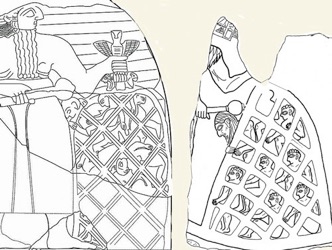
Left: sketch of the reconstructed scene in the upper register (‘mythological’ side) of the Lagashite Stele of the Vultures
with the surviving fragments (A, C, D and E) indicated, by Licia Romano (referenced below, 2007, Figure 1, at p. 21)
Right: sketch of the surviving relief on Sb 2,details above)
It is clear from the illustrations above that the scene depicted at the centre of the surviving fragment of Sb 2 is taken from the scene in the upper register on the ‘mythical’ side of Eanatum’s ‘Stele of the vultures: in both scenes, a standing male figure holds:
✴the fastener of a prisoner net in his left hand; and
✴a mace in his right hand, with its ‘business end’ touching (and possibly striking) the protruding head of one of the prisoners.
However, as Lorenzo Nigro (referenced below, at p. 85) observed, there are a number of important differences between these two portrayals. Perhaps the most important of these differences concerns the identity of the standing male figure wielding the mace:
✴in the case of the Lagashite relief, Sébastien Rey (referenced below, at pp. 247-8) identified this figure as Ningirsu, the city god of Lagash and Girsu; while
✴as we have seen, Lorenzo Nigro (as above) identified the corresponding figure in the relief on Sb 2 at Sargon.
I will return to the likely significance of this below, However, I would like to start with the differences between the two portrayals of the prisoners trapped in the prisoner net.
✴As Sébastien Rey (referenced below, at p. 248) observed, tin Eanatum’s stele, the prisoners are depicted as:
“... small and naked [figures] with shaved heads and faces, [whose] bodies are twisted and contorted in unnatural positions that emphasise the extreme degradation to which they have been subjected.”
The heads of 6 of them appear in the relevant surviving fragment of the stele and Sébastien Rey, in his reconstruction of this part of the relief (see his Figure 92, at p. 244), suggested that the now lost part of the net would have contained about 3 more.
✴Moved
As Nigro pointed out, while Eanatum’s objective had been to bully his neighbours into peaceful co-existence, Sargon:
“... does not want to slay those enemies who are ready to accept his sovereignty: [his ‘message is that] the Akkadian conquest brings order [and hence, peace and prosperity] to the defeated peoples.”
Sargon and the Stele of the Vultures
Given this striking iconographical similarity, we must address the circumstances in which Sargon might have become aware of the reliefs on the Lagashite stele, the surviving fragments of which were all found on Tell K at Girsu (the site of the Temple of Ningirsu).
Lugalzagesi and the Ningirsu Temple at Girsu
Sébastien Rey (referenced below, at p. 285) argued that the stele would originally been prominently displayed in the successive ‘incarnations’ of the Ningirsu temple until the temple itself:
“... it was finally destroyed by Lugalzagesi after his devastating conquest of Lagash” (my bold italics).
In this context, we should note that the Lagashite stele commemorated Eanatum’s victory over the neighbouring city of Umma, and it is probably no coincidence that, when Lugalzagesi conquered Lagash about a century later, he did so in his capacity as ensi of Umma. It is worth repeating here the damning message for posterity that the erstwhile ensi of Lagash record in his (apparent;y temporary) refuge at Girsu:
“The ensi of Umma, having sacked Lagash, has committed a sin against the god Ningirsu. The hand that he has raised against [Ningirsu] will be cut off! It is not a sin of Urukagina, king of Girsu. May Nisaba, the god of Lugalzagesi, the ensi of Umma, make them [= the people of Umma] bear this sin on their necks!”, (RIME 1.19.9.5; CDLI, P431158, lines 95-9).
We do not know how long Urukagina managed to hold Girsu but, as Sébastien Rey ( referenced below, at p. 301) pointed out, it was surely at this point (or soon thereafter) that:
“The sacred complex [at Girsu] was plundered and razed to the ground, creating a destruction horizon across Tell K that contained some of the defaced and shattered fragments of objects that were formerly the supreme emblems of [the] power and prestige [of Girsu and thus of Lagash]. Of paramount importance were the artefacts that celebrated historically important victories that had been inflicted by the rulers of Lagash on the state of Umma, and chief among them was the ‘Stele of the Vultures’.”
Lugalzagesi and the Destruction of the Stele
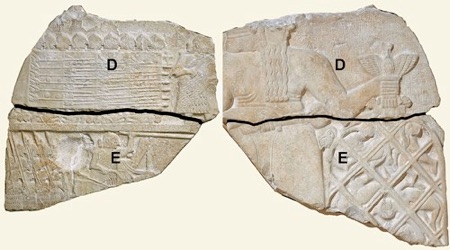
Break between fragments D and E on the historical side (left) and the mythical side (right)
Adapted from images in the website of the (Musée du Louvre)
Sébastien Rey (referenced below, at p. 302) observed that:
“The excavated fragments [of the stele from Girsu] bear witness to the brutal manner in which the [Ningirsu] temple ...was razed to the ground. ... [The] systematic nature of the damage [done to it] indicates that it was the result of a calculated programme and not just the work of an indiscriminate, rampaging mob.”
Although he acknowledged the difficulties in establishing the precise manner in which the stele had been broken up, he argued that:
“... it would seem likely that the [‘mythical’ side] was struck first, and that the initial blow was aimed at the upper right edge, at the top of Ningirsu’s casting net, between the fastener [now in Fragment D] and the netful of captives and corpses below [now in Fragment E]. The fact that this was probably a ... controlled blow can be seen in the clean horizontal break [between fragments D and E (illustrated above on the right), which extends] ... along the handle of the [Ningirsu’s] mace.”
He also pointed out (at p. 303) that, in landing this blow, Lugalzagesi had simultaneously:
“... delivered the fallen warriors of Umma [on the ‘historical’ side, along the top of Fragment E] from the marching feet of their [Lagashite] enemies [on Fragment D]. Ningirsu’s control over Umma was thereby terminated, and the citizens of Umma were symbolically emancipated.”
Sargon;s Conquest of Lagash
As we have seen, Sargon recorded in his Group 2 inscriptions that, during his conquest of Sumer, he had destroyed the walls of Uruk, Ur and Umma while treating Lagash somewhat differently:
“[Sargon] conquered Eninmar, destroyed its walls, and conquered its district and Lagash, as far as the sea. He washed his weapons in the sea”, (RIME 2.1.1.2: CDLI, P461927. lines 47-61).
This suggests that, by the time of Sargon’s invasion of Sumer, Lagash had lost its walls and was merely part of the territory of Eninmar [on the Lower Sea ??’]. We find an ensi of Lagash called Meszi on one of Sargon’s Group 3 inscription (RIME 2.01.01.12; P461938), among a group of three presumably captured Sumerian governors, the other two being from Ur and Umma (see lines 46’-54’). However, it seems to me that, although Sargon clearly took Lagash by force from Lugalzagesi and Meszi, he is unlikely to have mistreated either his new and recently-humiliated Lagashite subjects or their hallowed Ningirsu temple at Girsu. Indeed, as Sébastien Rey (referenced below, at p. 309) observed:
“... the existence of an Akkad temple [of some kind on the original site] is practically indisputable, thanks to the British Museum team’s discovery, in a spoil heap to the south of [this site], of an exceptional fragment of a votive bowl that was dedicated to Ningirsu by ... Rimush [Sargon’s son and successor].”
It seems to me Sargon probably displayed the remains of the stele in this new temple, where they may well have remained until the Lagashites made the mistake of rising up against Rimush.
the very fragmentary goddess behind Ningirsu (who apparently has maces rising from her shoulders and whom he argued would have been seated) as the goddess Ninhursag, although I argue in my page on Eanatum’s ‘Stele of the Vultures’ that she is more probably Inanna; and
as discussed above, in the original scene on Sb 2:
the standing figure holding the mace in his right hand and the prisoner net in his left hand is almost certainly Sargon; and
the full-sized seated goddess looking on from the right is almost certainly Ishtar.
Relief on Stele Sb 2
Collins S., “The Standard of Ur”, (2015) London
Foster B. R., “The Age of Agade: Inventing Empire in Ancient Mesopotamia”, (2016) London and New York
References
G.I. Gabriel, "Die ‚Sumerische Königsliste’ als Werk der Geschichte: Kritische Editionsowie text-, stoff- und konzepthistorische Analyse”, (forthcoming: I am grateful to Dr Gabriel for sending me an advance copy)
H.Postgate J. N., “City of Culture 2600 BC: Early Mesopotamian History and Archaeology at Abu Salabikh”, (2024) Oxford
Rey S., “The Temple of Ningirsu: the Culture of the Sacred in Mesopotamia”, (2024) University Park, PA
Gabriel, G. I.,"The ‘Prehistory’ of the Sumerian King List and Its Narrative Residue", in:
Konstantopoulos G. and Helle S., “The Shape of Stories”, (2023) Leiden and Boston, at pp. 234-57
Artemov N. “LUGAL KIŠ and Related Matters: How Ideological are Royal Titles?”, in:
Portuese L. and Pallavidini M, (editors), “Ancient Near Eastern Weltanschauungen in Contact and in Contrast: Rethinking Ideology and Propaganda in the Ancient Near East”, (2022) Münster, at pp. 67-86
Desset F. et al., “The Decipherment of Linear Elamite Writing”, Zeitschrift für Assyriologie, 112:1 (2022) 1–60
Lovisetto G., “Goddesses Visualized in Early Dynastic Mesopotamia”, in:
Babcock S. and Tamur E. (editors), “She Who Wrote: Enheduanna and Women of Mesopotamia, ca. 3400–2000 BC”, (2022) New York, at pp. 46-63
Osterman J., “From ki-en-gi to Šumerum: How Sumer was Created ?”, Radovi HSP, 54:3 (2022) at pp. 39-72
Steinkeller P., ‘The Sargonic and Ur III Empires’, in:
Bang P. F. et al. (editors), “The Oxford World History of Empire (Volume 2): The History of Empires”, (2021) New York, at pp. 43-72
Álvarez-Mon J., “The Art of Elam (ca. 4200–525 BC)”, (202o) Oxford and New York
van Dijk-Coombes R. M., “Lady of Battle, his Beloved Spouse”, Die Welt des Orients, 50:1 (2020) 146-76
Álvarez-Mon J., “Puzur-Inšušinak, the last king of Akkad? Text and Image Reconsidered”, Elamica 8 (2018) 169-217
Kesecker N. T., “Lugalzagesi: the First Emperor of Mesopotamia?”, Armenian Journal of Near Eastern Studies, 12:1 (2018) 76-95
Steinkeller P., “History, Texts and Art in Early Babylonia: Three Essays”, (2017) Boston and Berlin
Nowicki S., “Sargon of Akkad and his God: Comments on the Worship of the God of the Father among the Ancient Semites”, Acta Orientalia Academiae Scientiarum Hungaricae, 69:1 (2016) 63-82
Marchesi G., “Toward a Chronology of Early Dynastic Rulers in Mesopotamia”, in:
Sallaberger W. and Schrakamp I. (editors), “Associated Regional Chronologies for the Ancient Near East and the Eastern Mediterranean. History and Philology: Vol. 3”, (2015) Turnhout, at pp. 139-58
Sallaberger W. and Schrakamp I., “Part I: Philological Data for a Historical Chronology of Mesopotamia in the 3rd Millennium”, in:
Sallaberger W. and Schrakamp I. (editors), “Associated Regional Chronologies for the Ancient Near East and the Eastern Mediterranean. History and Philology: Vol. 3”, (2015) Turnhout, at pp. 1-130
Asher-Greve J. M. and Goodnick Westenholz J., “Goddesses in Context: On Divine Powers, Roles, Relationships and Gender in Mesopotamian Textual and Visual Sources”, (2013) Fribourg and Göttingen
Marchetti N., “Mesopotamian Early Dynastic Statuary in Context”, in:
Kaniuth K. et al. (editors), “Tempel im Alten Orient 7: Internationales Colloquium der Deutschen Orient-Gesellschaft: 11.-13. Oktober 2009 München”, (2013) Wiesbaden, at pp. 283-310
Steinkeller P., “An Archaic “Prisoner Plaque” from Kiš”, Revue d'Assyriologie et d'Archéologie Orientale, 107 (2013) 131-57
Zólyomi G., “The Vase Inscription of Lugal‐zagesi and the History of his Reign”, Notes for a seminar held at the Institute for Advanced Studies, Budapest (2013)
Seri A., “Adaptation of Cuneiform to Write Akkadian”, in:
Woods C. (editor), “Visible Language: Inventions of Writing in the Ancient Middle East and Beyond”, (2010) Chicago IL, at pp. 85-98
Visicato G, and Westenholz A., “Early Dynastic and Early Sargonic Tablets from Adab in the Cornell University Collections (CUAS Volume 11)”, (2010) Bethesda MA
Frayne D. R., “The Royal Inscriptions of Mesopotamia, Vol. 1: Presargonic Period (2700-2350 BC)”, (2008) Toronto
Romano L., “La Stele degli Avvoltoi: una Rilettura Critica”, Vicino Oriente, 13 (2007) 3-24
Maeda T., “Royal Inscriptions of Lugalzagesi and Sargon” , Orient, 40 (2005) 3-30
Kawakami N., “The Northwestern Territorial Extent of Sargon's Empire of Akkad”, (2004) thesis of the University of Liverpool
Hansen D. P., "Art of the Akkadian Dynasty", in:
Aruz J. and Wallenfels R. (editors), “Art of the First Cities: The Third Millennium BC, from the Mediterranean to the Indus”, (2003) New York, at pp. 189-238
Steinkeller P., “An Ur III Manuscript of the Sumerian King List”, in:
Sallaberger W. et al. (editors), “Literatur, Politik und Recht in Mesopotamien: Festschrift fur Claus Wilcke”, (2003) Wiesbaden, at pp. 267-92
Nigro L., “The Two Steles of Sargon: Iconology and Visual Propaganda at the Beginning of Royal Akkadian Relief", Iraq, (1998) 85-102
Westenholz, A., “The Old Akkadian Period”, in:
Sallaberger W. and Westenholz A.. “ Mesopotamien: Akkade-Zeit und Ur III-Zeit”, (1999) Freiberg and Göttingenm at pp. 17-117
Goodnick Westenholz J., “Legends of the Kings of Akkad”, (1997) Winona Lake, IN
Wilcke C., “Amar-girids Revolte gegen Narām-Suʾen", Zeitschrift für Assyriologie und Vorderasiatische Archäologie”, 87:1 (1997) 11-32
Frayne D. R., “Sargonic and Gutian Periods (2334–2113 BC): The Royal Inscriptions of Mesopotamia. Early Periods (Volume 2)”, (1993) Toronto, Buffalo and London
Colbow G., “Die kriegerische Ištar: Zu den Erscheinungsformen bewaffneter Gottheiten zwischen
der Mitte des 3. und der Mitte des 2. Jahrtausends”, (1991) Munich
Cooper J. S. and Heimpel W., “The Sumerian Sargon Legend”, Journal of the American Oriental Society, 103:1 (1983) 67-82
Amiet P., “L'Art d'Agadé au Musée du Louvre”. (1876) Paris
Hallo W. W., “Early Mesopotamian Royal Titles.: A Philologic and Historical Analysis”, American Oriental Series 43, (1957), New Haven CT
Main Page: Akkadian Empire (2300-2200 BC)
Topics: Sargon’s Stele Sb 1 and Sb 2 Akkadian Conquest of Elam