Empires of Mesopotamia:
Mesopotamia in the ED IIIb Period


Empires of Mesopotamia:
Mesopotamia in the ED IIIb Period
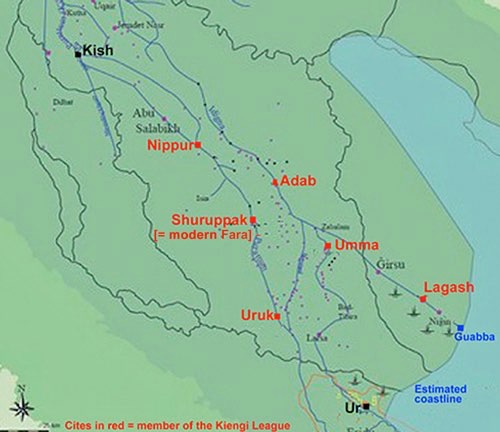
Known members of the so-called Kiengi League
Adapted from Jasmina Osterman (referenced below, Map 1, at p. 58): my additions in bold (red, black and blue)
King Enna-il of Kish
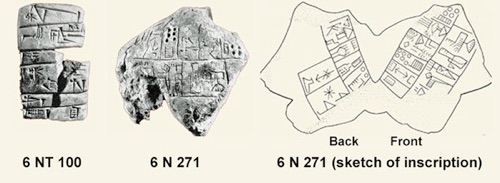
Left: inscription (RIME 1.8.3.1, P462184) on a tablet (6 NT 100) from Nippur
Centre: inscription (RIME 1.8.3.2, P462185) on a fragment of a statue of Enna-il from Nippur
Both objects now in the Iraq Museum: images adapted from Albrect Goetze (referenced below, Figure 2, at p. 108)
✴Right: sketch of 6 N 271: image adapted from Ignace Gelb et al. (referenced below, Plate 50)
Royal Inscriptions
Enna-il is known from two royal inscriptions from Nippur (illustrated above), the first of which. (RIME 1.8.3.1, P462184), is on a tablet (excavation number 6 NT 100)that is now in the Iraq Museum (museum number unknown). This inscription, which seems to be an Ur III period copy of an older original, records a dedication:
“For Ishtar/Inanna: Enna-il, son of A’anzu, the one who defeated Elam”, (obverse, lines 1-6).
Albrecht Goetze (referenced below, at p. 107) drew attention to the similarity between the structure of this inscription and that of Uhub, ensi of Kish (RIME 1.7.42.1; CDLI, P431031 - see below). As Douglas Frayne (referenced below, 2008, at p. 75) observed:
“While Enna-il appears in this text without the title king (lugal) or ruler (ensi), the epithet in lines 5–6, [literally, ‘the one who smote Elam with weapons’], suggests that he was a ruler, since epithets of this kind are normally the prerogative of kings alone. Thus, this Enna-il is almost certainly the same figure who is named [... [as] ‘king of Kish’ [in the following inscription]”.
Although his epithet claims that he had inflicted a defeat on ‘Elam’, we do not know whether he actually invaded Elam or simply expelled Elamite raiders from territory claimed by Kish.
This second inscription (RIME 1.8.3.2, P462185) is on a fragment of a limestone statue of Enna-il (excavation number 6 N 271) from Nippur and is now in the Iraq Museum (museum number IM 61325). According to Ignace Gelb et al. (referenced below, entry 26, at pp. 91-2), it was found:
“... in fill of the Parthian platform under a temple [that had been ?] built over the Inanna temple.”
According to Gianni Marchesi (referenced below, 2011, entry 10, at pp. 91-2), the surviving text, which was inscribed in two rows on what was originally the right shoulder of the statue, was probably in Akkadian.
✴the first row records the the purchase of several plots of land from ‘Enimannezi’ (presumably by Enna-il); and
✴the second row records that:
“Enna-il, king of Kish, [made] an [image of himself] ... and set it up before Ishtar /Inanna”, (see lines 14’-20’).
Other Sources for Enna-il from Nippur
Gianni Marchesi (referenced below, 2011, at p. 180) referred to an unpublished ED literary text from Nippur (6 NT 104) in which Enna-il is given the titles king of Kish and ensí-gal denlil (chief steward of the god Enlil). He noted that this title was later given to the hegemonic kings Lugal-zagesi of Uruk and Sargon of Akkad.
Piotr Steinkeller (referenced below, 2013, note 67, at p. 148) observed that:
“[Enna-il’s] presence at Nippur is [also] demonstrated by an ED literary text from Nippur (preserved in a later, possibly Ur III, copy), which describes his involvement in the delivery of Ur’s ‘first offering’ for Enlil from Ur to Nippur”.
He translated the relevant lines as follows:
“... the licorice, which sprouted in a desolate place for the table of Enlil; the fat of the cow (and) the pure milk, the 'first offering' of Ur for the table of Enlil; ... Enna-il, the king, hailed Enlil (and) [his spouse] Ninlil there”, (ECTJ 219, lines iii’:1 - iv’).
Aage Westenholz (referenced below, 1975, at p. 100), who first published this text, doubted that this ‘Enna-il, the king’ was also the ‘Enna-il, king of Kish’ of RIME 1.8.3.2 (above), but Ignace Gelb et al. (referenced below, at entry 26, at p. 92) speculated that they might have been one and the same king. Xianhua Wang (referenced below, at p. 83 and note 237) observed that, if the Ur III copy is authentic and does refer to the ‘Enna-il, king of Kish’ of RIME 1.8.3.2, then:
“... [Enna-il] would be the earliest historical [Mesopotamian ruler who] ... is known to have collected ‘first fruit offerings’ for Enlil and Ninlil, [and, in doing so, he may have been] acting as the ruler [= hegemon ?] of Ur”.
In fact, he is the first king of Kish who can be securely linked to Nippur in any capacity.
Enna-il’s Statue of Shara
Gianni Marchesi (referenced below, 2011, at p. 180 and note 108) published and translated the text on a statue that was dedicated:
“To Shara: [when] Enna-il was king of Kish: Uriri, the chief cook, presented (this statue).”
He suggested that:
✴the statue possibly came from Umma (where Shara was the chief deity); and
✴this might suggest that Enna-il was an ‘overlord’ there.
Piotr Steinkeller (referenced below, 2013, note 67, at p. 148) similarly argued that the inscription on this statue:
“... probably [indicates that] Enna-il exercised some form of suzerainty [hegemony ?] over Umma.”
However, it seems to me that, although:
✴Enna-il’s dedication of this statue was probably made at a temple of Shara at a city over which he exercised hegemony; and
✴King Mesilim of Kish had almost certainly exercised hegemony over Umma at some time in the ED II period;
this does not necessarily mean that Enna-il dedicated this statue to Shara at her temple at Umma. For example, note that there was also a Shara temples at Tell Agrab,(in the Diyala region) where a now-unknown king of Kish dedicated a stone bowl (presumably to Shara as hegemon - see my page on Kingship of Kish: Early Dynastic Period).
Date of Enna-il’s Reign
Gianni Marchesi (referenced below, 2011, at p. 92) presented a body of evidence that:
“... suggests that Enna-il lived and ruled at the beginning of the ED IIIb period.”
Piotr Steinkeller (referenced below, 2024, at p. 14) argued that Enna-il could have been:
✴the ruler of Kish at the time of the the Kiengi League (in the ED IIIa period); or
✴the unidentified king of Kish, who (together with Mari and Akshak) invaded the territory of Lagash during the reign of Eanatum (in the ED IIIb period).
King Enna-il of Kish Conclusions
It does seem likely that Enna-il used the title ‘king of Kish’ at some time after Menunsi. For Gianni Merchesi (referenced below, 2015, note 19, at p. 140), he:
“... was probably the last great king of Kish proper. In this connection, note that ... [the title] ‘chief steward of Enlil’, [which he was given literary text 6 NT 104 from Nippur - see above], ...was later borne by the overlords Lugalzagesi [king of Uruk] and Sargon [king of Akkad].”
I assume that the phrase ‘the last great king of Kish proper’ suggests that he was, first and foremost, the king of the city-state of Kish, and he ruled at a time when Kish still exercised hegemony over a large swathe of territory that included Nippur, Ur and a city of Shara (Umma? Tell Agrab ?). However, as Douglas Frayne (referenced below, 2008, at p, 38) observed, although Enna-il is named in surviving texts as ‘king of Kish’, we do not know his ‘dynastic home’. Furthermore, we know of a number of early kings of other city states who used the additional title ‘king of Kish’ and two of them, in particular, who (like Enna-il) had a string association with Inanna:
✴Mesanepada of Ur used the title:
•‘Mesanepada, king of Ur, the son of Meskalamdu, king of Kish’ in the inscription (RIME 1.13.5.1; CDLI, P431203) on lapis lazulu bead from Mari; and
•‘Mesanepada, King of Kish, dam nu-gig (husband of the nu-gig = Inanna)\ on the inscription RIME 1.13.5.2; CDLI, P431204) on a clar sealing from the ‘Royal Cemetery’ at Ur; and
after his death, his son and successor, A’anepada, used the title king of Ur, son of Mesanepada, king of Ur in an inscription (RIME 1:13:6:3; CDLI, P431208) foundation tablet from the Ninhursag temple that he built at Tell Ubaid; and
✴Eanatum, ensi of Lagash
•claimed in the inscription (RIME 1.9.3.5; CDLI, P431079) on the ‘Eanatum Boulder’ that:
“... because Inanna so loved Eanatum, ... [she] gave him the nam-lugal (kingship) of Kish in addition to the nam-ensi2 (rulership) of Lagash:
•described himself in the inscription (RIME 1.9.3.1; CDLI, P431075) on the ‘Stele of the Vultures’
“...beloved husband of Inanna”, (lines 564’-605’)
,
Utuk/Uhub
p
Two inscribed fragments from a bowl from Nippur, now in the British Museum ((BM 129401/2)
Images from the museum website
Piotr Steinkeller (referenced below, 2013, at p. 149) argued that:
“There are strong reasons to think that the power and influence of Kish began to wane in the ED IIIa period. This development appears to have been due primarily to the rise of Mari and Akshak as major political powers at about that time.”
He cited potential evidence for the hypothesis that the power of Kish waned in the ED IIIa period from the inscriptions on two very similar stone vessel fragments from Nippur (illustrated above), both of which are now in the British Museum):
✴RIME 1.7.42.1; CDLI, P431031 (BM 129401), which records that Utuk/Uhub, ensi of Kish, dedicated something to Zababa; and
✴RIME 1.15.1; CDLI, P432235 (BM 129402), which records that Puzuzu (or, perhaps, a now-unnamed ruler who was the son of Puzuzu), the conquerer Hamazi, dedicated something to a now-unnamed deity.
He argued that:
✴the fact that Utuk/Uhub used the title ensi of Kish (rather than the expected lugal (king)) in the inscription on the vessel BM 129401:
“... strongly suggests that [he] was a vassal, [probably of the ruler of either] Mari or Akshak”, (see p. 149); and
✴the fact that Puzuzu dedicated the vessel BM 129402 at Nippur suggests that he exercised hegemony over much of northern Mesopotamia.
He further argued that:
“Unless [Puzuzu] was yet another ruler of Kish, ... the chances are that he was a king of Akshak. Conceivably, he was identical with Zuzu, the ruler of Akshak [who is recorded in RIME 1.9.3.5 as] an adversary of Eanatum ... ”, (see p. 150 and note 79).
Before discussing these two inscriptions further, it is necessary to look at the history of the fragments that carry them. Herman Hilprecht (referenced below, as numbers 108-9 see p. 62 and Plate. 46) published the in 1896 as two parts of a single vessel that had been found in the same location (which, according to Douglas Frayne, referenced below, 2008, at p. 63, in the area southeast of the ziggurrat of Ur-Namma. As Julian Reade (referenced below) observed, they:
✴had originally been housed in the University Museum, Philadelphia (CBS 9571+9577 and CBS 9572);
✴were purchased in the early 20th century by an amateur historian, Laurence Waddell, who was convinced that they had been part of the Holy Grail (which, in his view, had originated in Sumer); and
✴were finally purchased by the British Museum in 1939.
Jerrold Cooper (referenced below, 1984, Plate V, at pp. 92-3), who re-published the inscriptions, argued that these fragments:
“... are not part of the same vase at all, despite a similar colour and fabric … The fragments are of different thickness and curvature.”
Douglas Frayne (referenced below, 2008, at p. 47 and p. 63) explicitly accepted Cooper’s argument and Piotr Steinkeller (as above) discussed the inscriptions as if they were carried by two separate objects.
Nicholas Postgate (referenced below, 2024, note 22, at p. 171), who was apparently only aware of RIME 1.7.42.1, was concerned that:
“The stone bowl of Utuk/Uhub found at Nippur is doubly enigmatic in that:
✴if correctly restored, he is given the title of e[nsi] of K[ish], a title not otherwise mentioned [in our surviving sources]; and
✴the bowl appears to be dedicated not to Enlil, but to Za[baba].
The second [enigma] may be accounted for if this bowl was brought as booty to Nippur by a king who had defeated Kish. Whether an ensi of Kish:
✴was subordinate to [such] a ‘king’; or
✴[simply] did not claim that title for himself;
might become clear if we had similar inscribed bowls from the Zababa Temple at Kish.”
However, his reasonable concerns can be looked at again in the light of the refutation by Julian Reade (as above) of Cooper’s argument that the two inscribed fragments under discussion here came from two different ‘vases’:
“[This] is not correct. The two fragments are as similar as one can expect such things to be:
✴they are both rim fragments, sharing an original diameter of ca. 40-44 cm and a maximum thickness of ca. 1.6 cm; and
✴their overall resemblance to one another strongly suggests that they derive from a single deep open bowl.
They do have two obviously distinct inscriptions, presumably made at different times:
✴one (BM 129401) is a dedication to Zababa by Utuk/Uhub, an ensi of Kish; and
✴the other (BM 129402) is a dedication by someone who conquered Hamazi.
... The former inscription is the more clear-cut, which may be due to differential weathering of the stone.”
I have to say that I find this convincing. Indeed, I would argue that the most likely sequence of events is that:
✴Utuk/Uhub, who (for whatever reason) used the title ensi of Kish, originally dedicated this stone bowl to Zababa at Kish; and
✴Puzuzu (or his son), at a time when he exercised hegemony over Kish and clearly controlled Nippur:
•added a second inscription to this bowl after his conquest of Hamazi (and perhaps other cities); and
•re-dedicated it at Nippur (presumably to Enlil).
References
Postgate J. N., “City of Culture 2600 BC: Early Mesopotamian History and Archaeology at Abu Salabikh”, (2024) Oxford
Rey S., “The Temple of Ningirsu: the Culture of the Sacred in Mesopotamia”, (2024) University Park, PA
Steinkeller P., “Campaign of Southern City-States against Kiš as Documented in the ED IIIa Sources from Šuruppak (Fara)”, Journal of Cuneiform Studies, 76 (2024) 3-26
Osterman J., “From ki-en-gi to Šumerum: how Sumer was Created?”, Radovi: Zavod za Hrvatsku Povijest Journal, 54:3 (2022) 39-72
Marchesi G., “Toward a Chronology of Early Dynastic Rulers in Mesopotamia”, in:
Sallaberger W. and Schrakamp I. (editors), “Associated Regional Chronologies for the Ancient Near East and the Eastern Mediterranean. History and Philology: Vol. 3”, (2015) Turnhout, at pp. 139-58
Sallaberger W. and Schrakamp I., “Part I: Philological Data for a Historical Chronology of Mesopotamia in the 3rd Millennium”, in:
Sallaberger W. and Schrakamp I. (editors), “Associated Regional Chronologies for the Ancient Near East and the Eastern Mediterranean. History and Philology: Vol. 3”, (2015) Turnhout, at pp. 1-130
Steinkeller P., “An Archaic “Prisoner Plaque” from Kiš”, Revue d'Assyriologie et d'Archéologie Orientale, 107 (2013) 131-57
Marchesi G., “The Historical Framework (Chapter 2)” and “The Inscriptions on Royal Statues (Chapter 4)”, in:
Marchesi G. and Marchetti N., “Royal Statuary of Early Dynastic Mesopotamia”, (2011) Winona Lake, IN, at pp. 97-128 and pp. 155-85 respectively
Wang X., “The Metamorphosis of Enlil in Early Mesopotamia”, (2011) thesis of Cambridge University
Frayne D. R., “The Royal Inscriptions of Mesopotamia, Vol. 1: Presargonic Period (2700-2350 BC)”, (2008) Toronto
Cripps E. L., “Land Tenure and Social Stratification in Ancient Mesopotamia: Third Millennium Sumer before the Ur III Dynasty”, (2006) thesis of Liverpool University.
Marchesi G., “Lumma in the Onomasticon and Literature of Ancient Mesopotamia”, (2006) Padua
Reade J. E., “The Holy Grail”, Nouvelles Assyriologiques Brèves et Utilitaires (NADU), 4 (2000), entry 72
Gelb I. J., et al., “Earliest Land Tenure Systems in the Near East: Ancient Kudurrus (First Volume: Text)”, (1991) Chicago IL
Gelb I. J., et al., “Earliest Land Tenure Systems in the Near East: Ancient Kudurrus (Second Volume: Plates)”, (1991) Chicago IL
Martin H. P., “A Reconstruction of the Ancient Mesopotamian City of Shuruppak”, (1988) Birmingham
Cooper J. S., “Studies in Mesopotamian Lapidary Inscriptions”, Iraq 46 (1984) 87- 93
Biggs R. D. and Postgate J. N., “Inscriptions from Abu Salabikh: 1975”, Iraq 40 (1978 ) 101–18
Westenholz A., “Early Cuneiform Texts in Jena: Presargonic and Sargonic Documents from Nippur and Fara in the Hilprecht-Sammlung Vorderasiatischer Altertümer, Institut Fur Altertumswissenschaften Der Friedrich-Schiller-Universität, Jena”, (1975) Copenhagen
Goetze A., “Early Kings of Kish”, Journal of Cuneiform Studies, 15:3 (1961) 105-11
Hilprecht H. V., “The Babylonian Expedition of the University of Pennsylvania, Series A: Cuneiform Tablets, Vol. I,:Part 2”, (1896) Philadelphia
Pomponio F. “Did Ur-Nanše Defeat Ur?”, in:
Alivernini S. et al. (editors), “‘And I Have Also Devoted Myself to the Art of Music’: Ancient Near Eastern Studies in Honor of Franco D’Agostino, Presented on His 65th Birthday by His Pupils, Colleagues and Friends”, (2025) Münster, at pp. 3-14
Lovisetto G., “Goddesses Visualized in Early Dynastic Mesopotamia”, in:
Babcock S. and Tamur E. (editors), “She Who Wrote: Enheduanna and Women of Mesopotamia, ca. 3400–2000 BC”, (2022) New York, at pp. 46-63
Steinkeller P., “Two Sargonic Seals from Urusagrig and the Question of Urusagrig’s Location’, Zeitschrift für Assyriologie, 112:1 (2022) 1–10
Steinkeller P.., “Babylonian Priesthood during the Third Millennium BCE: Between Sacred and Profane”, Journal of Ancient Near East Religions, 19 (2019) 112-51
Suter C., “On Images, Visibility, and Agency of Early Mesopotamian Royal Women”, in:
Lluis F. et al. (editors), “The First Ninety Years: A Sumerian Celebration in Honor of Miguel Civil”, (2017) Boston and Berlin, at pp. 337-62
Ławecka D., “Early Dynastic Kish: City-State or Country-State?”, in:
Bieliński P. et al. (editors), “Proceedings of the 8th International Congress on the Archaeology of the Ancient Near East (30 April -4 May 2012, University of Warsaw): Volume 1, Plenary Sessions, Township and Villages, High and Low - The Minor Arts for the Elite and for the Populace”, (2014) Wiesbaden, at pp. 425 -39
Vukosavovic F., “On Some Early Dynastic Lagaš Temples”, Die Welt des Orients, 44:1 (2014)
126-30
Romano L., “Ur-Nanshe’s Family and the Evolution of its Inside Relationships as Shown by Images”, in:
Marti L. (editor), “La Famille dans le Proche-Orient Ancien: Réalités, Symbolismes, et Images: Proceedings of the 55th Rencontre Assyriologique Internationale at Paris 6–9 July 2009, Paris”, (2014) Winona Lake, IN, at 183-192
Collins P., "Al Ubaid", in:
Aruz J. and Wallenfels R. (editors), “Art of the First Cities: The Third Millennium BC, from the Mediterranean to the Indus”, (2003) New York, at p. 84
Pomponio F., “The Hexapolis of Šuruppak,: Political and Economic Relationships between Šuruppak and other Towns of Central and Southern Mesopotamia”, in:
Pomponio F., and Visicato G., “Early Dynastic Administrative Tablets of Šuruppak”, (1994) Naples, at p. 10-20
Hall H. R. and Woolley C. L., , “Al-Ubaid: a Report on the Work Carried out at Al-Ubaid for the British Museum in 1919 and for the Joint Expedition in 1922-3”, Archive of Mesopotamian Archaeological Reports (1927)