Empires of Mesopotamia:
Kingdom of Kish in the Early Dynastic Period


Empires of Mesopotamia:
Kingdom of Kish in the Early Dynastic Period
Introduction

Map 1: Extent of the Akkadian and ‘Ur III[ Empires
Image adapted from Piotr Steinkeller (referenced below, 2021, Map 2.1, at p. 69)
My additions: text in red and blue
As Piotr Steinkeller (referenced below, 2021, at p. 43) observed, as far as we know, the two earliest examples of imperial experiments on record are:
✴the empire of Sargon of Akkad (ca. 2300-2200 BC); and
✴the empire of the so-called Ur III dynasty (ca. 2100-2000 BC).
He pointed out (at p. 44) that, in the 4th millennium BC, Uruk had apparently played a leading role in a commercial and trading network that involved other city-states across much of the swathe of territory that later belonged to Sargon’s empire: however, as he also pointed out, this so-called ‘Uruk Expansion’ was:
“... emphatically not an empire, ... [albeit that it] was responsible for the establishment of the trading patterns and commercial routes existing later in the very same region.”
He then suggested that:
“A more direct antecedent of the Sargonic Empire, in both time and space, was [probably] the kingdom of Kish.”
This putative ‘direct antecedent of the Sargonic Empire’ is the subject of the analysis below.
Archeological Evidence for Ancient Kish
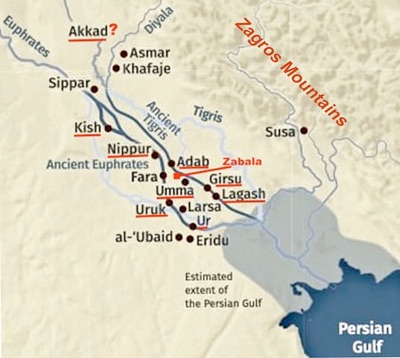
Map of Mesopotamia during the 3rd millennium BC
From the website of the Lagash Archeological Project: my additions in red
As Karen Wilson and Deborah Bekken (referenced below, at p. xix) pointed out, Kish was located on the floodplain of the Euphrates, some 12 km to the east of the later site of Babylon (and 80 km south of modern Baghdad). Excavations here have uncovered ancient remains under some 40 mounds that are scattered over an area of 2.4 km2. As Peter Moorey (referenced below, at p. xx) observed:
“Archaeologists and ancient historians now refer to [the totality of these mounds] as ‘Kish’, the ancient name of the city whose primary shrines lay about the standing ruin of an eroded ziggurat known locally as 'Tell Uhaimir’. Until the ancient topography of the whole area is much better known from documentary sources, ‘Kish’ suffices as a short-hand description for many closely related settlements:
✴extending back in time long before the use of writing; and
✴running down to the Mongol invasion, long after the name of Kish had passed from record.”
Karen Wilson and Deborah Bekken (referenced below, at p. xix) asserted that the Euphrates originally divided the urban area of Kish into:
✴a western area, which was dominated by [the] ziggurat found at Tell Uhaimir (probably the site of the temple of Zababa, the city-god of Kish); and
✴an eastern complex at Tell Ingharra that the ancients knew as Hursagkalama: as Peter Moorey (referenced below, at p. 82) observed:
“[At least from] Isin-Larsa period there is ample documentary evidence for an important shrine of Inanna/Ishtar on the site [of Hursagkalama]; indeed Ishtar was sometimes referred to as the ‘Lady of Hursagkalama’.”
However, Federico Zaina (referenced below, at p. 443), in a paper reporting on his recent review of the archeological evidence from Tell Ingharra (the most extensively explored area of ancient Kish), concluded that:
”... the hypothesis that views Tell Ingharra and Tell Uhaimir as independent villages [in the 3rd millennium BC] does not seem entirely convincing.”
Having said that, there is surviving epigraphic evidence that Kish was indeed divided in some way into two urban areas in the pre-Sargonic period: in two of the inscriptions in which Sargon commemorated his victory over Lugalzagesi of Uruk (RIME 2:1:1, inscriptions 1 and 2), we read that he also:
“... altered the two sites of Kish [and] made [them] occupy (one) city”, (see, for example, RIME 2:1:1:2, CDLI P461927, lines 100-8).
Furthermore, as Stephanie Dalley (referenced below, at p. 92) pointed out, while Inanna/Ishtar eventually had temples in both locations, at least by the Old Babylonian period:
“Kish-Uhaimir and Hursagkalama-Ingharra were regarded as two separate cities as far as cults were concerned ... Zababa, [unlike Inanna/Ishtar], is never referred to as a god of Hursagkalama ... [and ancient] lists of temples also name the two cities separately.”
According to Francesco del Bravo (referenced below, at p. 303) archeological evidence (primarily from Tell Ingharra and Tell Uhaimir) indicates that:
“... between the Late Uruk and Early Dynastic III period, Kish underwent three stages [of urban development], each representing a significant expansion ... :
✴Late Uruk = 10.1 ha;
✴ED I = 137.2 ha;
✴ED III = 230.9 ha.
These data clearly show how, ... in the span of a few centuries, [Kish] not only [reached] an urban status but was [also] by far the largest occupied settlement in northern [Mesopotamia, at least as far as we know].”
During this period, the use of the Sumerian language in northern Mesopotamia increasingly gave way to a Semitic language dubbed ‘Akkadian’ (presumably reflecting a period of migration from the north). Aage Westenholz (referenced below, at pp. 690-1) observed that, although the textual evidence from Kish is not as extensive as one would like:
“There is sufficient textual material from ED IIIa ... to allow an assessment of the [Kishite] population around 2600 BC. The language of record of these texts is difficult to define ... [However], there are:
✴26 Sumerian names;
✴6 Akkadian; and
✴13 names of uncertain linguistic affiliation (though most of them may turn out to be Sumerian).
Bearers of Akkadian names thus made up 13.3% of the inhabitants of Kish [at this time], while well over a half were [still] Sumerians. ... During ED IIIb ..., the percentage of Akkadian names increases steadily, although the process is difficult to monitor, due to the scarcity of material.”
According to Federico Zaina (referenced below, at p. 444) the surviving archeological evidence suggests that the period of Kishite expansion:
“... ends abruptly at the end of the ED IIIb period with a violent destruction attested in several areas ... During the[subsequent] Akkadian period, Kish seems to be mostly occupied by graveyards and small squatter buildings. Its partial regeneration as a smaller centre [only begins] at the very end of the 3rd millennium BC, with the erection of a massive building ... close to the ziggurats of Ingharra.”
Early History of Kish
Evidence of the ‘Prisoner Plaque’
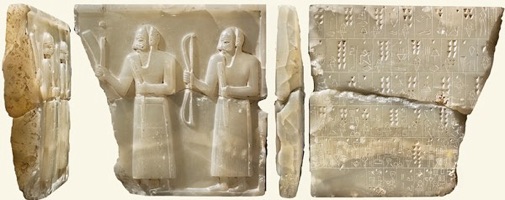
So-called ‘Prisoner Plaque; image from CDLI, P453401
Piotr Steinkeller (referenced below, 2013, at p. 131) characterised the inscription on the plaque illustrated above as:
“... to all appearances, ... the oldest historical inscription from Mesopotamia on record.”
The plaque in question, which is of unknown provenance, is now part of a private collection, although Steinkeller was able to examine high quality photographs and to access information about its material and measurements. He argued (at p. 132) that:
“On the basis of its script, the plaque may tentatively be dated to the ED II period or (although less likely) to the ED I period.”
More recently, Camille Lecompte (referenced below, at pp. 440-3) dated it to the later part of the ED II period.
The shallow relief on the front of this plaque (which depicts two standing male figures facing left, carrying bows and other objects) is relatively uninformative. However, the main body of the six-column text, which is written in Sumerian cuneiform on the reverse, records the number of prisoners from each of at least 25 different locations. Steinkeller offered the following tentative translation of the final lines of the surviving text (at p. 133):
“36,000 captives
(They were assigned) to the filling of threshing floors (with grain) and the making of grain stacks
The stone (monument) fashioned in Kish
Zababa is the god of manhood”, (col. vi, lines 3’-7’).
The inscription ends on the lower right edge with the name of the scribe, Amar-SHID. Since:
✴the surviving (incomplete) text records 28,970 captives (see p. 133); and
✴the figure 36,000 presumably represents the actual total of the listed captives;
it seems that about 20% of the original text has been lost.
Commissioning of the ‘Prisoner Plaque’
Steinkeller argued (at p. 132) that:
“The plaque almost certainly stems from Kish (or one of its dependencies, [as] is assured by the following data:
✴the plaque mentions Zababa, the patron god of Kish (vi 7');
✴the city of Kish is likely named in it as well (vi 6');
✴the signs, sign-values and other paleographic features of the inscription show strong connections to the early written materials from Kish and from northern [Mesopotamia] more generally ... ;
✴the [25] toponyms named in the [surviving part of the] inscription include [at least 8] that also appear in the Early Dynastic ‘List of Geographical Names’ [hereafter ‘LGN’] which, as argued by this author [in an earlier paper], represents a gazetteer of the archaic territorial state of Kish ...; and
✴the scene depicted on the [obverse] shows similarities to an ED II inlaid frieze excavated at Kish [see his Figure 5, at p. 153]”.
Although the relevance in this context of the overlap between the toponyms in this inscription and those in the LGN is still debated (as discussed in the following section), most scholars agree that the the other evidence put forward by Steinkeller does indeed strongly suggest that ‘Prisoner Plaque’ was commissioned by a ruler of Kish (see, for example, Aage Westenholz, referenced below, at p. 687).
Steinkeller observed (at p. 144) that the plaque :
“... does not name the ruler (or rulers) responsible for ... bringing [these 36,000 captives] to Kish (although it is possible that his name appeared at the very beginning of the inscription, now missing). Instead, its concluding lines praise Zababa, the divine master of Kish and (fittingly) a god of war."
It seems to me that, if (as was probably the case) the plaque was commissioned at Kish, then it is indeed likely that it was commissioned by its ruler and originally named as the king of Kish, who (in local tradition) had been given this hallowed, god-given kingship by (or at least with the help of) Zababa.
Prisoner List
As we have seen, the surviving part of the text records
✴records the presence at Kish of 36,000 prisoners used as slave labourers; and
✴assigns 28,970 of them to one of 25 named locations.
Steinkeller observed (at p. 142) that:
“The number of prisoners per toponym varies from 50 (i: 15') to 6,300 (v: 5'). Given the wide variation among [these] numbers, there is every reason to think that these are real, and not inflated, figures. Since the numbers (as preserved) add up to 28,970 captives, with a significant number of entries presently missing, it is likely that the figure of the total (36,000) is likewise a real one, although probably slightly rounded up”.
Steinkeller suggested (at p. 143) that:
“Both the large number of localities conquered and the huge figures of captives so obtained speak against the possibility that the plaque describes the outcome of a single military campaign. Much more likely, in my view, [is the hypothesis that] we find here a cumulative record of the conquests carried out by Kish over a period of time.”
In my view, it is hard to quarrel with any of this analysis, other than the fact that (as discussed below) there is nothing in the inscription to suggest that these putative ‘military campaigns’ were directed at with territorial conquests (as well as the capture of slaves).
This brings us to the question of geography: as Steinkeller observed (at p. 142):
“Of all the places that supplied captives, only three:
✴the land of Shubur/Subartu (v: 4');
✴Uri/Wari(um) (iii: 5'), and
✴Erud (iv: 10');
can be localised with confidence.
✴Shubur/Subartu, which supplied by far the largest number of captives (6,300), is identical with Assyria [see below];
✴Uri/Wari(um), [which supplied 1,340 captives], is the designation of the Diyala Region.; and
✴Erud, [which supplied 270 captives], (if this is identification is correct) is to be sought [to the east of the Tigris].
In other words, while it is clear that at least 20% of the 36,000 captives were taken from the east of the Tigris, we have no hard evidence that any of them was taken from elsewhere in Mesopotamia.
Steinkeller’s Conclusions
Steinkeller concluded (at p. 142) that:
“ As best as it can be ascertained, the plaque is a record of the prisoners of war who were acquired as booty by the state of Kish in the course of its territorial conquests. The preserved sections of the plaque name 25 conquered places ...”
He therefore concluded (at p. 145) that the ‘Prisoner Plaque’:
“... provides priceless information about the formation and the territorial conquests of the state of Kish during the phases of the ED period. In this connection, particularly eloquent is the mention of 6,300 captives acquired in the land of Shubur (Assyria). Here, one witnesses not only the oldest occurrence of Assyria's name, but also a palpable proof of Kish’s foreign expansion. The plaque also confirms what had been suspected by some scholars (this one among them) about the early Kishite state, [particularly in relation to its putative] hegemonic and militaristic character. The figure of 36,000 prisoners of war ... recorded in the plaque is astonishing, since it was not until the advent of Sargon of Akkad and his [successors] that rulers again were able to aspire to similar military feats. Because of this, the state of Kish is considered [by these scholars to be] a forerunner of the Sargonic empire.”
However, it seems to me that nothing in the surviving text indicates the circumstances in which any or all of the 36,000 captives were taken:
✴Steinkeller assumes that they had been captured during successive campaigns of conquest that had culminated in the hegemony of Kish over a huge part of northern Mesopotamia that extended at least as far north as Shubur (see below); but
✴it is equally possible that some or all of these captives had been taken in raids that were aimed primarily at the acquisition of slaves rather than of territory.
In other words, while the ‘Prisoner Plaque’ arguably confirms the ‘militaristic character’ of Kish in the ED II period, it does not (in my view) offer secure evidence that the Kishites either claimed or achieved hegemony over at least 25 locations, including some as far away as Shubur to the north and/or the Diyala valley to the east (see below).
Evidence of the so-called ‘List of Geographical Names’ (LGN)
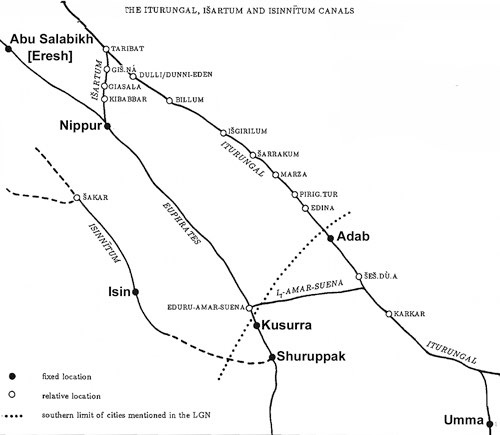
Southern limit of the territory covered by the LGN
Adapted from Douglas Frayne (referenced below, 1992, Map 3, at p 30)
As we have seen, Piotr Steinkeller (referenced below, 2013, at p. 142) pointed out that, although only 3 of the 25 locations named in the ‘Prisoner Plaque’ can be identified with a reasonable degree of certainty:
“... important insight into [the question of the significance of this list of 25 toponyms is arguably] provided by the fact that ... at least 8 [of them] ... are also named in the [ LGN] ... , which, in all likelihood, originated Kish [and] appears to be a gazetteer of the Kishite kingdom (or at least of the areas affected by Kishite conquests).”
As noted above, these potential insights depend crucially on the likely validity of Steinkeller’ hypotheses relating to the provenance and purpose of the LGN. We therefore need to look at this second potential source of information in more detail.
As Walther Sallaberger and Ingo Schrakamp (referenced below, at p. 65) observed, the LGN is known from a number of fragments from Abu Salabikh (probably the site of ancient Eresh) and has been reconstructed on the basis of a completely preserved duplicate from Ebla (in modern Syria).
✴Giovanni Pettinato (referenced below) published the ‘canonical’ list of 289 toponyms in 1981, and his numbering system remains in use;
✴Douglas Frayne (referenced below, 1992) published an early analysis of the list, which was based on his observation (at p. 1) that:
“A cursory examination of the toponyms in the LGN reveals that they fall into two distinct groups:
•group A: those located on river courses in the greater vicinity of the city of Kish, down to the general area of Nippur; and
•group B: those located in areas peripheral to Mesopotamia proper, for example, the Diyala river valley [and the region to the south of the Diyala and the east of the Tigris].
.... none of the cities [named in the LGN] seem to be situated below the latitude of Adab [see his Map 3, illustrated above].
✴Miguel Civil (referenced below) published a lexical text (MS 3204) on a tablet of unknown provenance that is now in the Schøyen Collection, which contains a near-duplicate of the second half of Pettinato’s ‘canonical’ list (LGN 176-289).
Walther Sallaberger and Ingo Schrakamp (referenced below, at p. 65) argued that:
“Only a tiny fraction of the 289 toponyms mentioned [in the LGN] can be identified and related to places attested in administrative texts from other archives. ... [However], although [Douglas] Frayne’s identifications of:
✴mostly northern [Mesopotamian] toponyms; with
✴[toponyms] attested in contemporary administrative texts from Abu Salabikh;
are probably wrong, the lack of southern place names [in the LGN is, indeed,] striking.”
In fact, only three toponyms in the LGN can be reasonably securely placed in southern Mesopotamian: Isin (LGN 70); ‘Enlil’ (=Nippur) (LGN 177); and Eresh (LGN 178).
As noted above, Piotr Steinkeller (referenced below, 2013, at p. 132) argued strongly that the LGN:
“.. represents a gazetteer of the archaic territorial state of Kish”.
He therefore asserted (at p. 148) that:
“According to the testimony of LGN, the state of Kish embraced:
✴the entire territory of northern [Mesopotamia];
✴the most northern section of southern [Mesopotamia, including] Nippur, Isin, and Eresh; and
✴large portions of the Diyala Region.
The Kishite expansion also affected [Shubur/Subartu - see below] and most of the ... [territory east of the Tigris], all the way to the Susiana.”
However, Aage Westenholz (referenced below, at pp. 697-8) pointed out this:
“... is really a bit of circular reasoning:
✴because the LGN enumerates cities in [these] regions, it is assumed to be a gazetteer of the Kishite state; and
✴on the strength of that assumption, it proves the extent of that state!”
He argued (at p. 692) that:
“... there is only slight support from Kish for the idea that the LGN is a gazetteer of the Kishite kingdom. In fact, the very idea that [the LGN] is a ‘gazetteer’ of anything is problematic: where do we find parallels to that? Furthermore, a good number of the place names in the LGN are also mentioned in the administrative documents from Fara [his point presumably being that this does not make it a gazetteer of Shuruppak, which was located at modern Fara].”
Locations Recorded in both the ‘Prisoner Plaque’ and the LGN
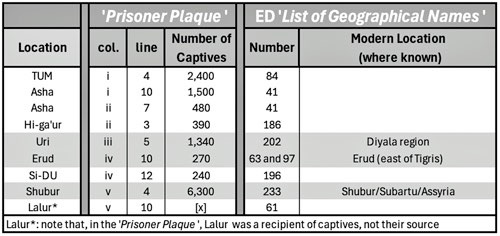
Table 1: Locations mentioned in both the ‘Prisoner Plaque’ and the LGN
See Piotr Steinkeller (referenced below, 2013, at p. 142 for the 8 localities named in both
the ‘Prisoner Plaque’ and the LGN and the 3 of these that can be reasonably securely identified
Table 1 summarises the overlaps that Piotr Steinkleer identified between the toponyms recorded on the ‘Prisoner Plaque’ and those in the LGN. The first point to make is that this overlap is not particularly comprehensive:
✴only 8 localities appear among both:
•the 25 localities mentioned in the surviving text of the ‘Prisoner Plaque’; and
•the 289 localities named in the LGN;
✴only 3 of these 8 localities can (or can probably) be identified at known ‘modern’ locations; and
✴all three of these locations are (or are probably) are located across the Tigris, to the east of Mesopotamia.
However, since (as noted above) the absence in the LGN of locations that are known to lie south of Nippur, Isin and Eresh, we might reasonably assume that other 5 ‘overlapping’ localities lay either:
✴to the north of Nippur, Isin and Eresh; or
✴to the east of the Tigris.
However, it is important to note that this is not necessarily true for the other 17+ locations that were originally recorded in the inscription on the ‘Prisoner Plaque’.
The record of Kishite military action in ‘Uri’ (the Diyala valley) is note particularly surprising since )as we shall see) the earliest surviving epigraphic evidence from Kishite royal inscriptions comes from this region. However, the fact that Shubur:
✴features prominently in the ‘Prisoner Plaque’ (as the source of no fewer than 6,300 prisoners) ; and
✴is also recorded in the LGN;
is worthy of further consideration.
Ancient Shubur/Subartu
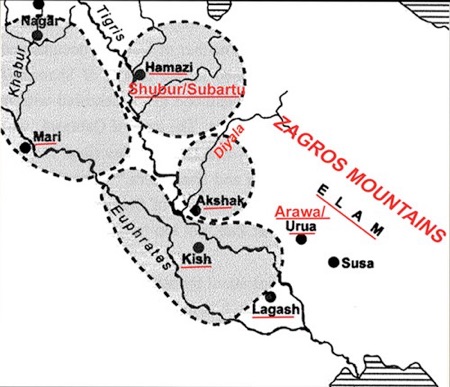
Political map of Mesopotamia and its eastern periphery in ca. 2400 BC
Adapted from Piotr Steinkeller (referenced below, 1998, Figure 1, at p. 86)
Piotr Steinkeller (referenced below, 1998, at p. 76 and note 2) began his important paper on this location by pointing out that:
“The geographical term ‘Subartu’ is of great antiquity ... Correctly, the toponym [should be]:
✴Shubartu in Akkadian; and
✴Shubur/Shubir/Shubar in Sumerian.
For convenience, however, the Anglicised form ‘Subartu’ (which has become popular of late) will be used throughout in this paper.”
He also observed that the question of the location of ancient Subartu is complicated by the fact that:
“... it is quite certain that, already in the 3rd millennium BC, ‘Subartu’ had two separate meanings:
✴a narrow sense, [‘Subartu Proper’]; and
✴a broad sense, [‘Greater Subartu’] ... .
In its narrow (and therefore, almost certainly, its original) sense, ... Subartu denoted an area extending north of the Diyala region and east of the Tigris as far as the Zagros mountains.”
He further observed (at p. 79) that:
“... in my opinion, the most likely candidate for [its unknown] capital ... is Hamazi, [which was] a very important (though rather mysterious) ... urban centre [at this time]: although [Hamazi’s] precise location [is also] unknown, it is generally agreed that [it[ was situated to the east of the Tigris and to the north of the Diyala Region.”
Some 20 years later, Steve Renette (referenced below, at p. 77) observed that:
“There is general agreement that ... [Hamazi] is to be found between the Tigris and the Diyala or Lower Zab [rivers], based on its close association with Shubur/Subartu.”
As Vitali Bartash (referenced below, at p. 266) observed, the earliest surviving written records of this location are in the sources under discussion here: more precisely, it appears:
✴as kur Shubur in the ‘Prisoner Plaque’, which he dated to ca. 2800–2700 BC; and
✴Shuburki in the LGN (see his note 17).
He then observed that:
“... Shuburki appears side by side with Elam in a lengthy inscription [on the famous ‘Stele of the Vultures’] commemorating the military exploits of Eanatum, an Early Dynastic ruler of the Lagash state in the south of Sumer (ca. 2470 BC).”
In fact Eanatum claimed of have defeated:
✴Elam and Subartu, the lands of timber and goods, in the inscription on the ‘Stele of the Vultures’ (RIME 1.9.3.1; CDLI, P431075, lines 588’-590’); and
✴Elam, Subartu and Arawa/Urua at the Asuhur canal, followed by Kish, Akshak and Mari at the Antasura shrine of Ningirsu (both locations were in Lagashite territory) in the inscription on the so-called ‘Eanatum Boulder’ (RIME 1.9.3.5; CDLI, P431079, lines 118-126-44).
However, while Eabatum also claimed in the second inscription that he had won the kingship of Kish and destroyed the city of Akshak on this occasion, there is no reason to think that he ever ventured further north than this. In other words, while there is nothing in our surviving sources to indicate that Kish exercised hegemony ove Shubur/Subartu in the ED II period, the fact that one of its rulers at that time was able to bring 6,300 prisoners from this region back to Kish must serve as graphic testimony to his precocious military ambition and capability.
Early History of Kish: Conclusions
We can reasonably assume that the ‘Prisoner Plaque’ was commissioned at Kish by a ruler (almost certainly a king) of that city, who seems to have had;
✴a precocious understanding of the potential ‘propaganda value’ of royal inscriptions; and
✴an impressive military capability, which allowed him to a secure large numbers of captives who could be put to work at Kish.
Furthermore, these captives were seized from places across a swathe of territory that extended as far as Shubur in the north, the Diyala region to the east and the area east of the Tigris. As we shall see, it is clear that these military successes paved the way for the creation of a powerful kingdom that was long remembered and revered. However:
✴nothing in this text suggests that this king who commissioned the ‘Prisoner Plaque’ exercised hegemony over any of the settlements within this territory: indeed, the fact that the text refers to the people brought to Kish as ‘captives’ suggest (at least to me) that they were seized during raids on territories that Kish did not control; and
✴we do not know how typical their captor was of the Kishite kings at this time.
Earliest Known ‘Historical’ Kings of Kish
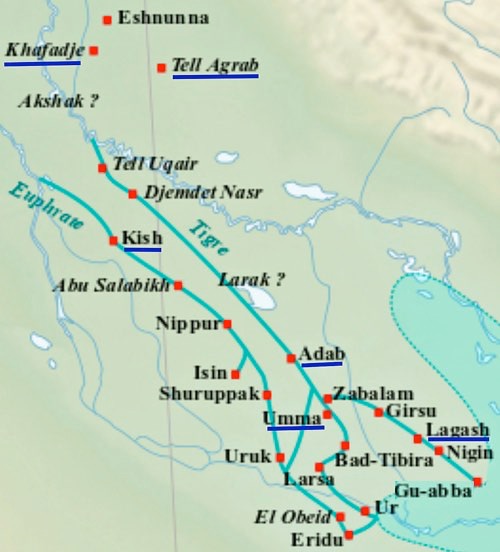
Map of Mesopotamia in the ED Period: adapted from Wikipedia: my additions in dark blue
As Douglas Frayne (referenced below, 2008, at p. 5) observed, one of the things:
“... complicating the historical picture in ED times is the fact that the title ‘lugal kish’ of ED royal inscriptions, while clearly referring in some cases to actual kings of Kish, ... seems, at other times, to be an honorific epithet meaning something like ‘king of the world’.”
In this section, I discuss four rulers whom I argue were (or probably were) ‘actual kings of Kish’ in the ED II period:
✴Enmebaragesi, whom Frayne also accepted as an ‘actual king of Kish’;
✴Akka, the putative son of Enmebaragesi, who is not known from any royal inscriptions and is thus outside Frayne’s database;
✴two kings of Kish whom Frayne assigned to his Chapter 8: ‘Rulers with the Title ‘King of Kish’ whose Dynastic Affiliations are Unknown’;
✴Mesalim; and
✴Lugalnamnirshum.
Enmebaragesi, King of Kish
Epigraphic Evidence for Enmebaragesi
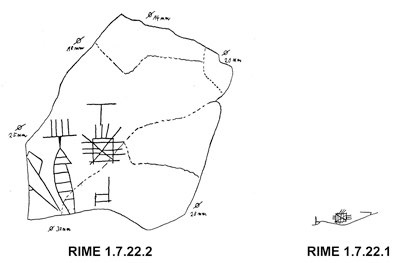
Sketches of two inscriptions recording Mebaragesi
Adapted from Nicholas Postgate (referenced below, 1994, Figure 2:6, at p. 30)
Douglas Frayne (referenced below, 2008, at p. 55) observed that:
“The first king of Kish for whom we have any inscriptions is [named as ‘Mebaragesi].”
As Piotr Steinkeller (referenced below, 2015, at p. 43) observed:
“... it is generally agreed that the archaic [name] ‘ME-barag-si’ appears as ‘En-me(-en)barag-ge-si’ in [later sources, including the ‘Sumerian King List’ (see below)]”.
He referred here to two inscriptions (see the sketches illustrated above), neither is as helpful as one might wish.
The more complete of them (RIME 1.7.22.2; CDLI, P431027) is on a fragment of a large stone (alabaster) bowl that was purchased on the local antiquities market and was then housed in the Iraq Museum (IM 30590), where it was exhibited with a note that it had been ‘confiscated at Kut’ (some 160 km south of Baghdad). The surviving text reads simply:
‘Mebaragesi, king of Kish’.
It was on the basis of this inscription that Gianni Marchesi (referenced below, 2015, at pp. 152-3) started his list of kings of Kish with ‘Mebaragesi’, arguing that:
“... [it] can be dated on palaeographic grounds to Period ED I ... [It] is quite possible that [this] ‘Mebaragesi, king of Kish’ was the self-same [Enmebaragesi], the 22nd king of the first dynasty of Kish, according to the ‘Sumerian King List’ [see below].”
As is clear from the illustration above, the second of Frayne’s ‘Mebaragesi’ inscriptions (RIME 1.7.22.1; CDLI. P431026) is even more fragmentary than RIME 1.7.22.2: in fact, it:
✴contains only a single word, ‘Mebaragesi’; and
✴is carried on a tiny fragment of a stone bowl.
However, at least we know its provenence:
✴it was excavated (at level L 46:4) on the site of the ‘Temple Oval’ at Khafayah (ancient Tutub, in the Diyala valley) and labelled Kh. III 35 (see Thorkild Jacobsen, referenced below, 1940, entry 2, at p. 146); and
✴it is now in the Iraq Museum (museum number now unknown).
Nicholas Postgate (referenced below, 1994, at pp. 29-30), who assumed that this ‘Mebaragesi’ was identical to the ‘Mebaragesi, king of Kish’ recorded in RIME 1.7.22.2, argued that:
“The significance [of this find] lies:
✴not only in the attestation of [the] historicity [of ‘Mebaragesi, king of Kish’; but also]
✴[in its original] location, for later parallels [see the discussion of King Mesalim of Kish below] strongly suggest that [Mebaragesi’s dedication of a stone] bowl at a Khafayah temple implied that [this] city acknowledged his hegemony.”
Not all scholars would accept this series of hypotheses: for example, Gianni Marchesi (referenced below, 2015, at p. 152) argued that archaeological context in which this shard was found suggests that it dates:
“... to the [ED IIIa or the beginning of the ED IIIb period]. Moreover, the sign bara2 of this inscription is quite different in shape from that on the [ED I stone bowl] of the namesake king of Kish [recorded in RIME 1.7.22.2]. It would, therefore, appear that the dedicator of [the stone bowl from Khafayah] was another [Mebaragesi, who was] not a king.”
However, Piotr Steinkeller (referenced below, 2013, note 70, at p. 149) rejected Marchesi’s late dating for this inscription, observing that:
“The fact that a votive inscription was discovered in a particular level does not necessarily mean that it dates to that level: such evidence is reliable only as an ante quem indicator”.
He also implicitly accepted that the ‘Mebaragesi’ of RIME 1.7.22.1 and the ‘Mebaragesi, king of Kish’ of RIME 1.7.22.2 were one and the same person.
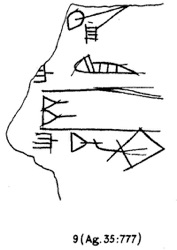
Sketch of the inscription (RIME 1:7:40:1; CDLI, P431028) on a fragment of a stone bowl (Ag. 35 :777)
from the Shara temples at Tell Agrab (now in the Iraq Museum)
From Thorkild Jacobsen (referenced below, 1942, Figure 205, at p. 291)
Piotr Steinkeller (as above) argued (at p. 149) that:
“... the discoveries of the inscriptions of:
✴[Mebaragesi at Khafayah, discussed above]; and
✴an unidentified king of Kish at Tell Agrab [known from a third inscription (RIME 1:7:40:1; CDLI, P431028), see the illustration above] ... ;
are convincing indicators of the Kishite presence in the Diyala [in the ED II period].”
We also know the provenance of this third inscription:
✴it is on a fragment of a stone vessel (Ag. 35:777) from the Temple of Shara at Tell Agrab (see Thorkild Jacobsen, referenced below, 1942, entry 9, at pp. 296-7); and
✴is now in the Iraq Museum (museum number now unknown).
It records a now unknown:
“... king of Kish, son of munus-ushumgal (literally ‘woman-great dragon’) ...”
This inscription potentially offers some support for the hypotheses discussed so far:
✴Since it was probably carried by a stone vessel that had been dedicated at the Shara temple at Tell Agrab, it provides support for Nicholas Postgate’s hypothesis that locations in this region acknowledged the hegemony of Kish.
✴As we have seen, Piotr Steinkeller had already established that, according to the inscription on the ‘Prisoner Plaque’, 1,340 captives from Uri/Wari(um)/the Diyala region were among 36,000 captives who had been used as slave labourers at Kish at some time in the ED II period. He was now suggesting that taken together:
•the inscription on the ‘Prisoner Plaque’; and
•the inscription RIME 1.7.22.1 from Khafayah; and
•this inscription from Tell Agrab;
indicated that Kish had had a permanent (perhaps hegemonic) presence here from an early date.
Enmebaragesi and Akka, son of Enmebaragesi
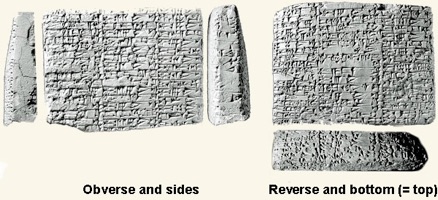
Surviving part of the tablet containing the Ur III recension of the Sumerian King List (USKL):
these images of the tablet (which is in a private collection) is adapted from CDLI: P283804
As Piotr Steinkeller (referenced below, 2015, at p. 43) pointed out:
“... it is generally agreed that the archaic [name] ‘ME-barag-si’ appears as ‘En-me(-en)barag-ge-si’ in the ‘Sumerian King List’.”
As discussed in my page Kish in the Ur III Sumerian King List (USKL), the way in which the Kishite kings were recorded in the surviving recensions of this text had evolved over time:
✴in the earliest recension, which:
•is known only from the tablet fragment illustrated above, which is of unknown provenance;
•was first published by Piotr Steinkeller (referenced below, 2003); and
•dates to the reign of Shulgi, the second king of the so-called Ur III dynasty (for which reason, it is referred to as the USKL);
originally started with an unbroken list of about 30 Kishite kings (of which 22 are recorded in three columns on the obverse of the surviving fragment); while
✴the other recensions (all of which date to the Old Babylonian period and are known collectively as the SKL) record the names of about 40 Kishite rulers (including most of the 22 names known from the USKL) but they are now assigned to one of three or four ‘city dynasties’ that are separated by lists of rulers from other cities.
Importantly, Enmebaragesi is the only Kishite king recorded among to 22 names in the USKL or the 38 names in the SKL who is also known from his royal inscriptions (discussed above). He appears, followed by his son and successor, Akka, in both:
✴the USKL (see Piotr Steinkeller, referenced below, 2003, lines obverse ii: 7-10); and
✴the later SKL recensions (see lines 83-8 of the composite translation at CDLI: P479895).
Interestingly, a biographical note was added to Enmebaragesi’s name in the SKL, which records (at lines 84-5 of the composite) that he defeated ‘the land of Elam’. Although such notes are relatively common in the SKL, this one is unusually ‘matter of fact’ and might actually reflect reality. Piotr Steinkeller (referenced below, 2013, at p. 148) that it might reflect:
“A tradition of the [Kishites’ eastern] expansion into the Susiana and onto the Iranian plateau ...”
However, if this late addition actually does have substance, it might might mean no more than that Enmebaragesi had occasionally driven off ‘Elamite’ raiders who threatened his territory.
Having looked at how the Kishite king list of the SKL evolved from that in the USKL, we can now consider how the latter list came into existence. Gösta Gabriel (referenced below, 2023, at p. 244) it was ultimately derived from
“... an existing list of [Kishite] rulers, and so continued the Kishite historiographical tradition, including the celestial origin of the city’s power and its extremely long first reign. Accordingly, the first recension of what would become the [USKL and then the SKL] was most likely written in Kish [itself] before ca. 2350 BC.”
In other words, while Shulgi’s scribe probably relied heavily for this part of his king list on an earlier list that had originated at Kish itself, there is no reason to believe that he felt constrained to leave this putative precursor untouched. As it happens, there is some reason to think that Akka was added to the list by Shulgi’s scribe. In this context, it is interesting to note that:
✴only two Kishite kings in the USKL are given patronymics:
•Meshnune, son of Nanne, who does not appear in the SKL and was probably added to an earlier Kishite king list by Shulgi’s scribe in error; and
•Akka, son of Enmebaragesi; and
✴although no royal inscriptions of Akka survive, both he and Enmebaragesi appear in the literary traditions that developed at the Ur III court.
In my page Kish in the Ur III Sumerian King List (USKL), I argue there (large following the work of Dina Katz (referenced below) that:
✴Akka was a probably figure taken from Sumerian myth, in which he was defeated by Shulgi’s hero, Gilgamesh;
✴the composer of the praise poem of Shulgi known as ‘Hymn O’ replaced Akka with the more prestigious (and historically attested) Enmebaragesi as the slayer of Gilgamesh; and
✴the USKL simply ‘nodded’ to the earlier literary tradition by including Akka and identifying him as Enmebaragesi’s son.
It is certainly the case that a number of the new names that added to the list in the SKL appeared there as the sons of the kings who preceded them.
Mesalim, King of Kish
As we shall see, Mesalim is a key figure for our understanding (such as it is) of the political situation in Sumer in the early part of the ED period, not least because:
✴three of his royal inscriptions survive; and
✴he is documented in inscriptions from other, later, Mesopotamian rulers.
However, none of this body of epigraphic evidence comes from Kish and (more surprisingly) it seems unlikely that he was among the 30 or so kings of Kish that were listed in the USKL:
✴he is certainly not among the 19 names that survive in this recension; and
✴nor is he listed in any of the later recensions of the SKL.
Interestingly, while the geographical focus of
✴the ‘Prisoner Plaque’ was in northern Mesopotamia and the Diyala region; and
✴the epigraphic evidence for Mebaragesi/Enmebaragesi was also in the Diyala (at Khafayah and Tell Agrab);
the epigraphic evidence for Mesalim takes us to Adab, Lagash and Umma, in the eastern part of southern Mesopotamia.
Mesalim’s Hegemony over Adab

Fragment of a stone bowl (A211) carrying an inscription (RIME 1.8.1.2; P462182) of Mesalim, King of Kish
From the Esar Temple at Adab, now in the Institute for the Study of Ancient Cultures at Chicago
Image from Karen Wilson (referenced below, Plate 106a)
The inscription illustrated above, which is found on fragments of two stone bowls from the Esar temple at Adab, records that:
“Mesalim, king of Kish, bur mu-gi4 (offered? the stone bowl) in the Esar temple [when] Ninkisalsi (was) ensi of Adab”, (RIME 1.8.1.2; P462182).

Three fragments from the rim of a steatite vessel (A192 a-c)
carrying an inscription RIME 1.8.1.3; P431033)) of Mesalim, King of Kish
From the Esar Temple at Adab, now in the Institute for the Study of Ancient Cultures at Chicago
Image from Karen Wilson (referenced below, Plate 51)
This second inscription from the same temple records that:
“Mesalim, king of Kish, beloved son of Ninhursag [dedicated this vessel] ...”, (RIME 1.8.1.3; P431033).
Although some scholars (see, for example, Andrew George, referenced below, entry 978, at pp. 140-1 and Douglas Frayne, referenced below, 2008, at p. 20) suggest that the Esar temple at Adab was dedicated to Inanna (= Ishtar), Karen Wilson (referenced below, at pp. 73-4 and in Table 9.1, at p. 100) has shown that the archeological evidence (which includes this inscription) indicates that this temple was dedicated to Ninhursag.
Nicholas Postage (referenced below, 2024, at p. 167) observed that the first of these inscriptions (RIME 1.8.1.2):
“... bears name of Mesalim ... [and] follows this with the name of the ensi of Adab. ... “
He pointed out that a similar naming convention is found on the so-called ‘mace of Mesalim‘ from Lagash (see below), suggesting that Mesalim was recognised as an overlord by both Adab and Lagash. In other words, at Adab, the ensi Ninkisalsi was presumably either:
✴a governor appointed by Mesalim; or
✴a local ruler who acknowledged his hegemony.
Postage also pointed out (again at p. 267) that:
“... the laconic phrase ‘[he] offered? the stone bowl’ (bur mu-gi4) [is significant]: the word bur in Sumerian refers specifically to a stone (not ceramic) bowl, as is evident from the professional name bur-gul ‘stone bowl beater’ . [It is surely] no coincidence that these two inscriptions [from the Esar temple at Adab] are found on stone bowl sherds. Two millennia later, Assurbanipal relates that he made burgû and bursaggû offerings to Marduk ... These rather scarce references to a ‘burgi’ ceremony seem all to have this in common, that the person presenting the offerings is a ruler (although we cannot be sure that this was invariably the case).”
He elaborated (at p. 127) as follows:
“Making a stone bowl was surely laborious ... [and they] were special: a ritual procedure which symbolised political hegemony over a city entailed the ruler making an offering in a stone bowl to the patron deity of the city. This is attested at Adab, [where the ruler in question was Mesalim, as hegemon]. ... [The earliest example is probably at Khafayah, where a stone bowl with the name of (En)mebaragesi ... must have come from a temple [as discussed above].
Mesalim’s Hegemony over Lagash

Mace-head of Mesalim, King of Kish (RIME 1.8.1.1; P462181), from the original Ningirsu temple at Girsu
Now in the Musée du Louvre (AO 2349), images from the museum website
The most famous of Mesalim’s surviving royal inscriptions is on a stone mace-head (illustrated above), which he dedicated to Ningirsu, the main god of Lagash, in his original temple at Girsu (the ‘religious capital’ of a political entity that already embraced both ‘Lagash proper’ and Girsu):
✴the top of the mace-head is carved with a relief of a lion-headed eagle (usually known as the Anzu bird), which, as Sébastien Rey (referenced below, at p. 176) pointed out, was already established by this period as the emblem of Ningirsu; and
✴the curved surface below it is carved with a frieze relief of six lions biting each other (which is another example of local iconography).
The inscription, which extends across two of the lions, records that:
“Mesalim, king of Kish, temple builder for the god Ningirsu, set up (?) this mace for the god Ningirsu [when] Lugal-sha-engur (was) ensi of Lagash”, (RIME 1.8.1.1; P462181).
As discussed above in the context of Adab:
✴Mesalim clearly exercised hegemony over Lagash and Girsu; and
✴Lugal-sha-engur, the ensi of Lagash, who is the earliest-known ensi of Lagash, was presumably either:
•a governor appointed by Mesalim; or
•a local ruler who acknowledged Mesalim’s hegemony.
Nicholas Postgate (referenced below, 2024, at p. 167) observed that:
“Mesalim [apparently formalised] his sovereignty by [over Lagash by] undertaking or subsidising building work on the temple of the city patron, Ningirsu, [at Girsu] ...”
He drew a parallel between Mesalim’s expression of piety towrds Nihussag at Adab and towards Ningirsu at Lagash/Girsu.
In fact, the earliest Ningirsu temple at Girsu (which is known to archeologists as the ‘Lower Construction’) almost certainly pre-dated Mesalim, although the inscription suggests that he was responsible for a significant restoration of it. Sébastien Rey (referenced below, at p. 61 and at pp. 209-10) observed that:
✴the mace was almost certainly originally housed within this archaic building; and
✴its find-spot suggests that it was subsequently ritually buried in the foundations of the temple that Ur-Nanshe (the first independent ruler of Lagash/Girsu that we know of) built over it.
In other words, it is clear that Mesalim exercised hegemony over Lagash/Girsu at some time prior to the reign of Ur-Nanshe, the founder of what we know as the first dynasty of Lagash, and that he remained a respected figure at Lagash even after the city itself had become independent.
Mesalim’s Hegemony over Umma
Unusually, we know more about Mesalim from the royal inscriptions of later rulers (in this case, rulers of Lagash). For example, about a century after Mesalim’s rule, Eanatum, ensi of Lagash (the grandson of Ur-Nanshe) looked back on his role in the establishment of the border between between Lagash and Umma in:
✴an inscription (RIME 1.9.3.2; P431076) found on three boundary stones; and
✴a very similar inscription (RIME 1.9.3.3; P431077) found on two spheroid jars;
all of which came (or probably came) from either Girsu or Lagash. More specifically, Eanatum recorded that, after his victory in a boundary dispute Umma, he had:
✴restored the boundary stele that Mesalim had erected to mark the boundary between the respective territories, which had originally been defined by the god Enlil (see, for example, RIME 1.9.3.2; P431076, lines 4-7); and
✴in deference to the gods, when he driven army of Umma back across the god-given border, he had not marched beyond that point (see, for example, RIME 1.9.3.2; P431076, lines 55’-60’).
Fortunately, we have a more complete account of these events from a royal inscription of a yet-later ensi of Lagash, Enmetena (Eanatum’s nephew): at the start of his account of his own boundary dispute with Umma, he looked back on the precedents set by Mesalim and Eanatum:
“Enlil, lugal kur-kur-a (king of all lands), ab-ba dingir-dingir-re2-ne-ke4 (father/elder of all the gods) ... demarcated the border between:
✴Ningirsu, [the city god of Lagash and Girsu]; and
✴Shara, [the city god of Umma].
Mesalim, king of Kish, at the command of [the god] Ishtaran, measured it out and erected a stele there:
✴Ush, ensi of Umma, acted arrogantly: he smashed that monument and marched on the plain of Lagash. Ningirsu, warrior of Enlil, at his (Enlil's) just command, did battle with Umma. ...
✴Eanatum, ensi of Lagash, [subsequently] demarcated the border with Enakale, the ensi of Umma. ... He inscribed (and erected) monuments at [the god-given border] and restored the monument of Mesalim, but did not cross [the border] into the plain of Umma”, (RIME 1.9.5.1; P431117, lines 1-58).
(Note that, by this time, the independent rulers of both Lagash and Umma used the title ‘ensi’).
It is clear from these later testimonies that Mesalim’s authority as hegemon extended to Umma, and that his role in the establishment of the boundary between Lagash/Girsu and Umma was long-remembered, at least at Lagash. Furthermore, when a later ruler of Umma, Gishakidu, (who was probably a contemporary of Enmetana - see Walther Sallaberger and Ingo Schrakamp, referenced below, at p. 78) restored this boundary, he described himself (inter alia) as the beloved friend of Ishtaran (RIME 1.12.6.2; CDLI, P431197, lines 13-4), which implies that he also accepted the boundary as it had been demarcated by Mesalim. In other words, although it is often suggested that Mesalim had acted as an arbitrator in the matter of a border dispute between Lagash/Girsu and Umma, the surviving evidence (such as it is) suggests that:
✴both parties had accepted and respected his right to establish the border between them (albeit at the command of Enlil); and.
✴this border had continued to be respected until Ush, ensi of Umma, allegedly ‘acted arrogantly’ (probably during the short reign of Eanatum’s father, Akurgal).
Lugalnamnirshum, King of Kish

Large copper spearhead inscribed with the name of Lugalnamnirshum, king of Kish (RIME 1.8.2.1: P462183)
From the original Ningirsu temple at Girsu, now in the Musée du Louvre (AO 2675: image from museum website
This copper spearhead, which is some 85 cm long, was found at the temple of Ningirsu at Girsu. As Sébastien Rey (referenced below, at p. 210) observed, it would originally have been fitted with an imposing shaft and displayed pointing downwards, as suggested by the relief of a standing lion on one of its surfaces (see the illustration above). The inscription on the neck of the spearhead (above the head of the lion) was only partially legible until 1994, when it was rescued from a layer of corrosion, revealing that it had been dedicated (presumably to Ningirsu) by Lugalnamnirshum, king of Kish (see, for example, Douglas Frayne, referenced below, 2008, at p. 73).
Sébastien Rey (referenced below, at p. 209) also pointed out that a number of scholars have been misled by an early, flawed description of the find-spot of this important object, which placed it in Ur-Nanshe’s temple on this site: thus. for example, Gianni Marchesi (referenced below: 2011, note 244, at p. 124; and 2015, at pp. 144-5, Uruk entry 4 and Table 1.2, at p. 142) argued that it had been dedicated by a king of Uruk who:
✴used the title ‘king of Kish’; and
✴exercised hegemony over Lagash towards the end of Ur-Nanshe’s reign and into that of his son, Akurgal.
In fact, as Sébastien Rey (as above) pointed out, this spearhead (like the mace of Mesalim discussed above) had been dedicated in Ningirsu’s original temple at Girsu and then ritually buried in the foundations of that of Ur-Nanshe. He therefore argued (at p. 210) that Lugalnamnirshum:
“... was doubtless one of Mesalim of Kish’s successors, and, therefore, in all likelihood, another foreign overlord of Girsu [and Lagash] in the period before Ur-Nanshe ascended to power.”
Early ‘History of Kish: Conclusions
Chronology
Any attempt to draw overall conclusions from the analysis above must begin with the extraordinarily difficult question of chronology. In other words, while my effort to place these four kings of Kish in chronological order is (I hope) relatively uncontroversial, the same could not be said about the chronological gap:
✴between Enmebaragesi and Mesalim; and
✴between Mesalim and the next important king of Kish, Menunsi, whom I discuss in a subsequent page.
Taking the second difficulty first: since (as I discuss in this subsequent page):
✴Menunsi is mentioned in an administrative tablet from the so-called Fara Period; and
✴other administrative documents from the same period relate to what was probably a military alliance that included the (presumably independent) city-states of Adab, Lagash and Umma;
I assume that we can be reasonably certain that Menunsi post-dated Mesalim (who exercised hegemony over all three of these city-states).
To take this further, I am going to follow both the methodology and the resulting conclusions of Piotr Steinkeller (referenced below, 2024, Appendix 3, at pp. 22-3), who addressed the relative dating of:
✴the reigns of:
•Enmebaragesi;
•Mesalim; and
•Ur-Nanshe, who (as noted above) was, as far as we know, the first independent ruler of Lagash; and
✴the administrative documents from the Fara Period.
His key points were that:
✴a comparison of the orthography/paleography of:
•Ur-Nanshe’s texts; and
•the Fara tablets;
strongly suggests that they were ‘roughly contemporaneous’; and
✴the orthography of a legal text from Adab (CUSAS 26, 69: CDLI, P427630), which mentions Akurgal the son and successor of Ur-Nanshe (see Akurgal, ensi of Lagash, at 5:5- 6:1):
“... constitutes a transitional phase between the orthography of:
•the Fara tablets and Ur-Nanshe’s inscriptions; and
•the inscriptions of Eanatum (the son and successor of Akurgal).
He followed this by arguing that:
“This evidence forces us to conclude that the reign of Ur-Nanshe was contemporaneous with the Fara tablets. Even if this reign was slightly later than those materials (a possibility that cannot be excluded), it still firmly belonged to the ED IIIa period, as it is usually defined by the archaeologists and philologists alike. ... As for Mesalim, whose reign has traditionally been dated to ED II, this ruler must have been a predecessor of Menunsi [see above]. This dating finds support in [Mesalim’s] inscriptions, whose paleography is strikingly archaic, being comparable to those of Enmebaragesi of Kish.”
If this is accepted, then it is reasonable to consider the Kishite kings discussed in this page:
✴Enmerbaragesi (and his son Akka, if he actually was a historical figure); and
✴Mesalim and Lugalnamnirshum, both of whom pre-dated Ur-Nanshe (as discussed above);
as all belonging to a relatively short period of time before Kish ceased to exercise hegemony over Adab, Lagash and Umma.
Prestige of the Kingship of Kish in the ED III Period
As we have seen, when Ur-Nanshe built a new temple over the original Ningirsu temple at Girsu, he ritually buried the objects that Mesalim and Lugalnamnirshum had dedicated to Ningirsu in the original temple in the foundations of the new one. Interestingly, however, he treated another a much older sacred object from the original temple in a very different way: according to Sébastien Rey (referenced below):
✴this object, which was dubbed by its discoverer the ‘figure aux plumes’, was a plaque that almost certainly depicted Ningirsu wearing a feathered head entering his temple (see p. 178);
✴in his view:
“There is no doubt ... that it was originally housed in the [original temple] and was probably fashioned to commemorate [its] construction and inauguration”, (see p. 181); and
✴it was subsequently preserved in Ur-Nanshe’s new temple (see p. 284).
In short, although Ur-Nanshe arguably chose to ‘recover the past’ in his new temple, he treated the objects that the earlier hegemonic rulers had dedicated to Ningirsu in the original one with due respect. This behaviour is, of course, not unexpected, since these objects clearly ‘belonged’ to Ningirsu. However, it does imply that Ur-Nanshe recognised that Ningirsu had recognised (and, arguably, that he had instigated) the earlier Kishite hegemony over Girsu and Lagash. This impression of the acceptance of the legitamcy of the earlier hegemonic rulers is also found in:
✴the claims of Eanatum that he restored Mesalim’s boundary stele and refused to march beyond it into what he still regarded as the territory of Umma; and
✴the testimony of Enmetena that :
“Enlil ... demarcated the border between Shara [and] Mesalim, king of Kish, at the command of Ishtaran, measured it out and erected a stele there.”
Furthermore, when a later ruler of Umma, Gishakidu, (who was probably a contemporary of Enmetana - see Walther Sallaberger and Ingo Schrakamp, referenced below, at p. 78) restored this boundary, he described himself (inter alia) as the beloved friend of Ishtaran (RIME 1.12.6.2; CDLI, P431197, lines 13-4), which implies that he also accepted the boundary as it had been demarcated by Mesalim. In short, while it is often claimed that Mesalim had intervened as arbitrator in a boundary dispute between Lagash and Umma, it is equally possible that both sides accepted the legitimacy of Kishite hegemony and thus Mesalim’s god-given right to establish the border between them.
I wonder (and this is pure speculation) whether the three small city-states of Lagash/Girsu, Umma and Adab welcomed the hegemony of the Kishites in the ED II period, possibly because it offered protection from other directions (perhaps from ‘Elamite’ raiders who had access to the Lower Sea’ ??). If so, then we might speculate further that Kish was weakened for various reasons in the Fara Period, allowing Ur-Nanshe (for example) to assume the kingship at Girsu/Lagash in relatively peaceful circumstances.
Stone Bowls
In the section above on the surviving inscriptions of Enmebaragesi, which happen to be on stone bowls, I quoted the following passage by Nicholas Postgate (referenced below, at p. 127):
“Stone bowls were special: a ritual procedure which symbolised political hegemony over a city entailed the ruler making an offering in a stone bowl to the patron deity of the city. This is attested at Adab and at Nippur, and the earliest example is probably at Khafayah, where a stone bowl with the name of (En)mebaragesi ... must have come from a temple”.
As promised there, I now return to this important observation. As Postgate subsequently made clear (at p, 167) the evidence of the ‘ritual procedure’ of this kind attested at Adab is found on three fragment of a stone (steatite) vessel from the Esar temple at Adab, which (as noted above) recorded that:
“Mesalim, king of Kish, beloved son of Ninhursag [dedicated this vessel] ...”, (RIME 1.8.1.3; P431033).
Postgate also pointed out (at p. 168) that there is evidence from the early version of the so-called ‘Kesh Temple Hymn’ from Abu Salabikh (probably ancient Eresh) that another king of Kish participated in a similar ritual at Kesh. This version, which belongs to the ED III/Fara period was published by Robert Biggs (referenced below) in 1971: prior to that date, this hymn was known only from the Old Babylonian period. As Biggs observed (at p. 196):
“Although the Abu Salabikh copies are approximately eight centuries earlier than copies known before, there is a surprisingly small amount of deviation (except in orthography) between them.”
One of these few ‘deviations’ occurred in a passage (at lines 105-17) that describes the dedication of the temple and the role played by various priests and the king:
✴in the the OB version we read (at line 107) that:
“In the temple, the king put a stone bowl in place”; but
✴in the Abu Salabikh version, this king is identified as the king of Kish.
Biggs commented that this:
“... implies composition of the [Abu Salabikh version] at a time when Kish controlled Sumer, at least ... in the general area of which Kesh is to be located.”
Although the location of ancient Kesh has long been the subject of debate, Piotr Steinkeller (referenced below, 2022, at p. 4) noted that, following a recent discovery:
“... the religious centre of Kesh, which ... can positively be identified as one of the ten tells forming the site of Tulul al-Baqarat [about 50 km north of Adab - see the map above].”
Postgate (as above) argued (at pp. 168-9) that:
“Since we know that Mesalim ... presented stone bowls to the temple at neighbouring [sic] Adab, one cannot avoid putting two and two together and seeing this as a reflection of a royal intervention in the temple affairs of Kesh, symbolising the same statement of sovereignty as already seen at Girsu and Adab, whether it was Mesalim himself or one of his predecessors or successors who was recognised as King of Kish. Inscribed stone bowls were not an innovation of Mesalim: (En-)mebaragesi ... left his succinct inscription on at least two stone bowls.:
✴[one that was] excavated at Khafayah... ‘ and
✴another ... [that] found its way onto the local antiquities market (IM 30590: ‘confiscated at Kut’).”
Interestingly, as shown on the map above, Kut is close to Tulul al-Baqarat, the site of ancient Kesh.
In short, it is possible that, for much of the ED I-II period Kish:
✴exercised hegemony over:
•the land along the left bank of the Tigris from Khafayah to Kesh; and
•other land on the right bank that included Adab, Umma and Lagash (and perhaps also Nippur and Shuruppak ??); and
✴used this land as a buffer zone from which to protect Kish and the cities over which it exercised hegemony from ‘Elamite’ raids.
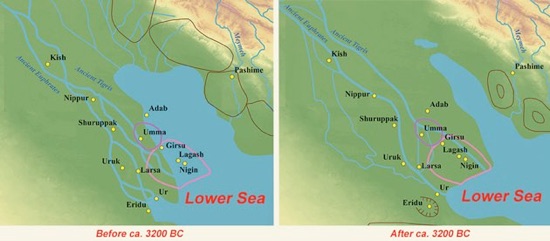
Image from Reed Goodman (referenced below, at p. 32); my additions in red
According to Reed Goodman (referenced below, at p. 32), recent studies of the hydrography on the site of ancient Lagash (as part of the program of excavations by a team from Penn Museum) have revealed that:
“The place where Lagash was first inhabited, [modern Tell al-Hiba] was underwater in the 4th millennium BC, indicating that people could not have settled there until long after the establishment of western cit ies on the Euphrates, like Ur and Uruk. By the time Lagash emerged from the water, around 3200 BC, it benefited from hundreds of years of cultural development in the western cities, such as the invention of the wheel, the cuneiform writing system and the institutions of formalised religion.”
Piotr Steinkeller (referenced below, 2024, Appendix 3, at p, 23), who (as we have seen) did not accept this ‘late’ dating for Mesalim and Menunsi, began his chronological analysis with the inscriptions of Ur-Nanshe, who was (as far as we know) the first independent king of Lagash. More specifically, he argued that these inscriptions display various ‘peculiarities typical of Fara texts’, which strongly suggests that his reign roughly coincided with the Fara period. However, he added that:
“... our best evidence in support of this [synchronism] is provided by CUSAS 26, 69 [= CDLI, P427630)], a legal text from Adab that mentions Akurgal, the son of Ur-Nanshe and his successor to the throne of Lagash [see Akurgal, ensi of Lagash, at 5:5- 6:1].”
He argued that this inscription:
“... constitutes a transitional phase between the orthography of:
✴the Fara tablets and Ur-Nanshe’s inscriptions; and
✴the inscriptions of Eanatum (the son and successor of Akurgal). “
He followed this by arguing that:
“This evidence forces us to conclude that the reign of Ur-Nanshe was contemporaneous with the Fara tablets. Even if this reign was slightly later than those materials (a possibility that cannot be excluded), it still firmly belonged to the ED IIIa period, as it is usually defined by the archaeologists and philologists alike. ... As for Mesalim, whose reign has traditionally been dated to ED II, this ruler must have been a predecessor of Menunsi. This dating finds support in [Mesalim’s] inscriptions, whose paleography is strikingly archaic, being comparable to those of Enmebaragesi of Kish.”
If this is accepted, then it is reasonable to consider the Kishite kings:
✴Enmerbaragesi (and his son Akka, if he actually was a historical figure); and
✴Mesalim and Lugalnamnirshum, both of whom pre-dated Ur-Nanshe (as discussed below);
as all belonging to a relatively short period of time before Kish ceased to exercise hegemony over Adab, Lagash and Umma.
References
Gabriel G. I., "Die ‚Sumerische Königsliste’ als Werk der Geschichte: Kritische Editionsowie text-, stoff- und konzepthistorische Analyse”, (forthcoming: I would like to express my gratitude to Dr Gabriel for allowing me to read a pre-publication copy of this much-needed book)
Goodman R, et al., “The Flooding of Lagash (Iraq): Evidence for Urban Destruction Under Lugalzagesi, the King of Uruk and Umma”, Geoarcheology, 40:5 (2025), online
del Bravo F., “The Diyala Region and the ‘Territorial State of Kish’”, in:
Ramazzotti M. (editor), “Costeggiando l’Eurasia: Archeologia del Paesaggio e Geografia Storica tra l’Oceano Indiano e il Mar Mediterraneo: Primo Congresso di Archeologia del Paesaggio e Geografia Storica del Vicino Oriente Antico (Sapienza Università di Roma, 5-8 Ottobre 2021)”, (2024) Rome, at pp. 297-314
Postgate J. N., “City of Culture 2600 BC: Early Mesopotamian History and Archaeology at Abu Salabikh”, (2024) Oxford
Rey S., “The Temple of Ningirsu: the Culture of the Sacred in Mesopotamia”, (2024) University Park, PA
Steinkeller P., “Campaign of Southern City-States against Kiš as Documented in the ED IIIa Sources from Šuruppak (Fara)”, Journal of Cuneiform Studies, 76 (2024) 3-26
Gabriel, G. I.,"The ‘Prehistory’ of the Sumerian King List and Its Narrative Residue", in:
Konstantopoulos G. and Helle S., “The Shape of Stories”, (2023) Leiden and Boston, at pp. 234-57
Wilson K. L. and Bekken D., “Where Kingship Descended from Heaven: Studies on Ancient Kish”, Chicago IL (2023)
Steinkeller P., “Two Sargonic Seals from Urusagrig and the Question of Urusagrig’s Location’, Zeitschrift für Assyriologie, 112:1 (2022) 1–10
Sommerfeld W., “Old Akkadian”, in:
Vita J.-P., (editor), “History of the Akkadian Language”, (2021) Boston and Leiden, at pp. 513-663
Steinkeller P., “The Sargonic and Ur III Empires”, in:
Bang P. F. et al. (editors), “The Oxford World History of Empire (Volume 2): The History of Empires”, (2021) New York, at pp. 43-72
Lecompte C., “A Propos de Deux Monuments Figurés du Début du 3e Millénaire: Observations sur la Figure aux Plumes et la Prisoner Plaque”, in:
Arkhipov I. et al. (editors), “The Third Millennium: Studies in Early Mesopotamia and Syria in Honor of Walter Sommerfeld and Manfred Krebernik”, (2020), Leiden and Boston, at pp. 417-46
Westenholz A., “Was Kish the Center of a Territorial State in the Third Millennium?—and Other Thorny Questions”, in:
Arkhipov I. et al. (editors), “The Third Millennium: Studies in Early Mesopotamia and Syria in Honor of Walter Sommerfeld and Manfred Krebernik”, (2020) Leiden and Boston, at pp. 686-715
Bartash V., “Going for the Subarean Brand: The Import of Labor in Early Babylonia”, Journal of Near Eastern Studies, 77 (2018) 263-78
Renette S., “Along The Mountain Passes: Tracing Indigenous Developments Of Social Complexity In The Zagros Region During The Early Bronze Age (ca. 3500-2000 Bce)”, 2018) thesis of the University of Pennsylvania
Steinkeller P., “History, Texts and Art in Early Babylonia: Three Essays”, (2017) Boston and Berlin
Zaina F., “Tell Ingharra-East Kish in the 3rd Millennium BC: Urban Development, Architecture and Functional Analysis”, in:
Stucky R. A. et al. (editors), “Proceedings of the 9th International Congress on the Archaeology of the Ancient Near East”, (2016) Wiesbaden, at pp. 431-46
Marchesi G., “Toward a Chronology of Early Dynastic Rulers in Mesopotamia”, in:
Sallaberger W. and Schrakamp I. (editors), “Associated Regional Chronologies for the Ancient Near East and the Eastern Mediterranean. History and Philology: Vol. 3”, (2015) Turnhout, at pp. 139-58
Steinkeller P., “On the Reading of the Pre-Sargonic Personal Name di-(d)Utu and Related Matters”, Journal of Near Eastern Studies, 74:1 (2015) 39-44
Sallaberger W. and Schrakamp I., “Part I: Philological Data for a Historical Chronology of Mesopotamia in the 3rd Millennium”, in:
Sallaberger W. and Schrakamp I. (editors), “Associated Regional Chronologies for the Ancient Near East and the Eastern Mediterranean. History and Philology: Vol. 3”, (2015) Turnhout, at pp. 1-130
Steinkeller P., “An Archaic “Prisoner Plaque” from Kiš”, Revue d'Assyriologie et d'Archéologie Orientale, 107 (2013) 131-57
Wilson K. L., “Bismaya: Recovering the Lost City of Adab”, (2o12) Chicago
Vacin L., “Šulgi of Ur: Life, Deeds, Ideology and Legacy of a Mesopotamian Ruler As Reflected Primarily in Literary Texts”, (2011), thesis of the School of Oriental and African Studies (University of London)
Marchesi G., “The Historical Framework (Chapter 2)” and “The Inscriptions on Royal Statues (Chapter 4)”, in:
Marchesi G. and Marchetti N., “Royal Statuary of Early Dynastic Mesopotamia”, (2011) Winona Lake, IN, at pp. 97-128 and pp. 155-85 respectively
Civil M., “The Lexical Texts in the Schøyen Collection: Cornell University Studies in Assyriology and Sumerology (CUSAS) 12”, (2010) Bethesda, MD
Dalley S. M., “Old Babylonian Prophecies at Uruk and Kish”, in:
Melville S. and Slotsky A. (editors), “Opening the Tablet Box: Near Eastern Studies in Honor of Benjamin R. Foster”, (2010) Leiden and Boston, at pp. 85-97
Marchesi G., “The Sumerian King List and the Early History of Mesopotamia”, in:
Biga M. G. and Liverani M. (editors.), “Ana Turri Gimilli: Studi Dedicati al Padre Werner R. Mayer da Amici e Allievi”, (2010) Rome, at pp 231-48
Frayne D. R., “The Royal Inscriptions of Mesopotamia, Vol. 1: Presargonic Period (2700-2350 BC)”, (2008) Toronto
Klein J., “The Brockmon Collection Duplicate of the Sumerian King List (BT14)”, in:
Michalowski P. (editor), “On the Third Dynasty of Ur: Studies in Honor of Marcel Sigrist”, Journal of Cuneiform Studies, Supplemental Series 1 (2008) at pp. 77–9
Steinkeller P., “An Ur III Manuscript of the Sumerian King List”, in:
Sallaberger W. et al. (editors), “Literatur, Politik und Recht in Mesopotamien: Festschrift fur Claus Wilcke”, (2003) Wiesbaden, at pp. 267-292
Steinkeller P., “The Historical Background of Urkesh and the Hurrian Beginnings in Northern Mesopotamia”, in:
Buccellati G. and Kelly-Buccellati M. (editors), “Urkesh and the Hurrians:Studies in Honor of Lloyd Cotsen”, (1998) Malibu CA, at pp. 75-98
Postgate J. N., “Early Mesopotamia: Society and Economy at the Dawn of History”, (1994) London and New York
George A. R., “‘House Most High: The Temples of Ancient Mesopotamia”, (1993) Winona Lake IN
Katz D., “Gilgamesh and Akka”, 1 (1993) Groningen
Frayne D. R., “Early Dynastic List of Geographical Names: American Oriental Series 74”, (1992) New Haven, CT
Pettinato, G., “Testi lessicali monolingui della Biblioteca: L. 2769” (1981) Naples
Moorey P. R. S., “Kish Excavations (1923-1933)”, (1978) Oxford
Biggs R.D., “An Archaic Sumerian Version of the Kesh Temple Hymn from Tell Abu Salabikh”, Zeitschrift Für Assyriologie, 61 (1971) 193–207
Jacobsen T., “The Inscriptions”, in:
Delougaz P. and Lloyd S. (editors), “Pre-Sargonic Temples in the Diyala Region”, (1942) Chicago IL, at pp.289-98
Jacobsen T., “The Inscriptions”, in:
Delougaz P. (editor), “The Temple Oval at Khafajah”, (1940) Chicago IL, at pp.146-50
Topic: Kish in the Ur III Sumerian King List (USKL)
Main Page: Kingdom of Kish in the Early Dynastic Period