

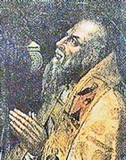
Detail of the altarpiece (1542) of
the Holy Family and St Brictius
by Jacopo Siculo
San Brizio
The Roman Martyrology records, under 9th July:
-
“At Martulae in Umbria, St Brictius, bishop. Under the judge Marcian, after having suffered much for the confession of our Lord, and having converted to Christ a great multitude of people, he rested in peace, a confessor”.
The Martyrology of Florus (825-40) records that St Brictius, bishop and confessor, was martyred on 9th July “in civitate Martulana”. St Brictius was also recorded as a bishop under 9th July in other early martyrologies, which give other forms of the place of martyrdom:
-
✴“Martulana Civitate” (the Martyrology of Adon); and
-
✴“Civitate Martula” (the Martyrology of Usuard).
There is some dispute about the location of this place, but it is usually thought to be Civitas Martana, the precursor of modern Massa Martana. (St Brictius is mentioned in the page on Saints of Massa Martana).
In Florus’ account, St Brictius was imprisoned and tortured by the judge “Martianus”. St Brictius escaped further punishment when Martianus was among those killed in an earthquake. Christ sent St Peter and an angel to comfort and encourage him, and he continued his ministry, before dying in peace. Those present at his death saw his soul, in the form of a dove, fly up to Heaven.
-
✴Note that Florus does not indicate when St Brictius died: however, the judge Martianus also appears in his account of SS Carpophorus and Abundius, who were martyred near “Hispolitanum civitatem” (probably Spoleto) during the Emperor Diocletian’s persecution of Christians (303 AD).
-
✴Note also that Florus does not associate St Brictius with Spoleto. However, the church of San Brizio in the village of the same name (30 km east of Massa Martana and 7 km north of Spoleto) incorporates architectural fragments from the 6th century, including a sarcophagus in the crypt that is said to hold the relics of St Brictius.
Legend of the Twelve Syrians (BHL 1620)
St Brictius is the main protagonist of the legend “Sanctii Anastasii et 11 fratrum, qui cum eo de Syriae partibus” (St Anastasius and 11 brothers who came from Syria, which is otherwise known as the Legend of the Twelve Syrians. According to this legend, St Anastasius travelled to Italy with his sons SS Brictius and Eutychius and other members of his extended family: SS Carpophorus, Abundius, Laurence, John, Isaac, Teudila, Proculus, Herculanus and Baractalis. A bishop named Urban ordained:
-
✴SS Brictius and Carpophorus as priests; and
-
✴SS Laurence and Abundius as deacons.
While in Rome, the family then embarked on a programme of evangelisation that led to their imprisonment. When St Anastasius was subsequently beheaded, SS Brictius and Eutychius led the rest of the family to safety along Via Cornelia. They then split up at a place called “Pax Sanctorum”: SS Eutychius and Proculus went their separate ways, while St Brictius and the rest of the family moved to Spoleto.
In the introduction, the events are set in the time of:
-
✴the Emperor Julian the Apostate, who was emperor in the west from 355 and sole emperor in the period 360-3; and
-
✴“ss. episcopo Urbano” or variants thereof, which is usually taken to be an anachronistic reference to Pope Urban I (died 230).
The paragraphs specifically dedicated to St Brictius are not set within a specific historical framework. However, the events unfold at the time of the martyrdom of SS Carpophorus and Abundius, which are set at the time of Diocletian’s persecution of Christians, in 303 AD. For an analysis of these chronological inconsistencies, see the Legend of the Twelve Syrians III.
Edoardo d’ Angelo (referenced below) has published the text of BHL 1620 (at pp. 190-214), and a translation into Italian (at pp. 215-25).
Legend of St Brictius within BHL 1620
As noted above, a bishop of Rome called Urban ordained
-
✴SS Brictius and Carpophorus as priests; and
-
✴SS Laurence and Abundius as deacons.
The account that follows describes the subsequent legend of St Brictius, which forms the nucleus of BHL 1620.
Lines 30-2
As noted above, after leaving Rome, St Brictius arrived in Spoleto with SS Carpophorus and Abundius and his other members of his extended family. There, they were able to covert many people to Christianity.
Lines 33-44 - SS Carpophorus and Abundius
The narrative is then interrupted by the first part of the Legend of SS Carpophorus and Abundius, which is essentially derived from the entry for these saints in the Martyrology of Florus.
Lines 45-67
St Brictius went into hiding when he heard that the magistri militum Turgius and Leontius had arrested SS Carpophorus and Abundius. He prayed for divine guidance for three days and three nights, at a place on the outskirts of the city called “Apianus”. An angel appeared to him and guided him to a “locus salutis” (safe place). As they walked together through a village, they met a blind man called “Pisentius”, whom St Brictius cured and baptised. He then continued to this safe location, which was “in superiorem viam in verticem collis” (on the upper road, at the top of the hill). The angel told him that he would remain here until the Day of Judgement, blessed him, and disappeared. St Brictius now began to evangelise the people throughout the region “sub montana Martulana” (under the Monti Martani). He built an oratory with his own hands on the spot at which he had received the angel’s blessing, which he called “Salustianum”. [In this place, one finds “Geniolato” ??]
According to Emore Paoli (referenced below, at p. 487), Salustianum was probably later the site of the church of San Brizio - see below).
Lines 68-106 - SS Carpophorus and Abundius
The narrative is then interrupted by the second part of the Legend of SS Carpophorus and Abundius.
-
✴Lines 68-99 were essentially derived from the entry for these saints in the Martyrology of Florus.
-
✴However lines 100-6 contained new information that changed the place of their martyrdom from Spoleto (as in Florus and the slightly later martyrologies) to Foligno. I suggest below that this change was probably related to the fact that relics claimed to be those of St Abundius were translated from Foligno to Berceto in ca. 850, under the auspices of Bishop Domenico of Foligno.
Lines 107-26
When the proconsul Martianus heard the St Brictius was still at “Civitate Martulana”, he ordered his arrest. The soldiers found him in his oratory, some six Roman miles from Spoleto, “in territorio Salustiano, in superiori via in vertice collis” (in the territory of Salustianum, on the upper road at the top of the hill).
Martianus had St Brictius tortured and imprisoned, but this process was cut short when Martianus was killed in an earthquake that struck his palace. St Peter and an angel appeared to the incarcerated St Brictius.
[Note that most of this information is included in the account by Florus, except that the place of St Brictius’ incarceration is now Spoleto.]
Lines 127-38
While still in the cell in Spoleto, St Peter consecrated St Brictius into the “ordine pontificatus, ut per singulas civitates episcopos ordinaret” (the order of the pontificate, with authority to ordain bishops in every city). The angel then took him back to Salustianum, telling him that he would die after 45 years. St Brictius then led a group of Christians to a place called “Mariano”, where he built a second oratory, which this time was dedicated to the Virgin.
St Brictius duly appointed the following bishops in the mountainous and flat zones of the [unnamed] city:
-
✴Spoleto (“Metropoli civitati Spoletinæ”), where he appointed St John, who destroyed all the pagan temples there and built the huge church of San Pietro near the mountains outside the city);
-
✴Bevagna (St Vincent);
-
✴Bettona (St Scipiodotus - see St Crispoltus), as St Peter had suggested; and
-
✴Perugia, (where he appointed his nephew St Herculanus, who subsequently earned the palm of martyrdom).
Lines 139-47 - St Herculanus
[The narrative is then interrupted by an account of the martyrdom of St Herculanus after the seven year siege of his city, Perugia, “tempore perfidus Totila Rex” (at the time of the perfidious King Totila: Perugia fell to Totila in 549). The account here is taken from the Dialogues of Gregory I, but the dies natalis (7th November) is taken from the Martyrology of Florus. It is unclear why this section was inserted into an account that describes events that took place under Diocletian in 303.]
Lines 148-60
St Brictius then built with his own hands a burial chamber at his oratory. An angel appeared to him at Easter to announce his imminent death. He died on 9th July, and those present saw his soul fly to Heaven in the form of a dove. Miracles still occur at St Brictius’ tomb on the anniversary of his death.
[Note that the motif of his soul ascending to Heaven in the form of a dove is included in the account by Florus. This motif also appears in two accounts in the Dialogues of Gregory I:
-
✴Three days after his last meeting with his sister St Scholastica, St Benedict had a vision of her soul, “which was departed from her body in the likeness of a dove ascending into Heaven”.
-
✴The monks attending the death of St Spes “all saw a dove coming out of his mouth, which ... ascended up into Heaven: ... his soul ... did in that manner appear so that almighty God might thereby show with what a true and simple heart that holy man [St Spes] had always served him”.]
Date of the Legend of St Brictius within BHL 1620
Emore Paoli (referenced below, at p. 489-91) pointed out that the legend must have been written at a time when there was a preoccupation with the episcopal structure of Umbria, with Spoleto at its heart. It took no account of the existence of the Byzantine corridor (St Brictius ordained his nephew as Bishop of Perugia), so it clearly post-dated the end of Lombard dominance in 773. He suggested that the reign of the Carolingian Duke Winigis of Spoleto (789-822) provided one likely window. However, I think this is unlikely, since the separate entries in the Martyrology of Florus for St Brictius of Massa Martana and SS Carpophorus and Abundius of Spoleto, which were written in the period 825-40, seem to have been incorporated into what seems to be a later composition. (Note that Emore Paoli (referenced below, at p. 486) drew the opposite conclusion: i.e. that Florus drew on BHL 1620).
In a different context, Emore Paoli (referenced below, at p. 499) pointed out that BHL 1620:
-
“... should be interpreted as the celebration, at the hagiographic level, of the good relations that the ex-Lombard Duchy [of Spoleto] had with the papacy: [this situation] progressively intensified during a large part of the 9th century, which found in Duke Guy I (842-58) perhaps one of its most vigilant guarantors. ... This is ... the time when it is possible to recognise a unanimity between the Franks, the Apostolic See and the institutions of the Duchy of Spoleto, both civic and ecclesiastical, which also involved the Abbazia di Farfa ...” (my translation).
He had already asserted (at p. 496) that:
-
“... the attribution to the monks of Santa Maria di Farfa ... of [BHL 1620 is a] hypothesis of which I am increasingly convinced ...” (my translation).
On this basis, Edoardo d’ Angelo (referenced below, at p. 108) dated BHL 1620 t0 about the middle of the 9th century, I conclusion with which I agree.
Lines 100-6
These lines of BHL 1620 provide support for the hypothesis that it was written in ca. 850. As noted above, while the other material in the legend that related to SS Carpophorus and Abundius essentially derived from Florus (see my page on SS Carpophorus and Abundius), these lines contained new information that changed the place of their martyrdom from Spoleto (as in Florus and the slightly later martyrologies from his) to Foligno. This material has no known earlier source, and we can reasonably assume that it appeared for the first time in BHL 1620.
According to this new information, having been imprisoned in Spoleto (where Florus had them beheaded), SS Carpophorus and Abundius were instead taken to civitas Fulginia and beheaded outside its walls. An angel appeared to a Christian lady called Eustochia and instructed her to retrieve the bodies at “Thanaritanus”, at the foot of "Monte Rotondo" (the round mountain), which was a Roman mile from the city. The angel further instructed Eustochia that, having found the bodies, she should bury them in a new sarcophagus. She duly obeyed these instructions and buried SS Carpophorus and Abundius in “spelunca sua” (literally “her cave”, presumably a cavern used for burial).
I think that this change of the place of martyrdom was made at the time of the translation of what were claimed to be the relics of St Abundius from Foligno to Berceto in 850. As recorded in BHL 0019 (see “Tractatus Praeliminaris ad Tomem Primum Julii” of 1719, search in this link on “Tyberius”), Abbot Tiberius was trying at this time to increase the prestige of his abbey in order to avoid (unsuccessfully, as it turned out) its transfer to the Bishop of Parma, and had prepared a new site in its church for the relics of St Moderanus. However, this saint had appeared to him in a dream and told him to reserve the new site for the relics of St Abundius. He learned from Bishop Domenico of Foligno (whom he met at the Council of Pavia in 850) that Foligno housed the relics of “SS Abundius and Carpophorus and of those who had suffered with them”. Bishop Domenico agreed to help Abbot Tiberius, and relics of St Abundius were duly translated to Berceto. BHL 0019 was presumably written soon after the translation, and presumably at Berceto. It says nothing about the life and martyrdom of St Abundius, concentrating on the miraculous events that attended the translation. Nevertheless, Tiberius would have needed to explain how the relics of St Abundius, whom Florus and later martyrologies had described as being martyred at Spoleto, came to be in Foligno. It seems to me that the new material in lines 100-6 of BHL 1620 would have served his purpose perfectly.
Commissioner of BHL 1620
As discussed below, the central ‘political’ message of the parts of BHL 1620 devoted to St Brictius seems to have been related to the precedents for the metropolitan status of the bishopric of Spoletp. Thus, the obvious candidate for its commissioning in Bishop Peter II of Spoleto, who was recorded in surviving documents on a number of occasions in the period in question:
-
✴In 842, the Emperor Lothar I entrusted the Abbazia di Farfa to him after the death of Abbot Sichardus.
-
✴In 844, he persuaded Lothar I to confirm the election of Abbot Hildericus at Farfa.
-
✴In 853, he attended the synod held by Leo IV in Rome. According to the ‘Liber Pontificalis’, 4 of the 67 bishops attending this synod had been sent by Lothar I and Louis II: the four included Bishop Peter.
-
✴After the synod, Leo IV sent him as his legate to the Council of Soissons (854).
-
✴In ca. 864, he was again documented in connection with the Abbazia di Farfa, in support of its negotiations with the Emperor Louis II in connection with an estate at Massa Torana (near Rieti).
There is also circumstantial evidence for his interest in contemporary hagiography.
It is known that, in ca. 853, Adon (later Archbishop of Vienne) travelled from Rome to Ravenna, where he compiled the material for his Martyrology (858). This martyrology constitutes the earliest surviving reference to three saints that were associated with Spoleto (SS Concordius, Pontian, and Gregory of Spoleto), which suggests that he stopped in Spoleto, where he presumably had discussions with Peter II.
Political Message of BHL 1620
BHL 1620 is famous for its incoherent chronology, but its central ‘political’ message is clear: while St Brictius was imprisoned in Spoleto, St Peter appeared to him and consecrated him into the “ordine pontificatus, ut per singulas civitates episcopos ordinaret” (the order of the pontificate, with authority to ordain bishops in every city). He subsequently escaped and took refuge in Massa Martana, from whence he duly appointed the bishops of the following cities:
-
✴Spoleto (“Metropoli civitati Spoletinæ”), where he appointed St John, who destroyed all the pagan temples there and built the huge church of San Pietro;
-
✴Bevagna (St Vincent);
-
✴Bettona (St Scipiodotus or Crispoltus); and
-
✴Perugia, (where he appointed his nephew St Herculanus, who subsequently earned the palm of martyrdom).
Reaction to BHL 2846?
It is often pointed out that the legend of St Felician of Foligno and Forum Flaminii (BHL 2846) involves two locations that also appear in lines 100-6 of BHL 1620 (above):
-
✴In the latter, SS Carpophorus and Abundius were beheaded outside the walls of civitas Fulginia, and a Christian lady called Eustochia retrieved their bodies at “Thanaritanus”, at the foot of "Monte Rotondo", which was a Roman mile from the city.
-
✴In the former, St Felician died at “Monte Rotondo", which was three Roman miles from “his city” (which could mean Forum Flaminii or, more probably, means Fulginia), and he was buried “iuxta Fulgineam civitatem”.
In addition, the central political message of BHL 2846 is similar to that of BHL 1620::
-
✴Pope Victor I ordained St Felician with metropolitan authority ‘per Thusciam Picenumque’ (for Tuscany [and Umbria] and Picenum);
-
✴he successfully evangelised Foligno, Spello, Bevagna, Nocera, Plestia and Trevi, and had some limited success in Perugia;
-
✴he also converted the Jews of Norcia and ordained one of them, Pisentius, as a priest; and
-
✴he ordained the deacon St Valentine as Bishop of Terni.
Thus it seems that the bishops of Spoleto and Foligno were setting out the precedents for what must have been their own claims for metropolitan authority, presumably at about the same time.
Albert Dufourcq (referenced below, at p. 84) suggested that BHL 1620 responded to the papal privilege granted to St Felician in BHL 2846 with the claim that the privilege given to St Brictius came from St Peter himself. This suggests that BHL 2846 was the earlier of the two: the reasons given by Emore Paoli (referenced below, at pp. 503-4) for placing the legends in the opposite chronological order - that the appearance of SS Abdon and Sennen in BHL 2846 was inspired by the appearance of St Abundius in BHL 1620 - seems to me to be less persuasive.
Albert Dufourcq suggested (at p. 83) that respective political messages implied antagonism between the respective dioceses:
-
“Forum Flaminii stands against Spoleto: the author [of BHL 2846] emphasises the persistent attachment [of Spoleto] to paganism”.
Emore Paoli (referenced below, at pp. 501-2) was of a similar opinion, suggesting that BHL 2846:
-
“... constitutes an attempt by Foligno to forge a solid pact with Perugia in order to undermine the hagiographic [propaganda] of Spoleto and to secure a leading rôle in the moves that were underway to reorganise the [episcopal structure of Umbria] ...” (my translation).
His reasoning was that BHL 2846 had Spoleto (as well as Assisi) impervious to the preaching of St Felician, while Perugia was at least partially receptive, in order to win the support of the latter against the former. However, I think that this aspect of the legend has precisely the opposite significance: the author of BHL 2846 stressed that he made no claim for St Felician as the first evangeliser of Assisi, Spoleto or (to any significant extent) Perugia because he eschewed any claim for authority over these dioceses.
This suggestion is supported by the fact that there is very little overlap between the respective territorial claims:
-
✴in BHL 1620, St Brictius appointed bishops at Spoleto, Bevagna, Bettona and Perugia; while
-
✴in BHL 2846, St Felician successfully evangelised Foligno, Spello, Bevagna, Plestia and Trevi
Apart from the overlap at Bevagna, two claims in BHL 2846 might have offended Spoleto: the St Felician had ordained:
-
✴Pisentius as a priest at Norcia; and
-
✴the deacon Valentine as bishop of Terni.
In fact, as I set out in my page on St Felician:
-
✴BHL 1620 made no counter-claim to Norcia; and
-
✴the reference to St Valentine in BHL 2846 probably had a specific significance that had nothing to do with any claims on the part of Foligno on the diocese of Terni.
Wider Political Significance
Bevagna, Bettona and Perugia, three of the four dioceses to which St Brictius appointed bishops, all bordered on the diocese of Todi. By 850:
-
✴the diocese of Bevagna had been absorbed by that of Spoleto; and
-
✴the diocese of Bettona had been absorbed by that of Assisi.
In addition, if civitas Martana, the base from which St Brictius operated, had ever been a diocese, it had been either been absorbed by Spoleto or alternatively divided between Spoleto and Todi in the 6th century. It is possible that, in commissioning BHL 1620, Peter II was intent upon curtailing the territorial aspirations of Bishop Agatone II of Todi and undermining the authority of Bishop Ivo (or Ibone) of Assisi and Bishop Benedetto II of Perugia. However, this is not necessarily the case: for example, as suggested above, the parts of the legend that relate to SS Carpophorus and Abundius, which involved changing the place of their martyrdom from Spoleto to Foligno, were probably included to facilitate the desire of Bishop Domenico of Foligno to give what he claimed were relics of St Abundius to Bishop Tiberius of Berceto.
We know that Bishop Domenico of Foligno reached his understanding with Bishop Tiberius of Berceto when both were attending the Council of Pavia in 850. It seems likely that he reached his related understanding with Bishop Peter, involving the related additions to BHL 1620, when both attended the synod the Pope Leo IV held in Rome in 853. This synod was remarkable for the number of Umbrian bishops attending:
-
✴Albano of Amelia;
-
✴Ivo [or Ibone] of Assisi;
-
✴Roderico of Citta di Castello;
-
✴Domenico of Foligno;
-
✴Erfo of Gubbio;
-
✴Stefano I of Narni;
-
✴Pietro I of Orvieto;
-
✴a representative of Benedetto II of Perugia;
-
✴Peter II of Spoleto; and
-
✴Agatone II of Todi.
It seems to me that the diocesan structure of Umbria was relatively stable by this time. Peter II might have used the occasion to remind Bishop Domenico of his “higher” claim on Bevagna, in return for his help in relation to the relics of St Abundius. Beyond that, it seems to me that the object of BHL 1620 was to underline to his colleagues his superior status, which was also exemplified by the fact that he was one of the four bishops (of 67) attending the synod who had been sent by Lothar I and Louis II.
Legend of the Twelve Syrians (BHL 1622)
The prototype for BHL 1622 was published under the title “Passio SS Abundii et Carpofori Martyrum” by Bonino Mombrizio, in his “Sanctuarium seu Vitae Sanctorum” (ca. 1478) and republished in 1910 (see pp. 16-9 in the link above). It was based on lines 1-106 of BHL 1620, and now had only eleven followers of St Anastasius: St Baractalis was omitted.
Edoardo d”Angelo summarised three other versions of this legend: BHL 1622b; BHL 1622d ; and BHL 1622f. [In the titles given by Edoardo D’Angelo for these versions, St Athanasius replaced St Anastasius.] BHL 1622d (discussed below) is the most important of these variants for this website.
BHL 1622d
The Leggendari del Duomo di Spoleto contain two virtually identical copies of this version of the legend, in both cases catalogued under 9th September as the “Passio s. Britii”:
-
✴one of these copies is in the legendary from San Felice di Narco (Volume II, Folios 100-2); and
-
✴the other is in the legendary from San Brizio (Folios 180-2).
Edoardo D’ Angelo (referenced below, at p. 98) suggested that 9th September was the date of the translation of the relics to San Brizio. A. Cordella and A. Inverni (referenced below) included a transcription of these two legends (at pp. 137-40) and translated the second of them into Italian (at pp. 89-93).
This version contains no new information, but the order in which St Brictius built his two oratories is reversed:
-
✴He first constructed the oratory dedicated to the Virgin at “Mariano”, and built there, “with his own hands”, the tomb in which he expected to be buried. It was here that he consecrated as bishops: John of Spoleto; Vincent of Bevagna; Crispoltus of Bettona; and Herculanus of Perugia.
-
✴As he prayed there at Easter, the angel appeared and took him to another place, telling him that he would stay there until the day of judgement. St Brictius called this place “Salustianum”, and built another small oratory there. [The actual death of St Brictius is not described, at least in the text reproduced in Cordella and Inverni]
By changing the end of the legend, the author of these two versions removes any doubt that St Brictius died at “Salustianum”, which he says is located on a small hill at the foot of the mountains. He probably associated this place with the later site of the church of San Brizio, in which the supposed relics were venerated. (This aspect of the accounts is discussed in more detail in the page on the Legend of the Twelve Syrians III.)
St Brictius in the Legend of the 300 Syrians
St Brictius is named in the legend of St Laurence (BHL 4748 d), who was one of an “infinita turba” (boundless multitude) of Syrian immigrants. By this route he found his way into the Legend of the 300 Syrians, a construct by local scholars in the late 16th and early 17th centuries in which a large group of Syrian monks arrived in Umbria in 516.
St Brictius at Orvieto (13th November)
The first cathedral of Orvieto (Santa Maria Prisca) had a secondary dedication to St Brictius. The venerated icon known as the Madonna di San Brizio, which he was believed to have given the city, survives in the Cappella Nuova (also known as the Cappella della Madonna di San Brizio) in the Duomo there. However, it was traditionally exposed on 13th November, the feast day of the French saint of this name.
Read more:
E. d’Angelo, “Terni Medievale: La Città, la Chiesa, i Santi, l' Agiografia”, (2015) Spoleto
E. Paoli, “ L' Agiografia Umbra Altomedievale”, in
“Umbria Cristiana: dalla Diffusione del Culto al Culto dei Santi (secc. IV-X): Atti del XV Congresso Internazionale di Studi sull' Alto Medioevo (Spoleto, 23-28 Ottobre 2000)”, Spoleto (2001) pp 479-529
R. Cordella and A. Inverni, “San Brizio di Spoleto, la Pieve e il Santo: Storia, Arte, Territorio”, Spoleto (2000)
A. Dufourcq, “Étude sur les Gesta Martyrum Romains: Tome III: Le Mouvement Légendaire Grégorien”, (1907) Paris
Return to Saints and Venerated Objects of Spoleto.