

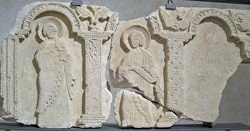
This ancient church stood on Via Flaminia to the north of Spoleto. All that survives from its fabric are two marble reliefs that are now in Room 8 of the Museo del Ducato di Spoleto:
-
✴a decorative relief (late 8th century); and
-
✴a relief of the Annunciation (9th century), illustrated above.
The church fell into disuse in the 16th century and part of it was transformed into a barn in 1677. It was converted for residential use in 1867.
Sarcophagi (mostly 4th and 5th centuries) and human remains discovered nearby in 1912 and 1958 suggest that the church stood in or near an early Christian cemetery.
Early Christian Funerary Inscriptions
Seven funerary inscriptions from SS Apostoli have been documented, five in Latin and two in Greek. Four of the five Latin inscriptions are now in Room 2 of the Museo del Ducato di Spoleto:
-
✴Exhibit 2.3: This is the funerary inscription for Bishop Spes (ca. 380 AD) described below.
-
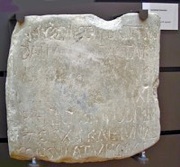
✴Exhibit 2.5: This inscription (CIL XI 4970) commemorates Brittius Dalmatius, who was ecclesiastical notary (notarius ae[clesiae]) for five years (presumably at Spoleto), and who died aged 31 on 21st May (XII kal[endas] iunas) in one of the consulates of “Honor...” (the Emperor Honorius (395-423), who was consul on 13 occasions).
-
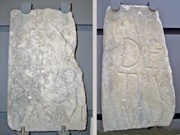
✴Exhibits 2.1 and 2.2: These two fragments commemorate Christians who died in the 4th or 5th century:
-
•CIL XI 4984 commemorates No[nna], who died on 6th July (pridie nonas iulias); and
-
•CIL XI 4985 commemorates [Pe]tru[s] Val ...
-
(These names are the best guesses from the surviving fragments).
Funerary inscription for Bishop Spes (late 4th century)
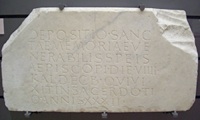
The inscription reads:
DEPOSITIO SANC/TAE MEMORIAE VE/NERABILIS SPEIS
AEPISCOPI DIE VIIII/ KAL DECB
QUI VI/XIT IN SACERDOTI/O ANNIS XXXII
It commemorates Bishop Spes, who died on 21st November, having lived as bishop for 32 years.
The monk John of Montecassino, who wrote the legend of St John of Spoleto in the reign of the Emperor Otto II (967-83), noted in it that a sarcophagus in SS Apostoli had been used to house the body of Bishop Spes after its apparently recent re-discovery. An ivory reliquary (perhaps 9th century) of an unknown St Spes in the Palatine Chapel at Aachen was opened in the late 19th century and found to contain exact transcriptions of this epitaph. This suggests that the rediscovery of the relics in the 9th or 10th century gave rise to a cult of “St Spes” and that some of the relics subsequently found their way to Aachen.
Funerary inscription for Tullius Anatolius Artemius (384 AD)
This funerary inscription (CIL XI 4968) was recorded in situ under the pavement of the apse in the 19th century, next to that of Bishop Spes.
Accipite sancti vobis / [fr]atre[m] dignumq(ue) mi(i)strum Chr(isti)
Tullium/ Anatolium Artemium c(larissimum) p(uerum)
qui vixit annos sex menses/ octo dies/ XXIII depositus die/ III Idus Oct(o)ber
Ricomere et Clearcho/ vv(iris) cc(larissimis) c(onsulibus)
The original has been lost but a transcription of it (together with an inscription of the epitaph of Bishop Spes) was found at Aachen in the late 19th century. It commemorated a boy who had died aged only 6 years and 8 months in the consulate of ‘Ricomere and Clearcho’ (Richomeres and Clearchus, in 384 AD). Tullius’ family names suggest that he had been the son of an official of the eastern part of the Empire. The first line of the inscription could not have described this young boy, and it has been suggested that Bishop Spes had donated an epitaph that he had intended for his own funerary monument.
Read more:
C. d’Angela, “Il Vescovo Spes e la Basilica Spoletina dei SS. Apostoli”, in
“Il Ducato di Spoleto: Atti del IX Congresso Internazionale di Studi sull' Alto Medioevo”, (1983) Spoleto, pp. 851-67
F. Antolini, ““La Basilica dei SS Apostoli a Spoleto”, in:
“Martiri ed Evangelizzatori della Chiesa Spoletina: Atti del Primo Convegno di Studi Storici Ecclesiastici: Spoleto, 2-4 gennaio 1976”, (1977) Spoleto , pp 179-83
For Bishop Spes and Tulius Anatolius Artemius, see the page on
Return to Monuments of Spoleto.
Return to Walk IV.