
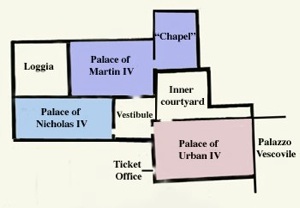
The museum is currently located on the ground floor of the Palazzi Papali.
Palace of Pope Urban IV
The entrance and ticket office are on the left of the palace attributed to Pope Urban IV. The rest of this room houses a collection of Umbrian (as opposed to Etruscan) finds from the area around Orvieto.
The door at the back of the room leads to the inner courtyard:
-
✴The first part of the wall on the left originally contained an open arch that was first closed in the 16th century. [Inscription of Cardinal Simoncelli ??].
-
✴The entrance in this wall leads to what was originally an open loggia and on into the palace attributed to Pope Nicholas IV (see below).
-
✴The entrance in front of you leads to the palace attributed to Pope Martin IV (see below). You can see two of the trifore windows of this palace from the courtyard.
Palace of Pope Nicholas IV
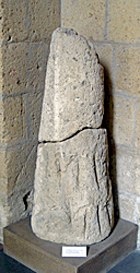
Etruscan inscription (ca. 4th century BC)
Finds from Necropolis of Crocifisso del Tufo
Many of the finds in the museum came from the most recent excavation (1982-3) of the necropolis of Crocifisso del Tufo.
Drinking horn (6th century BC)
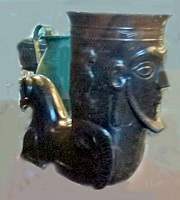
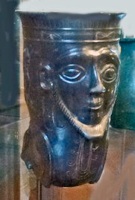
This striking bucchero drinking horn has a human head at one end and a crouching ram at the other. There is a similar object, apparently from Chiusi, in the Museum of Fine Arts, Boston.
Inscription [date?]
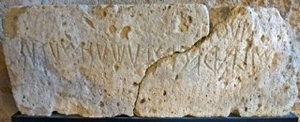
[Details ??]
[Not yet copied to page on necropolis]
Palace of Pope Martin IV
Finds from Cannicella (7th-5th centuries BC)
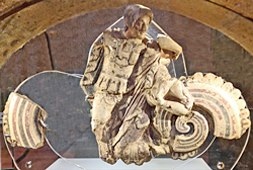
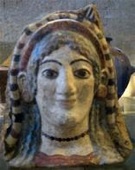
These finds from the temple in the necropolis of Cannicella are in the square tower that is usually referred to as the chapel. The exhibits include:
-
✴a fragment of a painted terracotta relief of a soldier slaying a woman (ca. 500 BC) that represents Neoptolemus, the son of Achilles sacrificing Polyxena, Princess of Troy to placate his father’s ghost; and
-
✴a beautifully preserved antefix in the form of a polychrome female head with particularly arresting features that possibly represents the goddess Vei.
Finds from the Tempio del Belvedere
Sporadic finds during the construction of the Pozzo di San Patrizio in 1527-32 pointed to an important Etruscan cult site nearby. The remains of the temple itself (now known as the the Tempio del Belvedere) were discovered during roadworks in 1828. Excavations on the site in 1923 unearthed the floor plan and a number of column fragments.
A number of decorative elements of exceptional quality that were also uncovered suggested that the temple had been dedicated to Tinia (Greek Zeus, Roman Jove). Their dating on stylistic grounds pointed to the rebuilding or extensive redecoration of the temple in the late 5th or early 4th century BC.
The following are in the Museo Archeologico Nazionale:
Terracotta Figures (ca. 400 BC)
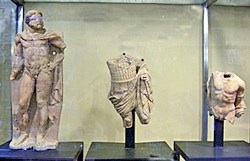
A number of terracotta figures discovered on the site include:
-
✴a splendid full length figure of a bearded God who is nonchalantly naked except for his cloak;
-
✴part of a figure in armour; and
-
✴part of a figure of a captive.
Terracotta Antefixes (ca. 400 BC)
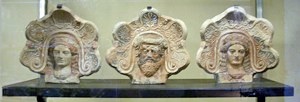
The large number of decorative elements found on the site include these three particularly well preserved polychrome terracotta antefixes (one with a bearded male head and two with female heads).
Finds from Palazzo del Popolo
The following were found in or near the present site of Palazzo del Popolo:
Antefix (5th century BC)
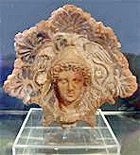
Finds from Via San Leonardo (ca. 400 BC)
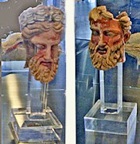
The finds exhibited in the museum include two hollow terracotta heads of a bearded man (probably Tinia/ Zeus). These heads might have been modelled on Phidias' famous statue of Zeus (437 BC) at Olympia.
Settecamini Necropolis
An archaeologist named Domenico Golini discovered this necropolis in 1863 on a hillside at Settecamini, about 3 km south of the Abbazia dei SS Severo e Martirio on the road to Porano. The tombs, which were laid out in tiers on the hillside, belonged to a number of aristocratic families that had probably had country estates nearby.
Two of the tombs that were on the higher part of the hillside were distinguished by a series of frescoes painted on their walls:
-
✴Golini I (dei Leinie); and
-
✴Golini II (dei Verenas).
The frescoes, which rapidly deteriorated, were detached in 1950 and moved to the Museo Archeologico, Florence. They were transferred to this museum in 1982 and are now displayed in a space that has been designed to replicate the original tombs. Grave goods from other tombs on the site or displayed nearby. The frescoes and grave goods are described in the page on the Settecamini Necropolis.
Chapel
Finds from the Campo della Fiera
The following were found during the excavation of a sanctuary at Campo della Fiera in 2008. They are now exhibited in the room that served as the chapel of the palace.
Terracotta Bust (ca. 400 BC)
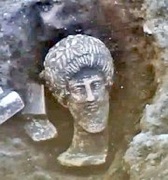
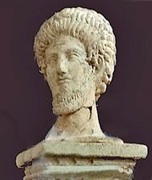
This terracotta portrait bust [published??], perhaps of a male divinity [or an emperor in the guise of a divinity ??], was found under and facing the tufa altar in the sacred area of Temple A when the altar itself was removed for restoration (as described at the end of the videoclip above).
Inscribed Base for a Statue (ca. 500 BC)
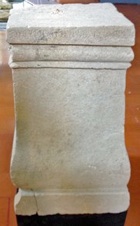
kanuta larecenas lauteniθa aranθia pinies puia turuce
tlusχval marveθul faliaθere
Kanuta, freedwoman of the Larecena, wife of Aranth Pinie, has offered ... [this statue?] to Tluschva
The inscription dates to the late 6th century BC.
This deity is named three times on the famous “Piacenza Liver” (as “Tlusc”, “Tluscv”, “Mar Tlusc”) and also appears in another recently-discovered inscription from Cerveteri. This deity (or group of deities) is usually taken to be female, and to be chthonic (related to the underworld):
-
✴“Tluschval” (as in the Orvieto inscription) seems to be a genitive form of the plural;
-
✴in his webpage, Glen Gordon suggests that “Tluschva” is “a single god [named for] a pluralized inanimate concept”, specifically “depths”.
The translation of the fuller name in the inscription at Orvieto (“tlusχval marveθul faliaθere”) is still debated among scholars:
-
✴ Giovanni Colonna (referenced in the page on Campo della Fiera) suggests that “marveθul” derives from “maru” (magistrate).
-
•He goes on to suggest that, in this inscription, it is an epithet that signifies “minister, acolyte or helper”, perhaps of Hades, the god of the underworld; while
-
•Simonetta Stopponi (in the appendix to the article of 2011 referenced in the page on Campo della Fiera) suggests that the magistracy in question was connected to the construction of public buildings, and translates “marveθul” as “of the seat or residence”.
-
✴“faliaθere” might be a locative related to “faladum”, a Latinised Etruscan word that Festus translated as “coelum” (heaven). Simonetta Stopponi (in the appendix mentioned above) translates it as “in the celestial place”, and tentatively suggests that this is the Etruscan name for the sanctuary at Campo della Fiera.
The inscription is discussed in context in the page Early Etruscan Inscriptions.
Head Vases (5th century BC)
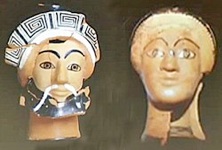
The objects found in the cavity described above included these two greek head vases, which depict:
-
✴Dionysus (ca. 480 BC), attributed to the London Class; and
-
✴a maenad (mid 5th century BC), attributed to the Cook Class.
Bases for Votive Bronzes
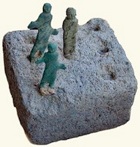
Votive Objects (mostly ca. 500 BC)
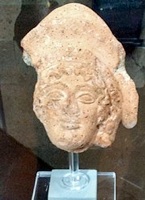
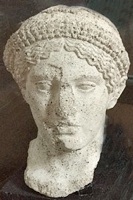
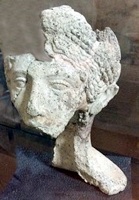
Two ditches in the sacred enclosure seem to have been used as a repository in the same circumstances pertaining to the rectangular cavity described above. The finds here included:
-
✴a number of terracotta heads of women, including:
-
•the oldest of these (illustrated above on the left) which dates to the second half of the 6th century BC; and
-
•another two (illustrated above at the centre and right) that date to the second half of the 5th century BC;
-
✴the terracotta bust of a female deity (first half of the 5th century BC) which is set on a base that is equipped with a hole that would have received liquid offerings;
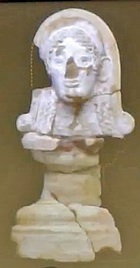
-
✴a small bronze head of a woman (490-80 BC), the base of which was found nearby.
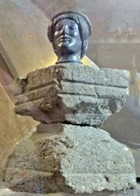
Thesaurus
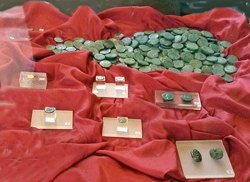
A thesaurus (stone container with an opening in its lid, often used for the collection of coins) was found in tact in 2008 in the sacred area of Temple A, in front of the tufa altar mentioned above. It was partially covered by a thick layer of ash and coals from sacrifices. It contained some 221 coins:
-
✴Most of the dateable examples came from the period 211-91 BC.
-
✴The remainder, from the triumviral and Augustan periods, included:
-
•a denarius (39 BC) commemorating Octavian and Mark Antony;
-
•18 coins commemorating Octavian and divus Julius (his deified “father”, Julius Caesar), at least some of which seem to have been “imitations” (perhaps locally minted) of the official issue of 38-7 BC; and
-
•14 coins (ca. 16 BC) commemorating Octavian after his accession as the Emperor Augustus.
-
✴Some dateable remains near to, but outside the thesaurus, including an as (coin) minted by C. Plotius Rufus (15 BC), suggest that, by this time, the thesaurus itself was no longer in easy use.
-
✴However, 6 of the 221 coins had been pushed under the lid thereafter. The most recent of these was a coin (7 BC) minted by M. Maecilius Tullus, which commemorated Augustus.
The way in which the coins were deposited is of great importance to any understanding of the associated cult practice:
-
✴The coins in the lower part of the thesaurus were mingled with the remains of a sacrifice, which suggests that they had all been ritually placed there in a single ceremony. This deposition comprised:
-
•all of the 187 Republican coins;
-
•the denarius (39 BC) commemorating Octavian and Mark Antony; and
-
•9 of the 18 coins commemorating Octavian and divus Julius (which dated to 38-7 BC, or perhaps later for the imitations).
-
The coins involved had presumably originally been donated separately, either in the thesaurus or elsewhere in the sanctuary, and were then ritually re-deposited. This re-deposition clearly post-dated 39 BC: Samuele Ranucci suggested that it probably took place “in or after the early 30s BC”.
-
✴The coins in the layer above this “single deposition”, which were obviously donated subsequently and probably separately before the thesaurus was sealed , comprised:
-
•8 of the 18 coins commemorating Octavian and divus Julius; and
-
•10 of the 15 coins commemorating Octavian as Augustus in 16-5 BC.
-
✴The coins subsequently pushed under the lid comprised:
-
•the last of the 18 coins commemorating Octavian and divus Julius;
-
•the last 4 of the 14 coins commemorating Octavian as Augustus in 16-5 BC; and
-
•the 15th coin commemorating Augustus, which had been issued by M. Maecilius Tullus in 7 BC.
The votive coins from the Republican period indicate the continuous use of the sanctuary at least from 211BC until some time after 91 BC. Clearly, by 211 BC, the traditional Etruscan practice of offering bronze or terracotta votives had been supplemented (perhaps replaced ?) by the donation of votive coins. The ritual deposition of these and a few of the later coins in the thesaurus in or after 37 BC was possibly associated with the contemporary renovation of this part of the sanctuary, which also involved the underground deposition in the sacred enclosure of presumably redundant ancient Etruscan votive offerings (above).
Bronze Nails
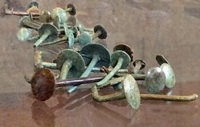
These are among a number of bronze nails, some of which appeared to have been unused, that were found along the southern wall of Temple A.
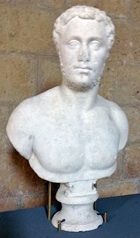
Portrait Bust (early 2nd Century AD)