

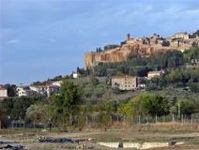
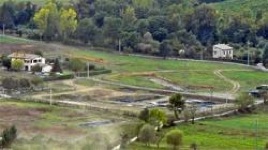
An important cult site at Campo della Fiera, on the plain below Orvieto, was first found during excavations carried out in 1876. These excavations uncovered a number of terracotta antefixes (6th – 4th centuries BC) that indicated one or more temples on the site. Further excavations in 1886 on an adjacent site slightly closer to the city uncovered a section of a paved Roman road, to the sides of which were a number of Etruscan and Roman tombs, and also more Etruscan architectural terracottas. Most of the terracotta antefixes from these early excavations are now in the Staatliche Museen, Berlin.
Excavations here were resumed in the 1990s, when the road that had been excavated 1886 was recovered. Further work in the location of the 1876 excavations unearthed yet more antefixes, including a female head (below) that was identical to one of those in Berlin. More systematic excavations have been carried out since 2000, on a site that now extends across some 5 hectares, and many of the finds are now in the museums of Orvieto (below).
-
✴In this videoclip, Simonetta Stopponi describes the results of the excavations of 2013.
-
✴As described in this page in the website “In Orvieto”, it is sometimes possible to make a guided visit to the site.
Since the time of its original excavation, the site at Campo della Fiera has been a leading candidate in the search for the Fanum Voltumnae (the shrine of Veltune, the Roman Voltumna/ Voltumnus), which had been the site of the annual pan-Etruscan meetings that featured in events described by Livy in the period 434-389 BC. (The early history of the Fanum Voltumnae is set out in the page on Etruscan Velzna. The recent programme of excavation has added to this conviction: thus, Giovanni Colonna (referenced below, at p. 204) recently asserted that:
-
“...we might reasonably assume, albeit that definitive proof is lacking, that [the sanctuary of the Etruscan Federation at the fanum Voltumnae] can be identified as the sanctuary .... at Campo della Fiera” (my translation).
As set out in my page on the Etruscans, many classical sources record that the twelve main Etruscan cities of Italy formed a federation, and that the leaders of its constituent city-states met in council, not only to celebrate their ethnic and religious links but also to discuss military matters. Livy, who recorded a series of such meetings in the period 434-389 BC, is the only surviving source for the fact that they took place at the fanum Voltumnae. Unfortunately, he never recorded where was located. Nevertheless, the sources on the events at Volsinii after the Roman conquest (set out on the next page) strongly suggest that the fanum Voltumnae was at Volsinii. Many scholars (including Giovanni Colonna, quoted above) believe that it was, in fact, at Campo della Fiera. L. Bouke van der Meer (referenced below, at p. 105) accepted that this is probable, but he cautioned that:
-
“... we cannot yet be sure until an inscription mentioning Veltumne or Veltune [the Etruscan name for the deity that the Romans called Voltumna, to which the fanum Voltumnae was presumably dedicated] is found [on the site] ....”
The name of one of the deities worshipped here was scratched on the inside of the base of a bucchero cup (ca. 400 BC): according to Simonetta Stopponi (referenced below, 21013b, at p. 636) it was found near the tufa altar in the sacred area of Temple A. This graffiti read: “apas” (of the father), the counterpart of the another inscription, “atial” (of the mother) found near Temple C (below). Claudia Giontella (referenced below,2011, at p. 291) observed that:
-
“... [the word] “apas” (of the father) probably indicates ownership by the father par excellence, Tinia ...” (my translation).
She considered (at p. 286) the possible relationship between Tinia and Voltumna/ Vortumnus, referencing the observations of Gérard Capdeville (referenced below. at p. 122) on the statement by Varro that:
-
“... the statue of Vortumnus stands [on the Vicus Tuscus in Rome] because he is the most important god of Etruria” (De Lingua Latina, V:46).
Capdeville asked rhetorically, since the Etruscan equivalent of the Greek Zeus is known to have been called Tinia:
-
“... who else [other than Tinia] could be the supreme god of the Etruscans, and how should we situate [Vortumnus/Veltumne/Veltune] in relation to him?” (my translation).
He resolved this by proposing that Veltumne/Veltune was the epithet applied to Tinia at the Fanum Voltumnae. Thus, this graffiti could indicate that Temple A was dedicate to Tinia, and perhaps to Tinia Veltumne, at least in ca. 400 BC.
Excavation of the Site
Ancient Roads
The site is crossed by two ancient roads:
-
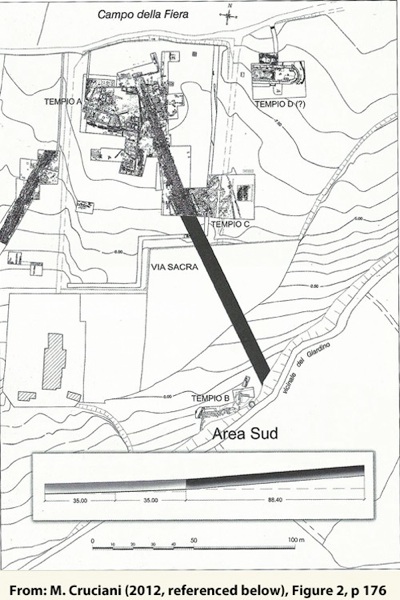
✴The paved road that was first discovered in 1886 and rediscovered in the 1990s is shown to the left in the plan above. According to Simonetta Stopponi (referenced below, 2013b, at p. 633), it:
-
“... was built in the mid 3rd century BC. The track, [now] exposed for more than 50 meters, was five meters wide and furrowed by the passage of wagons , connecting Orvieto with Bolsena.”
-
✴A much older road was discovered in 2004, of which some 70 meters have since been uncovered. It was not heavily used by wheeled vehicles, and was probably the “Via Sacra” of the sanctuary. (It is marked as such in the plan above). Given its width of some 7 meters, with pavements to the sides adding another 2.5 meters, it is perhaps the most monumental Etruscan road so-far discovered. According to Marco Cruciani (referenced below, at p. 171):
-
“The Via Sacra ... seems to have been articulated in three distinct phases ... .The systematic interventions [identified one above the other], which can be located respectively in the late 6th century BC, the mid 5th century BC and the mid 4th century BC, almost certainly relate to a more extensive structural plan that may have also involved other buildings of the sacred complex’ (my translation).
Sacred Enclosures
The original sacred enclosure was defined by monumental walls that surrounded stretches of these converging roads. A smaller enclosure was defined inside it, in the area between these two roads, in the triumviral or early imperial period, in a manner that seems to have emphasised the importance of one of the temples in the sanctuary, the so-called Temple A. There were two altars (see the Donarium and the Monolithic Tufa Altar below) in front of Temple A, both of which had to be removed for restoration following a period of extraordinarily heavy rainfall in 2012 (as shown in the videoclip above).
Temple A
This temple seems to have been monumentalised in ca. 400 BC. Unlike the others found to date, it remained in use for a long period after 264 BC. This temple might well have been the most important temple on the site for centuries. However, there is no direct evidence that it was originally dedicated to Veltune/ Voltumna (except for the graffiti “apas” found nearby - see below), albeit that the ancient name for the sanctuary makes this likely. If so, it would have lost this dedication when Veltune was “called” to Rome in 264 BC.
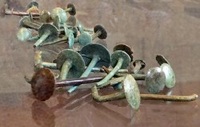
Simonetta Stopponi (referenced below, 2013 b, at p. 635) reported the discovery of a number of bronze nails, some of which appeared to have been unused, along the southern wall of Temple A. The possible significance is discussed below. Those illustrated above are now exhibited in the Museo Archeologico.
Temple A seems to have been renovated in the triumviral or early imperial period, at about the time, as evidenced by a new pavement that Simonetta Stopponi (referenced below, 2013b, at p. 635) dated to the period 50-25 BC.
Donarium
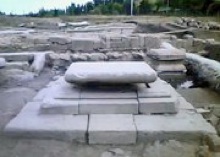
The first altar in front of Temple A is a donarium (an altar used for donations of votive offerings), which is closely aligned with the temple itself. This exceptionally important discovery indicates that cult use of Temple A was not interrupted by the destruction of Velzna in 264 BC (albeit that its dedication might have changed at this point).

M FOLV[IO Q F COS]OL D VOLSI[NIO CAP]TO (CIL I 2836)
M Fulvius, son of Quintus, consul, dedicated [it] after Volsinii had been captured
From one of two donative altars in the Sanctuary of Mater Matuta and Fortuna Virilis, Rome
[The five fragments in the drawing above and one from the identical inscription on the second altar
(CIL I 2836) are now in the Musei Capitolini, Rome ??].
Drawing in M. Torelli (1968), referenced below
Alba Frascarelli (referenced below) has demonstrated the close similarity between this donarium at Campo della Fiera and twin altars that Marcus Fulvius Flaccus erected in Rome, at the time of his triumph at Volsinii (which were inscribed as illustrated above). Alba Frascarelli (in her concluding sentence at p. 141) suggested that these three altars shared:
-
“... not only their chronology but also their planning and commissioning” (my translation).
The pair of donative altars in Rome were found in 1961 on the site of the sanctuary of Mater Matuta and Fortuna Virilis (later Sant’ Omobono). The upper surface of each contained numerous holes, which would have accommodate a series of small statues. Since Fortuna (like Minerva) was a Roman deity akin to Nortia, it is reasonable to assume that these statues were predominantly votive offerings to Nortia that Marcus Fulvius Flaccus had acquired during the defeat of Volsinii in 264 BC.
The upper surface of the altar at Volsinii was similarly equipped with holes that were probably meant to accommodate bronze votive offerings. One wonders what exactly Flaccus donated to the temple he had just despoiled?? (This is discussed further below).
Monolithic Tufa Altar
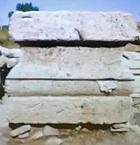
The bucchero cup (ca. 400 BC) with graffiti read: “apas” (of the father) described in the introduction above was found near this altar. (This was the counterpart of the another inscription, “atial” (of the mother) found near Temple C , described below). As explained in the introduction, the father in question could have been Tinia, the Etruscan version of Zeus, who might have been venerated here, at least in ca. 400 BC, as Tinia Veltumne, to whom the Fanum Voltumnae might have been dedicated.
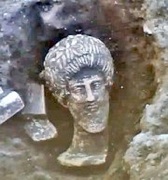
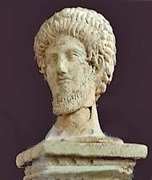
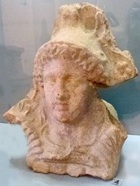
A terracotta portrait bust (ca. 400 BC) [published??], perhaps of a male divinity, was found under and facing this altar when it was removed for restoration (as described at the end of the videoclip above). The bust is now in the Museo Archeologico. [Could this be Tinia Veltumne ???]
Thesaurus
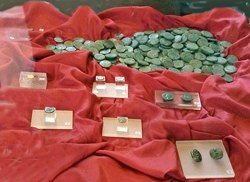
Samuele Ranucci (referenced below, 2009 and 2011) reported that a thesaurus (stone container with an opening in its lid, often used for the collection of coins) was found in tact in 2008 in front of the tufa altar mentioned above. A thick layer of ash and coals from sacrifices that rested against the altar covered part of the lid of the thesaurus, including the hole through which coins were inserted. This layer of ash contained a number of coins, the most recent of which, (RIC I: 389) dates to 15 BC: by this period, therefore, the thesaurus
was no longer in use (although, as explained below, six coins were subsequently pushed under the lid).
The thesaurus contained some 221 coins (including the six that had been pushed under the lid):
-
✴185 Republican asses, with the dateable examples dating to the period 211-91 BC, together with:
-
•a quniarius (RRC 343/2a) of 89 BC; and
-
•a denarius (RRC 422/1a) of 58 BC.
-
✴The remainder, from the triumviral and Augustan periods, included:
-
•a denarius (RRC 528/3) of 39 BC commemorating Octavian and Mark Antony;
-
•18 coins commemorating Octavian and divus Julius (his deified “father”, Julius Caesar), at least some of which seem to have been ‘imitations’ (perhaps locally minted) of the official issue (RRC 535/1) , which is usually dated to 38 BC (but see below); and
-
•15 coins commemorating Octavian after his accession as the Emperor Augustus:
-
-14 issued in 16-5 BC (RIC I: 373; 376; 379; 382; 386; and 389); and
-
-a 15th (RIC I 436), which had been issued by M. Maecilius Tullus in 7 BC.
Some dateable remains close to, but outside the thesaurus, which included an as (coin) minted by C. Plotius Rufus (RIC I 389) in 15 BC, suggest that, by this time, the thesaurus itself was no longer in easy use (although, as noted below, five of the coins of 16-5 BC and the coin of 7 BC were pushed under the lid thereafter.
The way in which the coins were deposited is important for our understanding of the associated cult practice:
-
✴The coins in the lower part of the thesaurus were mingled with the remains of a sacrifice, which suggests that they had all been ritually placed there in a single ceremony. This deposition comprised:
-
•all of the 187 Republican coins;
-
•the denarius (39 BC) commemorating Octavian and Mark Antony; and
-
•9 of the 18 coins commemorating Octavian and divus Julius (which dated to 38-7 BC, or perhaps later for the imitations).
-
The coins involved had presumably originally been donated separately, either in the thesaurus or elsewhere in the sanctuary, and were then ritually re-deposited. This re-deposition clearly post-dated 39 BC: Samuele Ranucci suggested that it probably took place “in or after the early 30s BC”.
-
✴The coins in the layer above this “single deposition”, which were obviously donated subsequently and probably separately before the thesaurus was sealed , comprised:
-
•8 of the 18 coins commemorating Octavian and divus Julius; and
-
•10 of the 15 coins commemorating Octavian as Augustus in 16-5 BC.
-
✴The coins subsequently pushed under the lid comprised:
-
•the last of the 18 coins commemorating Octavian and divus Julius;
-
•the last 4 of the 14 coins commemorating Octavian as Augustus in 16-5 BC; and
-
•the 15th coin commemorating Augustus, which had been issued by M. Maecilius Tullus in 7 BC.
Most of the coins are now exhibited in the Museo Archeologico.
The votive coins from the Republican period indicate the continuous use of the sanctuary at least in the period 211-91 BC. Clearly, by this time, the traditional Etruscan practice of offering bronze or terracotta votives had been supplemented (perhaps replaced ?) by the donation of votive coins. The ritual deposition of these and a few of the later coins in the thesaurus in ca. 30 BC was possibly associated with the contemporary renovation of this part of the sanctuary, which also involved the underground deposition in the sacred enclosure of presumably redundant ancient Etruscan votive offerings (below).
The presence of the 18 coins that commemorate both divus Julius and Octavian as divi filius, distributed through all three strata of the deposition, is intriguing. The precise date of the official issue is still debated. Luis Amela Valverde (referenced below, at pp. 34-5) summarised the preceding scholarship, but pointed out that these coins to do not identify Octavian as a triumvir. He therefore reasonably proposed a date between December 38 BC, when the triumvirs’ first five year term ended, and the summer of 37 BC, when the second five year term was apparently ratified, and that it was produced in Italy for the purpose of paying Octavian’s soldiers.
-
Was the ritual deposition of the coins at the bottom of the thesaurus associated with the rebellion then underway in Etruria or, perhaps more probably, with the end of the revolt following the Battle of Naulochus (36 BC) ?
Square Cavity/ Votive Deposit
A square cavity defined by ashlar blocks was discovered in this reduced area in 2008. It seems to have been filled in the triumviral period with a number of presumably “redundant” votive objects that seems to have been accumulated at the sanctuary over a long period of time. Its original function is unknown: Simonetta Stopponi (referenced below, 2013b, at p. 637) suggested that it might originally have been open to the sky, in order to render visible the huge oval boulder at the bottom, which might had served as an omphalos (a religious stone object representing the ‘navel of the world’, a point of communication with the gods).
The finds here included the following:
-
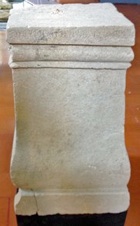
✴The important inscribed base of a (now lost) statue of the deity “Tluschva”. The Etruscan inscription, which is in two lines on each of two sides, has been transcribed:
-
kanuta larecenas lauteniθa aranθia pinies puia turuce
-
tlusχval marveθul faliaθere
-
Kanuta, freedwoman of the Larecena, wife of Aranth Pinies, has offered ... [this statue?] to Tluschva
-
The inscription dates to the late 6th century BC.
-
This deity is named three times on the famous “Piacenza Liver” (as “Tlusc”, “Tluscv”, “Mar Tlusc”) and also appears in another recently-discovered inscription from Cerveteri. The deity (or group of deities) is usually taken to be female, and to be chthonic (related to the underworld):
-
•“Tluschval” (as in the Orvieto inscription) seems to be a genitive form of the plural;
-
•in his webpage, Glen Gordon suggests that “Tluschva” is “a single god [named for] a pluralized inanimate concept”, specifically “depths”.
-
The translation of the fuller name in the inscription at Orvieto (“tlusχval marveθul faliaθere”) is still debated among scholars:
-
• Giovanni Colonna (referenced below) suggested that “marveθul” derives from “maru” (magistrate). He went on to suggest that, in this inscription, it is an epithet that signifies “minister, acolyte or helper”, perhaps of Hades, the god of the underworld.
-
•Simonetta Stopponi (in the appendix to the article of 2011 referenced below) suggested that the magistracy in question was connected to the construction of public buildings, and translates “marveθul” as “of the seat or residence”.
-
“faliaθere” might be a locative related to “faladum”, a Latinised Etruscan word that Festus translated as “coelum” (heaven). Simonetta Stopponi (in the appendix mentioned above) translated it as “in the celestial place”, and tentatively suggests that this is the Etruscan name for the sanctuary at Campo della Fiera. The inscription is now in the Museo Archeologico. The inscription is discussed in context in the page Early Etruscan Inscriptions.
-
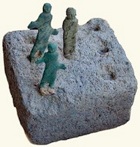
✴a number of stone bases with holes for votive offerings. In one case, three small bronzes (4th or 3rd century BC) remained still in place, and can be reconstructed as supporting a male figure in archaising style in the centre surrounded by (originally) seven worshippers. This composition perhaps represents the veneration of an archaic statue present in the sanctuary. Simonetta Stopponi (referenced below, 2013b, at p. 638) suggested that:
-
“... the empty bases of statues ... recall the Plinian account of the looting of 2,000 bronzes.”
-
This is a reference to the statement by Pliny the Elder that:
-
“... Metrodorus of Scepsis, who had his surname from his hatred of the [Romans], reproached us for having pillaged the city of Volsinii for the sake of the 2,000 statues that it contained” (‘Natural History’, 34:16).
-
-
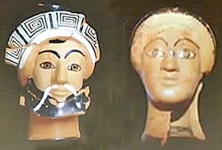
✴two head vases (illustrated above) portraying:
-
•Dionysus (ca. 480 BC), attributed to the London Class, on the left; and
-
•a maenad (mid 5th century BC) attributed to the Cook Class.
All of the objects described in this section are now in the Museo Archeologico.
Two Ditch Deposits
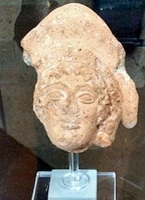
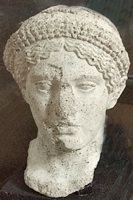
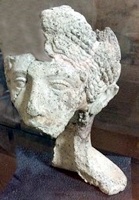
Two ditches in the sacred enclosure seem to have been used as a repository in the same circumstances pertaining to the rectangular cavity described above. The finds here included:
-
✴a number of terracotta heads of women, including:
-
•the oldest of these (illustrated above on the left) which dates to the second half of the 6th century BC; and
-
•another two (illustrated above at the centre and right) that date to the second half of the 5th century BC;
-
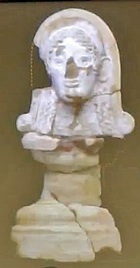
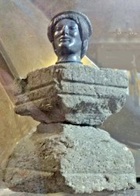
✴the terracotta bust of a female deity (first half of the 5th century BC) which is set on a base that is equipped with a hole that would have received liquid offerings;
-
✴a small bronze head of a woman (490-80 BC), described in detail by Claudia Giontella (referenced below, 2012), the base of which was found nearby; and
-
✴part of the right arm, together with another fragment of the hand, holding a pomegranate, which came from a huge statue (5th century BC ?) that might have depicted the enthroned titular deity of the temple, perhaps Persephone.
The large amount of “female” material here indicates a female deity who was mostly worshipped by women.
Portrait Bust (early 2nd century AD)
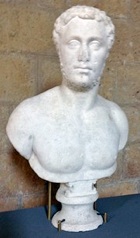
All of the objects described in this section ar now in the Museo Archeologico.
Temple C
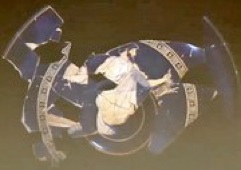
A nearby deposit contained (inter alia):
-
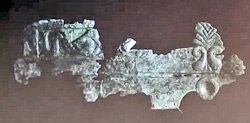
✴bronze fittings from a chariot (5th century BC), illustrated above;
-
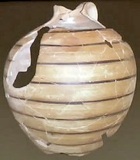
✴fragments of a Greek kylix (ca. 485 BC) depicting a bearded man holding a hare, attributed to Douris and inscribed “Hippodamas kalos” (Hippodamas is beautiful), illustrated above; and
-
✴ a bucchero cup inscribed “atial” (of the mother), the counterpart of the inscription “apas” (of the father) outside Temple A (above).
Structures outside the Reduced Sacred Area
A third temple (Temple B), which had a circular stone fountain in front of it, has been partially excavated at the southern edge of the site. Fragments of impasto pottery found here are among the oldest remains from the sanctuary. Like Temple C, this temple seems to have ceased to function as a cult site shortly before the destruction of Velzna.
The excavations of the area to the east of Temple A uncovered the remains of Roman baths, which might have been built over a fourth Etruscan temple (Temple D). A domus seems to have been built over part of the baths in the 5th century AD. [Recent excavations]
This site was later used as a necropolis and then for a medieval church (12th century), which is known from chronicles as San Pietro in Vetere. This church seems to have been abandoned after the Black Death (1348).
Other Finds from the Site
-
Antefix (4th century BC)
Conclusions
Sanctuary Before 264 BC
[In construction]
Function of the Sanctuary After 264 BC
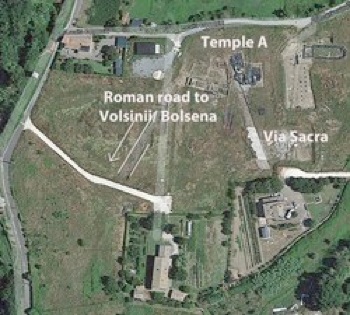
The paved road that was first discovered in 1886 and rediscovered in the 1990s is shown to the left in the aerial view above (picked out by two white lines). According to Simonetta Stopponi (referenced below, 2013b, at p. 633), it:
-
“... was built in the mid 3rd century BC. The track, [now] exposed for more than 50 meters, was five meters wide and furrowed by the passage of wagons , connecting Orvieto with Bolsena.”
This road must have constituted an “umbilical cord”, linking the displaced people there to what remained of their ancient city and ancient religion. The continued use of Temple A after 264 BC was thus, most probably, as an extra-urban sanctuary of the people of Volsinii.
Unlike the other temples identified in the sanctuary, the so-called Temple A remained in use for a long period after 264 BC. There is no direct evidence that it was originally dedicated to Veltune/ Voltumna, but the ancient name for the sanctuary makes this likely. If so, it would have lost this dedication when Veltune was “called” to Rome (an event that must have destroyed any pan-Etruscan character that the sanctuary had retained up to that point).
As noted above, the consul Flaccus seem to have been erected the donarium outside Temple A in 264 BC,
-
Did Flaccus commission the donarium for some of the statues of Nortia that he had taken from Velzna ??
-
If Temple A had originally been dedicated to Veltune, it would have been quite literally desecrated in 264 BC, when Flaccus “called” Veltune to Rome. Did the putative statues of Nortia that he donated to the now-empty temple signify that it had been re-consecrated to Nortia ?? This might account for the continuation of this cult in its Etruscan guise at Volsinii and among Volsinians in Rome into the 4th century AD ??
Simonetta Stopponi (referenced below, 2011, 2012, 2013 b) reported the discovery of a number of bronze nails, some of which appeared to have been unused, along the southern wall of Temple A. In the 2013b paper, p. 635, she gave an assessment of their significance:
-
“The most likely interpretation of the nails is for architectural terracottas, but the presence of such a large number of specimens raises the appeal to the Volsinian tradition of the clavus annalis [literally, annual nail], which was [originally] affixed to the temple of the goddess Nortia, recognised by some in the Orvietan Belvedere temple”.
Simonetta Stopponi cited Livy, (who, in turn, citied his contemporary, the annalist Lucius Cincius Alimentus):
-
“... there were seen at [Velzna]... nails fixed in the temple of Nortia, a Tuscan goddess,[which were used] as indices of the number of years” (‘Roman History’, 7:3:7).
Francesco Roncalli (referenced below, 2003, p 225-7) observed:
-
“Each of the Etruscan cities must have had its own place where the passing years (and thus the beginning and end of the civic and religious calendar year) was officially registered and ritually sanctioned. It seems significant that only the tradition at Volsinii and the custodian of the rite there, Nortia (whom Livy promoted to the rank of “Etruscan goddess”) achieved fame in this context in the Roman world [as evidenced by the text of Livy/ Cincius above].
-
-Perhaps this was because the recording of time at Velzna had pan-Etruscan relevance, possibly because it recorded, among other things, the annual pan-Etruscan councils?
-
-Perhaps the role of the priest who was elected by the “twelve people” to preside over these annual councils was analogous to that of the “praetor maximus”at Rome, who - probably following the Etruscan tradition - drove the nail in the cella of Minerva, thereby entrusting “his” year, its collegiate discussions and his own authority to the inscrutable immutability of destiny ?” (my translation).
If the analogy is pursued to its logical conclusion, this would suggest that the annual driving of the nail at Velzna had indeed taken place in the right-hand cella of the Tempio del Belvedere, at least until its destruction in 264 BC.
The tradition of the clavus annalis might have fallen into disuse in Volsinii in 264 BC, if not before: it had certainly lapsed in Rome at an early date. However, there is evidence that its memory persisted there into the triumviral and early imperial periods. For example, Cicero began a letter to Atticus (5:15): “I arrived at Laodicea on the 31st of July [51 BC]. From this day, you should move the nail of the year”. In the original Latin, the second sentence was:
-
“ex hoc die clavum anni movebis”
Here, Cicero was suggesting that Atticus should record the year of his stay in Laodicea in the ancient manner. The casual nature of the suggestion indicates that the driving of a nail was by this time associated quite generally (and, presumably, metaphorically) with the process of recording annual events.
Augustus revived the tradition in a modified form at his new Temple of Mars Ultor in the 1st century AD. From this point, the censor fixed the nail at this temple at the end of his five-year term.
-
Was the tradition of the clavus annalis introduced or revived at Temple A:
-
-in 264 BC, to record the putative change of its dedication to Nortia; or
-
-at the time of its renovation in the triumviral or early imperial period, to record:
-
-the restoration itself ??
-
-the birthday of Octavian or his designation as Augustus ??
Triumviral and Early Imperial Period
Temple A seems to have been restored in this period, as evidenced by its new pavement, which Claudia Giontella (referenced below, 2008) dated to the 3rd quarter of the 1st century BC. The sacred enclosure around this temple seems to have been reduced in size at this time in a manner that emphasised the importance of the temple itself. Simonetta Stopponi (referenced below, 2013a, at p. 138) suggested that this was:
-
“... inspired by the political propaganda of [the Emperor] Augustus, aimed at promoting the revitalisation of ancient traditions” (my translation).
Other developments were probably or possibly associated with these developments:
-
✴A large umber of ancient votive objects were buried in a rectangular cavity and two ditches in the reduced sacred enclosure.
-
✴A number of votive coins were ritually deposited in a thesaurus in front of the temple in ca. 30 BC. Most of these had been minted in the Republican period, but a few commemorated Octavian and divus Julius [and might have been minted locally for Octavian’s soldiers during the siege of Perugia in 40 BC - check ??]
-
✴A number of bronze nails that have been found along the southern wall of Temple A might relate to this period, as discussed above.
-
Did these changes coincide with the revival of the Etruscan Federation at Volsinii ?? Perhaps Temple A thereafter played a part in the annual meetings of the revived federation (together with a theatre and amphitheatre, either on this site or perhaps in Volsinii) ??
Early 4th Century AD
Evidence that the cult use of the complex continued into the Constantinian era includes a coin found here that commemorates Divus Constantius (the deified Emperor Constantius I, the father of the Emperor Constantine). The coin in question came from Constantine’s commemorative issues of 317-8, a series that commemorated his three deified ancestors. (I am grateful to Dr. Samuele Ranucci for the information on the dating of this coin).
The so-called Rescript of Constantine, which records the content of a decree (rescript) issued by the Emperor Constantine to the people of Hispellum, relates to an annual festival that was held at or near Volsinii, and which was presided over by two priests, elected (respectively) by a group of Etruscan and Umbrian participants .
The arrangements for these games were changed by the Rescript, although scholars are divided as to what these changes amounted to. There are broadly two schools of thought:
-
✴Some scholars hold that the games at/near Volsinii reverted to an earlier practice, which involved only Etruscan participation, while the Umbrians held their own parallel festival at Hispellum.
-
✴Others hold that joint games continued as before, except that they were held at Volsinii and Hispellum in alternate years.
-
It is possible that the “Etruscans” participating in this festival (both before and after the Rescript) did so as members of the revived Etruscan Federation.
-
I speculated above that Temple A, together with a theatre and amphitheatre, either on this site or perhaps in Volsinii, might have played a part in the annual festivals of the revived Etruscan Federation. Was this ritual landscape also used for the annual pan-Etruscan and pan-Umbrian festivals recorded in the Rescript ??
Read more:
L. Bouke van der Meer, “Campo della Fiera at Orvieto and Fanum Voltumnae: Identical Places?”, Babesch 88 (2013) 99-108.
S. Stopponi (2013a), “La Ricerca del Fanum Voltumnae: gli Scavi in Località Campo della Fiera”, in:
G. della Fina and E. Pellegrini (Eds), “Da Orvieto a Bolsena: un Percorso tra Etruschi e Romani”, (2013) Pisa, pp. 136-47
S. Stopponi (2013b), “Orvieto, Campo della Fiera: Fanum Voltumnae ”, in:
J. Macintosh Turfa (Ed.), “The Etruscan World”, (2013 ) Oxford, pp. 632-54
G. della Fina (Ed.), “Il Fanum Voltumnae e i Santuari Comunitari dell’ Italia Antica”, (2012) Orvieto includes the following particularly relevant articles:
S. Stopponi, “II Fanum Voltumnae: Dalle Divinità Tluschva a San Pietro”, pp 7-76
C. Bizzarri, “Gli Inizi del Santuario di Campo della Fiera: la Ceramica Greca” ,pp 77-114
C. Giontella, “Una Prestigiosa Offerta da Campo della Fiera: Donna o Dea ?”, pp 115-30
A. Frascarelli, “Un Donario Monumentale a Campo della Fiera”, pp 131-60
M. Cruciani, “Campo della Fiera di Orvieto: la Via Sacra”, pp 161-82
G. Colonna, “I Santuari Comunitari e il Culto delle Divinità Catactonie in Etruria”, pp 203-26
E. Albertini et al., “Il Tempio Ritrovato”, Darwin, 39 (2011) 30-5
C. Giontella, “Lo Scavo Archeologico di Campo della Fiera ad Orvieto”, Il Capitale Culturale, 2 (2011) 285-98
S. Ranucci, “A Stone Thesaurus with a Votive Coin Deposit Recently Found in the Sanctuary of Campo della Fiera, Orvieto (Volsinii)”, Proceedings of the XIV International Numismatic Congress), (2011) Glasgow, pp. 954-9
A. Maggiani, “Tluschva, Divinità Ctonie”, in
D. Maras (Ed.), “Corollari. Scritti di Antichità Etrusche e Italiche in Omaggio all' Opera di Giovanni Colonna”, Studia Erudita, 14 (2011) 138-149
S. Stopponi, “Campo della Fiera at Orvieto: New Discoveries”, in:
N. de Grummond and I. Edlund-Berry (Eds), “Archaeology of Sanctuaries and Ritual in Etruria”, Journal of Roman Archaeology Supplement 81, (2011) Portsmouth, Rhode Island, pp 16-44
For the inscribed base dedicated to Tluschval, see the Appendix at pp 37-42
S. Ranucci, “Il Thesaurus di Campo della Fiera, Orvieto (Volsinii)”, Annali Istituto Italiano Numismatica, 55 (2009) 103-39
C. Giontella. “Pavimenti in ‘Signino’ (cementizio) a Campo della Fiera, Orvieto”, in:
C. Angelelli, (Ed.), “Atti del XIV Colloquio AISCOM: Spoleto, 7-9 febbraio 2008”, (2009) Tivoli, pp. 111-8
L. Amela Valverde, “La Emisión Divos Iulius (RRC 535/1–2)”, Iberia, 6 (2003) 5–40
S. Stopponi, “Recenti Indagini Archeologiche in Località a della Fiera di Orvieto (TR)", Etruscan Studies, 9 (2002) Article 11 (http://scholarworks.umass.edu/etruscan_studies/vol9/iss1/11) - with a summary in English at the end
F. Roncallii, “I Culti’, in
G. Della Fina and E. Pellegrini (ed), “Storia di Orvieto: Antichità”, (20o3) Perugia: pp 217-35
G. Capdeville, “Voltumna ed altri Culti del Territorio Volsiniese” in
“Volsinii e il suo Territorio”, Annali della Fondazione per il Museo ‘Claudio Faina’,
6 (1999) 109-36
Return to Museums and Excavation Sites in Orvieto.
Return to Walk IV.