Empires of Mesopotamia:
First Dynasty of Ur
So-called ‘Standard of Ur‘


Empires of Mesopotamia:
First Dynasty of Ur
So-called ‘Standard of Ur‘
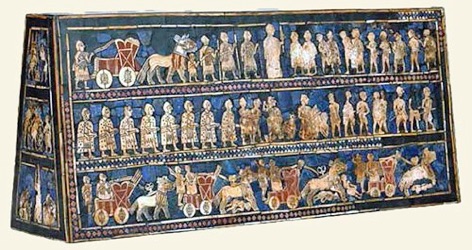
So-called Standard of Ur (U. 11164) from PG 779 (as reconstructed in 1973)
Now in the British Museum (BM 121201): images from the museum website
Discovery and Reconstruction of the Standard
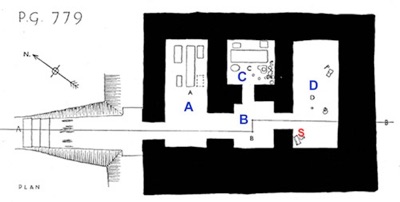
Plan of PG 779: from Leonard Woolley (referenced below, 1934b, Plate 24)
My additions in blue (Woolley’s labels for the four chambers) and in red (S = location of the Standard of Ur)
Leonard Woolley (referenced below, 1934a, at p. 60-1) discovered this important artefact during his excavations of the cemetery of Ur in 1927/8. More specifically, he found in PG 779, which is one of the two largest of Woolley’s ‘royal tombs, which is made up of four chambers (as illustrated above):
✴an outer door to the stone structure leads into a long narrow chamber (Chamber A) running along its whole width;
✴a second door in this chamber leads into two adjoining square chambers (Chambers B and C) that each occupied half the building's width; and
✴a second door in Chamber B leads into another long chamber (Chamber D) that took up the whole back part of the building.
The roofs of all four chambers had fallen and the chambers themselves had been looted, but he established that Chamber D had originally contained at least four human bodies and evidence of the original presence high quality grave goods. Furthermore, as he recorded (at pp. 60-1):
“At the south-west end [of Chamber D), there were remains of two ... bodies, one very fragmentary; the better preserved had its head in the corner of the chamber, close to the south-west wall, [in a sheltered position that the looters had apparently ignored, There, we] found the finest object in the tomb.
✴The head of the man was entirely covered with thousands of minute lapis-lazuli ball beads, [which] lay over and under the broken skull and were thick in the surrounding soil, It appeared that he had worn [a particularly opulent beaded 'head-dress']. ...
✴Above the man's head and slightly to the right of it, against the stones of the tomb wall, [were the remains of] the so-called 'Standard' of Ur’.”
What Woolley actually found were the shell plaques and the lapis lazuli, red limestone and shell tesserae that had been inlaid in bitumen on four sides of a wooden trapezoidal box:
✴the two largest faces had been rectangular; and
✴the two sides connecting them had been in the shape of narrow truncated triangles.
Woolley recorded (at p. 61) that:
“The wood which had been its core [of the object] had vanished ([although] traces of its grain could be distinguished on the bitumen afterwards) and the bitumen in which the tesserae were set had gone to powder, so that the tesserae were loose and kept in place only by the soil. With the decay of the wood, the main panels had been telescoped together, with the result that the triangular ends had been pushed out and broken ...”
Nothing was left of the top and bottom panels, which had presumably been undecorated. Woolley painstakingly embedded the recovered decorative pieces, inch by inch, in wax, maintaining the original design as far as was possible and then managed to dispatch them safely to the British Museum. When the trapezoidal shape of the original box became clear, he suggested that the original box had been mounted on a pole and carried in procession, although there is no evidence that this was the case. However, nobody seems to have found a more satisfactory name for the object that he designated the ‘Standard of Ur’.
As Dorota Ławecka (referenced below, note 4, at p. 337) observed, after the safe arrival of the remains and their setting in a new wooden box in the British Museum laboratory, the restored object:
“... was first put on display in 1928 . Since it was [only] consolidated with wax paraffin, its condition worsened over time ... Further conservation work was undertaken in 1973, during which:
•the [box] was completely dismantled and reassembled on a new mount; [and]
•the arrangement of the inlays (especially in the end panels) were adjusted [where necessary].”
Sarah Collins (referenced below, at pp. 50–59) provides a full account of the stages of this process, which resulted in the reincarnated]‘standard’ that we see today.
Sarah Collins (referenced below, at p. 15) pointed out that, from the time of the excavation of the standard, it was recognised that the mosaics on its two large rectangular faces had relayed narrative messages that allow them to be differentiated: one can be labelled the ‘war side’ and the other the ‘peace side’. I will discuss them in this order, before moving on to the mosaics on the two triangular sides.
Narrative Conveyed by the ‘War Side’
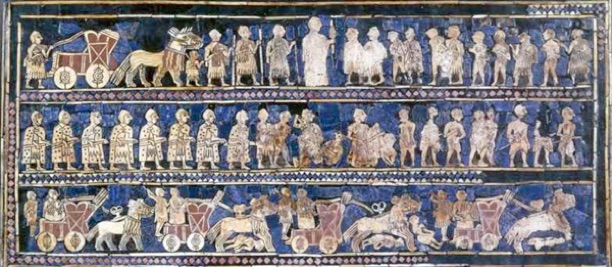
War side of the Standard of Ur
Bottom Register
As Sarah Collins (referenced below, at p. 13) pointed out, the narrative portrayed i(n three registers) on this side of the standard begins at the right extreme of the bottom register. Here we see a battle involving four of the king’s impressive four-wheeled war chariots, each of which is pulled by a team of four equids and manned a a two-man team made up of a charioteer and a soldier who stands behind him, wielding an axe or a spear. As Joost Crouel (referenced below, at p. 33) observed:
“The vehicles are moving at [increasing speeds] across a battlefield, symbolised by the stripped and bleeding human bodies of enemies prostrate beneath the draught teams. The position of the bodies need not be read literally since, if at all possible, equids avoid stepping on bodies for fear of injuring their own limbs. We have here, in fact, the earliest appearance of the motif of ‘the enemy beneath the team’s hooves’ that is to return early in the next millennium and later with another type of vehicle, the two–wheeled chariot. Wherever the motif appears, it must be taken as merely symbolic of victory.”
Middle Register
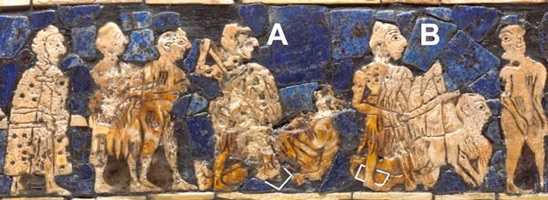
War side of the Standard of Ur (detail): middle of the middle register
Possible enemy standard (see below) picked out in white
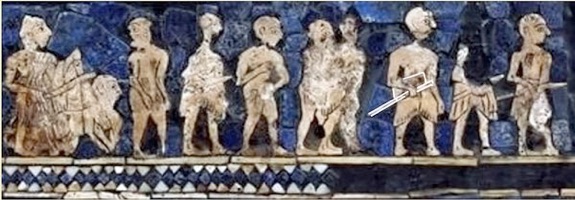
War side of the Standard of Ur (detail): right side of the middle register
Possible enemy standard (see below) picked out in white
The scene in the middle register begins with eight soldiers (who presumably belong to the army of Ur) marching in strict formation (not illustrated here). They are followed (in the middle of the register) by much more dynamic scenes involving a less orderly procession in which victorious soldiers (presumably in the army of Ur) roughly manhandle enemy prisoners. These scenes can be split into two consecutive groups:
✴in the first group (the middle of the middle register):
•each of three successive commanders of Ur (including my ‘commander A’ and ‘commander B’) manhandles a defeated enemy; and
•another prisoner looks backwards in horror at what he is witnessing; and
✴in the second group, soldiers of Ur roughly push other prisoners forward towards their fate..
Jerald Starr (in this page of his website ‘Sumerian Shakespeare’) suggests that three of the individual mosaics in these two groups each depict (or originally depicted) an enemy standard, which can be identified by its shape (which, he argues, emulates that of the ‘Standard of Ur:
✴in the group of scenes in the middle register:
•my ‘commander A’ (who is about to drive his spear into his opponent’s stomach) kicks away a now unidentifiable object that Starr suggests had originally been an enemy standard; and
•my ‘commander B’ (who holds a sickle sword in his right hand and the skirt of the prisoner that he is humiliating over his left arm) has his right leg in front of what Starr suggests is an enemy standard that is between his victim’s feet; and
✴in the group of scenes to the right, the third figure from the right (whom Starr identifies as an enemy prisoner) holds what he identifies as the box and pole of another yet another enemy standard.
I have picked out these putative enemy standards in white in the illustrations above. Starr further suggests that the motif of an enemy standard is used here as an artistic device which denotes that the enemy commander is of royal status. However, there are potential problems with these hypotheses:
✴the object that is arguably kicked away by my ‘commander A’ no longer survives and neither of Starr’s two other putative ‘enemy standards’ can be securely described as a rectangular box with trapezoidal sides; and
✴in any case, there is no surviving evidence from Mesopotamia (other than the potential evidence of the ‘Standard of Ur’) that boxes of this shape were ever:
•mounted on poles to serve as battle standards; or
•used in art to establish the royal status of military commanders.
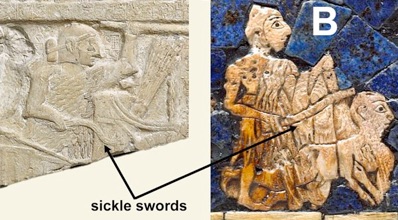
Left: Detail from the ‘historical side’ of the ‘Stele of the Vultures‘ from Girsu/Lagash,
now in the Musée du Louvre (AO 50): image from the museum website
Right: my ‘commander B‘ from the image above
Having said that, I think that Jerald Starr is on firmer ground with his suggestion that my ‘commender B’ is a ruler (presumably a ruler of Ur): note, for example that (as he points out) Eanatum, an ensi (ruler) of Lagash in the ED III period, is depicted wielding a sickle sword in his famous ‘Stele of the Vultures’ (as illustrated above). I hesitate to suggest that my ‘commender B’ was a king because (as we shall see) the central figure in the top register, who if generally assumed to represent a king of Ur, is depicted as the tallest figure in the composition (with his head protruding beyond the upper border). However, Starr is surely correct that he must be a man of great authority, and that his victim in the mosaic must have been of equal or higher status. Furthermore, I would add that:
✴since there is no suggestion that the my ‘commander B’ is actually about to strike his victim with his sickle sword, we must be looking at a ‘timeless event (in the sense that it is meant to be remembered for generations); and
✴the ritual submission of a powerful enemy ruler to a powerful commander of the army of Ur would indeed be an event of this kind.
(I discuss Starr’s assertion that the powerful enemy ruler t must be the king of Kish in my page on the first dynasty of Ur.)
Top Register
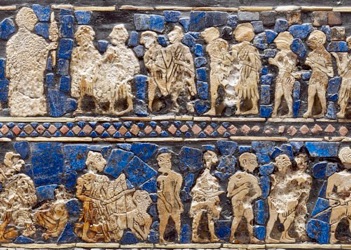
War side of the Standard of Ur (detail): right side of the top register
We should probably continue the ‘narrative’ by following the procession of prisoners of war from the middle to the top register, where it reaches the majestic figure at its centre. Although this figure is very damaged (see below), his superior status is underlined by the fact that his head protrudes beyond its upper decorative border: as Sarah Collins (referenced below, at p. 24) observed, he:
“... is no doubt a ruler, probably a king of Ur.”
He is also clearly the man who holds the fate of the enemy prisoners of war in his hands.
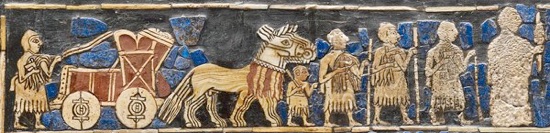
War side of the Standard of Ur (detail): left side of the top register
As Sarah Collins (referenced below, at p. 26) pointed out, if we now look at the mosaics behind and including this putative king of Ur, it seems that all of these figures (human and animal) are motionless. She suggested (at pp. 27) that:
✴the three soldiers behind the king, each of whom holds a long spear and an axe, could be his personal bodyguard or perhaps members of his family; and
✴the chariot on the left as the king’s chariot, which is a larger version of those seen un the bottom register.
However, this chariot is unmanned, albeit that:
✴a soldier (presumably the king’s charioteer) stands behind it, holding the reigns; and
✴a small figure (possibly a groom) controls the released equids by means of a lead round their necks.
It seems to me that the implication here is that this was the chariot in which the king (or, perhaps my ‘commander B’, if he is not the king) had led his men to victory.
Figure of the King of Ur in the Top Register
War side of the Standard of Ur (detail): middle of the top register
image from the standard as reconstructed in 1973
War side of the Standard of Ur (detail): middle of the top register
Watercolour by Mary Louise Baker of a photograph of the standard as constructed in 1928,
which was reproduced by Leonard Woolley (referenced below, 1934b, Plate 92)
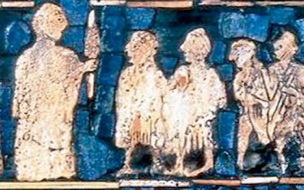
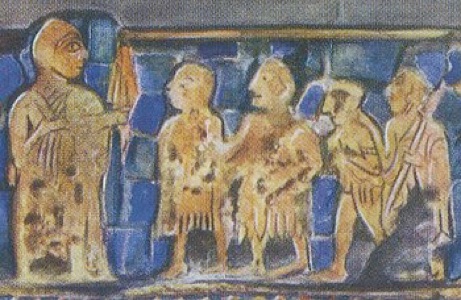
As we have seen, the figure at at the centre of the top register, whose head protrudes through the decorative border, is generally taken to represent the king of Ur. Jerald Starr (in this page of his website ‘Sumerian Shakespeare’) argued that the object in his left hand is:
“... his royal standard, [which] is just like the ‘Standard of Ur’ [itself when seen] from the side.”
Interestingly, Sarah Collins (referenced below, at p. 26 and Figure 17), who referenced the image painted by Mary Louise Baker that is illustrated above) suggested that this object:
“... part of a what looks like a large ceremonial spear that he is holding out in front of him.”
She also observed that, based on this image:
“...he was originally holding a weapon in his right hand that extended above his right shoulder”;
and Jerald Starr suggested that he had probably originally carried a sickle sword in this hand.
Sarah Collins (referenced below, at p. 26) characterised the two men in front of the king (who lead the procession of prisoners) as two Sumerian soldiers, and it certainly seems that (as illustrated above) Mary Louise Baker painted both of them as figures wearing helmets (= Sumerians). However, Jerald Starr argued that the figure nearest the king would have been the defeated enemy commander, who had been given back his clothes for the surrender ceremony. It seems to me that:
✴the first prisoner to be presented to the king must have been the most senior of the surviving prisoners of war, who was probably the man who had been captured and humiliated (in the middle register) by my ‘commender B’; but
✴this man might well have been the between these two soldiers and the soldier on the right in the image above.
It is also possible (as Jerald Starr suggested) that the second figure in front of the king (who is recognised by both authors as a Sumerian) is depicted carrying a rolled up battle standard under his left arm (and perhaps its pole in his left hand).
Narrative Conveyed by the ‘Peace Side’
Peace side of the Standard of Ur
Top Register
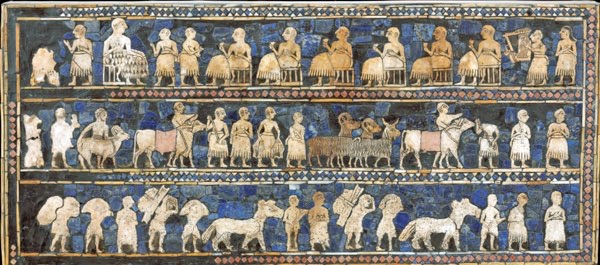
The most important figure on this side of the standard is the third figure from the left in the top register, who is seated and presides over a banquet attended by six seated guests. This important man is distinguished here by the facts that he is:
✴the largest of the seated figures (as emphasised by the position of his head in relation to the decorative border above); and
✴the only one of them who wears a ‘flounced’ skirt and faces right.
He must therefore be the victorious commander who is depicted at the centre of the top register of the war side, and the banquet that he hosts must represent a celebration of his recent victory. Furthermore, it is hard to escape the conclusion that he is the king of Ur.
The two men between the king and the first of his guests are clearly servants, and the man standing behind him (who is clearly a third servant) seems to be welcoming a now-lost figure who has just arrived. Sarah Collins (referenced below, at p. 36) observed that, since this damaged figure was relatively large and facing in the same direction as the king, it might have represented a queen. The man behind the last of the guests plays a bull-headed lyre and the long-haired man behind him might well be singing.
Lower Two Registers

Middle register: red = probably not Sumerian’, asterisk = probably an official with a religious function

Bottom register: red = probably not Sumerian’, asterisk = probably official with a religious function
Sarah Collins (referenced below, at p. 30) argued that: the men in these two registers:
“... are evidently part of one long procession bringing animals and goods towards the banquet.”
She also argued (at pp. 31-2) that:
✴five men in these registers (marked with asterisks above) hold their hands in a particular manner that might indicate that they are praying or that they have responsibility for religious aspects of the banquet;
✴the bald men in the middle of the middle register who are bringing bulls, goats and fish (also labelled in black) are probably all Sumerian’; and.
✴all the men behind them are probably not Sumerian (judging by their hairstyles and/or the way they are dressed).
Furthermore, she also argued (at pp. 33-4) that the ‘goods’ being carried or driven seem to fall into three groups:
✴the bulls, goats and fish that are brought by Sumerians are probably destined for consumption at the banquet; while
✴the heavy goods in the backpacks and sacks and the two equids, all of which are brought by ‘foreigners’, are probably:
•booty from the recently-defeated city; and/or
•tribute or gifts from other parts of Mesopotamia to be presented to the victorious king; and
✴the teams of equids are almost certainly intended to pull his chariots (and may have been captured during the recent battle).
Tribute Bearers
‘Foreigners’ labelled A1 and A2: tribute bearers (left end of the middle register)
‘Foreigner’ labelled B: goat hunter ? (end panel, top register)
Sumerian labelled C: goat herder (centre of the middle register)
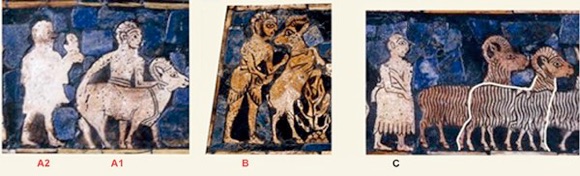
Any analysis of the likely identities of the ‘foreign’ tribute bearers on the war side of the standard is hampered by the fact that, in many cases, the shell used to depict them is badly degraded. However, this is fortuitously not the case for the first of them (labelled ‘A1’ in the illustration above: as Dorota Ławecka (referenced below, at p. 339) observed, this man (who brings a sheep as tribute) :
“... has a beard and a full head of black hair cut short on the side(s) and topped by a scalloped head-dress. ... Moreover, a man with a similar hairdo (labelled ‘B’ above) also appears on one of the short side-panel ...”
This second figure seems to be about to take hold of a wild sheep, and as Dorota Ławecka (as above) observed:
“He is wearing a wrapped-over short skirt ... and is shown (if Woolley’s restoration is correct) in a hilly region, indicated by a small scaly mound with a plant on top, [on which his prey is grazing].”
Dorota Ławecka also observed (at p. 346) that the tribute bearer ‘A2’ in the illustration above (who holds what could be a small sheep or a gazelle) is clearly:
“... bearded, [albeit that] the surface of the shell ... is almost entirely worn here, hiding further details.”
However, in the image of the peace side in the 1928 reconstruction that was pained by that Mary Louise Baker (which was reproduced by Leonard Woolley, referenced below, 1934b, Plate 91), A2 is portrayed as;
✴sporting the same ‘hairdo as ‘foreigner’ A1 (albeit that his hair is ginger); and
✴wearing a skirt that seems to be of the same type as that worn by ‘foreigner B’.
(Note that Leonard Woolley , referenced below, 1934a, at p, 268) recorded that the damaged image behind A2 was, in fact, probably misplaced.)
We might now look at the sheep that ‘foreigner A1’ is bringing as tribute (which is arguably of the same variety that which appears with ‘foreigner B’ in the illustration above). Dorota Ławecka (referenced below, at p. 346) that this sheep:
“... is smaller than the free-walking ones [herded by ‘Sumerian C’ in the illustration above’, and [also] non-fleeced. In my opinion, the animal looks different not because it had been sheared or plucked, as [others have suggested], ... but because it was the intention of the artist ... to make it look different.”
However, it is a possibility that there is no real dichotomy here: perhaps the artist wanted to indicate that:
✴the sheep with ‘foreigner A1; was valued for its fleece (and thus be kept alive, to be shorn at regular intervals); while
✴that of ‘Sumerian C’ was valued for its meat (which was about to be eaten at the banquet).
Ławecka is surely correct to in arguing (at p. 346) the way in which ‘foreigner A1’ handles his sheep:
“ ... may indicate that a depiction of a wild animal was intended [here], in contrast to the flock of domesticated sheep walking unattended., [with ‘Sumerian C’ simple walking behind them]. ”
Having considered various possibilities, she concluded that:
“... although it cannot be established with certainty,there is a good chance that our sheep ... comes from the hilly country.
She also suggested (at p. 348) that the equids in the bottom register (and those on the war side) probably came from the region around Subartu, in the area north of Sumer. In relation to the way in which men that I have labelled in red were depicted:
“... does not conform to typical south Mesopotamian iconography, and their distinct appearance was noticed and commented on already by [Leonard] Woolley. ... People in this part of the standard are characterised by their distinctive coiffures and dresses in a deliberate attempt to set them apart from the other protagonists of the narrative.”
She rejected Woolley’s suggestion that the distinct headdress of the ‘tribute bearers:
“... is reminiscent of that depicted on the mother-of-pearl and slate mosaic from Kish ...”.
Rather, she argued that:
“Detailed analysis of the group’s costumes [and] headgears, and the kind of animals depicted [here] lead me to the conclusion that what was illustrated was a group of tribute-bearers coming from a region even more distant than the Kish area: that is from the piedmont or the mountainous zone outside the Mesopotamian plain.”
Main Panels of the Standard of Ur: Conclusions
Sarah Collins (referenced below, at p. 5) began her invaluable monograph on the Standard of Ur by characterising it as:
“... a remarkable work of ancient narrative art.”
Although the interpretation of visual narrative of this kind is inherently subjective, I think that we can be reasonably sure that:
✴the war side of the standard ‘documents’:
•a major victory won by the king of Ur who is depicted at the centre of its top register’ and
•the formal submission to him of the commander whom he has just defeated (and presumably supplanted); and
✴the peace side ‘documents’ the victory celebrations, as the king presides over a banquet, having received tribute in the form of:
•domesticated animals and fish from across Sumer; and
•other precious goods (including teams of equids to pull his war chariots) as war booty and/or tribute from rulers the north who wanted to receive his friendship or to acknowledged his hegemony.
Furthermore, although it is a relatively small object (with its rectangular panels measuring about 50 cm in length and 20cm in height), its high artistic value and the exotic nature of its components (lapis lazuli and red marble from the east and shell from the Lower Sea) speak to the economic, political and cultural prosperity that this victory (and presumably others like it) have secured.
This leaves us wondering about the nature of the ‘audience’ for this narrative. As Jerald Starr (in this page of his website ‘Sumerian Shakespeare’) pointed out, although it was to detailed and too fragile of have served as a standard of war, it might well have served:
“... as a royal standard, the kind of standard carried during processions of the king.”
Perhaps it followed the king as he processed through his increasing domains and publicly displayed whenever and wherever he was in residence. And, since it was found in the royal grave PG 779 at Ur, it seems (at least to me) that this must have been the grave in which he was buried.
References
Crouwel J. H., “Wheeled Vehicles and their Draught Animals in the Ancient Near East: an Update”, in:
Raulwiing P. et al., (editors), “Equids and Wheeled Vehicles in the Ancient World: Essays in Memory of Mary A. Littauer”, (2019) Oxford, at pp. 39-48
Lawecka D., “Who were the Tribute-Bearing People on the ‘Standard of Ur’?”, Journal of Near Eastern Studies, 76:2 (2017) 337-48
Collins S., “The Standard of Ur”, (2015) London
Woolley C. L. (1934a), “Ur Excavations (Volume I): The Royal Cemetery (Text)”, (1934) London and Philadelphia PA
Woolley C. L. (1934b), “Ur Excavations (Volume II): The Royal Cemetery (Plates)”, (1934) London and Philadelphia PA