Empires of Mesopotamia:
First Dynasty of Ur
Iconography on Objects from the ‘Royal Cemetery’ of Ur


Empires of Mesopotamia:
First Dynasty of Ur
Iconography on Objects from the ‘Royal Cemetery’ of Ur
Master of the Animals and the Bull-Man
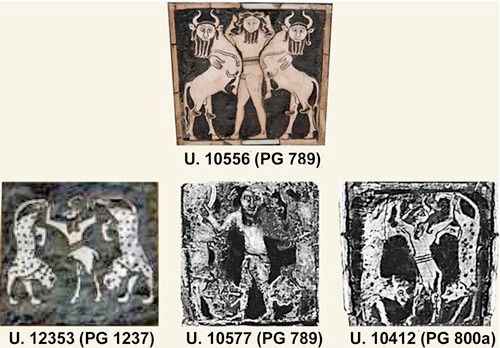
Shell panels depicting the Master of the Animals and/or a bullman
U. 10556 (Great Lyre): Naked hero grasping a pair of human-headed bulls:
image from the website of the Penn Museum {B17694A)
U. 12353 (Golden Lyre): modern reproduction: plaque depicting a bull-man holding a pair of leopards by their tails:
image from Carole Rawcliffe (referenced below, at p. 71)
U. 10577: Naked hero holding two upturned lions (?) that each bites one of his legs
U. 10412: Bull-man holding a pair of leopards by their hind legs
Last two images from Jack Cheng, referenced below, Figure 1, at p. 166)
Text
Goats and Other Ungulates in Trees
Shell Plaques from Lyres
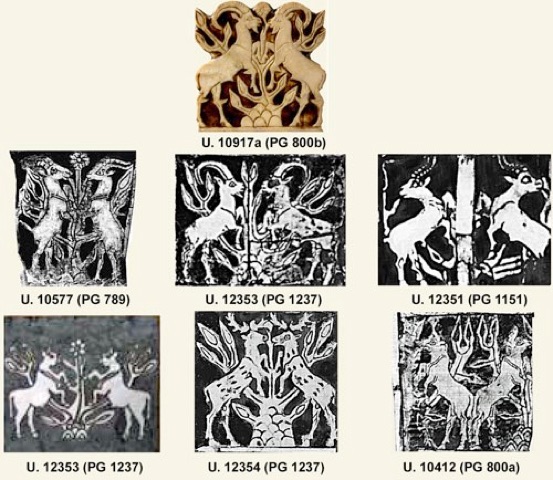
Plaques from (or possibly from) lyres that depict goats or other ungulates in trees
U. 10917a): image from the website of the British Museum (BM 121529)
U. 12353 ( bottom row above: modern reproduction of a plaque from the Golden Lyre from the death pit PG 1237:
image from Carole Rawcliffe (referenced below, at p. 71)
Other five images from Jack Cheng( referenced below, Figure 1, at p. 166)
The plaque U. 10917a (the first illustrated above) is a lovely example of an iconic image that is used on many artefacts from the cemetery: a pair of ungulates reaches up into a tree that stands on a mound of stones:
✴the stones probably signify a mountain location; and
✴the tree has some branches with what seem to be leaves (or possibly buds or fruits) and, in many cases, at least one otherwise bare branch that ends with a distinctive eight-petal ‘rosette’.
U. 10917a was found near a lyre in the burial chamber of Queen Pu-abum to which it might have belonged, and the other six plaques in this illustration can be more certainly associated with the decoration of the sound box of a lyre:
✴in U. 10917a, U. 10577, U. 12353 (middle register) and U. 12351, the ungulates in question are goat (often described as a mountain goats or ibexes);
✴in U. 12353 (bottom register), they appear to be deer;
✴in U. 12354, they are clearly antlered deer; and
✴in U 10412, they appear to be bulls.
Shell Plaques on Gaming Boards
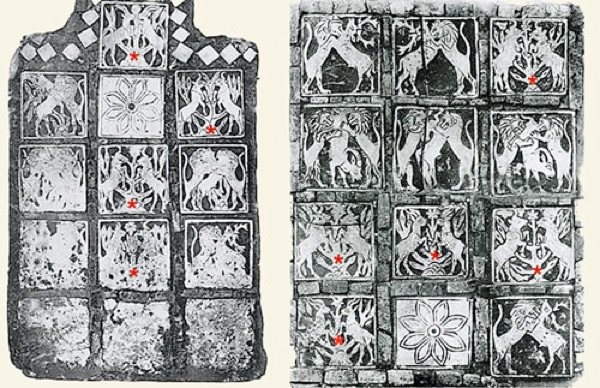
Shell plaques from two gaming boards (both now in the Iraq Museum ?): red asterisks indicate ungulates in trees
Left: U. 10557 (burial chamber PG 789) Right: U. 11162 (Chamber D of PG 779 )
Images from Leonard Woolley (referenced below, 1934b, plates 96 and 97 respectively), my additions in red
Motifs of Other Objects
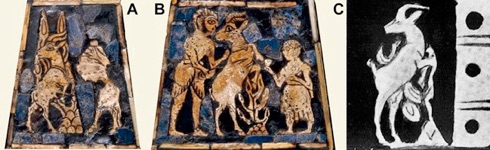
A and B: from the end panel of Standard of Ur (U. 11164: as reconstructed in 1973), from chamber D of PG 779:
now in the British Museum (BM 121201): images from the museum website
C: Sketch of an inlay from the damaged ‘wardrobe-chest’ (U. 10441-2) from the death pit PG 800a:
detail from Leonard Woolley (referenced below, 1934b, Plate 94)
The plaques A-C illustrated above also probably originally depicted a pair of goats in a tree.
Statuettes
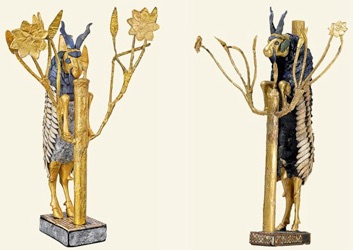
Two reconstructed statues of a male goat in a flowering tree, found near ‘body 61‘ in the death pit PG 1237
Left: U. 12357B, from the Penn Museum (30-12-702) Right: U. 12357A, from the British Museum (BM 122200)
Images adapted from those in the websites of the respective museums
Text
Attacking Lions
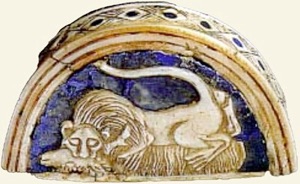
Inlaid lid of a silver box (U. 10436) from the death pit PG 800a
Now in the Penn Museum (B16744A): image from the museum website
Text
Shell Plaques from Lyres
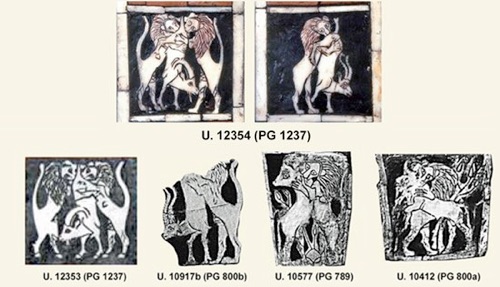
U. 12354: one complete and one incomplete plaque from the Silver Lyre from the death pit PG 1237,
both of which probably originally depicted a pair of lions attacking an upturned goat
Now in the British Museum (BM 121199); images from the museum website
U. 12353: modern reproduction of a plaque from the Golden Lyre from the death pit PG 1237:
image from Carole Rawcliffe (referenced below, at p. 71)
Three images of plaques from Jack Cheng( referenced below, Figure 1, at p. 166):
U. 10917b: fragment of a plaque that probably originally depicted a pair of lions attacking an upturned goat
U. 10577: a lion grasping a deer by its neck and biting the back of its head
U. 10412: a lion grasping a deer by its neck and biting the back of its head
Text
Shell Plaques on Gaming Boards
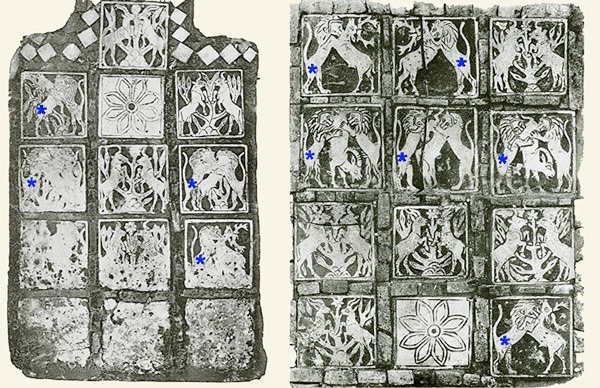
Shell plaques from two gaming boards (both now in the Iraq Museum ?): blue asterisks indicate attacking lions
Left: U. 10557 (burial chamber PG 789) Right: U. 11162 (Chamber D of PG 779 )
Images from Leonard Woolley (referenced below, 1934b, plates 96 and 97 respectively), my additions in blue
Text
Lion-Headed Eagle (Anzu Bird)
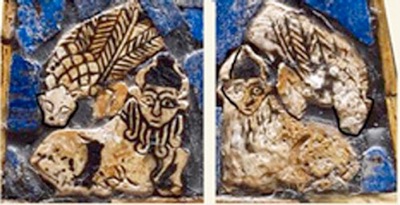
Two images of a lion-headed eagle (Anzu bird) on the back of a human-headed bull
From the end panel of Standard of Ur (U. 11164: as reconstructed in 1973), from chamber D of PG 779
Now in the British Museum (BM 121201): images from the museum website
Text
Shell Plaques
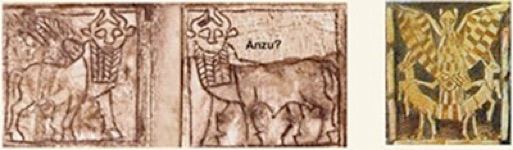
Left: Two plaques form a gaming board (U. 9776) from the filling of the shaft above PG 589,
both of which probably originally depicted a lion-headed eagle (Anzu bird) on the back of a human-headed bull
Now in the Penn Museum (B16742): images from the museum website
Right: Plaque from a lyre (U. 10412) from the death pit PG 800a, grasping a pair of goats
Now in the British Museum (BM 121198)
Image from a painting by Mary Baker, reproduced by Leonard Woolley (referenced below, 1934b, Plate 110)
Text
Sealing from a Lapis Lazuli Seal
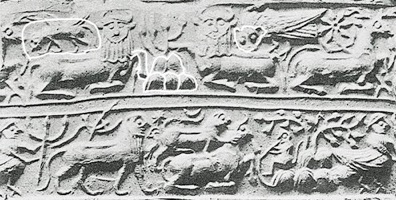
Impression produced by an uninscribed seal (U. 11734) from Burial C of PG 1054a
Was in the Iraq Museum: image from Leonard Woolley (Referenced below, 1934b, Plate 192), my additions in white
According to Leonard Woolley (referenced below, 1934a, at pp. 99-100), this lapis lazuli seal was found:
“... [at] the waist [of the male body in the wooden coffin in Burial C], where it must have hung from a belt ...”
According to Léon Legrain (in Leonard Woolley (referenced below, 1934a, entry 12, at p. 336):
✴in the upper register of the seal impression:
•two bisons [= man-headed bearded bulls] crouch on either side of a mound of stones, while:
-the one on the left is attacked by a winged lion;
-the one on the right is attacked by a lion-headed eagle; and
•at the extreme right, a stag crouches on the hills ‘among high grass and star-flowers’; and
✴in the lower register:
•a bull crouches at the centre crouches in front of a goat who faces away from a tree growing out of a mound of stones,
•the bull is attacked from behind by ‘a lion standing over him ... [and] a human-headed lion, strangely bearded’; and
•to the right, a ‘bird-man carries a branch, probably broken from the sacred tree’.
As Kathleen McCaffrey (referenced below, at p. 195, the motif of the man-headed bearded bull on the right which has:
✴one of its front legs on a mound of stones from which a tree emerges; and
✴a lion-headed eagle on its back;
is also found on a small limestone relief from Tell Ubaid (see below).
Images of the Anzu Bird from Tell Ubaid
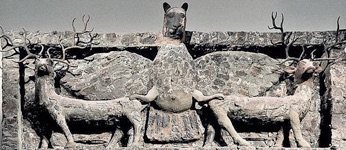
Copper relief of an Anzu bird grasping two stags from the Ninhursag temple at Tell Ubaid;
probably originally on the external facade, above the entrance
Now in the British Museum (BM 114308); image from Wikimedia
Text
Text
References
Miller et al., “A Sacred Landscape of Sumer: Statuettes from Ur Depicting a Goat on a Tree”, Journal of Ancient Near Eastern Religions”, 20 (2020) 27-47
van Dijk R. M., “Mesopotamian Early Dynastic Bull-Lyres”, in:
"Calidoscopio del Pasado:’ XIV Jornadas Interescuelas / Departamentos de Historia: Facultad de Filosofía y Letras, Universidad Nacional de Cuyo., Mendoza, Argentina (2013), at pp. 1-17
Cheng J,, "A Review of Early Dynastic III Music: Man’s Animal Call”, Journal of Near Eastern Studies, 68:3 (2009) 163-78
McCaffrey K., “Female Kings of Ur’”, in:
Bolger D. (editor), “Gender Through Time in the Ancient Near East”, (2008) Lanham, MD, at pp. 173-215
Rawcliffe C. et al., “Laser Engraving Gulf Pearl Shell - Aiding the Reconstruction of the Lyre of Ur “, in:
Nimmrichter J. et al. (editors), “Lasers in the Conservation of Artworks: LACONA VI Proceedings, Vienna, Austria, Sept. 21–25, 2005”, (2007) Heidelberg, at pp. 68-74
Marchesi G., “Who Was Buried in the Royal Tombs of Ur? The Epigraphic and Textual Data”, Orientalia, NS 73:2 (2004) 153-97
Hansen D. P., ”Great Lyre’ with Bull’s Head and Inlaid Front Panel”, in:
Aruz J. and Wallenfels R. (editors), “Art of the First Cities: The Third Millennium BC, from the Mediterranean to the Indus”, (2003) New York, at pp. 105-7
Woolley C. L. (1934a), “Ur Excavations (Volume I): The Royal Cemetery (Text)”, (1934) London and Philadelphia PA
Woolley C. L. (1934b), “Ur Excavations (Volume II): The Royal Cemetery (Plates)”, (1934) London and Philadelphia PA