Roman Republic


Empires of Mesopotamia:

First Dynasty of Ur 


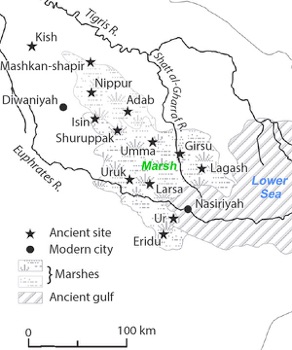
Location of Ur and other excavated Sumerian cities in ca, 4000 BC

Map adapted from Emily Hammer and Angelo di Michele (referenced below, Figure 1, at p. 454)

As Emily Hammer and Angelo di Michele (referenced below, at p. 455) observed, the ancient Sumerian city of Ur (located at modern Tell al-Muqayyar) stood on the Euphrates, close to the Mesopotamian marshes and the Lower Sea.  Roger Matthews and Amy Richardson (referenced below, at p. 131)  highlighted:

  1. “... the immense significance of the city of Ur through the obscure centuries at the transition of the 4th–3rd millennia BC and beyond.”

However, we have relatively little evidence for its subsequent history prior to the late 3rd millennium, when it became the political capital of Ur-Namma, the founder of the ‘Ur III’ dynasty (which ruled over all Sumer and Akkad, as well as much of the surrounding territory). 

Indeed, were it not for Sir Leonard Woolley’s famous excavation at Ur in the early 20th century, Ur would play only a minor role in our reconstruction of the history of Mesopotamia in the centuries before Ur-Namma.  As will become clear, a large proportion of the surviving evidence comes from either:

  1. graves that he was able to excavate in the so-called ‘Royal Cemetery’; or

  2. areas of spoil deposition in successive strata on this site.

As Willian Hafford (referenced below, at p. 202) observed, the many objects found in these later strata: 

  1. “... were likely dumped in [the area of the cemetery] from an early temple of Nanna or other important buildings that once existed near this space.”

As we shall see, this body of evidence points to what was probably a relatively short period of prosperity and political self-confidence at Ur in the ED IIIa period, which seems to include the period of what we know as the Ur I dynasty (the subject of this page).  However, as Douglas Frayne (referenced below, at p. 381) pointed out, the so-called Ur II dynasty that is recorded in the Sumerian King List (SKL) is probably a phantom. 

Epigraphic Evidence for the Putative Ur I/II Period 

In the sections below, I have ordered the respective rulers of Ur following Douglas Frayne (referenced below, at pp. 385-405), although the order in which they actually reigned is sometimes uncertain.

Meskalamdu


Seal from grave PG 1054 in the Royal Cemetery, with an inscription (CDLI, P247679) identifying King Meskalamdu  

Now in the British Museum  (exhibit BM 122536); image from Julian Reade (referenced below, 2003, at p. 103) 

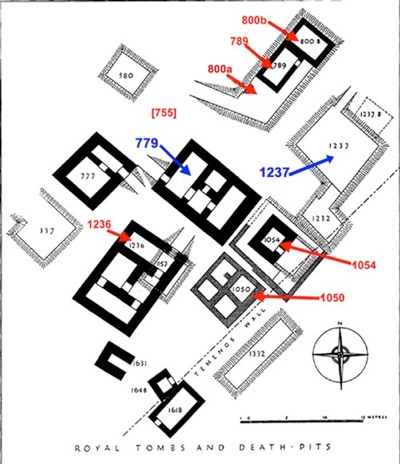
The inscription (CDLI, P247679), which is on a seal from grave PG 1054 in the Royal Cemetery (illustrated above) and is now in the British Museum (exhibit BM 122536), reads:

  1. mes-kalam-du10 lugal’, (Meskalamdu, the king).  

Note that the find spot of this seal does not mean that Meskalamdu was buried in PG 1054:

  1. as Gianni Marchesi, 2004, at p. 162) observed:

  2. “... the main occupant of the stone-built sepulchral chamber [PG 1054] was a high-ranking woman, buried together with four male attendants”; and

  3. as Peter Moorey (referenced below, at p. 28) observed, Meskalamdu’s seal (together with two gold daggers) had been placed in a wooden box in the upper level of PG 1054 that had ‘rotted away’. 

However, given its find spot, we might reasonably assume that this was the seal of Meskalamdu, king of Ur. 


Inscribed lapis lazuli bead (RIME 1.13.5.1; CDLI, P431203) from Mari   

Now in the National Museum, Damascus: image from Jean-Claude Margueron (referenced below, at p. 143) 

The inscription (RIME 1.13.5.1; CDLI, P431203) on an eight-sided bead  from Mari (illustrated above and discussed in the section below on Mesanepada) reads:   

  1. “For [DN]: Mesanepada, king of Ur, the son of Meskalamdu, king of Kish, has consecrated (this bead)”, (translation from Jean-Claude Margueron, referenced below, at p. 143). 

Thus, it seems that Meskalamdu used the titles ‘king of Ur’ and ‘king of Kish’, although , as far as we know, he did not use both titles at once.

Pu-abum (Second Wife of Meskalamdu ?)


Lapis lazuli seal from grave PG 800B in the Royal Cemetery: inscription (CDLI, P247683) identifying Queen Pu-abum  

Now in the British Museum (exhibit BM 121544); image from the website of the Morgan Library & Museum 

The famous tomb of Queen Pu-abum is the only ‘royal’ tomb that was discovered in the cemetery that had escaped the attentions of looters.  The body remained in place, and she can be securely identified from the inscription on the seal illustrated above: this was one of three seals that she was wearing when she was buried, but, although all three were clearly hers, this one is the only one that actually identified her by inscription.  Interestingly, as William Hafford (referenced below, at p. 213) pointed out, her name seems to be Akkadian,  He also observed that:

  1. “It was unusual for a cylinder seal to be inscribed with only a female name and title; the fact that Pu-abum’s husband or father are not named on the seal suggests she may have ruled in her own right.  The massive wealth found in [her] tomb further bespeaks her power and prestige.  Her grave goods included: thousands of beads; silver, gold, and exquisite stone vessels; and, perhaps most impressive of all, a headdress of gold and imported stones that weighed some 2.21 kilograms.”

Douglas Frayne (referenced below, at p. 387) argued that:

  1. “The fact that [Pu-abum’s] seal was found in the tomb beside that of Meskalamdu [= PG 789] almost certainly means that she was a (second) wife of that king.”

The assumption here seem to be that the high-ranking woman who was buried in PG 1054 had been Meskalamdu’s first wife, but it is not clear that this was the case.  Furthermore, the identity of the occupant of PG 789 is similarly unclear: as William Hafford (referenced below, at p. 210) pointed out: 

  1. “Having discovered the built chamber of PG 800B, a queen’s tomb, while excavating the neighbouring PG 789, [Leonard Woolley] interpreted the proximity of the two tombs as suggesting a close relationship between their occupants.  Unfortunately, Woolley’s romantic story of the queen who outlived her husband (presumably buried in PG 789) but so loved him that she demanded to be buried next to him when she died ... has little basis in fact.”

He argued (at p 211) that:

  1. “Woolley’s poignant story of the loving couple that occupied tombs PG 789 and PG 800B is intriguing and perhaps still possible, but only if it was the occupant of PG 789 who wished to be buried near Pu-abum, who had already been placed in PG 800B.” 

Akalamdu (Son of Meskalamdu) 

According to Douglas Frayne (referenced below, at p. 389):

  1. “Meskalamdu was apparently succeeded by his son Akalamdu as king of Ur.  While no inscription of the king himself is as yet extant, a seal inscription, [CDLI, P247682], from a royal tomb at Ur, [PG 1050],mentions his wife Ashusikilan.”

It this is correct, then we must assume that, for whatever reason, Akalamdu was soon succeeded by his brother or half-brother Mesanepada.

Mesanepada

As we have seen, Mesanepads is named as the king of Ur on the lapis lazuli bead illustrated above.  As Jean-Claude Margueron, referenced below, at p. 139) pointed out, this bead was found, together with other precious objects, in a jar that was buried in the ‘sacred precinct’ of the pre-Sargonic palace at Mari.  The excavators characterised these objects as the ‘treasure of Ur’ and  speculated that this ‘treasure’ had been a royal gift from Ur.  However, it has subsequently emerged that the objects themselves are quite disparate, and the circumstances in which this particular object found its way (presumably from Ur) to Mari are actually unknown. 

Furthermore, there is some doubt about the identity of the god to whom Mesanepada dedicated this bead: for example:

  1. Jean-Claude Margueron, referenced below, at p. 143) found the divine name to be illegible;

  2. Douglas Frayne (referenced below, 2008, RIME 1.13.5.1, at p. 392) gave ‘an lugal-[ni]’ (to the god An, his lord); and

  3. Glenn Magid (referenced below, at p. 10) and the entry at CDLI, P431203 give ‘dlugal-kalam’ (to the god Lugalkalam).

Thus, the only ‘hard information’ that we can take from the inscription on this bead is that Mesanepada used the title ‘king of Ur’ at a time when his father, Meskalamdu, (who was presumably still alive) used the title ‘king of Kish’.


Seal of Mesanepada (RIME 1.13.5.2; CDLI, P431204) from he Royal Cemetery

Now in the Penn Museum (Sealing 31-16-677), image from museum website  

A second royal inscription of Mesanepada (RIME 1.13.5.2; CDLI, P431204) is on a clay sealing (illustrated above) that was found in a ‘spoil’ stratum in the ‘Royal Cemetery’.  The inscription on this seal reads:

  1. “Mesanepada, King of Kish, dam nu-gig (husband of the nu-gig)”.

Glenn Magid (referenced below, at p. 6) observed that nugig could have been either: 

  1. the name of one of Mesanepada’s actual wives; or

  2. the name of: 

  3. “... a well-known type of priestess.  If so, then [this inscription] would constitute the earliest evidence for a ritual that is otherwise attested only later in Mesopotamian history: the annual ‘sacred marriage’ between the king and a goddess (embodied in the person of her priestess).”

Petr Charvát (referenced below, 2017, at p. 196 and note 37) translated nugig as ‘the Lofty One’, and observed that this could have been either a reference to the ‘nugig priestess’ (a priestess of Inanna) or an epithet Inanna herself.  Pirjo Lapinkivi (referenced below, at pp. 18-20) observed that: 

  1. “Enmerkar, the legendary king of Uruk, was the earliest Sumerian ruler who called himself Inanna’s husband. ... Even if the evidence [of the Enmerkar legend] is questionable, there are other sources that indicate an affectionate relationship between the Sumerian ruler and the goddess of love as early as the ED II period: [for example], there is a seal impression of Mesanepada ... [that] declares [him] to be ‘the husband of the nu-gig’.  The term nugig probably refers to the common epithet of Inanna ... The impression also has designs of a star and a crescent moon, which were both  common symbols for Inanna in her astral aspect (the planet Venus and the morning and evening star).” 

As we shall see, this is the earliest of a series of indications that the title ‘king of Kish’ might have been in the gift of the goddess Inanna (a suggestion first made by Tohru Maeda, referenced below, 1981, at pp. 7-9).  

Nintur, Wife of Mesanepada 


Lapis lazuli seal of Nintur, wife of Mesanepada (RIME 1.13.5.3; CDLI, P247685) from Ur  

Now in the Penn Museum  (exhibit CBS 16852; image from Julian Reade (referenced below, 2003, at p. 103)  

Mesanepada is also named in a seal of his wife, which was found in loose soil in the stratum above the royal graves in the Royal Cemetery: this inscription (RIME 1.13.5.3; CDLI, P247685 ) reads:  

  1. “Nintur, the queen, the wife of Mesanepada”. 

(Crown Prince ?) Meskalamdu


Electrum helmet from grave PG 755 in the Royal Cemetery of Ur, 

which belonged to a warrior who may have been called Meskalamdu: now in the Iraq Museum (IM. 8629)  

Image (of a copy of the original helmet) from William Hafford (referenced below, Figure 8.9, at p. 225)

A  complication in our search for the ‘historical’ King Meskalamdu is that it seems that one of the most impressive of the graves in this cemetery, PG 755, belonged to a man of that name: as Willian Hafford (referenced below, at p. 266) observed, this grave: 

  1. “... contained a wooden coffin and many spectacular offerings that are only paralleled in the [so-called ‘royal tombs’ in the cemetery].  Some of the grave goods also had explicit royal connections, including several metal vessels bearing the names of, [inter alia], Meskalamdu (RIME 1.13.7.1, CDLI, P431212) ... The bones inside [the coffin] were those of a robust young man who wore a silver-plated belt from which hung a gold dagger and a whetstone made of lapis lazuli: 

  2. an electrum helmet made in the form of an elaborate wig [illustrated above], a form that is sometimes associated with Early Dynastic kings, was set near the man’s skull; and

  3. two electrum axes, a gold lamp, a gold bowl, and many beads were also found near his body. 

  4. Outside his coffin were many more offerings including copper, clay and stone vessels, as well as daggers or short swords, axes, and arrowheads.  The overall impression is not solely of wealth but also of military might.” 

However, Hafford argued that this man was not the king of that name whose seal was discussed above, although the two men might have been related to each other.  Gianni Marchesi (referenced below, 2004, at pp. 183-5):

  1. argued that the warrior buried in PG 755 may well have been:

  2. the homonymous grandson of the king Meskalamdu; and

  3. the son of Mesanepada and Nintur; and

  4. suggested (at p. 186) that he might have a ‘crown-prince’ at the time of his death. 

A’anepada 

A’anepada is the only son of Mesanepada who is known from surviving inscriptions, which have been  found at both Ur and Tell Ubaid (some 6 km west of Ur).  I discuss his inscriptions from Ur here and those from Tell Ubaid in the section below of the Ninhursag temple there.

Inscriptions from Ur 


Copper cone with an inscription of A’anepada  (CDLI, P423674) from Ur, now in the British Museum (BM 090951)

Image from Julian Reade (referenced below, 2024, Figure 15, at p. 43) 

The inscribed copper cone illustrated above had long languished in the British Museum before Julian Reade (referenced below, 2002, at pp. 250-3) recognised it as one of three objects that had been found at Ur in 1858, when John Taylor: 

  1. “... had excavated a shrine foundation deposit that was still in its original position.”

Gábor Zólyomi (referenced below, at p. 85) translated the inscription on the cone  as follows: 

  1. The dwelling AB.IGI.BUR, the sanctuary, the mountain of snakes, where? Inana ..., the Abzu (whose) god no crown (i.e., ruler) would disobey, its owner, the god of A’anepada, Enki, the father who created him, made his (= A’anepada’s) lordship apparent.  He (= A’anepada) (then) established the AB.IGI.BUR for him (= Enki), called its name for him, and fashioned his crown for him.” 

Nicholas Kraus (referenced below), who had produced a translation that was slightly modified by Gábor Zólyomi (above) commented (at p. 59) that: 

  1. “Based on the inscription, the [cone] appears to commemorate laying the foundations of a structure known as the AB.IGI+BUR by A’anepada, along with the fashioning of a crown for Enki.” 

Julian Reade (referenced below, 2024, at p. 44) suggested that the AB.IGI+BUR might be an early version of esh-bur, which was a shrine dedicated to Inanna Ninkununa and built or restored by the king Ur-Namma  (see: RIME 3/2.1.1.15; CDLI, P432125; and RIME 3/2.1.1.16; CDLI, P432126).  

Douglas Frayne (referenced below) was unaware of the inscription above (or perhaps doubted its authenticity).  However, he did publish another inscription of A’anepada from Ur (RIME 3/2.1.1.15; CDLI, P432207, which is now in the (UK) Birmingham Museums and Art Gallery, (BCM 1103-052).  This inscription, which is on a fragment of calcite bowl apparently found under the pavement of rooms 16–17 of the Enunmah (Moon Temple) reads: 

  1. “To [DN]: A’an[epada], king of Ur ...”   

Other Kings of Ur Known from Their Royal Inscriptions 

Meskiagnun 


Fragment of a calcite bowl dedicated by Gansaman, wife of Meskiagnun (RIME 1.13.8.1, P431213) from Ur 

Now in the British Museum  (exhibit BM 122255; image from Wikimedia Commons 

This vase fragment was found in loose soil in the stratum above the royal graves in the Royal Cemetery.   The surviving inscription (RIME 1.13.8.1, P431213) reads: 

  1. “For (the life of) [Meskiag]nun, king of Ur: Gansaman, his wife, dedicated (this bowl)”.

Douglas Frayne (referenced below, 2008, at p. 403) and Gianni Marchesi (referenced below, 2015: p. 140, note 13 and p. 144, Ur entry 2) accept that the name of this king can be completed as Meskiangnun.  Gianni Marchesi (referenced below, 2004, note 97, at p, 168) argued that:

  1. “...  on an epigraphic basis, this king of Ur seems to be an earlier ruler than Mesanepada ...”.

However, Douglas Frayne (as above) placed him after A’anepada (perhaps because he is described as the son of Mesanepada in the SKL ??).  In short, the date of the reign of thus king at Ur is unknown.  

Elili 

The inscription (RIME 1.13.9.1, P431214) on two clay foundation cones of unknown provenance, one of which is now in the British Museum (BM 121343), reads:

  1. “For the god Enki, king of Eridu: Elili, king of Ur, built his (= Enki’s) Abzu (temple)”.

Douglas Frayne (referenced below, at p. 405) argued that:

  1. the Abzu temple recorded here was almost certainly at Eridu and this was presumably the original location of these foundation cones; and

  2. the King Elili of Ur who built this temple was also named in the SKL (as discussed further below).  

Meskalamdu, Mesanepada and the Kingship of Kish

We can now consider the significance of the fact that both Meskalamdu and Mesanepada used the titles king of Ur and king of Kish, starting with the facts that:

  1. as far as we know, neither of them ever held both titles at the same time; and

  2. in the inscription on the bead from Mari (in which both men are named), Mesanepada is described as ‘king of Ur, the son of Meskalamdu, king of Kish’. 

Hypothesis of Gianni Marchesi

Gianni Marchesi (referenced below, 2015, at p. 145, Uruk entry 6) argued that, in this period, Meskalamdu (and subsequently Mesanepada) used the title ‘king of Kish’ in order to signify that he actually ruled at both Uruk and Ur (rather than at Kish itself):

  1. as he noted (at pp. 144-5, Uruk entry 4), he based this hypothesis on the fact that an earlier ruler named Lugalnamnirshumma had been described (in a votive offering at Girsu) as ‘king of Kish’; and 

  2. since

  3. he believed that this votive object had been found in the same architectural context as another such object dedicated by the chief lamentation priest of Uruk; and

  4. ‘foreign’ dedications at Girsu were unusual;

  5. then Lugalnamnirshumma had probably ruled at Uruk (in which case, king of Kish’ was an honorary title), 

However, as I discussed above, Sébastien Rey (referenced below, at p. 209) pointed out that: 

  1. a number of scholars have been misled by an early, flawed description of the find-spot of this spear-head of Lugalnamnirshumma within the complex archeological site of the temple at Girsu; and

  2. the problems that this has raised have been: 

  3. “... compounded by the theory that kings of Uruk might perhaps have assumed the ‘catch-all’ title king of Kish ...” 

He pointed out (at p. 210) that, once it is understood that the spear-head of Lugalnamnirshum’

  1. had not been buried in the same archeological context as the votive offering of the chief lamentation priest of Uruk; and

  2. it had actually been buried in the same archeological context as the votive offering as the famous mace-head of King Mesalim of Kish;

it becomes clear that Lugalnamnirshum was:

  1. “... one of Mesalim of Kish’s successors, and, therefore, in all likelihood, another foreign overlord of Girsu [and Lagash].”

Thus, there is no particular reason to assume that Lugalnamnirshum had ruled at Uruk, thereby undermining Marchesi’s hypothesis that, by extension, Meskalamdu and then Mesanepada used the title of king of Kish to signify that he ruled at both Ur and Uruk. 

Likely Significance of the Title ‘King of Kish’ 

Marchesi (as above) assumed that the putative post ‘king of Uruk’ would have been more prestigious than that of ‘king of Ur’.  He therefore argued that:

  1. “... after occupying the more prestigious post of king of Uruk, Meskalamdu gave Ur to his son Mesanepada to rule.  Upon the father’s death, Mesanepada ascended the throne of Uruk, as is revealed by the title ‘king of Kish’ on his seal,”

Clearly this suggestion must be modified if it is accepted that there is no evidence that the title ‘king of Kish’ ever meant ‘king of Uruk.  It is, of course, possible, that:

  1. at some point in his reign, Meskalamdu retired in order to allow Mesanepada to rule at Ur, at which point he himself adopted the honorary title of ‘king of Kish’; and

  2. Mesanepada subsequently followed his example by retiring to make way for one of his sons and adopted the honorary title of ‘king of Kish’. 

However, as we have seen, the only known son and successor of Mesanepada, A’anepada, is referred to in his surviving inscriptions only as:

  1. A’anepada, king of Ur (RIME 1:13:6:1; CDLI, P431260); or

  2. A’anepada, king of Ur, son of Mesanepada, king of Ur (RIME 1:13:6:3; CDLI, P431208). 

Furthermore, this second inscription suggests that Mesanepada was using the title ‘king of Ur’ at the time of his own death (which presumably coincided with A’anepada’s accession).  In short, the most likely scenario is that:

  1. Meskalamdu actually captured Kish, at which point:

  2. he became ‘king of Kish’; and

  3. Mesanepada adopted the ‘lesser’ title ‘king of Ur’; and

  4. on Meskalamdu’s death, Mesanepada became king of Kish, but subsequently lost control of that city, at which point he reverted to the ‘king of Ur’, the title that he duly passed on to his son, A’anepada. 

This begs the question of what evidence (if any) might support the hypothesis that:

  1. Meskalamdu actually did conquer Kish and was able to pass on the title ‘king of Kish’ to Mesanepada, his son and successor; and

  2. Mesanepada was subsequently expelled from Kish but was at least able to pass on the title ‘king of Ur’ to A’anepada, his son and successor. 

Petr Charvát (referenced below, 2017, who assumed that:

  1. both Meskalamdu and Mesanepada belonged to ‘the Kish royal line’ (see p. 197); and

  2. Meskalamdu (rather than his homonymous grandson) was buried in PG 755 in the Royal Cemetery of Ur (see 196);  

argued (at pp. 196-7 and note 38) that: 

  1. “It may be eloquent that the times of the lavish expenditure poured into the ‘royal graves’ [at Ur] came to an abrupt end with [Mesanepada], as shown by archaeological observations of:

  2. the cessation of those extravagant burial practices; and

  3. [the] renewed superposition of administrative-discard layers over the cemetery deposit, displaying the Mesanepada documents over the last stratum of the ‘royal graves’.

  4. ...  Needless to say, in a short time, Ur was also reduced to ashes by enemy action, [as evidenced by RIME 1.9.1.6b - see the discussion below], and the wheel of wars and devastation continued its motion with an awe-inspiring regularity until the beginning of the Old Akkadian period.”

Actually, the ‘dumping’ of Mesanepada’s seal above the royal graves tells us nothing about the date of his reign: the seal might have remained in its original location for a considerable period of time before it was dumped.  That leaves us with the evidence of ‘extravagant burial practices’, which is indeed in evidence in the case of:

  1. Pu-abum (PG 800 B), whose Akkadian name might suggest that she came from Kish; and

  2. Meskalamdu (PG 755), who, as noted above, was certainly a warrior and might well have been

  3. the son of Mesanepada; and

  4. recognised as the crown prince at the time of his extravagant burial. 

In other words, it is possible that:

  1. Pu-abum was queen at a time when Meskalamdu and Mesanepada belonged to ‘the Kish royal line’; and

  2. the warrior Meskalamdu (who was buried in PG 755) had died in battle, perhaps when Mesanepada was driven from Kish. 

However, it seems to me that the best evidence for the hypothesis that: 

  1. Meskalamdu, the father of Mesanepada captured Kish;  and

  2. Mesanepada inherited from him the title ‘king of Kish’ but subsequently last it;

is found in the epigraphic evidence (discussed above) that Mesanepada was simply ‘king of Ur’ at the time of his death and the accession of his son, A’anepada.  

Likely Date of the Reign of Mesanepada 

As discussed above, it is arguable that Mesanepada:

  1. inherited the title ‘king of Kish’ from his father; but

  2. subsequently lost control of Kish but was still ‘king of Ur’ at the time of his death. 

Furthermore, the evidence discussed so far arguably supports the hypothesis that Mesanepada:

  1. ruled towards the end of  what might well have been a relatively short period of ‘extravagant burial practices’ in the Royal Cemetery; and

  2. might well have buried one of his sons (a warrior named Meskalamdu) in one of these extravagant graves (PG 755) before his own death. 

Thus, if we can establish the period in which these ‘extravagant burial practices’ were used, we can also date the reign of Mesanepada. 

As William Hafford (referenced below, at p. 198) observed:

  1. “The famous Royal Cemetery of Ur is only one part of a large and very deep burial ground in the middle of the ancient city.  The site’s initial excavators divided this burial ground ... into three primary layers or periods of burial that might be considered discrete cemeteries within it.”

He pointed out that:

  1. burial in the lowest (= earliest) layer probably ended in the ED I-II period (ca. 3100 -2600 BC) and

  2. burial in the upper layer started the Akkadian period (ca. 2334–2154 BC). 

However, we are concerned here with the middle layer, which, as Hafford pointed out, the burials were:

  1. “... mostly belonged to the ED III period (ca. 2600–2334 BC).  It is this layer that is identified as the Royal Cemetery, since all of the 16 graves designated as royal [because they contained evidence of extreme wealth and human sacrifice] were found ... ”

(Interestingly PG 755, which certainly contained evidence of extreme wealth, was omitted from Leonard Woolley’s list of ‘royal graves’ because it lacked evidence for human sacrifice.) 

Thus, we can be reasonably sure that Meskalamdu and Mesanepada reigned at some time in the ED III period (ca. 2600–2334 BC).  It is therefore at least possible that Mesanepada’s putative loss of the kingship of Kish had something to do with the activities of the so-called Kiengi League, a military alliance of six city states of Kiengi (= Sumer), that is known principally from two administrative texts (WF 92; CDLI, P011049 and WF 94; CDLI, P011051) from Shuruppak (modern Fara):

  1. these documents belong to a large collection of administrative, lexical and literary texts from Fara (the so-called ‘Fara texts’) that all apparently date to the ED IIIa or Fara period (ca. 2600 - 2450 BC); and 

  2. they describe the mobilisation of troops from six Sumerian cities (Uruk, Adab, Nippur, Lagash, Shuruppak and Umma) in an alliance directed against an unnamed enemy. 

I  discuss the possibility that this campaign was directed against Mesanepada, King of Kish and Ur, after considering the surviving evidence for the date of the reign of his son and successor, A’anepada, which relates to his documented cimstruction of the Ninhusag temple at Tell Ubaid.  

A’anepada and the Ninhursag Temple at Tell Ubaid 


Plan of the mud brick platform and walls of the Ninhursag Temple at Tell Ubaid 

From Hall and Woolley (referenced below, detail of Plate II)  

Harry Hall, an archeologist working in Mesopotamia for the British Museum, recorded (in Hall and Woolley, referenced below, at p. 5) that: 

  1. “ While exploring the desert near Ur one Sunday at the beginning of April [1919], I discovered a new prehistoric and early Sumerian site ... about 4 miles due west of Ur.   This is a small tell, about 30 ft. high and 150 ft. long, called locally ‘Tell al-'Ubaid’.”

Although Hall was only able to devote a few weeks to the excavation of the mound, he made a number of important discoveries that had clearly belonged to a Sumerian temple.  The mound was then left untouched until Leonard Woolley returned to it as the head of a joint expedition of the British Museum and the Museum of the University of Pennsylvania  in 1923-4.  As he recorded (in Hall and Woolley, referenced below, at pp. 59-60), by the end of his work:

  1. “The [roughly rectangular] plan of the building had been established so far as the state of its ruins permit.  ... [In particular], ...  the south-east side had amply repaid us:

  2. not only had we got from it (as Dr. Hall had from its eastern corner) a collection of objects of art unrivalled from any early Babylonian site; but

  3. amongst these [objects] was the foundation-tablet of the temple, which fixed the date and authorship of the building and brought into Mesopotamian history a period which, heretofore, had been generally regarded as mythical.” 

The quotes above are from the joint report of these successive campaigns, and the crucial inscription to which Woolley referred (which is discussed in context below) reads as follows: 

  1. “For the goddess Ninhursag: A’anepada, king of Ur, son of Mesanepada, king of Ur, for the goddess Ninhursag, he built (her) temple”, (RIME 1:13:6:3; CDLI, P431208).  

Woolley’s Reconstruction of the Temple 


Leonard Woolley’s theoretical reconstruction 0f the putative facade of the temple 

From Harry Hall and Leonard Woolley (referenced below, Plate XXXVIII)  

As Leonard Woolley pointed out (in Hall and Woolley, referenced below, at p. 105), although the objects found on the site of the temple were of great significance:

  1. “... it must be emphasised that the ground-plan that we possess is that of the substructure only; of the temple that stood upon it there is not a single brick left in situ: nothing remains to fix even its outline, and any idea which we may form of its original appearance must needs be largely theoretical.”

Thus, the famous illustration above is the product of a theoretical construction, based on:

  1. the known (roughly rectangular) plan of what the excavators dubbed ‘second period’ (see below) and the existence of stone stairs on its southern side; and

  2. the fact that the great majority of objects recovered from the temple were found in front of this wall (on one or other side of the stairs), which led to the reasonable conjecture that:

  3. this wall was the facade of the temple; and

  4. the stairs led up to its main entrance. 

Ömür Harmanşah (referenced below, at p. 383) argued that:

  1. The building, [as Woolley reconstructed it], presents us [with] a rich assemblage of architectural technologies of cladding and decoration at the time.  [The surviving examples of these included]: 

  2. two beautifully constructed columns that flanked the entrance, [which] were built from palm logs covered with a coating of bitumen and inlaid with mother of pearl, pink limestone and black shal;

  3. the copper alloy high relief figure of the famous lion-headed [Anzu] bird clasping two stags [that] topped the entrance to the temple; and

  4. the facade, [which] was decorated with a row of copper bulls, shell-inlaid narrative friezes, and elaborate multi-coloured clay nails. 

  5. This iridescent and luminous quality of the materials used on the building (mother of pearl, shell, copper alloy, black shale, limestone, among other materials) perhaps speaks to the notion of ‘me’, ... [which he defined as] divine power made visible through the tantalising exotic materials of faraway lands ...”. 

Archeological  History

According to Leonard Woolley (in Hall and Woolley, referenced below, at p 61):

  1. “The ruins of the temple mound belonged to three distinct periods.  The lowest down and the earliest of these was that identified by the foundation tablet [of A’anepada].”

In other words, Woolley argued that A’anepada’s temple belonged to a ‘first period’, which had ended when it had been: 

  1. “... violently destroyed, [as] was evident from the condition of the ruins:

  2. the objects found lowest down on the floor level at the foot of the platform were just those which could have been removed and flung there (and could not have fallen there of themselves); and

  3. on the top of these [objects] lay whole sections of the actual walls of the shrine, undermined and overthrown before the delicate ornament attached to the wall face had had time to fall off or decay. 

  4. It was also evident that the ruins had been long neglected and exposed to the weather ...”

He also pointed out that the discovery of bricks carrying inscriptions of the Ur III king Shulgi (his ‘King Dungi’) apparently marked the start of the final ‘third period’ of the temple’s history.   He therefore argued (at p. 64) that there had been three successive temples on this site:

  1. the temple of A’anepada, which suffered a violent destruction (perhaps at the hands of  Eanatum, ensi of Lagash - see p. 65);

  2. a second temple, which was built after a significant interval (as evidenced by the state of the ruins of its predecessor) and remained in use until shortly before the Ur III period (when it was possibly destroyed by Sargon of Akkad - see p. 65); and

  3. a third temple, which was built by Shulgi, whom Woolley designated (at p. 65) the ‘last man’ to build at [Tell Ubaid]’.

I will return to the likely circumstances in which A’anepada’s temple was destroyed below.  First, however, we should look at the potential evidence from the object that survived its destruction.

Surviving Objects from the ‘First Period’ Temple  


Plan of the excavated area in front of the putative southern facade 

Detail from Harry Hall and Leonard Woolley (referenced below, Plate II) 

Inscriptions from the Site 

As noted above, the most informative (and thus the most important) inscription found on the site (RIME 1:13:6:3; CDLI, P431208) is on on a stone foundation tablet that is now in the British Museum (BM 116982), which records that: 

  1. “For the goddess Ninhursag: A’anepada, king of Ur, son of Mesanepada, king of Ur, for the goddess Ninhursag, he built (her) temple”.  

The find spot is marked (as number 40) on the plan above.  Three other inscriptions of A’anepada were found nearby:

  1. the inscription (RIME 1:13:6:1; CDLI, P431206), on a hollow gold bead that was found closer to the facade (at location number 39) reads simply: 

  2. “A’anepada, king of Ur”: and

  3. two fragmentary inscriptions (RIME 1.13.06.04; CDLI, P431209; and RIME 1.13.06.05; CDLI, P431210) on bowl fragments (from locations 41-2), each of which probably recorded the dedication (presumably by an important official) to Ninhursag for the life of A’anepada that was made at the time that he had built this temple.    

Copper Lions’ Heads


Three lions’ heads from the Ninhursag temple at Tell Ubaid 

Now in the British Museum (BM 114315, 117918 and 114312 respectively); images from the museum website  

Harry Hall (in Hall and Woolley, referenced below, at p. 18) recorded that, beneath: 

  1. “... a mass of twisted, crushed and contorted copper [objects] ... and luckily preserved by it from great damage, were found four copper heads, [one of which no longer survives] and two foreparts of life-size lions, each head filled with bitumen, ... so that the [copper] formed a mask ... Each of these heads had large eyes ... [and] was also furnished with teeth of white shell ... In the mouth of each was a red jasper tongue (missing in one case).  The lion was thus represented grinning ferociously, with wide open eyes, ...” 

The find spots of these heads are marked (as P-S) on the plan above.  Hall (as above) argued that: 

  1. “... it  is evident that these four lions performed some architectural function, jutting forth from the wall from which they had fallen.  They must have fallen at one blow, as they were found in a line, side by side.” 

These finds were the basis for the presence of the two lions ‘guarding’ the putative main entrance to the temple in Woolley’s reconstruction.    


Left: Two limestone lions’ heads  from Ur-Nanshe’s Ningirsu temple at Girsu,

both now in the Musée du Louvre (AO 231 and AO 233); images from the museum website  

Right: Sketches of a pair of  identical lions’ heads from Girsu attributed to Akurgal: 

from André Parrot (referenced below, Figure 21): 

the originals are now in the archeological museum of Istanbul (ESH 46 and Esh 48)  

Christina Tsouparopoulou (referenced below, at p. 204-6) pointed ed that the three lions’ heads from Tell Ubaid are stylistically similar to a number from Girsu, albeit that the Girsu lions are:

  1. considerably smaller (around 10 cm in height, which is about half the size of those from Tell Ubaid) and

  2. made of limestone rather than copper on bitumen. 

Sébastien Rey (referenced below, at pp. 279-81) recorded that these heads were found together at the ‘Ur-Nanshe level’ in the SE side of the Ningirsu temple at Girsu and that they fall into two groups:

  1. the two that are now in the Musée du Louvre, which are made of limestome: 

  2. AO 231; and

  3. AO 233, which is inscribed with the name of Ur-Nanshe (RIME 1.9.1.24b; CDLI, P431059);

  4. are of almost exactly the same size and might have been made as a pair (AO 231 male and AO 233 female); and  

  5. the two (a matching pair) that are now in the archeological museum of Istanbul, which are very similar to AO 231, although they are made of gypsum:

  6. ESH 456, which carries what is now a fragmentary inscription of Ur-Nanshe (RIME 1.9.1.25; CDLI, P431060); and 

  7. ESH 458, which carries an inscription (RIME 1.9.2.2a; CDLI, P432072) that Douglas Frayne (referenced below, 2008, at p. 122) attributed to Ur-Nanshe’s son, Akurgal. 

Interestingly, although Rey pointed out (at p.283) that all of these lions were depicted with protruding tongues (albeit that he acknowledged (at p. 279) that the significance of this unusual characteristic is unclear).   As to the function of these objects, Rey argued (at p. 279) that their good physical condition and the location of their burial indicates that they belonged to a ‘coherent assembly’ of sacred objects that had been displayed in Ur-Nanshe’s temple and then give ritual burial when this temple had been deconsecrated.   He also suggested  (at p. 283) that, given their small size and the fact that at least some of them were inscribed, they may well have been:  

  1. “... ornamental elements that were fixed to pieces of temple furniture ... Indeed, they could have been designed to adorn a range of sacred appurtenances inside the sanctum sanctorum.” 


Lion’s head of Akurgal from Tell V at Girsu on an inscribed lion’s head (RIME 1.9.2.1: CDLI, P431071);

now in the Musée du Louvre (AO 3295

The basic design of the lions’ heads from the Ur-Nanshe temple at Girsu was also later used in other contexts at Girsu: for example, Douglas Frayne (referenced below, 2008, at p. 122) recorded that an alabaster lion’s head from Tell V (‘Tell des Tablettes’) there (which was comparable in height but cylindrical, measuring some 16 cm from front to back) carried the following inscription:

  1. “For the god Ningirsu: Akurgal, ensi of Lagash, son of Ur-Nanshe, king of Lagash, built the Antasur”,  (RIME 1.9.2.1: CDLI, P431071). 

This brings us to the question as to whether the stylistic similarities between the lions’ heads from:

  1. A’anepada’s Ninghursag temple Tell Ubaid on the one hand;  and

  2. Ur-Nanshe’s Ningirsu temple Girsu on the other;

are close enough to suggest that they belonged to a single stylistic culture: after all, the difference in size and material between them might simply reflect that the fact that they had different functions.  In my opinion, the fact that they all share the unusual ‘protruding tongue’ motif strongly suggests that this was the case (as discussed further below).   

Copper Relief  


Copper relief of  the lower part of an eagle grasping two stags in the location of its discovery ( location Z)  

From  Hall and Woolley (referenced below, Plate V, image 8)


Copper relief illustrated above, after its restoration/reconstruction 

Exhibited in the British Museum (BM 114308); image from Wikimedia  


Drawing of the relief on a silver vase of Enmetena, ensi of Lagash, from the temple of Ningirsu at Girsu  

The vase is now in the Musée du Louvre (exhibit AO 2674) and this sketch from the website of ‘Old European Culture’ 

As Harry Hall (in Hall and Woolley, referenced below, at p. 22-3) remembered, as packing had begun at the end of his campaign at Tell Ubaid: 

  1. “... the most remarkable object of all was discovered.  This is a great relief of copper within a copper frame, measuring ... 2·375 x 1·07  meters, on a wood backing; it represents the lion-headed eagle,  ... the mythical bird of the god Ningirsu, holding two stags by their tails.”


which apparently originally decorated the facade of the temple, depicted an upright lion-headed eagle (known as the Anzu bird) with outspread wings, grasping a pair of stags.  As Piotr Steinkeller (referenced below, 2019a, at p. 996) pointed out, this image belongs to a group: 

  1. “... of Pre-Sargonic images in which deer (or, alternatively, gazelles and ibexes) are juxtaposed with the lion-headed eagle, who was the alter-ego of Ningirsu/Ninurta.  Since [Ningirsu/ Ninurta] counted as Ninhursag’s son, one may be confident that, in these representations, the deer/gazelles/ibexes signify the goddess.  ... Since [the relief above] was a centrepiece of Ninhursag’s own temple [at Tell Ubaid], its pairing of [the Anzu bird] with the stags  ... (rather than with the usual lions, which reference Ningirsu/Ninurta’s martial aspect) must be intentional, with the stags standing for the goddess.” 

In fact, we cannot assume that, at the time of the installation of this relief, Ninhursag was regarded as the mother of Ningirsu: as Steinkeller himself noted (at p. 988), our earliest source for this relationship is from the Sumerian literary tradition of the Old Babylonian period, when Ningirsu/ Ninurta was indeed characterised a son of Enlil and Ninhursag.  However:

  1. there is no reason to doubt that the Anzu bird was regarded as a representation of Ningirsu at this time (see below); and

  2. it remains likely that the stags that this ‘alter-ego’ of Ningirsu grasps do indeed represent either Ninhursag herself or (more probably) her temple at Tell Ubaid. 

Example of This Iconography from Girsu


Carved pierced plaque of Ur-Nanshe (RIME 1.9.1.26; CDLI, P431061), now in the Musée du Louvre (AO 2783)   

Image from museum website 

Interestingly, the relief on the plaque illustrated above, which carries a royal inscription of Ur-Nanshe,  depicts the Anzu bird in the same way, but, in this case, it is grasping the ‘usual’ lions.  As Douglas Frayne (referenced below, 2008, at p. 112) observed, this is one of:

  1. “Three very similar wall plaques of Ur-Nanshe from Girsu, [all of which] depict an Anzu bird standing on two lions.”  

The inscription (RIME 1.9.1.26; CDLI, P431061) on this example reads:

  1. “For Ningirsu: Ur-Nanshe, king of Lagash, son of Gunidu, built the E-Tirash [a shrine dedicated to Ningirsu at the now-unknown Tirash]”. 

Frayne (as above) argued that:

  1. “While only part of the titulary of Ur-Nanshe is preserved on the other two plaques, [each of them] very likely bore the same or a similar inscription.”

As we have seen above, Piotr Steinkeller characterised the Anzu bird as the ‘alter-ego’ of Ningirsu, the city god of Lagash/Girsu (whose name means ‘Lord of Girsu’).  Sébastien Rey (referenced below):

  1. similarly referred to the Anzu Bird as the ‘chief emblem’ and the ‘avatar’ of Ningirsu (see p. 176); and

  2. observed (at p. 8) that:

  3. “... Ningirsu is very often pictured with an [Anzu bird], or even symbolised by an image of this supernatural creature, who appears as a representative aspect of his divinity.  Invoking the myth that unites the god and the fabulous bird, [its] outstretched wings and irresistible talons, which are capable of seizing the fiercest predators, act in large part as a metaphor for the god’s taming of the Mesopotamian wilderness.” 

Again, I think that it is probably misleading to interpret this relief in the light of much later literary traditions: in this case, the myth that united Ningirsu with the Anzu bird dates to the Old Babylonian period (see, for example Stephanie Dalley (referenced below, at p. 203 and pp. 222-7).  It was presumably inspired (at least in part) by images and perhaps local legends from Lagash/Girsu:

  1. the earliest surviving image of the lion-headed eagle is on a mace-head that King Mesalim of Kish (the overlord of Lagash at some time before the reign of Ur-Nanshe) dedicated to Ningirsu at his ‘original’ temple at Girsu, in which the Anzu bird is associated with a frieze of six lions; and

  2. the relief under discussion here is the first of a series of objects associated with later independent rulers of Lagash that feature the iconography of the upright Anzu bird grasping a pair of lions.

I think that Ur-Nanshe’s plaques at Girsu celebrated Ningirsu’s patronage of and support for Ur-Nanshe and his authority over Ur-Nanshe’s new city-state of Lagash, Girsu and Nigin (symbolised by the pair of lions).  

Nicolò Marchetti (referenced below, at p. 66) observed that:

  1. “At the foot of [the staircase that led up to the facade] were an altar and a floor of pressed crushed limestone.  Numerous objects were found piled at the sides of [the] staircase, near the temple.  ... The similarities between [these objects and] the finds from Phase 5 of the temple of Ningirsu on Tell K at Girsu are remarkable, especially since all of the stylistic and epigraphic data concords in indicating that the two complexes were roughly contemporary, [with] the one at [Ubaid] probably running parallel also to Phase 6 at [Girsu].”

It is clear from Marchetti’s description (at pp. 43-4) of the phases of the construction at Girsu, as he understood them, that he was broadly synchronising Ur-Nanshe’s temple of Ningirsu at Girsu with A’anepada’s temple of Ninhursag at Tell Ubaid. 


  1. The oldest temple was built by the second king of the First Dynasty of Ur and may be assumed to have existed throughout that dynasty ... Its violent destruction, of which we have ample proof, can hardly have taken place during the time of [that] dynasty which [A’anepada’s [grandfather had] established; it is the work of an enemy who emphasises his triumph by overthrowing the shrines of the vanquished gods ...: [Cyril Gadd (in Hall and Woolley, referenced below, at p. 138)] argues that the destruction was, in all probability, due to Eanatum of Lagash.”

Cyril Gadd (in Hall and Woolley, referenced below, at p 138) argued that: 

  1. “The condition of the ruins of the first temple ... proves that it was a violent destruction that put an end to the glories of A’anepada's work.  Down to and including the reign of Sargon of Akkad, two destructions of Ur are recorded by the inscriptions of the respective conquerors, Eanatum of Lagash and Sargon himself.  The latter is not in question as a possible destroyer of the first temple [on chronological grounds] ...  On the other hand, the age of Eanatum has been strongly suggested by the foregoing material investigation of the inscriptions, no less than by the archaeological features of the monuments which were found with them.”


Nicolò Marchetti (referenced below, at p. 66) observed that:

  1. “At the foot of [the staircase that led up to the facade] were an altar and a a floor of pressed crushed limestone.  Numerous objects were found piled at the sides of [this] staircase, near the temple.  ..The similarities between [these objects and] the finds from Phase 5 of the temple of Ningirsu on Tell K at Girsu are remarkable, especially since all of the stylistic and epigraphic data concords in indicating that the two complexes were roughly contemporary, [with] the one at [Ubaid] probably running parallel also to Phase 6 at [Girsu].”

It is clear from Marchetti’s description (at pp. 43-4) of the phases of the construction at Girsu, as he understood them, that he was broadly synchronising Ur-Nanshe’s temple of Ningirsu at Girsu with A’anepada’s temple of Ninhursag at Tell Ubaid. 

Christina Tsouparopoulou (referenced below, at pp. 204-6) drew attention to the resemblance between:  

  1. seven mostly limestone lion heads that had probably come from Ur-Nanshe’s Ningirsu temple at Tell K, Girsu, some of which (including AO 233, illustrated above) carry inscriptions of Ur-Nanshe; and

  2. the three lion heads from the Ninhursag temple at Tell Ubaid (BM 114315, 117918 and 114312, illustrated above), albeit  that these are about twice the size of those from Girsu and cast in bronze (which suggests that the two groups of objects had different functions.  

The comparison between AO 233 from Girsu and BM 114315 from Tell Ubaid is striking; each of these lions is depicted with a protruding tongue.  This arguably reinforces the hypothesis of Nicolò Marchetti (above) that the two temples were broadly contemporary. 


Likely Date of the Reign of A’anepada: Analysis and Conclusions  

The similarities between:

  1. objects discovered at Ur-Nanshe’s new Ningirsu temple at Girsu; and

  2. those discovered on the site of  A’anepada’s Ninhursag temple at Tell Ubaid;

could have been the result of cultural interaction between two broadly contemporary rulers, in which case (given the importance of the temple at Girsu), it would be reasonable to assume that A’anepada had followed Ur-Nanshe’s lead when ‘furnishing’ his temple at Tell Ubaid.  However, given:

  1. the strong tradition of the ‘Anzu-bird iconography’ at Girsu/Lagash; and

  2. its use there as an emblem of Ningirsu, the Lord of Girsu;

I find it hard to believe that A’anepada commissioned the relief of this bird grasping a pair of stags for his ‘new’ temple at Tell Ubaid.  In other words, it is arguably more likely Ur-Nanshe or a later ruler of Lagash gained control of A’anepada’s temple, an event that was commemorated in the iconography of the relief on its facade. 

We might be able to take this idea further by considering the possibility (suggested by Petr Charvat - see above) that Ur was ‘reduced to ashes by enemy action’ after the reign of Mesanepada, as evidenced by an inscription (RIME 1.9.1.6b; CDLI, P431040) on two sides of a broken slab from Lagash.  Francesco Pomponio (referenced below):

  1. observed that this slab had probably served as a door socket before it was re-used for ‘a scribal exercise on stone’ (see p. 7); and

  2. established that it carried copies of two separate inscriptions: as he observed (at p. 10):

  3. the text on the so-called ‘peace side’ (lines 1-61) is:

  4. “... a copy of a plaque of Ur-Nanshe, [the first independent king of Lagash as far as we know], similar to many inscriptions of this king”; but

  5. the text on the ‘war side’ (lines 62-105): 

  6. “... belongs to a wholly different category of texts, of which no specimen ... has [yet] been discovered with Ur-Nanshe as its author.  In all probability, it was copied from a stele in which a scene of war or a parade of prisoners was carved, flanking or otherwise accompanying the inscription.”

It is this ‘war side’ text that is of interest for our present analysis.  Pomponio pointed out (at pp. 8-9) that, if we take only the internal evidence from this inscription (in which Ur-Nanshe is not actually mentioned), then all we can sat is that:

  1. it describes a war that involved three armies led (respectively) by men named as:

  2. the man of Lagash;

  3. the man of Ur; and

  4. the man of Umma; and

  5. the fate of Lagash is unspecified but the armies from Ur and Umma were defeated in turn. 

It is usually assumed that Lagash defeated Ur and then Umma.  However, as Pomponio argued (at p. 11) that, if this were the case, then it is difficult to find:

  1. “An explanation of the use  of the [title ‘man of Lagash’] by a [victorious] king of Lagash ... But the problem [disappears] if we assume that the ‘war side’ is not the work of Ur-Nanshe, or even of another [ruler] of Lagash.” 

However, it seems to me that this problem can also be solved if we consider that Ur-Nanshe could well have been involved in the defeat of ‘the man of Lagash’ before he became king of that city: after all, as Piotr Steinkeller (referenced below, 2019b, pp. 122-3) observed, Ur-Nanshe, who names himself in his inscriptions as ‘son of Gunidu, son of Gursar’ is:

  1. “... the first ruler of Lagash for whom extensive historical information survives ... He appears to have been a usurper, but the specifics of his rise to power remain uncertain.” 

Perhaps his rise to power was the direct result of the part he played in the defeat of the man of Lagash, the man of Ur and the man of Umma suggested by RIME 1.9.1.6b.  If so, it is also at least possible that this victory also brought him control (however temporary) of the Ninhursag temple that A’anepada had built or rebuilt at Tell Ubaid. 

I accept that:

  1. it is most unlikely that the famously unwarlike Ur-Nanshe played the leading role in this putative victory; and

  2. there is no surviving evidence that he ever exercised any control over either Ur or Umma. 

However, as Sébastien Rey (referenced below, at pp. 279-81) observed:

  1. Enmetana (Ur-Nanshe’s grandson) ritually buried a pair of copper bull’s heads that came from Ur-Nanshe’s  temple of Ningirsu at Girsu; and 

  2. one of them carries an inscription on its forehead that reveals that it had been dedicated to Ningirsu by:

  3. “Lugalsi, gala-mah (the chief lamentation-priest) of Uruk”, (see Gianni Marchesi, referenced below, 2011, note 244, at  p. 124 for the translation).

Perhaps Ur-Nanshe played a significant part in a successful Uruk-led campaign against Lagash, Ur and Umma, after which he was able to claim the kingship of Lagash and also acquire territory at Tell Ubaid (although control over Ur itself would presumably have fallen to Uruk).  If so, then we could reasonably assume that this campaign was fought during the reign of A’anepada and probably marked the end to the dynasty that had been founded by his grandfather Meskalmadu. 

This brings us back to the likely date of A’anepada’s reign, which arguably was broadly contemporary  with that of Ur-Nanshe.  Recently, Piotr Steinkeller (referenced below, 2024, at pp. 22-3) presented an analysis of the:

  1. “... evidence available to us in that respect is the orthography/paleography of Ur-Nanshe’s texts as  compared with those of his successors at Lagash and that of the Fara [texts].  ... This evidence forces us to conclude that the reign of Ur-Nanshe was contemporaneous with the Fara [texts].  Even if this reign was slightly later than those materials (a possibility that cannot be excluded), it still firmly belonged to the ED IIIa period, as it is usually defined by the archaeologists and philologists alike.” 

Rise and Fall of Meskalamdu’s Dynasty at Ur

In the sections above, I suggested that:

  1. Meskalamdu and his son Mesanepada ruled at Ur in the ED III period, when the city experienced a time of prosperity evidenced by the ‘extravagant burial practices’ adopted in the ‘Royal Cemetery’;

  2. this prosperity was probably associated with Mesklamdu’s conquest of Kish;

  3. Mesanepada:

  4. inherited the title ‘king of Kish’ from his father;

  5. subsequently lost control of that city, perhaps at the hands of the Kiengi League; 

  6. was predeceased by his son, the warrior Meskalamdu who was buried in PG 755 (and who possibly died in battle ??); and

  7. passed on the title ‘king of Ur’ to one of his surviving sons, A’anepada; and

  8. A’anepada:

  9. built or rebuilt the Ninghursag temple at Tell Ubaid;

  10. was subsequently defeated by Uruk, at which point:

  11. -Ur fell to Uruk; and

  12. -Tell Ubaid and its Ninhursag temple passed under the control of Uruk’s ally in this campaign, Ur-Nanshe (who was, by this time, now installed as king of Lagash).   

In what follows, I will attempt to find further support for this hypothesis. 

Did Mesanepada Lose Kish to the Kiengi League ? 

As discussed above. the Kiengi League is that it was a military alliance that included the cities of Uruk, Adab, Nippur, Lagash, Shuruppak and Umma.  Until recently, the general view was that Kish led this alliance against Ur. 


Thus, for example, Xianhua Wang (referenced below, at p. 236 and notes 642- 3) observed that:

  1. “The difficulty historians have in elucidating the history of southern Mesopotamia during the transition from the ED Period to the Sargonic Period [are probably] due to the complexity of the process of the reshuffling of regional powers.  The regional power that began the process after the Hexapolis [= Kiengi League] was likely Ur from the south, excluded from the Hexapolis, when the Royal Cemetery evidenced the growth of royal power in the city.  The disbanding of the Hexapolis may be the achievement of Meskalamdu or Mesanepada ... ” 

In this scenario, Meskalamdu or Mesanepada, as king of Ur, had defeated the Kiengi League (which was presumably deemed to have been led by Kish), thereby experiencing a ‘growth of royal power’ that was evidenced by the short period of extravagant burials in the Royal Cemetery at Ur.

More recently, Piotr Steinkeller (referenced below, 2024) hypothesised that Uruk led the Kiengi League and that its target was Kish.  Among his arguments for this hypothesis, he observed that:

  1. none in the surviving Fara sources indicates that Kish led a military alliance of Sumerian cities against anyone (see note 9, at p. 7); and

  2. the absence of Ur from the Kiengi League (and its almost total absence from the ‘Fara texts’ more generally) might simply indicate that it was directly subject to Uruk at this time, which would mean that:

  3. “... its status would have been not unlike that [which] it enjoyed later in the ED IIIb period, when ... it was a dependency of Uruk, with Uruk’s ruler exercising a dual kingship over these two city-states”, (see p. 11).  

However, it seems to me that, assuming we accept that Uruk led the alliance in an engagement against Kish, we cannot rule out the possibility that this took place when both Ur and Kish were controlled by Mesanepada. 

Interestingly. Piotr Steinkeller (referenced below, 2024), who was writing before the publication of Francesco Pomponio’s paper on RIME 1.9.1.6b - see above ) had been troubled by this inscription: he observed (in note 33, at p.11) that:

  1. “Given the fact that the reign of Ur-Nanshe of Lagash was roughly contemporaneous with the Fara sources, it is conceivable that Ur-Nanshe himself (or, alternatively, his son A-kurgal) participated in the postulated campaign [of the Kiengi League] against Kish.  It is otherwise known, however, that Ur-Nanshe was involved in military conflicts with Umma and Ur, [as suggested by the ‘war side’ of this inscription].  If, [as he believed], Umma and Ur ... were subjects of Uruk at that time, this would have made Lagash an enemy of Uruk.”

He dismissed this potential objection to his hypothesis that Uruk had been the leader of the Kiengi League against Kish with the observation that:

  1. “... since political alliances must have been subject to frequent change in the south, this information [from RIME 1.9.1.6b] is of little value.  It is also likely that inter-city-state conflicts continued even in the presence of hegemonic powers, such as those of Kish or Uruk.”

However, as argued above, it seems to me that a more likely explanation is that Ur-Nanshe fought alongside Uruk in this campaign against the man of Lagash, the man of Ur (A’anepada ?) and the man of Umma. 

If we now combine:

  1. the hypothesis of Piotr Steinkeller that Uruk led an alliance of the Sumerian states that also included Adab, Nippur, Lagash, Shuruppak and Umma against Kish;

  2. my suggestion that the target of this campaign might well have been Mesanepada, king of both Kish and Ur;

  3. the hypothesis of Francesco Pomponio, that RIME 1.9.1.6b describes a campaign led by a now-unknown commander against the man of Lagash, the man of Ur and the man of Umma; and

  4. my suggestion  that the would-be usurper Ur-Nanshe played a significant part in this invasion as an ally of Uruk;

we arrive at the following hypothesis:

  1. the political stability of southern Mesopotamia was disrupted when Meskalamdu conquered Kish (possibly at a time when Kish still exercised hegemony over Lagash, Umma and Adab);

  2. Mesanepada inherited the title king of Kish from his father;

  3. Uruk and its allies in the Kiengi Leage expelled Mesanepada from Kish, thereby further destabilising the political stability of the region; and

  4. Ur-Nanshe supported Uruk in a successful campaign against Lagash, Ur (possibly by this point, ruled by A’anepada) and Umma, which paved the way for him to become king of Lagash.

Interestingly, Piotr Steinkeller (referenced below, 2024, at pp. 10-2) supported his hypothesis that Uruk led the Kiengi League in a successful campaign against Kish by highlighting an administrative document from Abu Salabikh (TSSh 302; CDLI, P010800, which probably dated to the Fara period and: 

  1. “... which appears to be a gazetteer of the places remaining under the hegemony of Uruk.  According to its colophon (col. 6, lines 1-4), this text lists:

  2. ‘103 territories of Uruk (under) the ensik Lumma’.”

Although many of these toponyms are obscure, his list of those that can be identified includes:

  1. Ur (col. ii, line 8);

  2. Kesh (col. ii, line 9);

  3. Umma (col. iv, line 2);

  4. Kulaba (col. vii, line 3);

  5. Nippur  (col. ix, line 1); and

  6. Larsa  (col. xi, line 6).

He argued (at p. 11, following Gianni Marchesi, referenced below, 2006, at p. 62, whom he quoted at note 30) that:

  1. “It appears quite likely that it was this Lumma (about whom nothing else is known) who commanded the troops participating in the postulated campaign [of the Kiengi League] against Kish.”

He continued as follows:

  1. “Assuming that these locales indeed were Uruk’s dependencies, or that they at the very least recognised some form of Uruk’s sovereignty, at the time when TSSh 302 was written down Uruk held sway over most of southern Babylonia ... In the deep south, the territories allegedly controlled by Lumma included Umma, Ur, and Larsa. ... Text TSSh 302 omits to mention either Lagash or Adab. This could be interpreted that these two city-states remained completely independent of Uruk at that time.”

Actually, if Uruk did control Kesh at this time, then it would presumably also have controlled the nearby city of Adab.  We can, however, reasonably hypothesise that:

  1. Lagash did not appear in this document because it was under the control of Uruk’s ally, Ur-Nanshe; and

  2. these were the circumstances in which Ur-Nanshe acquired control (however temporarily) over the Ninhursag temple at Tell Ubaid. 

However, as Piotr Steinkeller (referenced below, 2024, at p. 9) observed:

  1. “What is beyond doubt is that, even if the campaign I am postulating did succeed in sacking the city of Kish, it certainly did not put an end to the territorial state of Kish.  Although it may have irrevocably weakened its power, it did not remove it from the map or even marginalise it.  It is known that Kish remained a great power until its capture by Lugalzagesi [of Uruk, who was subsequently defeated by Sargon]”.  

Ur in the Sumerian King List

Ur in the USKL   


Pink = Kish and Akkad; Green=Uruk; Purple= Ur; Grey = others 

Piotr Steinkeller (referenced below, 2003) published the earliest-known recension of the Sumerian King List.  Although this text is known from only a single broken tablet of unknown provenance which preserves only about half of it (see CDLI; CDLI, P283804), the surviving last line indicated that the list itself was compiled for Shulgi, the second of the so-called Ur III kings.  Since all of the other known recensions were compiled in the later Old Babylonian period, this Ur III recension is usually referred to as the USKL.  Steinkeller was able to establish (at p. 274) that it:

  1. originally started with a list of about 30 kings of Kish, the last of which was Mesnune, son of Nanne; and

  2. after a relatively long lacuna, the surviving text begins with the record for king Sargon of Akkad. 

Although we do not know which rulers were listed in the USKL between Meshnune and Sargon, Gösta Gabriel (forthcoming, referenced below, Chapter 5.2.2.):

  1. estimated that there would have been room on the original tablet for:

  2. 9 rulers from a single city; or 

  3. 6 rulers from two cities (with 3 lines for a transfer formula between them): and

  4. argued that:

  5. the last ruler in the list must have been Lugalzagesi of Uruk (whom Sargon defeated and deposed); and 

  6. since the USKL began with a continuous list of about 30 Kishite rulers, the likelihood is that it continued with a list of 9 rulers of Uruk.

If so, then there would have been no rulers of Ur in the list other than Ur-Namma (the father of Shulgi and the last ruler named in the list.  The resulting ‘dynastic’ structure of the USKL is summarised in the table above. 

Another way of approaching this completion problem is to consider what Shulgi’s objectives were when he commissioned this list and how this might have affected its contents.  One indication of this might lie in the fact that the scribe who compiled it dedicated it to dSulge, (the divine/deified Shulgi).  In this context, Piotr Steinkeller (referenced below, 2017, at pp. 151-2) argued that: 

“... the deification of Shulgi was a strategic move meant to accomplish a specific political objective: ... [which was probably] the unification of [Mesopotamia].  This hypothesis is supported} by the history of the Ur III royal titulary.” 

He summarised this history as follows:

  1. Ur-Namma:

  2. revived the Sargonic title of ‘dannum (the mighty one)’: and

  3. also introduced a completely new title, ‘king of Sumer and Akkad’;

  4. Shulgi:

  5. continued to use this titulary in the first 20 years; but

  6. after his deification in the 20th year of his reign, he

  7. -re-introduced the title ‘king of the four corners of the world’, which had been first used by the Akkadian king Naram-Sin (Sargon’s grandson); and

  8. -in one surviving inscription (RIME 3/2.1.2.58, P432218) he added the title, ‘dingir kalam-ma-na (the (god of his land)’.

He argued that, although Ur-Namma had:

  1. “... assumed unquestioned power over the two halves of [Mesopotamia], a degree of political and cultural separateness between the South and the North had still existed at that time, and this situation needed an official acknowledgment, in titulary [i.e.. ‘king of Sumer and Akkad’] and probably also on the ritual level. ... However, as soon as [Shulgi] assumed divinity ... , he abandoned this title completely.” 

He had:

  1. already argued (at pp. 135-6) that ‘king of the four corners of the world’:

  2. was one of the titles that Naram-Sin had created ‘subsequent to (and clearly in reflection of) his deification’; and

  3. implied ‘universal domination’; and

  4. he now argued that Shulgi’s title ‘god of his land’ implied a unified realm.

This important passage provides support for Gabriel’s hypothesis that all of the kings who had originally been named in the lacuna between Meshnune and Sargon had been rulers of Uruk: as is shown in the table above, if we adopt this hypothesis, then Shulgi, the son of Ur-Namma, is characterised as the heir of:

  1. Sargon, king of Akkad and the Kishite kings; and

  2. Utu-hegal (whose victory over Tigrian liberated Sumer from the Gutians) and about 12 earlier rulers of Uruk (which, in my view, would have started with Gilgamesh, whom Shulgi frequently celebrated as his brother). 

Ur in the Old Babylonian Recensions of the Sumerian King List  


The USKL was subsequently used in the Old Babylonian period by scribes at the court of the Isin kings as the basis of a number of very similar recensions that are referred to as the SKL (tout court).  24 of these (often fragmentary) recensions survive and, in the sections in which they overlap, there are surprisingly few differences between them.  In all of these (as far as we can tell):

  1. the number of Kishite rulers was increased to 39: and

  2. the new list was split was split into 3 or 4 segments by the introduction of a number of intervening ‘city dynasties’. 

Gösta Gabriel (referenced below, forthcoming), in his analysis of these recensions., established that the composite text should include: 

  1. four so-called Ur I kings (see his Section 5.3.3, CDLI: P479895, lines 133-144):

  2. Mesanepada; 

  3. Meskiagnanna, the son of Mesanepada; 

  4. Elulu; and

  5. Balulu; and

  6. 5 or 6 Ur II kings, albeit that only two names remain legible (see his Section 5.3.7, CDLI: P479895; lines 192-202):

  7. Nanne ; and

  8. Meskiagnanna, the son of Nanne.

Interestingly, the father and son pairs:

  1. Mesanepada and Meskiagnuna in the ‘Ur I’ list (see lines 7-11); and

  2. Nanne and Meskiagnanna in the Ur II’ list (lines 17-21);

also appear in the so-called ‘Tummal Chronicle’.  Since these records are unlikely to be independent of each other, we might reasonably assume that, at least by the time of the Isin kings), the existence of these two father/son pairs of kings of Ur were firmly established in Sumerian tradition. 


Father/son pairs with similar names in the USKL and the SKL  

See Piotr Steinkeller (referenced below, 2003, at p. 271, lines iii: 11-15) for Nanne and Meshnune in the USKL; and 

CDLI, P479895 for the entries for father/son pairs with similar names in the SKL  

This raises the question of where the ‘authors’ of these late compositions found the names of rulers of Kish who were not recorded in the USKL.   Piotr Steinkeller  (referenced below, 2003) was able to move the analysis forwards by looking at the similarly-named father/ son pairs in the USKL and the SKL that are set out in the table above.  He observed (at p. 278) that the pair of Nanne and his son, Meshnune, who appear  at the end of the Kishite list in the USKL:  

  1. “... appears to have had a double (or even a triple) life in the (later ) SKL, [which was derived from the USKL]”. 

He suggested that:

  1. Nanne of the USKL is probably identical to the name given to two rulers in the SKL:

  2. Nanne of Ur II (see line 193); and

  3. Nanniya the stonecutter in Kish III a+b’ (see line 254); and

  4. Meshnune of the SKL is identical to the name given to two rulers in the SKL, Meskiagnanna of both Ur I (see line 137) and Ur II (see line 196).

Gösta Gabriel (referenced below, forthcoming, see, for example, Table 6.50) agreed with these observations.  Steinkeller then posed an interesting question:

  1. “Is it possible ... that Nanne and Meshnune in the USKL are, in fact, Mesanepada and Meskiagnuna of Ur, whom USKL classified as Kishite rulers because Mesanepada held the title [king of Kish] ?  If so, the SKL’s decision to reclassify them as rulers of Ur would be fully justified.” 

The implication here is that:

  1. Shulgi’s scribe (or the source on which he relied) had (presumably epigraphic) evidence for Mesanepada and Meskiagnanna/Meskiagnuna, son of Mesanepada as kings of Kish; and

  2. these names were misread as Mesanepada and Meshnune. 

The problems with this is that: 

  1. it is not clear why ‘Mesanepada’ would be read as ‘Nanne’; and

  2. although:

  3. ‘Meskiagnanna/Meskiagnuna’ might have been abbreviated as Meshnune; and

  4. we have some evidence (from RIME 1.13.8.1, P431213 - see above) for a king of Ur named [Meskiag]nun:

  5. there is no surviving evidence for a ruler Meskiagnanna/Meskiagnuna, son of Mesanepada, who used the title king of Kish (albeit that evidence for this might have been available to the compiler of the USKL or his source).

However, Steinkeller’s hypothesis deals elegantly with the fact ‘Meshnune’ is conspicuously absent from the list of Kishite rulers named in the SKL.  It has also generally found support among other scholars: 

  1. Piotr Michalowsk (referenced below, at p. 160) argued that:

  2. “This [hypothesis]  is but part of a larger argument which the reader is invited to investigate, but it makes much more sense than the older idea, according to which ‘Nane’ is an abbreviation of ‘A’anepada’”; and 

  3. Gösta Gabriel (referenced below, 2023, at p.) also argued that the compilers of the SKL: 

  4. “... appropriated two rulers from the hegemony of Kish [in the USKL] , Nanne and Meshnun, restyling them as rulers of Ur (Ur I and Ur II, respectively).”

Jean Jacques Glassner (referenced below, at pp. 101-2) made a more general observation that is important for this analysis: 

  1. “Ur cuts a poor figure in the [SKL].  No foundation narrative recalls its origins and no historiographical note evokes the exploits of the kings.  Indeed, apart from the [SKL], no epic or historical literature celebrates its past.  Curiously, the modern historian seems better equipped to know the history of the city than was the ancient chronicler. ... It really seems as if any memory of the kings of Ur from the beginning of the 3rd millennium BC had become completely blurred, despite their [or, at least, their wives] having been solemnly buried with astonishing pomp, amid cohorts of servants.  The [compiler of the SKL] was therefore obliged to resort to invention to fill the gaps.  So, the [Ur II] dynasty, whatever the written variants, simply duplicates the [Ur I dynasty].”

Gianni Marchesi (referenced below, 2004, note 97, at pp. 167-8), commenting on the  relationship on the names of kings or Ur known from inscriptions and those recorded in the SKL, similarly observed that:

  1. “Apparently, the author of the [SKL] was unaware of the actual sequence of the ED kings of Ur and ordered them at random.”

Interestingly, Gösta Gabliel (forthcoming, referenced below, at note 58, Chapter 6.2.21.5) judged that Glassner was ‘größtenteils recht (largely right)’ about the duplication of Ur I and Ur II in the SKL, although he noted that the names ‘Nanne’ in the USKL and ‘Mesanepada’ in the record of the Ur I kings in the SKL are not identical.

In short, it seems to me that there is much to be said for the hypothesis that the compilers of both the USKL and the SKL essentially relied on royal inscriptions  for the names of these kings: as I observed above, many such inscriptions e would presumably have ‘resurfaced’ during Ur-Namma’s civic projects at Ur, thus allowing the reconstruction (however imperfect) of a previously forgotten strand of history.  If so, then the absence of Meskalandu from the lists might reasonably be ascribed to the accidents of discovery.  Furthermore:

  1. as noted above the incomplete name of the husband of Gansaman. which is known from her seal (RIME 1.13.8.1; CDLI, P431213) might have been Meskiagnun, and we cannot rule out the possibility that Mesanepada actually did have a son of that name  (although the argument here is in danger of circularity); and

  2. as Douglas Frayne (referenced below, at p. 405) observed: 

  3. “According to the SKL Meskiagnun was succeeded by King Elulu, to whom a reign of 25 years is ascribed [see line 141].  An inscription [RIME 1.13.9.1; CDLI, P431214 - discussed above] found on two clay cones deals with a certain Elili’s construction of Enki’s Abzu [temple, which is] almost certainly in Eridu.  Scholars have universally equated this king of Ur with the Elulu of the king list.”  


References 

Gabriel G. I., "Die ‚Sumerische Königsliste’ als Werk der Geschichte: Kritische Editionsowie text-, stoff- und konzepthistorische Analyse”, (forthcoming): I would like to express my gratitude to Dr Gabriel for allowing me to read a pre-publication copy of this much-needed book)

Pomponio F. “Did Ur-Nanše Defeat Ur?”, in:

  1. Alivernini S. et al. (editors), “‘And I Have Also Devoted Myself to the Art of Music’: Ancient Near Eastern Studies in Honor of Franco D’Agostino, Presented on His 65th Birthday by His Pupils, Colleagues and Friends”, (2025) Münster, at pp. 3-14 

Kraus N., “A Dedicatory Peg of Ayanepada from Ur”, Nouvelles Assyriologiques Brèves et Utilitaires (NADU), 38 (2024) 59-61

Matthews R. and Richardson A., ”Ur and the Cities of the ‘City Seal’ eEvidence”, in:

  1. Postgate J, N. and Thomas D, C,. (editors), “Ur 1922–2022: Papers Marking the Centenary of Sir Leonard Woolley’s First Season of Excavations at Ur”, (2024) London, at pp. 117-36

Reade J., ”The Ziggurrat of Ur”, in:

  1. Postgate J, N. and Thomas D, C,. (editors), “Ur 1922–2022: Papers Marking the Centenary of Sir Leonard Woolley’s First Season of Excavations at Ur”, (2024) London. at pp. 35-48

Rey S., “The Temple of Ningirsu: the Culture of the Sacred in Mesopotamia”, (2024) University Park, PA 

Steinkeller P., “Campaign of Southern City-States against Kiš as Documented in the ED IIIa Sources from Šuruppak (Fara)”, Journal of Cuneiform Studies, 76 (2024) 3-26  

Tsouparopoulou C. “The Early Dynastic “Maison des Fruits” at Tell K in Tello (Ĝirsu)”, Bulletin of the American Society of Overseas Research, 391 (2024) 191-225 

Zolyomi G., “Some Remarks on a Recent Edition of Aya-ane-pada’s Metal Peg”, Nouvelles Assyriologiques Brèves et Utilitaires (NABU), 50 (2024) 83-5

Gabriel, G. I.,"The ‘Prehistory’ of the Sumerian King List and Its Narrative Residue", in:

  1. Konstantopoulos G. and Helle S., “The Shape of Stories”, (2023) Leiden and Boston,  at pp. 234-57 

Hammer E, and di Michele A., “The Suburbs of the Early Mesopotamian City of Ur (Tell al-Muqayyar, Iraq)”, American Journal of Archaeology”, 127:4 (2023) 449–79 

Hafford W. B., “The Royal Cemetery of Ur”, in:

  1. Tinney S. and Sonik K., “Journey to the City: A Companion to the Middle East Galleries at the Penn Museum”, (2019) Philadelphia PA, Chapter 8, at pp. 195-234 

Steinkeller P. (2019a), “Texts, Art and Archaeology: An Archaic Plaque from Mari and the Sumerian Birth-Goddess Ninhursag”, in: 

  1. Chambon G. et al. (editors), “De l’Argile au Numérique: Mélanges Assyriologiques en l’Honneur de Dominique Charpin”, (2019) Leuven, Paris and Bristol CT, at pp. 977-1011

Steinkeller P. (2019b), “Babylonian Priesthood during the Third Millennium BCE: Between Sacred and Profane”, Journal of Ancient Near Eastern Religions, 19 (2019) 112-51 

Charvát P., “The Origins of the LUGAL Office”, in:

  1. Drewnowska O. and Sandowicz M. (editors), “Fortune and Misfortune in the Ancient Near East: Proceedings of the 60th Rencontre Assyriologique Internationale at, Warsaw, 21–25 July 2014”, (2017) Winona Lake, IN, at pp. 193-200 

Steinkeller P., “History, Texts and Art in Early Babylonia: Three Essays”, (2017) Boston and Berlin 

Marchesi G., “Toward a Chronology of Early Dynastic Rulers in Mesopotamia”, in: 

  1. Sallaberger W. and Schrakamp I. (editors), “Associated Regional Chronologies for the Ancient Near East and the Eastern Mediterranean: History and Philology: Vol. 3”, (2015) Turnhout, at pp. 139-58 

Harmanşah O., “Cattlepen and the Sheepfold: Cities, Temples, and Pastoral Power in Ancient Mesopotamia”, in:

  1. Ragavan D. (editor), “Heaven on Earth: Temples, Ritual, and Cosmic Symbolism in the Ancient World”, (2013) Chicago, at pp. 371-92

Marchesi G., “The Historical Framework (Chapter 2)”, in: 

  1. Marchesi G. and Marchetti N., “Royal Statuary of Early Dynastic Mesopotamia”, (2011) Winona Lake, IN, at pp. 97-128

Marchetti N., “Archeological Contexts and Chronology of Early Dynastic Statuary (Chapter 3)”, in: 

  1. Marchesi G. and Marchetti N., “Royal Statuary of Early Dynastic Mesopotamia”, (2011) Winona Lake, IN, at pp. 11-96

Wang X., “The Metamorphosis of Enlil in Early Mesopotamia”, (2011) thesis of  Cambridge University 

Frayne D. R., “The Royal Inscriptions of Mesopotamia, Vol. 1: Presargonic Period (2700-2350 BC)”, (2008) Toronto 

Lapinkivi P., “The Sumerian Sacred Marriage and Its Aftermath in Later Sources”, in:  

  1. Nissinen M. and Uro R. (editors), “Sacred Marriages: The Divine-Human Sexual Metaphor from Sumer to Early Christianity”, (2008) University Park, PA, at pp. 7-42 

Marchesi G., “Lumma in the Onomasticon and Literature of Ancient Mesopotamia”, (2006) Padua 

Magid G., “Sumerian Early Dynastic Royal Inscriptions”, in: 

  1. Chavalas M. W. (editor), “The Ancient Near East: Historical Sources in Translation”, (2006) Malden, MA and Oxford, at pp. 4-16 

Michalowski P., “The Strange History of Tumal", in”

  1. Michalowski P. and Veldhuis N. (editors), “Approaches to Sumerian Literature: Studies in Honour of Stip (H. L. J. Vanstiphout)”, (2006) , Leiden, at pp. 145-66

Glassner J.-J., “Mesopotamian Chronicles”, (2004) Atlanta GA 

Marchesi G., “Who Was Buried in the Royal Tombs of Ur? The Epigraphic and Textual Data”, Orientalia,  NS 73:2 (2004) 153-97 

Collins P., "Al Ubaid", in: 

  1. Aruz J. and Wallenfels R. (editors), “Art of the First Cities: The Third Millennium BC, from the Mediterranean to the Indus”, (2003) New York, at p. 84 

Margueron J.-C., "Mari and the Syro-Mesopotamian World", in: 

  1. Aruz J. and Wallenfels R. (editors), “Art of the First Cities: The Third Millennium BC, from the Mediterranean to the Indus”, (2003) New York, at pp. 135-64 

Reade J., “The Royal Tombs of Ur", in: 

  1. Aruz J. and Wallenfels R. (editors), “Art of the First Cities: The Third Millennium BC, from the Mediterranean to the Indus”, (2003) New York, at pp. 91-132  

Steinkeller P., “An Ur III Manuscript of the Sumerian King List”, in:

  1. Sallaberger W. et al. (editors), “Literatur, Politik und Recht in Mesopotamien: Festschrift fur Claus Wilcke”, (2003) Wiesbaden, at pp. 267-292 

Reade J., “The Early Iranian Stone ‘Weights’ and an Unpublished Sumerian Foundation Deposit”,  Iran, 40:1 (2002) 249-55

Dalley S., “Myths from Mesopotamia Creation, the Flood, Gilgamesh and Others”, (2000, revised edition), Oxford and New York

Maeda T., “‘King of Kish’ in Presargonic Sumer”, Orient, 17 (1981) 1-17 

Moorey P. R. S., “What Do We Know About the People Buried in the Royal Cemetery?”, 1 (1977) 24-40 

Hall H. R. and Woolley C. L., , “Al-Ubaid: a Report on the Work Carried out at Al-Ubaid for the British Museum in 1919 and for the Joint Expedition in 1922-3”,  Archive of Mesopotamian Archaeological Reports (1927)


Foreign Wars (3rd century BC)


Home