Empires of Mesopotamia:
First Dynasty of Lagash
Topic: Lion-Headed Eagle (Anzu Bird)


Empires of Mesopotamia:
First Dynasty of Lagash
Topic: Lion-Headed Eagle (Anzu Bird)
Prior Events
Mace-Head of Mesilim
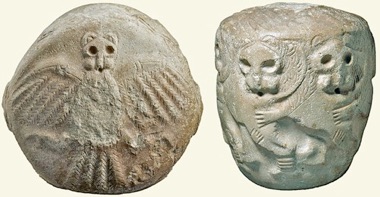
Inscribed mace-head of Mesilim, King of Kish (RIME 1.8.1.1; P462181),
from the site of the original Ningirsu temple at Girsu (Tell K)
Now in the Musée du Louvre (AO 2349); images from the museum website
The object illustrated above was excavated on Tell K at Girsu, the site of the original archaic temple of Ningirsu, the city-god of both Lagash and its religious capital, Girsu. Sébastien Rey (referenced below, at p. 209) characterised this beautiful object as:
“... an oversized and therefore symbolic limestone votive mace-head ... that is decorated with reliefs ...”
He described the figure on the flat, un-pierced upper surface as:
“... a lion-headed eagle with outspread wings.”
This is probably the earliest-known image of the mythical, hybrid creature that is the subject of the current page.
In what follows, I refer to this hybrid creature as ‘Anzu’ or ‘the Anzu bird’, although it is also known as the ‘Imdugud’ (or variants thereof), and Sébastien Rey, whom I cite extensively below, generally refers to it as ‘the Thunderbird’. However, these names may well be anachronistic: as far as I know, it is never referred to by name in any of our surviving sources that relate to Lagash/Girsu before the time of Gudea, who ruled at Lagash some 200 years after the end of its first independent dynasty.
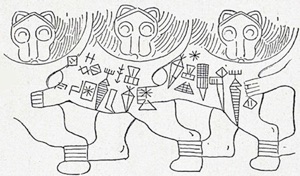
Sketch of two of the six lions in the frieze around the mace-head of Mesilim
Adapted from Ernest de Sarzec (referenced below, XXXIV)
The frieze that runs around the curved surface of the mace contains the figures of six half-erect leaping lions, each of which seems to be to be chasing and grasping the one in front of it. Importantly, the cuneiform inscription carved across two of these lions reads:
“Mesilim, king of Kish, temple builder for the god Ningirsu, (dedicated this mace-head) to/for the god Ningirsu [when] Lugal-sha-engur (was) ensi of Lagash”, (RIME 1.8.1.1; CDLI, P462181).
In other words, Mesilim, king of Kish, rebuilt (or, more probably, restored) the archaic temple of Ningirsu on Tell K at a time when:
✴he exercised hegemony over Lagash and Girsu; and
✴the otherwise unknown Lugal-sha-engur exercised delegated authority (as ensi of Lagash).
Furthermore, we might reasonably assume that, by this time, ‘Lagash’ represented a single polity that included (at least) both Lagash itself and Girsu. Sébastien Rey (referenced below, at p. 150) tentatively dated the mace-head to ‘some time between 2600 and 2500 BC’.
We know from Mesilim’s other surviving royal inscriptions and others of later independent rulers of Lagash that Mesilim’s hegemony included at least two other citied of southern Mesopotamia (Umma and Adab). He must have dedicated this mace-head in the archaic Nngirsu temple (dubbed by the excavators the ‘Lower Construction‘ since, when Ur-Nanshe, the first independent ruler of Lagash, covered this hallowed structure with a stepped platform upon which he built its successor, he ritually buried it under this platform, in the area that surrounded the archaic temple walls (see Sébastien Rey, referenced below, at pp. 207-10).
‘Feathered Figure’ Plaque
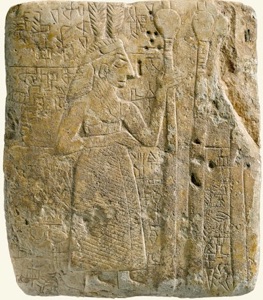
Relief of the ‘Figure aux Plumes’ (Feathered Figure) on an archaic inscribed plaque from Tell K
Now in the Musée du Louvre (AO 221); image from the museum website
We now need to go even further back in time in order to analyse the relief on the plaque illustrated above, which is one of the oldest objects discovered on Tell K: as Sébastien Rey (referenced below, at p. 181) observed, although the archeological context in which it was found is obscure:
“There is no doubt ... that it was originally housed in the ‘Lower Construction’, and it was probably fashioned to commemorate [its] construction and inauguration.”
He tentatively dated both the ‘Lower Construction’ itself and the putative ‘foundation’ plaque to 2900-2800 BC. We are primarily concerned with the shallow relief on what is usually thought to have been the obverse of the plaque, in which a male figure wearing distinctive headgear approaches an entrance defined by a pair of monumental maces. Rey argued that:
✴this figure represents Ningirsu himself and the maces mark the threshold to his temple (see p. 178); and
✴although the position of his hands relative to the maces is hard to establish, the likelihood is that he gestures with his free left hand toward this threshold (see p. 174).
The inscription on this plaque names the temple as the é.dnin.gir.su (House of Ningirsu),
One of the most distinctive features of this image is the nature of Ningirsu’s headgear: as Sébastien Rey (referenced below, at p. 175) observed:
“As soon as the [relief] was found, [this headgear] was interpreted ... as a crown with two large feathers ... Although this interpretation has been questioned, ... it is almost certainly the right one. ... The similarity between the chevron-like form of:
✴the ... feathers [of the Anzu bird] on the top surface of the [much later mace-head of Mesilim - see below]; and
✴the decorative features of the headdress [of this figure of Ningirsu];
is particularly striking.”
In other words, since the feathers depicted on Mesilim’s mace-head clearly belong to a bird, the likelihood is that the very similar ‘decorative features’ on Ningirsu’s headdress are also bird feathers. Rey pointed out (at p 176), it would be:
“... no surprise [if] the sculptors of [this relief] drew on [an] inextricable link between Ningirsu and the [Anzu bird] that went back to the most archaic times.”
He:
✴pointed out that (as we shall see) the Anzu bird remained at the heart of the iconography of Ningirsu at Lagash for centuries; and
✴argued that it cannot be coincidental that this creature was used to decorate at a number of later votive mace-heads dedicated to Ningirsu (see below), since the mace was a symbol of Ningirsu’s aspect as ‘the heroic god of combat’.
Drawing all these thoughts together, he argued that the ‘iconographic triad’ used in the ‘Feathered Figure’ relief, which comprised:
✴Ningirsu himself;
✴his crown, ‘decorated with feathers of the Anzu bird; and
✴the ‘two maces with ovoid heads fixed on long shafts’ that marked the entrance to his temple;
had represented:
“... a core component of [Ningirsu’s] cult ... from as far back as it is possible to go.”
This plaque must have been prominently displayed in Ningirsu’s original temple until its deconsecration. However, the archeological evidence strongly suggests that it was then transferred to the successor built by Ur-Nanshe. As Sébastien Rey (referenced below, at p. 229) observed, unlike the archaic temple (which had been preserved after its deconsecration), Ur-Nanshe’s temple was largely demolished in the reign of his great grandson, Enmetena (in order to make way for yet another new temple) and only the lowest meter or so of its survived below the destruction level. , However, Rey derived a good deal about Ur-Nanshe’s temple from what he dubbed ‘an exceptional hoard of artefacts’ that were found at roughly the Ur-Nanshe floor level in the area that would have surrounded the temple’s walls. These objects, which had presumably been displayed in Ur-Nanshe’s temple and then buried at the time of its demolition, included the ‘Feathered Figure’ plaque. The important point for the present analysis is that, as Rey pointed out (at p. 175), ‘a particularly apt and direct comparison’ can be made between;
✴the feathers in Ningirsu’s crown in the relief on the inaugural plaque from his original temple on tell K; and
✴those of the Anzu bird in the relief on the votive mace-head that (many years later) Mesilim, as overlord of Lagash and Girsu, dedicated in this temple.
He argued (at p. 176) that the sculptors of the later objects discussed below:
“... drew on the [apparently] inextricable link between Ningirsu and the [Anzu bird] that went back to the most archaic times.”
First Dynasty of Lagash: Ur-Nanshe
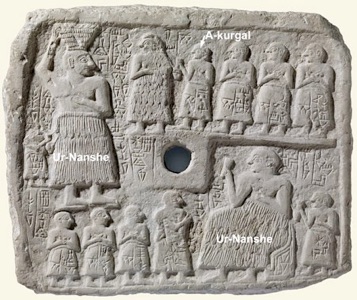
Pierced relief of Ur-Nanshe from his Ningirsu temple on Tell K at at Girsu (RIME 1.9.1.2, P431035)
Now in the Musée du Louvre (AO 2344); image from museum website
As Piotr Steinkeller (referenced below, 2019b, p. 122) observed, Ur-Nanshe is:
“... the first ruler of Lagash for whom extensive historical information survives ... He appears to have been a usurper, but the specifics of his rise to power remain uncertain.”
He added (at note 25) that:
“Ur-Nanshe’s background is obscure. In his inscriptions, he calls himself ... ‘son of Gunidu, son of Gursar’, Since his father ... is never identified as a ruler of Lagash, ... it appears almost certain that Ur-Nanshe [himself] was an outsider who had somehow succeeded in taking over the throne of Lagash. The interpretation of the epithet “ ‘son’ of Gursar’ is notoriously difficult.: ... Gursar [could be] either the name of Ur-Nanshe’s grandfather/ancestor or a toponym. ... [In my opinion], Gursar was [probably] Ur-Nanshe’s eponymous ancestor, a solution that (if correct) would strengthen the assumption that Ur-Nanshe [himself] was a homo novus.”
However, Sébastien Rey (referenced below, at pp. 152-3) argued that Gursar was probably Ur-Nanshe’s birthplace, which he located ‘in the vicinity of Nigin, which was:
“... absorbed into Ur-Nanshe’s unified territory, although the triad of cities (Girsu, Lagash and Nigin) seem each to have maintained their own traditions and local social systems.”
In other words, this might explain why Nigin apparently joined Lagash and Girsu as the third important centre within the territorial state of Lagash.
Francesco Pomponio (referenced below, 2025, at pp. 3-4) observed that, in his 40 or so surviving inscriptions, Ur-Nanshe claims to have undertaken a plethora of civic projects, including:
✴the rebuilding of the walls of Lagash; and
✴19 other major building or rebuilding projects, almost all of which were of a religious character, notably including his construction of his new Ningirsu temple at Girsu, which (as we have seen) he build on a raised raised platform over the archaic original (in position from which it would have dominated the plain below).
Pomponio argued (at p. 4) that:
✴all this building activity suggests that Ur-Nanshe had risen to power after a period of crisis in which the state of Lagash had suffered significant physical damage (although, as Sébastien Rey observed(at p. 217), there is no surviving archeological of epigraphical evidence for this putative devastation); and
✴since military conflicts are hardly mentioned in his inscriptions, that his subsequent reign was probably both long and peaceful.
The pierced limestone relief illustrated above points to another important characteristic of Ur-Nanshe’s reign: although he apparently did not rule Lagash by right of dynastic succession, he produced a large number of sons, thereby promising his (presumably grateful) subjects the prospect of dynastic rule thereafter. Furthermore, this plaque is not a unicum: it is actually the best-preserved of four surviving ‘genealogical’ plaques of Ur-Nanshe that were (or were probably) placed in his new temple. Each of them depicts Ur-Nanshe alongside other figures, all identified by inscription, most of whom are members of his immediate family (which included at least nine sons: Akurgal, who succeeded him; Addatur; Anikurra; Anita, who was apparently also his cup bearer; Anupa; Gula; Lugalezen; Menu; and Mukurmushta). Sébastien Rey (referenced below) illustrated all four of them (as Figure 89, at p. 231), with the one illustrated here as his example A:
✴the inscription on ‘example A’ begins:
“Ur-Nanshe, lugal (king) of Lagash, son of Gunidu, son of Gursar, built the é.dnin.gir.su (House of Ningirsu, which, as we have seen, had also been the name of its hallowed predecessor)”, (RIME 1.9.1.2; CDLI, P431035, lines 1-6); and
✴the other three examples carried essentially the same inscription.
Ur-Nanshe is illustrated twice in ‘example A’:
✴in the upper register, where he carries a basket of bricks on his head (a motif that is repeated in Rey’s example D); and
✴in the lower register, where he is enthroned and raises a beaker in his right hand.
It seems likely that the ‘crown of bricks’ symbolises Ur-Nanshe’s building of the new temple, and that the beaker suggests an inaugural libation or celebration.
Drawing this body of evidence together, it seems that, although Ur-Nanshe probably came to the throne of Lagash as an outsider, he succeeded in creating a city-state that securely included:
✴Lagash itself, where he built or rebuilt a number of temples, including the Bagara temple of Ningirsu and the Ibgal temple of Inanna;
✴Girsu (which had apparently been its religious capital since at least the time of Mesilim), where he built the new and imposing temple to Ningirsu (literally, the ‘Lord of Girsu;); and
✴Nigin (which was probably his birthplace) where he built built or rebuilt the temple of its city-goddess, Nanshe.
It is interesting to note that, when he ritually deconsecrated and enveloped the archaic Ningirsu temple at Girsu, he:
✴built his new temple above it, at a much higher level from which it would have dominated the landscape;
✴preserved the archaic name and continued to display the ‘Feathered Figure; plaque (presumably in the sanctum sanctorum); and
✴ritually buried a number of sacred objects that it had housed, including the mace of Mesilim.
Perhaps his ‘message’ was that Ningirsu, who had previously given the kingship of Lagash to the ‘outsider’ Mesilim, now gave it to a ‘new Mesilim’, Ur-Nanshe. This hypothesis is, of course, hard to prove, but, in the following section, I will look for possible support for it in Ur-Nanshe’s use of the motif of the lAnzu bird.
Archaic Stamped Bricks from Tell K
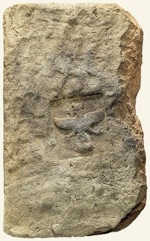
Archaic stamped brick, probably from the site of the original Ningirsu temple at Girsu (Tell K)
Now in the Musée du Louvre (AO 398); image from the museum website
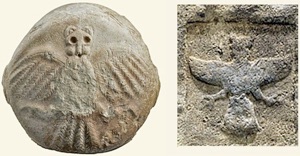
Comparison of the Anzu bird on the mace-head of Mesilim (left) and on this archaic brick
Sébastien Rey (referenced below, at p. 14) noted that a small number of surviving archaic bricks from Girsu are stamped with an image of an Anzu bird with outspread wings. He argued that these bricks:
“... doubtless originate from one of the ... ancient iterations [of the Ningirsu temple]. Unfortunately, none [of them] were found in situ, but they testify to the antiquity of the fusion of the god [Ningirsu] and [this] mythical hybrid bird.”
He suggested (at p. 632) that the rectangular brick illustrated above (for example), which probably came from Tell K, might have belonged to the Ur-Nanshe temple, since:
“It is assumed from its appearance to be archaic (perhaps Early Dynastic) ... and this seems to be further confirmed by its preserved dimensions, ... which are close to those of the bricks used by Ur-Nanshe.”
Clearly, the image of the Anzu bird impressed on this brick corresponds to that on the mace-head of Mesilim. This allows us to say that this hybrid creature was still recognised in association with Ningirsu at the time of Ur-Nanshe. It is therefore at least possible (given the archeological context) that the use of this motif on the brick stamp intentionally referenced the use of this motif on the mace-head of Mesilim.
Other Archaic Images of the Anzu Bird from Girsu
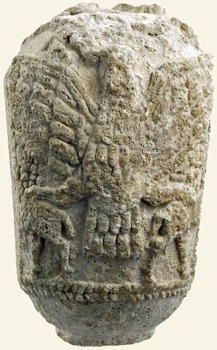
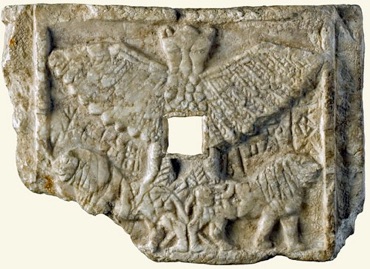
Left: Ovoid alabaster mace-head from Tell K, with reliefs of two Anzu birds, each grasping a pair of animals
Now in the Musée du Louvre (AO 237); image from museum website
Right: Inscribed pierced plaque of Ur-Nanshe (RIME 1.9.1.26; CDLI, P431061) from Girsu
Now in the Musée du Louvre (AO 2783); image from museum website
According to André Parrot (reference below, at p. 101), the excavators of Tell K recorded that the alabaster mace-head illustrated above (on the left) was found ‘near the Ur-Nanshe temple’. Interestingly, the relief around its curved surface depicts two Anzu birds with outstretched wings (diametrically opposite each other), each grasping a pair of four-legged animals walking in opposite directions, which have been variously identified:
✴Parrot himself (who reproduced a sketch of the relief as Figure 21h, at p. 85) identifies them as ’deer or ibexes’;
✴the museum identifies them as ‘deer’; and
✴Renate van Dijk-Coombes (referenced below, at p. 203) referred to them generically as ‘goats and antelopes’.
However, given the apparent similarity between the grasped animals in this image and those in the relief on the right (discussed below), I suggest that it is at least possible that they are lions. It is thus possible (but, by no means certain) that:
✴Ur-Nanshe dedicated this mace-head to Ningirsu in his new temple; and/or
✴the animals grasped by the Anzu birds were lions.
Turning now to the pierced plaque also illustrated above (on the right): as Douglas Frayne (referenced below, 2008, at p. 112) observed, this is one of:
“Three very similar wall plaques of Ur-Nanshe from Girsu, [all of which] depict an Anzu bird standing on two lions.”
The inscription (RIME 1.9.1.26; CDLI, P431061) on this example reads:
“For Ningirsu: Ur-Nanshe, king of Lagash, son of Gunidu, built the E-Tirash [a shrine dedicated to Ningirsu at the now-unknown Tirash]”.
Frayne (as above) argued that:
“While only part of the titulary of Ur-Nanshe is preserved on the other two plaques, [each of them] very likely bore the same or a similar inscription.”
Douglas Frayne (as above), who assumed that the plaques were commissioned for the Ningirsu shrine at Tirash, observed that:
“The finding of these plaques at Girsu is not evidence (as it might appear at first glance) for the location of Tirash at Girsu: the pieces may have been fabricated at Girsu [for transportation] to Tirash, or they may be ‘strays’ from Tirash itself.”
This is reasonable, since Ur-Nanshe commemorated his building of Tirash itself in a number of his surviving inscriptions. Furthermore, as Andrew George (referenced below, entry 1o97, at p. 150) observed, a Nigirsu shrine at Tirash was mentioned by later rulers of Lagash and was documented in the Ur III period ‘among other cult centres near Lagash’.
Thus, these three inscribed reliefs and their inscriptions securely indicate that Ur-Nanshe associated Ningirsu with the hallowed motif of a Anzu bird with outspread wings. However, as far as we know, he was the first ruler of Lagash to depict this hybrid creature grasping a pair of lions. It is possible (although this is speculative) that Ur-Nanshe wished to associate Ningirsu with both Girsu and Lagash. Pushing this speculation further, it is possible that, in A) 236, the hybrid creature is rescuing the lions from an unpleasant medium (flood water ? rubble ?) represented the ‘beaded’ surface on which they walk. So far, so whimsical. However, as we shall see, later evidence makes it clear that the motif of the Anzu bird with outstretched wings grasping a pair of lions became emblematic of both Ningirsu and the dynasty that Ur-Nanshe founded at Lagash.
Eanatum and the ‘Stele of the Vultures’
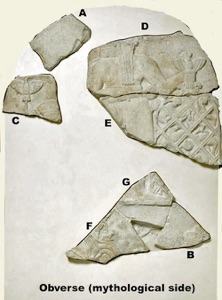
Surviving fragments from the obverse of the two-sided ‘Stele of the Vultures’ from the Temple of Ningirsu at Girsu,
now in the Musée du Louvre (AO 50): images from the museum website (my additions in black)
The earliest surviving accounts of the (subsequently recurring) border dispute between Lagash and Umma belong to the reign of Eanatum, the grandson of Ur-Nanshe, and the most important of these comes from the inscription on his so-called ‘Stele of the Vultures’. As Jerrold Cooper (referenced below, at pp. 23-4) pointed out, the fragmentary text at the start of this account suggests that Eanatum was addressing a problem that had existed in the reigns of Ur-Nanshe and Akurgal (respectively his grandfather and his father). The relevant (now very lacunose) passage reads as follows:
“... its subsistence rations he [the king of Umma] reduced. Its grain rent he took away. The king of Lagash ... the ruler of Umma, an aggressive act, he committed against it, and into Lagash, up to its frontier he pressed. Akurgal, king of Lagash, son of Ur-Nanshe, king of Lagash ...”, (RIME 1.9.3.1; CDLI, P431075, lines 1’-20’).
Cooper suggested (at p. 24) that:
✴the first mention of a ‘king of Lagash’ (at lines 5’-6’) might well have been part of an episode involving Ur-Nanshe;
✴when the text begins again, Umma is defying Lagash and Akurgal is introduced (lines 8’-20’); and
✴when it begins yet again, Umma is still trespassing in the Gu'edena (lines 21’-.28’).
He reasonably argued that:
“The implication is that the occupation of the Gu'edena [had] occurred under Akurgal [and] remained for Eanatum to resolve.”
According to the story told (in words and images) on the ‘Stele of the Vultures’, that is precisely what Eanatum did.
Sébastien Rey (referenced below, at p. 285) argued that this double-sided stele:
“... was almost certainly placed inside the trophy room of the Ur-Nanshe [temple] by Eanatum, screening the entrance in accordance with the convention that can be traced back as far as the [original temple], in which the [archaic] ‘Stele of the Captives’ performed the same function.”
(See Sébastien Rey, referenced below, at pp. 184-5 for the sad fate of the archaic ‘Stele of Captives’). It clearly survived in the temple on Tell K until the temple itself was razed to the ground by Lugalzagesi (who, some five generations later, served as ensi of Umma before becoming king of Uruk). Perhaps understandably (as Sébastien Rey recorded at pp. 301-2), it was then smashed in what must have been a satisfying act of revenge, and the surviving pieces were spread across the site. Only seven of them (identified as fragments A-G. see the illustration above) have been found to date, and all of these are now in the Musée du Louvre. In what follows, we are concerned with the obverse or ‘mythical’ side of the stele (as opposed to the reverse, which depicts scenes from the battle between Eanatum and the man of Umma).
Anzu Fastening
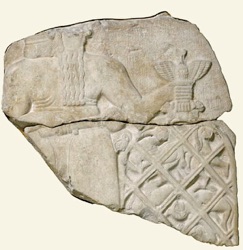
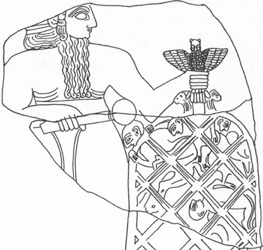
Left: Detail of obverse (fragments D and E) of the ‘Stele of the Vultures’ from the Ningirsu temple at Girsu
Now in the Musée du Louvre (AO 50): image from the museum website
Right: Sketch of this relief, from Renate van Dijk-Coombes (referenced below, Figure 1, at p. 199)
The relief on the adjoining fragments (D and E, illustrated above) depicts the giant figure Ningirsu, (who was the author of Eanatum’s victory over Umma and also the owner of the Gu’edena, his ‘beloved field’) clasps:
✴in his left had, a casting net filled with suffering and humiliated prisoners of war; and
✴in his right hans, a giant mace that is in contact with the protruding skull of one of the captives (presumably the enemy commander).
Importantly for our present purpose, the fastener of the net is a figurine of an Anzu bird with outstretched wings. Importantly, as Renate van Dijk-Coombes (referenced below, at p. 204) observed, in this image the Anzu bird:
“... again holds a lion in each claw, although in this case only the heads of the lions are visible.”
In other words, this image essentially replicates the iconography used on Ur-Nanshe’s three ‘Anzu plaques’. However, in this image on Eanatum’s stele, the Anzu arguably serves as an attribute (or perhaps even an emblem) of Ningirsu.
Anzu Crowns
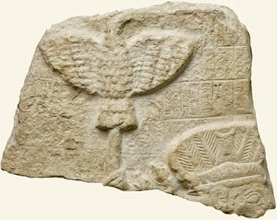
Details of obverse fragments C (left) and B of the ‘Stele of the Vultures’, both depicting the head of a goddess
Now in the Musée du Louvre (AO 50): images from the museum website
The fragments C and D (illustrated above) seem to depict the same (probably seated) goddess:
✴in fragment C (in the upper register), she looks to the right (at Ningirsu and the casting net); and
✴in fragment B (in the lower register), she looks to the left (again at Ningirsu, who now approaches in a chariot.
The interesting thing for our present analysis is that:
✴in both cases, she wears a horned crown (as befits a goddess), with the space between the horns filled with what seems to be the upper part of a lion-headed eagle with outstretched wings; and
✴in fragment C, the remains of what seem to be mace heads can be seen immediately behind her head.
Reign of Enanatum I
Enanatum I, the son of Akurgal, succeeded his brother, Eanatum, as ensi of Lagash. Judging by his surviving inscriptions, his reign was dominated by the continuing border dispute with Umma, although he found time to undertake what seems to have been a major restoration of the Ibgal temple of Inanna at Lagash. As Sébastien Rey (referenced below, at p. 241) observed, the following inscription, which was carried by bricks found near the temenos wall around the Ur-Nanshe temple of Ningirsu at Girsu, suggests that he had carried out refurbishment work on the temple itself using imported cedar:
“Enanatum, ensi of Lagash son of Akurgal, ruler of Lagash: when the god Ningrsu chose him in his heart, he brought white cedars down to him from the mountains. When he had filled in the temple with them, he laid its roof thatch(?) of white cedar (branches). The poplar lions that he installed for him there as gatekeepers, he set for the god Ningirsu, his master who loves him”, (RIME 1.9.4.3, CDLI, P431100).
Rey suggested (at p. 242) that the poplar lions mentioned as gatekeepers in the inscription might have been installed directly outside the temple entrance.
Mace-Head of Bara-kisumun, Sukkal of Enanatum I

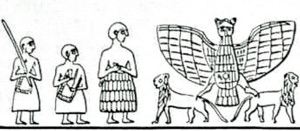
Mace-head dedicated to Ningirsu by Bara-kisumun for the life of Enanatum I (RIME 1.9.4,19, P431115)
The mace-head, which probably came from the Ningirsu temple at Girsu, is now in the British Museum (BM 23287)
The sketch to the right of the entire relief is from Jean Evans (referenced below, 2003, Figure 28, Cat. 35, at p. 76)
The mace-head illustrated above, which is obviously directly relevant to the current discussion, carries an inscription (RIME 1.9.4.19, CDLI, P431105) that reads as follows:
“To Ningirsu of the Eninnu [which must have been the current name for Ur-Nanshe’s Ningirsu temple at Girsu]: the workman of Enanatum, ensi of Lagash, Barakisumun (who was) the minister (sukkal), dedicated (this mace-head) for the life of Enanatum his master”.
The inscription is on the top of the mace-head, and the relief on the main curved surface is sketched in full to the right. In this case (as in the case of the image on the fastener of Ningirsu’s casting net in the ‘Stele of the Vultures’, the iconography of the Anzu bird clasping the haunches of two lions essentially replicates that on the three Ur-Nanshe’s ‘Anzu plaques’. Jean Evans (referenced below, 2003, at p. 76) suggested that the largest of the three figures who approach the Anzu bird from its right is probably Barakisumun and noted that he is followed by a two smaller figures, one carrying a vessel for libation and the other clasping a large staff. Sébastien Rey (referenced below, at p. 176) argued that since, in this iconography, offerings are brought to the Anzu bird, it explicitly acts as Ningirsu’s avatar.
In construction from here
Reign of Enmetena
Enmetena succeeded his father, Enanatum I, as ensi of Lagash. He seems to have inherited the border dispute with Umma fromhus father and to have brought it to some kind of conclusion. He subsequently turned his attention to the extension of his territory to the southwest (in the direction of Uruk and, as Jerrold Cooper (referenced below, at p. 33) pointed out, since his:
“.... hegemony soon extended all the way to Patibira, it is unlikely that it was he who backed off in a confrontation with nearby Umma.”
His advance in this direction seems to have been halted when he agreed a ‘brotherhood’ pact with Lugal-kigine-dudu, lord of Urukand king of Ur.
See Sébastien Rey (referenced below, at pp. 293-8) for this vase, the Dudu plaque and Enmetena’s Ningirsu temple on Tell K.
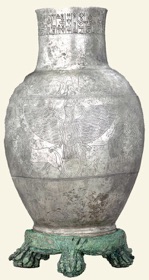
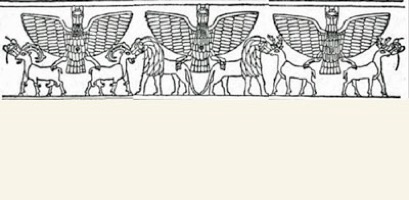
Silver vase of Enmetena, ensi of Lagash, from the temple of Ningirsu at Girsu,
now in the Musée du Louvre (exhibit AO 2674)
Sketch of the central image above and those that flank it, from the website of ‘Old European Culture’
Enmetena vase - RIME 1.9.5,7; CDLI, P431124) (noted seated calves in frieze above the main image)
As Piotr Steinkeller (referenced below, 2019, p, 998 and Figure 10) observed:
“This object is decorated with four interlocked depictions of [the Anzu bird], standing over other animals: a pair of lions (twice), a pair of stags, and a pair of ibexes [= mountain goats]. The whole group is so arranged that the lions touch the heads of the stags and the ibexes with their mouths; it appears that, rather than attacking them, they are licking them in a friendly fashion.”
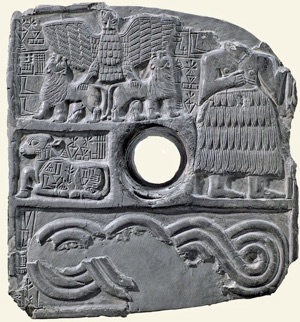
Plaque of Dudu, sanga of Ningirsu, from the temple of Ningirsu at Girsu,
now in the Musée du Louvre (exhibit AO 2354)
Dudu - RIME 1.9.5.28; CDLI, P431145
Note that, while on the Vase of Enmetena, the lions bite the heads of horned ungulates, on the Plaque of Dudu, they turn their heads upwards to bite/nuzzle the wings of the Anzu.
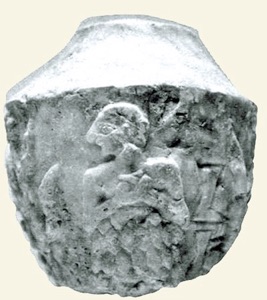
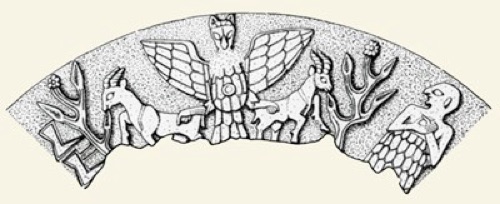
Mace head from the Bagara temple of Ningirsu at Lagash, now in the Iraq Museum
Above: image from Donald Hansen (referenced below, at p. 209)
Below: Drawing of the part of the relief on this mace-head, from Jean Evans (referenced below, 2012, Figure 38, at p. 101)
Published there courtesy of Holly Pittman, University of Pennsylvania, Al-Hiba publication project
Donald Hansen (referenced below, at p. 209) recorded the discovery of a votive mace-head of Dudu during his excavation of the Bagara temple of Ningirsu at Lagash. Holly Pittman, who is cited in the above caption, kindly informed me that the name Dudu [ref. to the plaque above] is inscribed on it, next to the tree on the left in the drawing. As far is I know, apart from the references above, this object is unpublished. The drawing depicts Dudu apparently meditating on an image of the Anzu bird that clasps the haunches of a pair of horned ruminants, each of which (perhaps surprisingly) continues to enjoy nibbling the leaves on one of the flanking trees. [Image redolent of part of the relief on the ‘Enmetena vase’ Is the rest of the relief now lost ? Any sign of another Anzu and/or lions and/or stags ?]
Note that Piotr Steinkeller (referenced below, 2019, p, 998 and Figure 9) discussed the relief on a mace-head from the Nationalmuseet, Copenhagen that:
“... depicts [an Anzu bird], repeated four times, who, in each instance, grasps with his outstretched ‘hands’ a pair of gazelles [presumably identified as such because their horns are much smaller than those of Enmetena’s ‘ibexes’ ?]. The mace-head is surmounted by the image of an uncoiled seven-headed serpent, who menaces the [Anzu].”
Note also his citation of an object (BLMJ 2051: date ? provenance?) which Scott Jones (“Lions, Serpents, and Lion-Serpents in Job 28:8 and Beyond”, Journal of Biblical Literature, 130:4 (2011) 663–86) depicted as his Fig. 6 and described (at p. 676) as:
“... an engraved shell inlay of either Ningirsu or Ninurta slaying the mušmahhu.”
[If this is as late as it sounds, then it is derivative rather than informative]
Interestingly, Enmetena (and hence, presumably, Mesilim):
✴regarded Enlil, the city-god of Nippur, as the ‘father/elder of all the gods’; and
✴naturally assumed that he had authority over the lesser gods Ningirsu and Shara in the matter of the location of the border between their respective territories (albeit that he delegated the matter of the execution of his commands to Ishtaran). As Aage Westenholz (referenced below, 2020, at p. 696) observed:
“Mesilim is said to have acted in accordance with the [command of] ... Ishtaran, [who] was the divine protector of treaties, as indicated by the spelling of his name dKA.DI (god of just verdict).”
.
In the sections above, the Anzu bird has cropped up as:
✴the putative source of the feathers in Ningirsu’s crown, as depicted in the relief on the ‘Feathered Figure’ plaque, which probably commemorated the inauguration of the earliest Ningirsu temple on Tell K;
✴a figure depicted on a mace-head that Mesilim, king of Kish and overlord of Lagash/Girsu dedicated to Ningirsu in this temple;
✴a motif used on a few archaic bricks found on Tell K, some of which might have come from the temple that Ur-Nanshe subsequently built on this site; and
✴a standing figure with outspread wings that grasps a pair of animals (possibly lions ??) on a mace-head (AO 237) from Tell K that could date to the reign of Ur-Nanshe; and
✴a standing figure with outspread wings that grasps a pair of lions on three inscribed plaques found at Girsu, which Ur-Nanshe had apparently intended to dedicate to Ningirsu at his shrine at nearby Tirash.
Sébastien Rey (referenced below, at p 176) argued that it would be:
“... no surprise [if] the sculptors of [the ‘Feathered Figure’ relief] had drawn on an] inextricable link between Ningirsu and the [Anzu bird] that went back to the most archaic times. ... As is clear from the [mace-head] of Mesilim, ... the use of the [Anzu bird] as a chief emblem of [Ningirsu] was well-established by the age of [the Kishite hegemony.”
Actually, the evidence of these two objects alone would not allow us to do more that hypothesise that the Anzu bird was the ‘chief emblem’ of Ningirsu, although the other evidence summarised in the list above does offer further support for this hypothesis. Furthermore, as Renate van Dijk-Coombes (referenced below, at p. 200) observed (in the context of southern Mesopotamia more generally), the iconography of the Anzu bird with outspread wings grasping a pair of lions:
“... is particularly associated with the god Ningirsu, [and] it is found on objects from Lagash, all of which were dedicated to Ningirsu ...”
Indeed (as discussed further on the following page), we find this iconography used in the reigns of all of Ur-Nanshe’s dynastic successors. Having said that, these facts alone do little more than confirm the fact that there was a close and long-standing association between Ningirsi and the Anzu bird. However, Sébastien Rey (as above) put his finger on one particularly important piece of evidence that arguably allows us to prove his hypothesis about the nature of this association: the relief on a mace-head from the reign of Enanatum I, Ur-Nanshe’s grandson (see the illustration above) depicts offerings being brought to the Anzu bird with outspread wings grasping a pair of lions, and it is hard to argue with Rey’s assertion that, in this case, the Anzu bird acts as an avatar of the god Ningiru.
Naming the Lion-Headed Eagle
The earliest written references to this mythical bird in a source from Lagash belong to the reign of Gudea, some 300 years after the reign of Ur-Nanshe. For example, as Gianni Marchesi (referenced below, 2016, at p. 88) pointed out:
“... the well-known iconographic motif of the lion-headed eagle ... above two lions ... recalls Ningirsu’s [appearance in] Gudea’s dream, as reported in [‘Gudea: Cylinder A’]:
‘The first ‘man’ in the dream: the enormity of him was like the heavens; the enormity of him was like the earth! He:
✴as for his head, was a god;
✴as for his arms, was anzux (=NÍ.MI)mušen (Anzu, followed by the determinative ‘mushen’, which indicates that Anzu is the name of a bird); and
✴as for his underneath, was the flood.
Lions lay to the right and the left of him!”, (lines 101-9).
Furthermore, in this text, after Ningirsu had sailed along the canal from Girsu to Nigin, where he prayed to the city-goddess Nanshe, who explained to him that:
“The person who (as you said) :
✴was as enormous as the heavens, ... [and] as the earth;
✴whose head was like that of a god, whose wings ... were like those of the Anzu bird;
✴whose lower body was ... like a flood storm; [and].
✴at whose right and left lions were lying;
was in fact my brother Ningirsu. He spoke to you about the building of his shrine, the E-ninnu”, (lines 125-31).
As Sébastien Rey (referenced below, at p. 3) summarised:
“The unearthly colossus [that represented Ningirsu] wore the horned crown of a god, ... had the wings of the fabled [lion-headed eagle ... and] was flanked by ferocious lions, who lay on the ground beside him.”
In other words, we know from these passages that, at least by the time of Gudea (probably just before the start of the ‘Ur III period), the lion-headed eagle with outspread wings who was usually depicted grasping a pair of lions was called the Anzu bird.
We also know that, in this guise, Ningirsu had commanded Gudea to build ‘his shrine, the E-ninnu. As Sébastien Rey (referenced below, at p. 14) observed:
“The seminal term é.ninnu is first attested during the reign of Enanatum I, [the great grandson of Ur-Nanshe], on a superb white mace-head dedicated to Ningirsu by one of the king’s legates, on which the god Ningirsu is integrated with his avatar, ... lion- headed eagle. The assimilation was by no means new, of course. Indeed, [as we have seen], it is attested on the Ningirsu temple’s foundational document, the [‘Feathered Figure’ plaque], where the plumes that adorn the god’s crown represent the wings of [Anzu]. Similarly, some rare archaic bricks survive that are stamped with images of the [Anzu] with outspread wings, and these doubtless originate from one of the temple’s ancient iterations. Unfortunately, none were found in situ, but they testify to the antiquity of the fusion of the god and the [Anzu]. The term Eninnu (‘house fifty’) refers to the fifty divine powers of Enlil, which he granted to his filial champion, Ningirsu. In this context, where ‘fifty’ stands for an infinite plenitude, the word Eninnu is perhaps best translated as the ‘house of the almighty’.
At the time of Enanatum I, the Eninnu was a later iteration of Ur-Nanshe’s temple on Tell K, which still stood of the site of the original hallowed temple that had been founded at the dawn of history. However, Gudea’s father-in-law and predecessor, Ur-Bay, had already built its replacement on Tell A, and we know from his royal inscriptions (see for example RIME 3/1.1.6.5; CDLI P431927) that he called it ‘é-ninnu anzuMUSHEN.babbar’ (House of Fifty [and?] the White Anzu). As Sébastien Rey (referenced below, at p. 475) pointed out, Ur-Bau’s Ningirsu temple on Tell A:
“... remained standing inside the temenos walls of Gudea’s divinely inspired sanctum sanctorum.”
Finally, we know from ‘Cylinder A’ that Gudea transferred the the title of Ur-Bau’s temple to his own:
“Accepting what Nanshe had told him, [Gudea] opened his storehouse up and took out wood from it. [He] checked (?) the wood piece by piece, taking great care of the wood. He ... built (?) a blue chariot from them for [Ningirsu and] harnessed to it the stallion Pirig-kashe-pada. He fashioned for [Ningirsu] his beloved standard, wrote his name on it, and then entered before ... his master Lord Ningirsu [into] ‘é-ninnu anzuMUSHEN.babbar. ...”, (lines 174-93).
As Sébastien Rey (referenced below, at p. 631) observed, the manufacture of the first brick to be used in Gudea’s massive new temple was a matter of great ritual importance, which explains why he dealt with the process in this cylinder inscriptions. One of the corresponding passages in ‘Cylinder A’ that Rey reproduced (at p. 631, is important for the present discussion:
“In respect of ... the brick mould, [Gudea] had a kid lie down, and he requested from[ it] an omen about the brick. He [the kid ?] looked at the excavated earth (?) approvingly, and the shepherd, [Gudea], ... it with majesty. After making a drawing on the ... of the brick mould and ... the excavated earth with majesty, he made the Anzu bird the standard of his master, [Ningirsu], glisten there as a banner”, ‘Gudea: Cylinder A’, lines 345-52).”
Rey acknowledged that this text is ‘a little obscure’, but:
“... the single brick that Gudea apparently made with the mould was clearly marked with the ‘Anzu’ motif.”
The word that Rey (and most other scholars) translated as ‘standard’ is transliterated as ‘shu-nir’.
However, Richard Averback (referenced below, at p. 208) argued that:
“There is no ‘portable standard’ referred to here. Rather, shu-nir in [the apparent context of this fragmentary passage] means ‘emblem’: ... the image of the Anzu bird was engraved on the brick mould so that it would form an impression on the first brick [to be laid by Gudea himself in the building of the new temple].”
This was clearly what Rey had had in mind, as evidenced by his Figure 228 (at p. 6320, which illustrates two of five rectangular ‘Anzu bricks’ that the British Museum found on the site, although none of these can be confidently associated with Gudea’s temple.
Anzu in the Literary Tradition
As Chikako Watanabe (referenced below, at p. 34) observed:
“In ‘Gudea Cylinder A’, Anzu is still described as a divine emblem in close association with the god Ningirsu (who is a local form of the divine hero Ninurta in ... Lagash). However, some time during the Ur III period, the role of Anzu changed, and the creature is suddenly counted among the slain enemies of the god Ninurta. In [two Sumeruan myths]:
✴Lugal-e’, which deals with the victory of Ninurta over [the demon] Asakku [= Asag]; and
✴‘Angim’ [= ‘The Return of Ninurta to Nippur’], which deals with Ninurta’s victorious return to Nippur from an expedition to the mountains;
Anzu appears as one of the eleven monsters slain by the god. Hence, Anzu plays a role predominantly as a wicked monster that stole the Tablet of Destinies from its righteous divine owner and, for this evil deed, the creature is to be vanquished by the divine hero Ninurta. The adoption of Anzu as Ninurta’s animal attribute is explained in the [Sumerian] myth ‘Ninurta and the Turtle’, in which the god Enki tells Ninurta that he will place his feet on Anzu’s neck, since the divine hero caught the creature with his mighty weapon.”
As Selena Wisnom (referenced below, at pp. 34-5) observed, a later Akkadian poem ‘Anzû (the Akkadian writing of ‘Anzu’):’
“... alludes to a surprising variety of earlier poems.
✴Naturally, it borrows specific features from ‘Lugal-e’, the most important Sumerian composition about the deeds of Ninurta.
✴The relationship with ‘Angim’, ... is not as direct, but this poem is still part of Anzû’s intertextual context, ([i.e.], the traditions about Ninurta that circulated at the time of its composition).
Examining the background from which Anzû emerged reveals how much is new to the Akkadian poem, [which] pulls together aspects of Ninurta’s rise to power from ‘Lugal-e’ and ‘Angim’ to create a new version of the story, where [Ninurta’s] victory over Anzû is now the definitive event that secures his shrine and reputation. In doing so, Anzû competes with earlier poems to establish itself as the new standard.”
Sébastien Rey (referenced below):
✴similarly referred to the Anzu Bird as the ‘chief emblem’ and the ‘avatar’ of Ningirsu (see p. 176); and
✴observed (at p. 8) that:
“... Ningirsu is very often pictured with an [Anzu bird], or even symbolised by an image of this supernatural creature, who appears as a representative aspect of his divinity. Invoking the myth that unites the god and the fabulous bird, [its] outspread wings and irresistible talons, which are capable of seizing the fiercest predators, act in large part as a metaphor for the god’s taming of the Mesopotamian wilderness.”
Again, I think that it is probably misleading to interpret this relief in the light of much later literary traditions: in this case, the myth that united Ningirsu with the Anzu bird dates to the Old Babylonian period (see, for example Stephanie Dalley (referenced below, at p. 203 and pp. 222-7). It was presumably inspired (at least in part) by images and perhaps local legends from Lagash/Girsu:
✴the earliest surviving image of the lion-headed eagle is on a mace-head that King Mesilim of Kish (the overlord of Lagash at some time before the reign of Ur-Nanshe) dedicated to Ningirsu at his ‘original’ temple at Girsu, in which the Anzu bird is associated with a frieze of six lions; and
✴the relief under discussion here is the first of a series of objects associated with later independent rulers of Lagash that feature the iconography of the upright Anzu bird grasping a pair of lions.
I think that Ur-Nanshe’s plaques at Girsu celebrated Ningirsu’s patronage of and support for Ur-Nanshe and his authority over Ur-Nanshe’s new city-state of Lagash, Girsu and Nigin (symbolised by the pair of lions).
References:
Pomponio F. “Did Ur-Nanše Defeat Ur?”, in:
Alivernini S. et al. (editors), “‘And I Have Also Devoted Myself to the Art of Music’: Ancient Near Eastern Studies in Honor of Franco D’Agostino, Presented on His 65th Birthday by His Pupils, Colleagues and Friends”, (2025) Münster, at pp. 3-14
Rey S., “The Temple of Ningirsu: the Culture of the Sacred in Mesopotamia”, (2024) University Park, PA
Steinkeller P., “Campaign of Southern City-States against Kiš as Documented in the ED IIIa Sources from Šuruppak (Fara)”, Journal of Cuneiform Studies, 76 (2024) 3-26
Steinkeller P. (2019a), “Texts, Art and Archaeology: An Archaic Plaque from Mari and the Sumerian Birth-Goddess Ninhursag”, in:
Chambon G. et al. (editors), “De l’Argile au Numérique: Mélanges Assyriologiques en l’Honneur de Dominique Charpin”, (2019) Leuven, Paris and Bristol CT, at pp. 977-1011
Steinkeller P. (2019b), “Babylonian Priesthood during the Third Millennium BCE: Between Sacred and Profane”, Journal of Ancient Near Eastern Religions, 19 (2019) 112-51
Wisnom L. S., “Weapons of Words: Intertextual Competition in Babylonian Poetry: a Study of Anzū, Enūma eliš, and Erra and Išum”, (2019) Leiden and Boston
Watanabe Ch. E., “Composite Animals in Mesopotamia as Cultural Symbols”, in:
di Paolo S. (editor), “Composite Artefacts in the Ancient Near East: Exhibiting an Imaginative Materiality, Showing a Genealogical Nature”, (2018) Oxford, at pp. 31-8
van Dijk-Coombes R. M., “Lions and Winged Things: A Proposed Reconstruction of the Object on the Right of the Lower Register of the Mythological Side of Eanatum's Stele of the Vultures”, Die Welt des Orients, 47:2 (2017) 198-215
Marchesi G., “Gudea and the Master of Lions: Philological Notes on the Louvre Dish AO 153”, Journal of Near Eastern Studies, 75 (2016) 85-9
Evans J. M., “The Lives of Sumerian Sculpture: and Archeology of the Early Dynastic Temple”, (2012) New York
Marchesi G., “The Historical Framework (Chapter 2)”, in:
Marchesi G. and Marchetti N., “Royal Statuary of Early Dynastic Mesopotamia”, (2011) Winona Lake, IN, at pp. 97-128
Frayne D. R., “The Royal Inscriptions of Mesopotamia, Vol. 1: Presargonic Period (2700-2350 BC)”, (2008) Toronto
Romano L., “La Corona del Dio: Nota sull’Iconografia Divina nel Protodinastico”, Vicino Oriente,
14 (2008) 41-57
Evans J., “Mace-head Dedicated for the Life of Enanatum", in:
Aruz J. and Wallenfels R. (editors), “Art of the First Cities: The Third Millennium BC, from the Mediterranean to the Indus”, (2003) New York, at pp. 75-6
Dalley S., “Myths from Mesopotamia: Creation, the Flood, Gilgamesh and Others”, (2000 Oxford George A., “House Most High: The Temples of Ancient Mesopotamia”, (1993) Winona Lake, IN
Hansen D. P., “Royal Building Activity at Sumerian Lagash in the Early Dynastic Period”, The Biblical Archaeologist, 55:4 (1992) 206-11
Averbeck R. E., “A preliminary study of ritual and structure in the Cylinders of Gudea”, (1987) thesis of Dropsi College
Parrot A., “Tello; Vingt Campagnes de Fouilles (1877-1933)”, (1948) Paris
de Sarzec E., “Découvertes en Chaldée: Second Volume Partie Epigraphique et Plances”, (1884)
Paris