Empires of Mesopotamia:
First Dynasty of Lagash
II: Akurgal, Eanatum, Enanatum I


Empires of Mesopotamia:
First Dynasty of Lagash
II: Akurgal, Eanatum, Enanatum I
Akurgal, Son of Ur-Nanshe
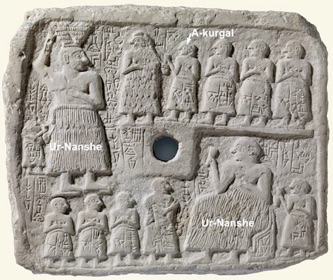
Pierced relief of Ur-Nanshe from his Ningirsu temple at Girsu (RIME 1.9.1.2; CDLI, P431035)
Now in the Musée du Louvre (AO 2344); image from museum website
As Douglas Frayne (referenced below, at p. 121) pointed out:
“One of Ur-Nanshe’s sons, Akurgal, is mentioned in all four [of Ur-Nanshe’s genealogical plaques, one of which is illustrated above]. He apparently followed his father as city ruler of Lagash. The scarcity of inscriptions from his reign suggests that he ruled for a short time. [His] name likely means ‘The father (is) the great mountain’.”
Xianhua Wang (referenced below, at p. 50) suggested that, since the god Enlil was given the epithet ‘kur-gal’ (Great Mountain) in the ‘Zame Hymns’ (in which he was recognised as the leading deity in the Sumerian pantheon) and ‘a’ indicates ‘father’, Akurgal’s name probably means son of Enlil.
Lions’ Heads of Ur-Nanshe and Akurgal
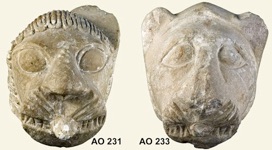
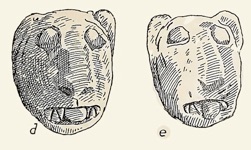
Two pairs of lions’ heads from Ur-Nanshe’s Ningirsu temple at Girsu
Left: One pair is now in the Musée du Louvre (AO 231 and AO 233); images from the museum website
Right: Sketches of the other pair, from André Parrot (referenced below, Figure 21):
the originals are now in the archeological museum of Istanbul (ESH 46 and Esh 48)
Sébastien Rey (referenced below, at pp. 279-81) recorded that these four lions’ heads heads were found together at the ‘Ur-Nanshe level’ in the SE side of the Ningirsu temple at Girsu and that they fall into two groups:
✴the two that are now in the Musée du Louvre, which are made of limestone:
•AO 231; and
•AO 233, which is inscribed with the name of Ur-Nanshe (RIME 1.9.1.24b; CDLI, P431059);
are of almost exactly the same size and might have been made as a pair (AO 231 male and AO 233 female); and
✴the two (a matching pair) that are now in the archeological museum of Istanbul, which are very similar to AO 231, although they are made of gypsum:
✴ESH 456, which carries what is now a fragmentary inscription of Ur-Nanshe (RIME 1.9.1.25; CDLI, P431060); and
✴ESH 458, which carries an inscription (RIME 1.9.2.2a; CDLI, P432072) that Douglas Frayne (referenced below, 2008, at p. 122) attributed to Akurgal.
Interestingly, Rey pointed out (at p.283) that all of these lions were depicted with protruding tongues (albeit that he acknowledged (at p. 279) that the significance of this unusual characteristic is unclear). As to the function of these objects, Rey argued (at p. 279) that their good physical condition and the location of their burial indicates that they belonged to a ‘coherent assembly’ of sacred objects that had been displayed in Ur-Nanshe’s temple and then give ritual burial when this temple had been deconsecrated. He also suggested (at p. 283) that, given their small size and the fact that at least some of them were inscribed, they may well have been:
“... ornamental elements that were fixed to pieces of temple furniture ... Indeed, they could have been designed to adorn a range of sacred appurtenances inside the sanctum sanctorum. [of Ur-Nanshe’s temple].”
Akurgal and the Antasura Shrine
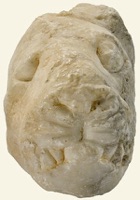
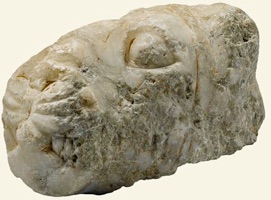
Two views of a lion’s head from Tell V at Girsu that carries an inscription (RIME 1.9.2.1: CDLI, P431071);
now in the Musée du Louvre (AO 3295) , images from the museum website
Douglas Frayne (referenced below, 2008, at p. 122) recorded that this alabaster lion’s head from Tell V (‘Tell des Tablettes’) carries the following inscription:
“For the god Ningirsu: Akurgal, ensi of Lagash, son of Ur-Nanshe, king of Lagash, built the Antasura”, (RIME 1.9.2.1: CDLI, P431071).
As Filip Vukosavovic (referenced below, at pp. 127-8) observed, Akurgal is the earliest known ruler of Lagash who claimed to have built (or rebuilt) this extra-urban temple (or shrine) of Ningirsu. According to Sébastien Rey (referenced below, at p. 237) it was in the Gu’edena, a stretch of fertile land on the border between Lagash and Umma (see below).
Akurgal and the Border Dispute between Lagash and Umma
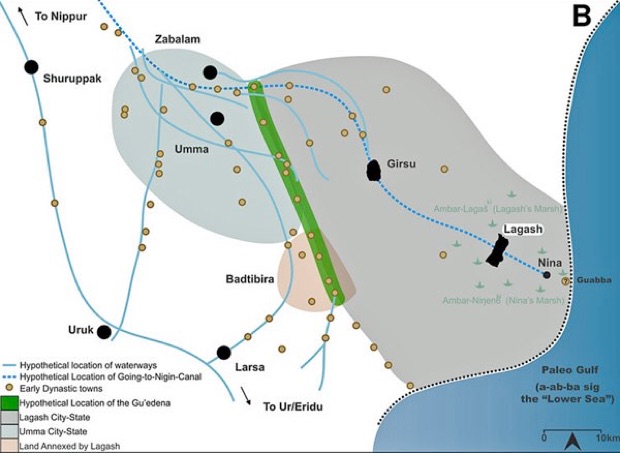
Border between Lagash and Umma in the ED period, (with the land along the Gu’edena canal, marked in green)
Map from Reed Goodman et al. (referenced below, Figure 1, at p. 2)
As we have seen above, Akurgal is known to have built or rebuilt the Antasura temple (or shrine) of Ningirsu in the Gu’edena, a fertile strip of land on the border between Lagash and Umma. As we shall see, this took place at a time at which the ownership of this land was about to become a bone of contention between Lagash and Umma. However, as Jerrold Cooper (referenced below, 1983, at pp. 23-4) observed, we do not hear of hostilities with Umma in this border region during the reign of Ur-Nanshe. He therefor argued that:
“Present evidence (including the general otherness of Ur-Nanshe's inscriptional style) ... leads me to believe that the border conflict as a leitmotif in the historical records of Lagash and the various topoi that accompany it have their origin in the inscriptions of Eanatum, [Akuragal’s son and successor].”
The earliest surviving account of these recurring border disputes does indeed belong to Eanatum’s reign and, in particular, to his so-called ‘Stele of the Vultures’, which I discuss at length below. However, as Cooper observed, Akurgal is named in the (now very lacunose) opening lines of its inscription. The relevant passage now reads as follows::
“... its subsistence rations he [the king of Umma] reduced, its grain rent he took away. The king of Lagash ... the ensi of Umma committed an aggressive act against it, and pressed into Lagash, up to its frontier. Akurgal, king of Lagash, son of Ur-Nanshe, king of Lagash ...”, (RIME 1.9.3.1; CDLI, P431075, lines 1’-20’).
Cooper suggested (at p. 24) that:
✴the first mention of a ‘king of Lagash’ (at lines 5’-6’) might well have been part of an episode involving Ur-Nanshe;
✴when the text begins again, Umma is defying Lagash and Akurgal is introduced (lines 8’-20’); and
✴when it begins yet again, Umma is still trespassing in the Gu'edena (lines 21’-.28’). 9/3/15
Cooper therefore reasonably argued that:
“The implication is that the occupation of the Gu'edena that occurred under Akurgal remained for Eanatum to resolve [after his father’s death].”
Eanatum
Sealing of Eanatum
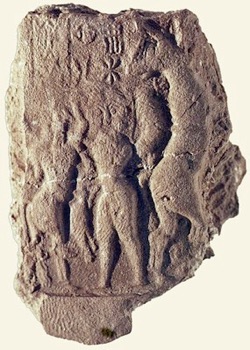
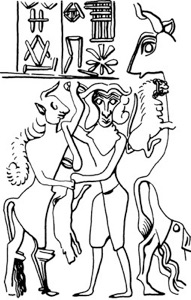
Left: Fragment of a clay sealing of Eanatum, from ‘Area C’ at Al-Hiba (Lagash)
carrying an inscription (RIME 1.9.3.15, CDLI: P431090) identifying Eanatum (current location unknown ?)
Image from the website ‘Legacy Exploration [at Al=Hiba]’ (University of Pennsylvania)
Right: Sketch of the surviving relief from Donald Hanssen (referenced below, Figure 19)
The fragmentary seal impression of Eanatum illustrated above, which was found in ‘Area C’ of the excavation carried out in 1970-1 at Al-Hiba, carries an inscription (RIME 1.9.3.15, CDLI: P431090) that identifies:
“Eanatum, ensi ... “
As Donald Hanssen (referenced below, at p. 70) observed, the relief on the original seal (now lost) had been:
“... executed in a magnificent, fully modelled style. The [contest between a] hero and [a] bull-man ... beneath the inscription would be a subsidiary scene of the major contest with figures filling the entire seal to the right and left. The small animal dangling from the hand of the bull-man appears unique. There is [also] a small lion on the back of the large bull [that has its] head turned back. Small animals used in this fashion are common in ED III glyptic, but not in this identical pose.”
Eanatum and the Border Dispute(s) between Lagash and Umma
Demarcation of the Border between Lagash and Umma
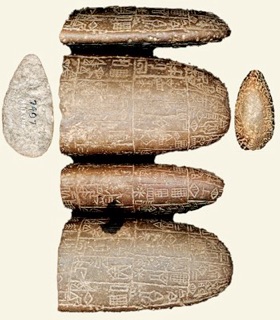
Left: Boundary stone of unknown provenance carrying inscription RIME 1.9.3.2 (ex. 02: CDLI, P222407),
now in the Harvard University Museum; image from the CDLI website
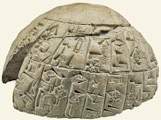
Right: Spheroid jar from Girsu carrying inscription RIME 1.9.3.3; CDLI, P431077,
now in the the Musée du Louvre (AO 4442+4597), image from museum website
Two surviving inscriptions of Eanatum refer to the original demarcation of the border between Lagash and Umma by King Mesilim of Kish, who had apparently exercised hegemony over both cities at some time before the reign of Ur-Nanshe:
✴RIME 1.9.3.2; CDLI, P431076, which is found on three surviving boundary stones (one of which apparently came from Girsu); and
✴RIME 1.9.3.3; CDLI, P431077, which is known from two spheroid jars, one from Girsu and the other from Lagash.
In the first of these inscriptions (RIME 1.9.3.2, which is the more complete of the two), we read that:
✴Mesilim had erected a stele on a particular spot on the border that Enlil had demarcated (lines 4-8); and
✴when a now-unnamed ‘man of Umma’ smashed this stele and occupied the surrounding fields:
“Eanatum, ensi of Lagash:
•given strength by Enlil;
•fed rich milk by Ninhursag;
•given a fine name by Nanshe;
the one who subjugates foreign lands for Ningirsu, restored to Ningirsu his beloved field(s). Eanatum did not pass beyond the point where Mesilim had erected the (boundary) monument and (moreover, he) restored it”, (lines 41’-60’).
The inscription RIME 1.9.3.3 similarly records Mesilim’s designation of the border between Lagash and Umma. It also records that Eanatum destroyed Umma and cursed any future ruler of Umma who violated the border. He then listed a number of punishments, the last of which is particularly interesting:
“May a hand be raised against him in his own city”, (RIME 1.9.3.3; CDLI, P431077, lines 31’-32’).
Interestingly, Enmetena (Eanatum’s nephew) gave a more complete account of these events at the start of his account of his own boundary dispute with Umma:
“Enlil, lugal kur-kur-a (king of all lands), ab-ba dingir-dingir-re2-ne-ke4 (father/elder of all the gods) ... demarcated the border between:
✴Ningirsu, [the city god of Lagash and Girsu]; and
✴Shara, [the city god of Umma].
Mesilim, king of Kish, at the command of [the god] Ishtaran, measured it out and erected a stele there:
✴Ush, ensi of Umma, acted arrogantly: he smashed that monument and marched on the plain of Lagash. Ningirsu, warrior of Enlil, at his (Enlil's) just command, did battle with Umma. ...
✴Eanatum, ensi of Lagash, demarcated the border with Enakale, the ensi of Umma. ... He inscribed (and erected) monuments at [the god-given border] and restored the monument of Mesilim, but did not cross [the border] into the plain of Umma”, (RIME 1.9.5.1; CDLI, P431117, lines 1-58).
Furthermore, when a later ruler of Umma, Gishakidu, (who was probably a contemporary of Enmetana - see Walther Sallaberger and Ingo Schrakamp, referenced below, at p. 78) restored this boundary, he described himself (inter alia) as the beloved friend of Ishtaran (RIME 1.12.6.2; CDLI, P431197, lines 13-4), which implies that he also accepted the boundary as it had been demarcated by Mesilim.
In short, while it is often claimed that Mesilim had intervened as arbitrator in a boundary dispute between Lagash and Umma, it is more likely that:
✴both sides accepted the legitimacy of Kishite hegemony in the ED II period and thus of Mesilim’s god-given mandate to establish the line of the border between them; and
✴later disputes centred on related issues, including the original location of this border and practical matters relating to the use by both parties of the wide and potentially fertile plain through which it ran.
‘Stele of the Vultures’
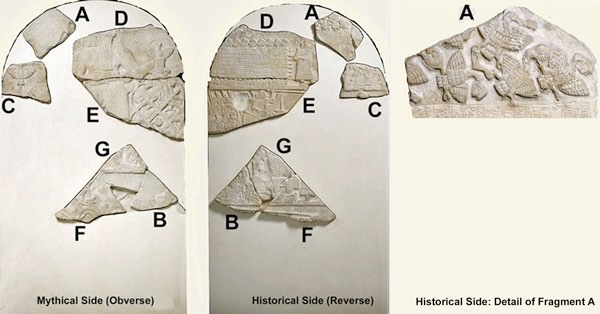
Surviving fragments from the obverse of the two-sided ‘Stele of the Vultures’ from the Temple of Ningirsu at Girsu,
now in the Musée du Louvre (AO 50): image from the museum website (my additions in black)
As mentioned above, the most important surviving source for the history of the border wars between Lagash and Umma during Eanatum’s reign is the magnificent ‘Stele of the Vultures’. This originally huge limestone stele is known from seven surviving fragments (A-G, exhibited in the Musée du Louvre as AO 50):
✴fragments A-F were excavated at the site of the Temple of Ningirsu at Girsu; and
✴fragment G, which clearly belonged to this stele, subsequently emerged in London and was re-united with the other fragments in Paris.
All of these fragments carry reliefs and inscriptions (RIME 1.9.3.1; CDLI, P431075) on both sides. As Renate van Dijk-Coombes (referenced below, at pp. 198-9) observed, as soon as these fragments were laid out in what would have been their respective positions, it became obvious that the stele had what might be dubbed:
✴a historical side, on which the reliefs depict a battle and its immediate aftermath (in four registers, ‘read’ from bottom to top); and
✴a mythological side, in which the reliefs (in two registers) depict the imagined actions thereafter of a male and a female deity.
The stele owes its modern name to the relief on the reverse of fragment A, the final scene in the ‘historical’ sequence, which depicts a flock of vultures carrying off the remains of fallen enemy soldiers. The inscription on each of the edges identifies:
“Eanatum, kur gu2 gar-gar (the subjugator of the lands of Ningirsu)”, (RIME 1.9.3.1; CDLI, P431075, lines 630’-632’ and 633’-635’).
Sébastien Rey (referenced below, at p. 285) argued that this stele must have been given a place of honour in Ur-Nanshe’s Ningirsu temple at Girsu and then displayed equally prominently in its successor, which was built by Eanatum’s nephew, Enmetena, where it probably remained until this temple felt the fury of Lugalzagesi (erstwhile ensi of Umma, before he became king of Uruk). As Rey pointed out (at p. 301), it was surely at this point (or soon thereafter) that:
“The sacred complex was plundered and razed to the ground, creating a destruction horizon across Tell K that contained some of the defaced and shattered fragments of objects that were formerly the supreme emblems of Girsu’s power and prestige. Of paramount importance were the artefacts that celebrated historically important victories that had been inflicted by the rulers of Lagash on the state of Umma, and chief among them was the ‘Stele of the Vultures’.”
Eanatum’s Dream
Jerrold Cooper (referenced below, 1983, at p. 26) observed that, although the details of Eanatum’s campaign(s) against Umma is/are poorly preserved in the inscription on the ‘Stele of the Vultures’:
“... the events leading up to [it.them] are well preserved and rather remarkable.
✴The god Ningirsu, angered at Umma's expropriation of his land, engenders [the birth of] the giant Eanatum, who is suckled by the goddess Ninhursag and given his name by the goddess Inana.
✴Eanatum utters an imprecation against the ruler of Umma, and then has a dream in which Ningirsu appears to him and predicts that:
•Umma will lose its northern allies and will be defeated by Eanatum [see below]; ... [and]
•the ruler of Umma will [subsequently] die at the hands of his own subjects.
The surviving text relating to Eanatum’s dream reads as follows:
“To him who lay sleeping, to him who lay sleeping, [Ningirsu] came to stand by his head. To Eanatum, he who lay sleeping, his beloved king, Ningirsu, came to stand by his head”, (RIME 1.9.3.1; CDLI, P431075, lines 121’-123’).
Unfortunately, the text that follows in fragmentary, although it clearly reproduce the words that Ningirsu had spoken to Eanatum in his dream. The first legible line, which contains references to Umma and Kish (ummaki kiški-am6), is variously translated and interpreted: for example, Jerrold Cooper (referenced below, 1983, at p. 45) followed by Douglas Frayne, referenced below, 2008, at p. 130-1) gave:
“Kish itself must abandon? Umma, and being angry, cannot support it.”
This is reflected in Cooper’s suggestion above that Umma and Kish were allies in this campaign. However, the entry in CDLI, P431075 (partly following Jan Keetman, referenced below, entry 58) gives:
“Umma, like Kish, shall therefore wander about and, after being seized by you, shall surely be removed (?)”, (lines 132’-136’).
Jan Keetman suggested that, in this passage:
“... Ningirsu speaks to Eannatum in figurative language. He expresses [his judgement ?] that Kish is not fulfilling its guarantee obligation for the ‘Mesilim’ border treaty, perhaps even playing a ‘political game’ behind the scenes” (my translation).
However, it seems to me that, while:
✴Eanatum clearly insisted that Mesilim had originally defined the border between Lagash and Umma on the orders of Enlil; and
✴it is entirely possible that Kish supported Umma in the current border dispute;
it is extremely unlikely that Eanatum held the contemporary ruler of Kish responsible for enforcing Enlil’s decision. I wonder if this text rather means something like:
“Umma will go the way of Kish: after you have seized it (= the disputed territory and/or Umma itself), it (= Umma) will surely cease to be a meaningful political force.”
It seems that Ningirsu then promised Eanatum that the sun god Utu would march with him into battle and also that:
“I shall smite [the leading men of Umma ?], and I shall make their myriad corpses stretch to the horizon. ... They shall raise a hand against [the ensi of Umma] and, they shall kill him in the heart of Umma’: (lines 143’-150’).
Nothing in the surviving text confirms (or denies) that Ush was actually killed at this time and in this way, so caution is needed: as Jerrold Cooper (referenced below, 1983, at p, 40) observed, the topos of a ruler being killed by his own subjects was often used at this time, sometimes as a threat in curse formulae and sometimes to imply that the ruler in question had suffered a particularly shameful death (whether of not he actually had).
Eanatum’s Campaign(s) against Umma
Jerrold Cooper (referenced below, 1983, at pp. 25-6) argued that Eanatum’s account of this war in the inscriptions on the ‘Stele of the Vultures’ suggests that it involved at least two discrete episodes:
✴At the start of the account, we read that:
“They fought each other, and a man shot an arrow towards Eanatum. He was penetrated by the arrow, but he broke it off(?). He made noises in front of them with ... A man of the wind ... Eanatum, like a destructive storm of rain, he left behind a deluge in Umma. ... Eanatum, a man of just words, had a border territory from Umma marked off, and he left it under the control of Umma. He erected a stele in that place. He defeated the ruler of Umma ... and he heaped up 20 tumuli”, (RIME 1.9.3.1; CDLI, P431075, lines 153’-181’).
Cooper argued that this demarcation of the border and attention to the burial of the dead signified the end of the putative first episode.
✴Then, in a putative second episode, we read that:
“... Eanatum obliterated many foreign lands for Ningirsu. Eanatum returned to Ningirsu his beloved field, the Gu'edena. The fields by his side, the interest-bearing places of Ningirsu, ... [Long, now-fragmentary list of fields that Eanatum returned to Ningirsu] ... Eanatum, the one nominated by Ningirsu, he (Eanatum) returned it to him”, (RIME 1.9.3.1; CDLI, P431075, lines 187’-228’).
In support of this hypothesis of two separate episodes, Cooper pointed out (at p. 26) that:
✴most of Eanatum’s surviving ‘victory’ inscriptions (see Table 1 below) refer to a victory over Umma, suggesting that [at least one such] victory occurred early [in his reign]; but
✴the inscription on the ‘Stele of the Vultures’ also has a long list of Eanatum's ‘foreign’ campaigns (see below), which must have been compiled towards the end of his reign.
He pointed out (again at p. 26) that:
✴moving the putative second episode to a relatively late date in Eanatum’s reign would solve this chronological conundrum; and:
✴the hypothesis of a late date for the inscription is also suggested by:
“... the fact that only there (and in a tiny fragment of another inscription) is Eanatum called ‘king’ (lugal); in all his other inscriptions his title is ‘ruler’ (ensi).
This is generally accepted: for example, Javier Álvarez-Mon (referenced below, at p, 267 and note 17) recently asserted that:
“The ‘Stele of the Vultures’ commemorates a (second) victory of Eanatum of Lagash over Umma as result of a border conflict ... .”
It seems to me that since, as we have seen, Enmetena (in RIME 1.9.5.1; CDLI, P431117, lines 1-58) mentions Eanatum’s interactions with two rulers of Umma (the first with Ush and the second with Enakale), we might reasonably associate Ush with the first of these episodes and Enakale with the second (as accepted, for example, by Walther Sallaberger and Ingo Schrakamp, referenced below, entries 2 and 3, at pp. 74-5).
Causes of Eanatum’s War with Enakale
We read in the ‘Stele of the Vultures’ inscription that, after Eanatum’s putative second victory over Umma, he forced its ensi (presumably Enakale) to swear that he would desist from his earlier offences (thus allowing us to form an impression of what these offences had entailed):
“Eanatum gave the great casting-net of Enlil to the ensi of Umma and had him swear by it [in the following terms]: the ensi of Umma to Eanatum does swear:
‘By the life of Enlil, king of heaven and earth, I shall exploit the fields of Ningirsu as an interest-bearing loan. I shall operate the levees up to the spring, and forever and ever(?. ) I shall not cross over the boundary territory of Ningirsu. I shall not make changes to its levees and irrigation ditches. I shall not smash its steles to bits. [If I ever violate this agreement, on that day, may] the great casting-net of Enlil, king of heaven and earth, on which I have sworn, fall on Umma from the sky!’”, (RIME 1.9.3.1; CDLI, P431075, lines 235’-282’).
This oath is repeated in succession for the following deities: Ninhursag; Enki; Sin; Utu; and Ninki.
We can take this analysis further by looking again at Enmetena’s account of the agreement that ended Eanatum’s war with Enakale: I reproduced part of the relevant passage above, but the complete passage reads:
“Eanatum, ensi of Lagash, uncle of Enmetena, ensi of Lagash, [together] with Enakale, ensi of Umma, demarcated the (border) ground and extended its levee from the Princely Canal to the Gu'edena. He left 215 nindan of Ningirsu's field under the control of Umma and made it into ‘a field with no owner’ [= no-man’s land].
[This was followed by an account of the physical structures that Eanatum erected on the newly- secured border - see the description below].
The man of Umma consumed (?) one guru of the barley of Nanshe and the barley of Ningirsu as an interest-bearing loan”, (RIME 1.9.5.1; CDLI, P431117, lines 32-69).
This presumably means that, under the terms agreed between Eanatum and Enakale, Umma could use the designated ‘no-man’s land’ to grow and harvest an agreed amount of barley each year and pay for it later at an agreed basic price plus interest.
Taking these two sources together, it seems that the Eanatum resumed war with Umma because Enakale had allegedly:
✴failed to pay his debts to Lagash arising from his exploitation of the ‘no-mans land’ on the border;
✴failed to operate the levees there for the agreed period of time;
✴diverted water from the levees and its irrigation ditches, presumably to the detriment of Lagash; and
✴‘smashed to pieces’ a number of border stele that had presumably marked the border, at least as it was defined by Lagash.
Eanatum’s Monuments on the Newly-Secured Border
As note above, Enmetena described a number of monuments that Eanatum erected on the newly-secured border after his victory over Enakale:
“Eanatum, ensi of Lagash, uncle of Enmetena, ensi of Lagash, demarcated the border with Enakale, ensi of Umma. He extended the (boundary-) channel from the Nun-canal to the Gu'edena, leaving ... [a large strip] of Ningirsu's land under Umma's control and establishing a no-man's land there.
✴He inscribed (and erected) monuments at that (boundary-) channel and restored the monument of Mesilim, but did not cross into the plain of Umma.
✴On the boundary mound [= dyke] of Ningirsu (named) Namnunda-kigara, he constructed:
•a dais (shrine) of Enlil;
•a dais (shrine) of Ninhursag;
•a dais (shrine) of Ningirsu; and
•a dais (shrine) of Utu”, (RIME 1.9.5.1; CDLI, P431117, lines 32-67).
These boundary shrines were presumably intended to leave the lasting impression that these powerful deities guaranteed the inviolability of the border that was marked by the ‘dyke of Ningirsu’, which was named Namnunda-kigara.
Eanatum’s ‘Foreign’ Victory List in the ‘Stele of the Vultures’
Although most of the inscription on the stele deals with Eanatum’s victories over Umma, we read thereafter that:
“Eanatum, lugal (king) of Lagash [long list of divine patrons], defeated:
✴Elam and Shubur/Subartu, the lands of timber and goods;
✴[a now-illegible location];
✴Susa;
✴the ensi of Arawa/Urua, [although he] marched ahead of Arawa’s standards [see Gàbor Zólyomi, referenced below, for this translation] and heaped up tumuli;
✴[unknown number of unknown locations]];
✴Arua, which he obliterated;
✴[unknown number of unknown locations];
✴the [leader of ??] shue3 Kiengi (the land of Sumer);
✴[unknown number of unknown locations];
✴Ur ...; [and
✴[unknown number of unknown locations]”, (RIME 1.9.3.1; CDLI, P431075, lines 564’-605’).
I will return to these ‘foreign’ victories after discussing the fuller account of them from a number of surviving ‘victory inscriptions’, the most important of which is the inscription on the so-called ‘Eanatum Boulder’
‘Eanatum Boulder’
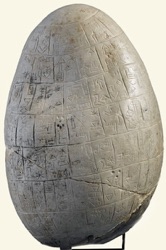
‘Eanatum Boulder’ from Girsu (now in the Musée du Louvre: AO 2677); image from the museum website
(See also the image and translation by Reed Enger, "The Eanatum Boulder",
in Obelisk Art History, Published May 18, 2015; last modified May 26, 2021)
The inscription (RIME 1.9.3.5; CDLI, P431079) on the so-called ‘Eanatum Boulder’, which is known from two examples (one on the boulder from Girsu illustrated above and another on a boulder from Lagash, which is now in the Iraq Museum), contains the most comprehensive list of Eanatuum’s victories. The inscription begins at home:
“Eanatum, ensi of Lagash, [long list of divine patrons], son of Akurgal, ensi of Lagash, restored Girsu for Ningirsu (and) built the wall of the holy precinct for him. For Nanshe, he built (the city of) Nigin”, (RIME 1.9.3.5; CDLI, P431079, lines 1-33).
Victories before the Invasion of Lagash by King Zuzu of Akshak
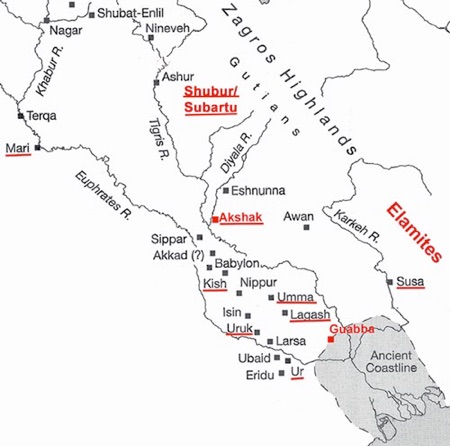
Map of Mesopotamia and its eastern periphery
Adapted from Willian Hamblin (referenced below, Map 2, at p. 43), my additions in red
We then read that, before his defeat of Umma:
“Eanatum defeated:
✴Elam, the amazing mountain, and made burial mounds for it; [and]
✴the [army of the] ruler of Arawa/Urua, who stood with the (city's) emblem in the vanguard, and made burial mounds for it (RIME 1.9.3.5; CDLI, P431079, lines 39-44).
As Piotr Steinkeller (referenced below, 2018, at p. 177 - see also Figure 10,1, at p. 178) observed, at this time, the place-name ‘Elam’ in Mesopotamian sources is usually:
“... a designation of the Iranian highlands and of the various ethnic groups living there. As employed in 3rd millennium sources, this designation generally excludes Khuzestan (the Susiana and Deh Luran plains), where the cities of Susa, Arawa/Urua, Uru’az, AdamDUN, Awan and Pashime/Mishime were located. However, already in the ED IIIb sources from Lagash, ‘Elam’ is occasionally used as a broad description of the entire eastern flank of southern Babylonia.”
Clearly, in this passage, Eanatum is aware of the ethnic difference between:
✴the people of lowland Arawa/Urua (which was located near Susa and described in later sources as ‘the bolt of Elam’); and
✴the (undifferentiated) warrior tribes of the Elamite highlands.
The narrative then turns to Sumer, where:
“[Eanatum] defeated:
✴Umma, made 20 burial mounds for it [and] returned to Ningirsu his beloved field, the Gu'edena;
✴Uruk;
✴Ur; [and]
✴Kiutu” (RIME 1.9.3.5; CDLI, P431079, lines 45-58).
Although the location of Kiutu is uncertain, it is usually assumed to have been in Sumer (see, for example, Stefano Seminara, referenced below, at p. 160).
The narrative then returns to the lowland plain around Susa, where Eanatum:
“... defeated:
✴Uruaz. and killed its ensi;
✴Pashime/Mishime [which] he destroyed; and
✴Arua, [which] he obliterated.
All the lands trembled before Eanatum, the one nominated by Ningirsu”, (RIME 1.9.3.5; CDLI, P431079, lines 59-71).
Lummagimdu/Lummagendu Canal
Eanatum’s record of his construction of this canal begins with the precise information that he built it:
“In the year when the king of Akshak arose, [when] Eanatum, nominee of Ningirsu, beat back Zuzu, king of Akshak, from the Antasura of Ningirsu to Akshak, (and) destroyed (it)”, (RIME 1.9.3.5; CDLI, P431079, lines 74-83).
I will discus the events recorded along with those recorded subsequently below. For the moment, I will focus on the information that:
“At that time, Eanatum (Eanatum being his own name, while his ‘Tidnum name’ is Lumma) dug a new canal for Ningirsu and named it ‘lumma gimdu’ (Good/Sweet as/like Lumma)”, (RIME 1.9.3.5; CDLI, P431079, lines 84-107).
Jerrold Cooper (referenced below, 1983, at p. 25) reasonably suggested that, since this is one of only two civic projects mentioned in this long inscription, the inscription itself had probably been commissioned in order to commemorate the completion of this work. Note, in passing, that this passage is not without its problems: for example, Gianni Marchesi (referenced below, 2006) argued that:
✴the ‘Tidnum name’ of Eanatum’ still awaits a convincing explanation’ (see p. 26) and, although Marchesi made this assertion some 20 years ago, it remains valid; and
✴in any case:
•the name ‘Lumma’ is probably that of a deity (see p. 113);
•the word itself is probably an epithet meaning ‘the Lusty One’ (see p. 113); and
•the deity in question is probably Ningirsu (see p. 114).
His translation of this passage (see pp. 125-6) is therefore:
“At that time, when Eanatum’s own name ... and fame ... flourished/grew, he (Eanatum) dug a new canal for Ningirsu and named it Lummagendu (‘As Sweet as the Lusty One’) for him (= Ningirsu).”
This project is recorded again in slightly more detail later in the inscription:
“For Ningirsu, [Eanatum built] the Lummagimdu/Lummagendu (canal) for Ningirsu: Eanatum, given strength by Ningirsu, [also built] the reservoir of the Lummagimdu/Lummagendu (canal) with 3600 gur of bitumen”, (RIME 1.9.3.5; CDLI, P431079, lines 127-137).
Tirash Temple
This second account of the building of the Lummagimdu/Lummagendu canal is followed by a brief account of the second civic project mentioned above:
“Eanatum, a man subject to the word of Ningirsu, whose (personal) god is Shulutul, built the ‘é.gal tirash’ for him (Ningirsu)”, (RIME 1.9.3.5; CDLI, P431079, lines 138-144).
I discuss this further in the context of another reference to this temple in another of Eanatum’s inscriptions ((RIME 1.9.3.7a).
Victories after the Invasion of Lagash by King Zuzu of Akshak
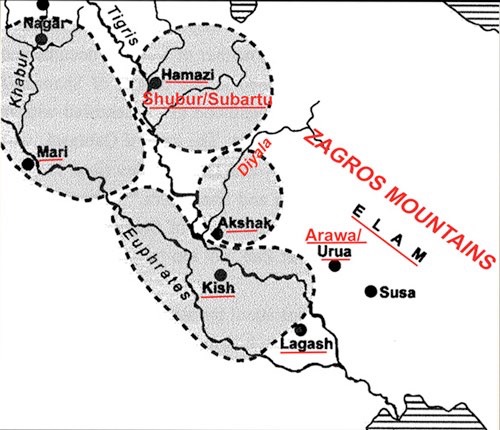
Political map of Mesopotamia in ca. 2400 BC
Adapted from Piotr Steinkeller (referenced below, 1998, Figure 1, at p. 86)
As we have seen, Eanatum recorded in the inscription on the ‘Eanatum Boulder’ that he had dug the Lummagimdu/Lummagendu canal for Ningirsu:
“In the year when the king of Akshak arose, [when] Eanatum, nominee of Ningirsu, beat back Zuzu, king of Akshak, from the Antasura of Ningirsu to Akshak, (and) destroyed (it)”, (RIME 1.9.3.5; CDLI, P431079, lines 74-83 - see Kamran Zand, referenced below, for this translation).
Thereafter, following the initial record of Eanatum’s building of Lummagimdu/Lummagendu canal, we read that:
“... because Inanna so loved Eanatum, ... [she] gave him the nam-lugal (kingship) of Kish in addition to the nam-ensi2 (rulership) of Lagash:
✴Elam trembled before Eanatum and he sent the Elamite back to his land.
✴Kish trembled before him.
✴He sent the king of Akshak back to his land.
Eanatum, ensi of Lagash, the subjugator of the many foreign lands of Ningirsu, defeated:
✴Elam, Shubur/Subartu and Arawa/Urua at the Asuhur (canal); and
✴Kish, Akshak and Mari at the Antasura of Ningirsu”, (RIME 1.9.3.5; CDLI, P431079 lines 98-124).
Piotr Steinkeller (referenced below, 2018, at p. 180 and note 11) suggested that we are dealing here with a major war that was waged against Lagash by what might well a coalition consisting of:
✴three armies from the territory to the east of the Tigris (Elam, Shubur/Subartu and Arawa/Urua), fought near the Asuhur canal; and
✴the armies of three cities of northern Mesopotamia (Akshak, Kish and Mari), fought at the Antasura.
Victories over Elam, Shubur/Subartu and Arawa/Urua at the Asuhur
The first thing to say here is that, although we have read about an earlier victory over Elam and Arawa/Urua, the presence of Shubur/Subartu in this group of Eanatum’s victories is somewhat unexpected. As Vitali Bartash (referenced below, at p. 266) observed, this locality had been recorded in our surviving sources of only two previous occasions:
✴as kur Shubur in the so-called ‘Prisoner Plaque’, where it is recorded as the source of 6,300 prisoners that had been enslaved by a ruler of Kish in the ED II period; and
✴Shuburki in the ED ‘List of Geographic Names’ (see his note 17), which generally deals with localities in northern Mesopotamia and its eastern periphery.
He then observed that:
“... Shuburki appears side by side with Elam in a lengthy inscription [i.e RIME 1,9.3.1] commemorating the military exploits of Eanatum ...”
In other words, as far as we know, Shubur/Subartu made its first appearance in the recorded history of Sumer in Eanatum’s royal inscriptions (including RIME 1,9.3.5, under discussion here).
Any analysis of the significance of Eanatum’s claimed victory over Shubur/Subartu should obviously start with the question of its geographical location: as Piotr Steinkeller (referenced below, 1998, at p. 77) pointed out, this is complicated by the fact that:
“... it is quite certain that, already in the 3rd millennium BC, Subartu had two separate meanings:
✴a narrow sense, [‘Subartu Proper’]; and
✴a broad sense, [‘Greater Subartu’] ... .
In its narrow (and therefore, almost certainly, its original) sense, ... Subartu denoted an area extending north of the Diyala region and east of the Tigris as far as the Zagros mountains.”
He further observed (at p. 79) that, since Shubur/Subartu is closely linked to Elam and Arawa/Urua in Eanatum’s inscriptions:
“... it is absolutely certain ... that [this location] must have been ‘Subartu Proper’, the area to the east of the Tigris ... [Furthermore], in my opinion, the most likely candidate for [its unknown] capital ... is Hamazi, [which was] a very important (though rather mysterious) ... urban centre [at this time]: although its precise location [is also] unknown, it is generally agreed that Hamazi was [also] situated to the east of the Tigris and to the north of the Diyala Region.”
Some 20 years later, Steve Renette (referenced below, at p. 77) observed that:
“There is general agreement that ... [Hamazi] is to be found between the Tigris and the Diyala or Lower Zab [rivers], based on its close association with Shubur/Subartu.”
Victories over Kish, Akshak and Mari at the Antasura
The events in the account above that are relevant here are as follows:
✴when Zuzu, the king of Akshak ‘arose’, Eanatum beat him back from the Antasura of Ningirsu to the city of Akshak, which he destroyed;
•digression regarding the digging of a new canal;
✴because Inanna ‘so loved’ Eanatum (who was already the ensi of Lagash), she conferred on him the additional title of ‘king of Kish’;
•digression noting the Elam trembled before Eanatum;
✴Kish trembled before Eanatum;
✴Eanatum sent the king of Akshak back to his land;
•digression noting the Eanatum’s victory over Elam, Shubur/Subartu and Arawa/Urua at the Asuhur canal; and
✴Eanatum defeated Kish, Akshak and Mari at the Antasura of Ningirsu.
As Kamran Zand (referenced below) observed, the episode dealing specifically with King Zuzu of Akshak is usually reconstructed as follows:
✴Akshak forms an alliance with Kish and Mari;
✴this coalition, under the leadership of Zuzu, invades Lagashite territory;
✴Eanatum defeats Kish, Akshak and Mari at the Antasura; and
✴Zuzu is beaten back to Akshak.
Zand agreed with Piotr Steinkeller (referenced below, 1993, note 20, at p. 118) that:
“The vague language of the passage make it most unlikely that he followed Zuzu all the way to Akshak. It seems certain that, had Eanatum taken Akshak, he would have stated it in quite unequivocal terms.”
Victories after the Invasion of Lagash by King Zuzu of Akshak: Conclusions
Although the account of Eanatum’s military activities in the latter part of the inscription on the Eanatum Boulder’ is vague, repetitive and convoluted, it probably boils down to two separated but related victories:
✴one over Elam, Shubur/Subartu and Arawa/Urua at the Asuhur canal; and
✴the other over Kish, Akshak and Mari at the Antasura.
Chronology of Eanatum’s Victories
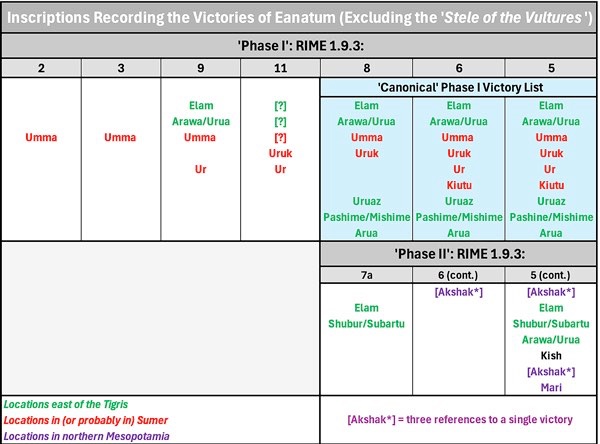
Table 1: Eanatum’s victories, in the order in which they are recorded in his royal inscriptions
See the discussion above for the victories recorded in RIME 1.9.3: numbers 2 and 3
Other victory lists here are adapted from the table in Stefano Seminara (referenced below, at p. 151)
As Jerrold Cooper (referenced below, 1983, at pp. 24-5) observed:
“The relative chronology of Eanatum's reign (which is of unknown length) cannot be disentangled [with any certainty], despite repeated scholarly efforts to do so. His wide-ranging military activities are most fully recorded in [two passages from [the ‘Eanatum Boulder’ that are separated by his first account of his building of the Lummagimdu/Lummagendu canal, as discussed above].”
As is clear from the table above, when all of Eanatum’s surviving ‘victory inscriptions’ (excluding the unusual inscription of the ‘Stele of the Vultures’ - see below), his victories fall into two groups:
✴those beginning (or probably beginning) with victories over Elam, Arawa/Urua, Umma and other places in Sumer (in the upper part of the table); and
✴those that include his victory over Akshak and/or both Elam and Shubur/Subartu.
As noted above, Jerrold Cooper (referenced below, 1983, at p. 26) reasonably argued that, since a large proportion of these inscriptions record a victory over Umma, it is likely that the victory in question took part in the early part of his reign. For this reason, I hypothesise two chronological phases for these victories, designated in Table 1 as Phase I and Phase II.
Eanatum’s Victories: Phase I
I discussed the first two inscriptions in Table I above, in the context of Mesilim’s original designation of the border between Lagash and Umma and the first known dispute relating to it, which seems to have involved Eanatum and Ush, the ensi of Umma. I will now discuss the other Phase I inscriptions in the order in which they appear in the table.
RIME 1.9.3.9: Brick Inscriptions from Girsu
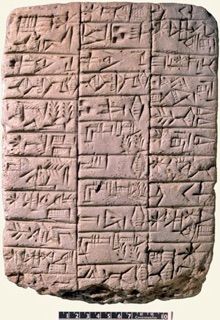
Fired brick from Tell L at Girsu carrying the inscriptiom RIME 1.9.3.9; CDLI, P431084;
Now in the British Museum (BM 85977): image from the museum website
This inscription is known from some 40 surviving bricks (one of which is illustrated above) from Tell K at Girsu, the site of the Ningirsu temple, which had been rebuilt on a platform over the original temple by Ur-Nanshe, Eanatum’s grandfather: after recording that Eanatum had defeated:
✴KUR NIMki (the country/mountain of Elam);
✴Arawa/Urua;
✴Umma; and
✴Ur;
the text ends as follows:
“At that time, [Eanatum] built a well of fired bricks for the god Ningirsu in his (Ningirsu’s) broad courtyard. ... At that time, Eanatum was loved by Ningirsu”, (lines 30-33).
As noted above, the inscription of the ‘Eanatum Boulder’ recorded that Eanatum:
“... restored Girsu for Ningirsu (and) built the wall of the holy precinct for him”, (RIME 1.9.3.5; CDLI, P431079, lines 26-30).
As Sébastien Rey (referenced below, at p. 238) observed, this large well that he built in the courtyard outside the Ningirsu temple became:
“... a tremendously significant and extremely long-lasting feature of the sacred complex on Tell K.”
The inscription on these bricks seems to have been the earliest among those that survive to record Eanatum’s first victory over Elam and Arawa/Urua. As noted above, the term used for Elam here is KUR NIMki. As François Dessset (referenced below, at pp. 3-4) pointed out, the sign ‘NIM’ in association with the topographic determinative ‘KI’ is known to have been in use before the time of Eanatum as a (probably geographic) qualifier of individuals (both divine and mortal). However, he argued (at p. 4 and note 16) that:
“A new function appeared [for the sign NIM] in the archives of Lagash, first of all in the [inscription RIME 1.9.13.9, in which] the sign NIM [is combined] with a territory, KUR (country/mountain) [in the phrase] KUR NIMki (the mountain land of Elam). ... NIM seemed to be linked to a topographical reality, which [the] Mesopotamians created [for] a previously undesignated territory]... by qualifying it with [NIM], a sign traditionally [previously] associated with persons. The territory thus defined probably corresponded to a general concept: the eastern highlands.”
Interestingly, in Eanatum’s other inscriptions, ‘Elam’ is written:
✴NIM (see, for example, RIME 1.9.3.5; CDLI, P431079, lines 35 and 108); or
✴NIMki (in the phrase Elam and Shubur/Subartu - see RIME 1.9.3.5; CDLI, P431079, line 118).
Since (as noted above) Arawa/Urua is described in later sources as ‘the bolt of Elam’, we can reasonably assume that the first victory of Eanatum recorded in this inscription was against armies from Arawa/Urua and the Elamite highlands.
The victory against Umma that is the next in the list was presumably a reference to Eanatum’s victory over Ush, ensi of Umma, in the putative first episode in the hostilities described in the ‘Stele of the Vultures’ (see further below). Hostility between Ur and Lagash might well have been fuelled by competition for the control of maritime trade via the Lower Sea (as discussed below), and it is possible that these two references refer to a single campaign in which Umma and Ur were allies.
RIME 1.9.3.11: Inscription on a Diorite Mortar of Unknown Provenience
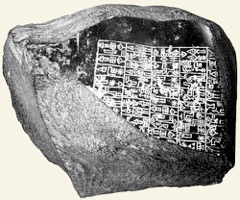
Fragment of a black diorite mortar carrying an inscription of Eanatum (provenience unknown)
Now in the British Museum (BM 90832), image from the museum website
The next inscription inTable 1 (RIME 1.9.311; CDLI, P431086) is on a black diorite mortar of unknown provenience, is now in the British Museum (BM 90832). It was originally published by Jerrold Cooper (referenced below, 1984, at pp. 87-92). The surviving text is on two sides of the mortar (usually referred to as ‘Side 1’ and ‘Side 4’).
The first part of the text on ‘Side 1’ is now illegible: the first part of the surviving text here records that:
“He defeated [Ur]uk. [He defeated] Ur. … Eanatum, the one who built the temple of Gatumdug. His personal god is Shulutul. Eanatum fashioned (a statue of) Nanshe ... He established regular offerings [for]:
✴Na[nshe], for (her) giguna-mah (temple);
✴Ningirsu, for (his) ... temple; and
✴Enlil at Nippur (…).
It seems likely that:
✴this mortar (like the bricks carrying RIME 1.9.3. 9 discussed above) was commissioned at the time of Eanatum’s victory over Ush, ensi of Umma; and
✴this victory over Umma was recorded in the now-illegible initial part of the text, before the record of victories over Uruk and Umma.
Interestingly, this seems to be the earliest surviving reference to hostilities between Uruk (the erstwhile ally of Ur-Nanshe) and Lagash. The other inscription (on ‘Side 4’) begins with a warning that no-one should confiscate the mortar that Eanatum had fashioned for Nanshe, the mistress of the pure mountain in the Emah. Although there is no surviving external evidence for the original location(s) of the mortar of Eanatum and the statue of Nanshe that is recorded in its inscription, the internal evidence from the inscription suggests that both objects were dedicated in a temple of Nanshe named the giguna-mah (Great Temple Terrace) and/or the Emah. As noted above, the inscription on the ‘Eanatum Boulder’ recorded that Eanatum:
“... ‘built’ Nigin for Nanshe”, (RIME 1.9.3.5; CDLI, P431079, lines 31-33);
which suggests the the temple in question was in Nigin.
The remainder of the text on ‘Side 4’ articulates a series of curses on anyone who destroys or burns the mortar itself or effaces its inscriptions. One particular element of this text is both important and obscure, so I offer four translations (in reverse date order and with the sentence order changed where necessary to facilitate comparison):
✴“... (this) great mortar of Nanshe, while it is left on its pedestal: may the ensi of Lagash ... In the event that it has been completely smashed by a dog(?) or, during the rubbing of its inscription ... :
may he not pass by (Nanshe): may that king of Kish not pass by (Nanshe)”, CDLI, P431086, lines 39’-45’).
✴“... if the ensi of Lagash removes the large mortar of Nanshe from its pedestal, ... If a stranger smashes it to bits or effaces its inscription, ... :
may he never pass (before Nanshe): may he, even if he is a king of Kish, never pass (before Nanshe)”, (Christopher Woods, referenced below, at p. 40).
✴“... as for the large mortar of Nanshe, preserve it on its pedestal. The ensi of Lagash ... Since he incited a stranger to smash [the mortar] completely and to erase its inscription:
may (that man) never pass (before Nanshe): may that king of Kish never pass (before Nanshe)”, (Douglas Frayne, referenced below, 2008, RIME 1.9.3.11, at p. 161).
✴“If the large mortar of Nanshe is removed from its pedestal, [may] the ensi of Lagash [three lines missing]:
may [ ] never pass [before Nanshe]: may that king of Kish never pass (before Nanshe)”, (Jerrold Cooper, referenced below, 1984, at p. 90).
Although this is all extremely confusing, it seems to me that we are grappling here with two events:
✴an earlier violation of the sacred mortar carried out by a now unnamed king of Kish, which led to the curse ensuring that he would never ‘pass before Nanshe’; and
✴the restoration of the mortar and its return to its pedestal by Eanatum, who also commissioned its inscriptions, which include curses on anyone responsible for future violations.
I wonder (and this is pure speculation) whether this earlier king of Kish was Mesanepada, who had also had the title king of Ur (see the discussion below).
Canonical List of Eanatum’s ‘Phase I’ Victories
As we have seen, the victory list articulated in the inscription (RIME 1.9.3.5; CDLI, P431079) on the ‘Eanatum Boulder’ reads as follows:
“Eanatim defeated:
✴Elam, the lofty mountain (land) and heaped up tumuli;
✴the ensi of Arawa/Urua, [although he] marched ahead of Arawa’s standards and heaped up tumuli;
✴Umma, heaped up 20 tumuli and restored to Ningirsu control his beloved the Gu’edena;
✴Uruk; Ur; [and] Kiutu [which, as noted above, is usually assumed to have been in Sumer];
✴Uruaz, which he sacked, [having killed] its ensi;
✴Pashime/Mishime, which he sacked; and
✴Arua, which he destroyed.
All the foreign lands trembled before Eanatum, the nominee of the god Ningirsu.”
This list of victories seems to have become a canonical list of those that Eanatum secured in a specific period of his reign, since it is reproduced:
✴in an inscription (RIME 1.9.3.6; CDLI, P431080) that is found on two surviving boulders from unknown locations in Girsu; and
✴with only Ur and Kiutu missing, in an inscription (RIME 1.9.3.8; CDLI, P431083) found on 11 brick inscriptions from an unknown location in Girsu.
Eanatum’s Victories (‘Phase I’): Analysis and Conclusions
These victories in what I have called ‘Phase I’ clearly fall into two geographical subgroups:
✴Umma, Uruk, Ur and (probably) Kiutu in Sumer; and
✴a number of locations to the east:
•Elam and Arawa/Urua (the ‘bolt of Elam’); and
•a group of locations (Uruaz, Pashime/Mishime and Arua) that, according to Stefano Seminara (referenced below, at p. 160) were (or were probably) located also on the eastern side of the Tigris and to the south of ‘Elam’.
In relation to Eanatum’s victories in Sumer, the most obvious point to make is that none of them appears in the (presumably later) ‘Phase II’ victory lists. It seems to me that we might therefore reasonably assume that the victories against Umma recorded in:
✴RIME 1.9.3: numbers 2 and 3: and
✴the ‘Phase I’ inscriptions;
were secured by Eanatum against Ush, ensi of Umma. It is, of course, possible that Uruk, Ur and Kiutu went to war against Eanatum as allies of Umma.
This brings us to Eanatum’s ‘Phase I’ engagement with armies from the east: in the most detailed inscriptions (RIME 1.9.3: numbers 5, 6 and 8), Eanatum defeated:
✴NIM hur-sag-u6-ga (Elam, the lofty mountain), and heaped up tumuli;
✴the ensi of Arawa/Urua (despite the fact that he marched ahead of his city’s standards) and heaped up tumuli;
✴Uruaz. and killed its ensi;
✴Pashime/Mishime [which] he destroyed; and
✴Arua, [which] he obliterated.
Piotr Steinkeller (referenced below, 2018, at p. 180) argued that:
“Since Eanatum claims to have sacked and destroyed [Uruaz and Pashime/Mishime], it appears certain that he actually campaigned in the [lowland plain around Susa. ... However, it] is unlikely that [he] campaigned in the highlands: his conflict with ‘Elam’ probably having been of a purely defensive nature.”
I wonder whether the unrest in Sumer at this time attracted the attention of raiders from the east, and that, having ended his dispute wit Umma, Eanatum was able to drive them back towards the Zagros and attack their lowland settlements. There is certainly no indication that he had territorial aspirations in the east.
Eanatum’s Victories: Phase II
As we have seen, the inscription (RIME 1.9.3.5; CDLI, P431079) on the ‘Eanatum Boulder’ is our only complete source for the victories claimed by Eanatum in Phase II. The account begins with the information that Eanatum dug the Lummagimdu/Lummagendu canal for Ningirsu:
“In the year that the king of Akshak rose up, [when] Eanatum, the one named by Ningirsu, drove Zuzu, the king of Akshak, from the Antasura [shrine] of Ningirsu to Akshak, which he destroyed”, (RIME 1.9.3.5; CDLI, P431079, lines 72-83).
This passage is also found (without the name of Zuzu) in RIME 1.9.3.6; CDLI, P431080, followed by an now-lost passage on the digging of a new canal.
We then read in RIME 1.9.3.5 that:
✴Innana bestowed the kingship of Kish on Eanatum (see below); and
✴he secured two distinct victories:
•against Elam, Shubur/Subartu and Arawa/Urua at the Asuhur canal; and
•against Kish, Akshak and Mari at the Antasura of Ningirsu.
As it happens, Eanatum’s consecutive victories over Elam and Shubur/Subartu are recorded in two of his other royals inscriptions:
✴the ‘Stele of the Vultures’ (discussed in a later section below); and
✴another inscription (RIME 1.9.3.7a; CDLI, P431081) discussed here.
RIME 1.9.3.7a: Inscription on Two Boulders
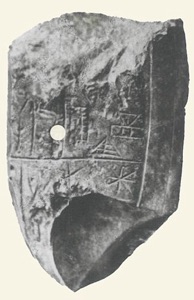
Boulder from Tell A at Girsu, carrying an inscription (RIME 1.9.3.7a; CDLI, P222404) of Eanatum
Now in the Musée du Louvre (lost ?), image from Ernest de Sarzec (referenced below, Pl. 2, number 3)
This inscription is known from two examples:
✴one from Tell A at Girsu, which is now in the Musée du Louvre (illustrated above); and
✴the other, which is of unknown provenience and is now in the Istanbul Museum (ESh 1632).
The inscription reads:
“[For the god Ningirsu], [Eanatu]m, ensi of Lagash, [who subjuga]tes [the foreign lands] for the god, [su]bjugated [Elam] and Shubur/Subartu to him. He built the ‘é.tirash’ for (the god Ningirsu) and made it splendid for him. As for Eanatum, who is commissioned by [Nin]gir[su], because of the strength given by the Ningirsu, (when he rages) against the foreign lands, nobody is able to resist him.”
In fact, Ur-Nanshe referred to:
✴his building of ‘tirash’ in many of his surviving inscriptions; and
✴specifically to his building of the the ‘é.tirash’ in one of them ( RIME 1.9.1.26; CDLI, P431061).
Since Eanatum’s rebuilding of this shrine is the only civic project mentioned in RIME 1.9.3.7a, we might reasonably assume that the inscribed boulders carrying it were specifically commissioned in order to commemorate his both his rebuilding of this shrine and his victories over Elam and Shubur/Subartu at the Asuhur canal.
As we have seen, Eanatum’s building of the ‘é.gal tirash is recorded in the inscription (RIME 1.9.3.5; CDLI, P431079) on the ‘Eanatum Boulder’. Andrew George (referenced below, entry 1097, at p. 150) translated:
✴é.tirash (as in RIME 1.9.3.7a) as ‘the House of Tirash, a shrine built for Ningirsu’; and
✴é.gal tirash (as in RIME 1.9.3.5) as ‘the Palace of Tirash
However, Filip Vukosavovic (referenced below, at p. 130) argued that the latter name:
“... should not be understood as ‘the palace (of) Tirash (place)’, but as ‘the big house/temple (of the) Tirash (compound)’."
It is therefore possible that Eanatum:
✴restored his father’s é.tirash immediately after his victories over Elam and Shubur/Subartu at the Asuhur canal (as recorded in RIME 1.9.3.7a); and
✴rebuilt it on a larger scale (or added an adjoining larger structure) and renamed it é.gal tirash after his victories over Akshak, Kish and Mari at the Antasura (as recorded in RIME 1.9.3.5).
Eanatum’s Victories in the ‘Stele of the Vultures’
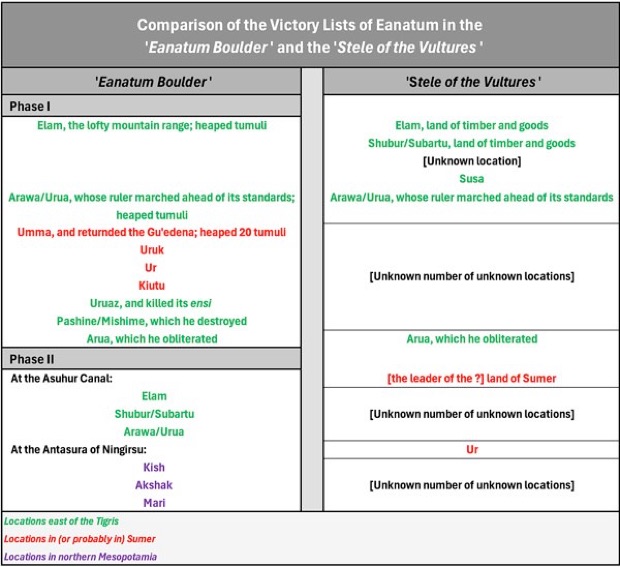
Table 2: Eanatum’s victories recorded in the ‘Eanatum Boulder’ and the ‘Stele of the Vultures’
Table 2 focuses on Eanatum’s victory lists his two most important surviving inscriptions:
✴the ‘Eanatum Boulder’, which (as discussed above) contains the fullest list we have for the period up to and including the victory over Akshak, Kish and Mari at the Antasura, arranged in two (presumably chronological) phases; and
✴the ‘Stele of the Vultures’, which (as discussed above) seems to include:
•two accounts not represented in the table:
-those leading up to the victory over Ush, ensi of Umma;
-those leading up to the victory over Enakale, ensi of Umma; and
•a now-incomplete list of the victories over opponents other than Umma.
There is obviously a degree of overlap between these two lists, albeit that it is far from complete. In the table above, I have attempted to accommodate the overlap as far as possible by aligning two of the victories in Phase I of the ‘Eanatum Boulder’ (those over Arawa/Urua and Arua) with the similarly worded victories in the ‘Stele of the Vultures’, although (as Jerrold Cooper, referenced below, 1983 at p. 25) pointed out, we cannot be sure:
✴whether or not the apparent ‘canonical order’ of the Phase I victories in Table 1 was obligatory; and/or
✴whether it was chronological or determined by other factors.
There is, however, one overlap (not shown in Table 2) that might have some bearing on the matter:
✴after Eanatum’s ‘Phase I’ victory over Umma in the ‘Eanatum Boulder’; and
✴after his putative victory over Ush, the ensi of Umma; in the ‘Stele of the Vultures’;
he ‘heaped up 20 tumuli’ for the dead. In other words, it does seem likely that both of these sources both belong to the latter part of Eanatum’s reign (albeit that the fragmentary nature of the latter source makes it impossible to go further.
Even if this suggested chronology is disregarded, it is striking that the victory over shue3 Kiengi (the land of Sumer) recorded in the ‘Stele of the Vultures’ does not appear in any of the other surviving inscriptions of Eanatum. Interestingly, Jasmina Osterman (referenced below), in her study of the way in which the meaning of the Sumerian ‘ki-en-gi’ evolved over time until it became equated with ‘Sumer’, observed (at p. 53) that:
“... ‘ki-en-gi’ appears for the first time as part of the royal ideology on royal inscriptions. [More specifically], it is written on the monumental royal ‘Stele of Vultures’ of Eanatum ... . The final part of the text, which is quite damaged, states within in the context of Eanatum’s victories that he first defeated the city of [Urua] and then Arua. This is followed by the damaged portion in which only [the following text is preserved]:
‘... from the Kiengi, Ur he destroyed (šu-e3 ... ki-en-gi uri5 ki |GIN2.ŠE3| be2-se3)’.
... The inscription [itself] is about the victory over the city of Umma, ... and the emphasis on the victory over Ur indicates that there was an alliance between those two cities (Umma and Ur) that had something to do with Kiengi.
I wonder whether Eanatum’s [claimed] victory over Enakale, ensi of Umma was secured after:
his victory over Kish, Akshak and Mari at the Antasura of Ningirsu; and
his adoption of the title King of Kish.
Note that, in the dream that Eanatum described in the ‘Stele of the Vultures’, Ningirsu
‘... Umma, like Kish, shall therefore wander about, and by means of ones seized by anger(?) shall surely be removed”, (RIME 1.9.3.1; CDLI, P431075, lines 121’-150’).
Eanatum and Kish
If we attempt a similar reconstruction of the episode dealing specifically with Kish, matters are more complicated:
✴Kish joins a coalition led by King Zuzu of Akshak that had presumably formed for the purpose of invading Lagashite territory;
✴Inanna confers the kingship of Kish of Eanatum;
✴Kish (like Elam) trembles before Eanatum; and
✴Eanatum defeats Kish (along with Akshak and Mari) at the Antasura.
In a later paper, Steinkeller (referenced below, 2013, at p. 150) the further decline of Kish in the context of:
“... the actions of ... Eanatum, who extensively campaigned in the Susiana and possibly even as far [Shubur/Subartu], taking the title of the ‘King of Kish’ . Eanatum also claimed to have defeated Kish, Mari, and Akshak. However, since the ... battles in question [were] fought within Lagash’s territory, it would appear that ... Lagash was on defensive, with the conflict’s probable cause having been:
Eanatum’s military accomplishments in the east; and
his possible attempts to extend his power into northern [Mesopotamia].
There are certainly no indications that Eanatum succeeded in sacking Kish itself.”
However, Aage Westenholz (referenced below, at p. 688) responded with a more nuanced view of these events:
“Steinkeller argues convincingly that Eanatum’s was a defensive victory; but Eanatum surely did more than merely seeing his enemies off.
Zuzu of Akshak was pursued all the way to the safety of his own city, soundly beaten; [and]
Eanatum ... claimed to be ‘king of Kish’ and a fragment of an inscription of his [CDLI, P221781 - see Westenholz’s note 4 for his completion] has actually been excavated there, as if to prove the veracity of that claim.
Even so, his dominion over [Kish] was probably quite short-lived.”
It seems to me that it is entirely possible that:
✴King Zuzu of Akshak exercised hegemony over Kish and Mari at the time of his attack on Lagash; and
✴after Eanatum had repelled this attack and pursued Zuzu towards Akshak, he was able to assume hegemony over Kish, albeit that this situation might not have endured for very long. (I will return to Eanatum’s claim to the kingship of Kish below).
presumably after these victories:
“... because Inanna so loved Eanatum, ... [she] gave him the nam-lugal (kingship) of Kish in addition to the nam-ensi2 (rulership) of Lagash”, (lines 102-106).
It seems to me that, in these passages, Eanatum was drawing a parallel between his own exploits and those of king Mesilim of Kish, who:
had exercised hegemony over Lagash in the ED II period (as we shall see); and
was recorded with great reverence as the protector of the border between lagash and Umma in Eanatum’s royal inscriptions (see, for example, RIME 1.9.3.2; CDLI, P431076., see lines 4-8 and line 55’-60’).
Interestingly, Kish is also referred to on one of the surviving fragments of this stele: we read that, as Eanatum lay sleeping, ‘his beloved king, Ningirsu’ appeared to him in a dream to reassure him that:
“Umma, like Kish, shall therefore wander about, and by means of ones seized by anger(?), shall surely be removed”, (obverse, lines 124’-136’).
This seems to suggest that Kish was allied with Umma at this time, which might explain why (according to the Eanatum Boulder):
Kish subsequently ‘trembled before’ Eanatum; and
Inanna, who loved him, ‘gave him the kingship of Kish’.
Enanatum I
Text
References:
Goodman R, et al., “The Flooding of Lagash (Iraq): Evidence for Urban Destruction Under Lugalzagesi, the King of Uruk and Umma”, Geoarcheology, 40:5 (2025), online
Rey S., “The Temple of Ningirsu: the Culture of the Sacred in Mesopotamia”, (2024) University Park, PA
Wang Z., “The ‘Holy War’ of Eanatum in Light of the Early Dynastic Central Babylonian Tradition”, in:
Poliskaya I. et al. (editors). “Religion and War from Antiquity to Early Modernity”, (2024) London, at pp. 40-50
Álvarez-Mon J., “The Bow of Elam, the Mainstay of Their Might”, in:
Tavernier J. et al. (editors), “Susa and Elam II: History, Language, Religion and Culture”, (2023) Leiden, at pp. 259-98
Lovisetto G., “Goddesses Visualized in Early Dynastic Mesopotamia”, in:
Babcock S. and Tamur E. (editors), “She Who Wrote: Enheduanna and Women of Mesopotamia, ca. 3400–2000 BC”, (2022) New York, at pp. 46-63
Osterman J., “From ki-en-gi to Šumerum: how Sumer was Created”, Radovi (Zavod za hrvatsku povijest), 54 (2022) 39-72
Seminara, S., “The World According to E-anatum: The Narrative of the Events in E-anatum's Royal Inscriptions”, Vicino Oriente, 24 (2020), 151-65
Westenholz A., “Was Kish the Center of a Territorial State in the Third Millennium?—and Other Thorny Questions”, in:
Arkhipov I. et al. (editors), “The Third Millennium: Studies in Early Mesopotamia and Syria in Honor of Walter Sommerfeld and Manfred Krebernik”, (2020) Leiden and Boston, at pp. 686-715
Steinkeller P., “Texts, Art and Archaeology: An Archaic Plaque from Mari and the Sumerian Birth-Goddess Ninhursag”, in:
Chambon G. et al. (editors), “Mélanges Assyriologiques en l'Honneur de Dominique Charpin”, (2019) Leuven, Paris and Bristol CT, at pp. 977-1012
Bartash V., “Going for the Subarean Brand: The Import of Labor in Early Babylonia”, Journal of Near Eastern Studies, 77 (2018) 263-78
Renette S., “Along The Mountain Passes: Tracing Indigenous Developments Of Social Complexity In The Zagros Region During The Early Bronze Age (ca. 3500-2000 Bce)”, 2018) thesis of the University of Pennsylvania
Steinkeller P., “Birth of Elam in History”, in:
Álvarez-Mon J. et al. (editors), “The Elamite World”, (2018) Oxford and New York, at pp. 177-202
Watanabe Ch. E., “Composite Animals in Mesopotamia as Cultural Symbols”, in:
di Paolo S. (editor), “Composite Artefacts in the Ancient Near East: Exhibiting an Imaginative Materiality, Showing a Genealogical Nature”, (2018) Oxford, at pp. 31-8
Zólyomi G., “E-ana-tum and the Ruler of Arawa”, Journal of Ancient Civilisations, 33:2 (2018) 141-63
Desset F., “Here Ends the History of Elam: Toponomy, Linguistics and Cultural Identity in Susa and Southwestern Iran (ca. 2400-1800 BC)”, Studia Mesopotamica, 4 (2017) 1-32
van Dijk-Coombes R. M., “Lions and Winged Things: A Proposed Reconstruction of the Object on the Right of the Lower Register of the Mythological Side of Eanatum's Stele of the Vultures”, Die Welt des Orients, 47:2 (2017) 198-215
Sallaberger W. and Schrakamp I., “Part I: Philological Data for a Historical Chronology of Mesopotamia in the 3rd Millennium”, in:
Sallaberger W. and Schrakamp I. (editors), “Associated Regional Chronologies for the Ancient Near East and the Eastern Mediterranean. History and Philology: Vol. 3”, (2015) Turnhout, at pp. 1-130
Vukosavovic F., “On Some Early Dynastic Lagaš Temples”, Die Welt des Orients, 44:1 (2014)
126-30
Zand K. V., “What happened to Zuzu, King of Akšak?”, Cuneiform Digital Library Notes, (2014)
Keetman J., “Ein weiterer frühdynastischer Beleg für das selbständige Personalpronomen der 2. Person Singular im Sumerischen”, Nouvelles Assyriologiques Brèves et Utilitaires (NABU), 4 (2012) entry 58
Woods C., “Mutilation of Image and Text in Early Sumerian Sources”, in:
May N. N. (editor), “Iconoclasm and Text Destruction in the Ancient Near East and Beyond”, (2012) Chicago, at pp. 33-56
Frayne D. R., “The Royal Inscriptions of Mesopotamia, Vol. 1: Presargonic Period (2700-2350 BC)”, (2008) Toronto
Lapinkivi P., “The Sumerian Sacred Marriage and Its Aftermath in Later Sources”, in:
Nissinen M. and Uro R. (editors), “Sacred Marriages: The Divine-Human Sexual Metaphor from Sumer to Early Christianity”, (2008) University Park, PA, at pp. 7-42
Romano L., “La Stele degli Avvoltoi: una Rilettura Critica”, Vicino Oriente, 13 (2007) 3-24
Hamblin W. J., “Warfare in the Ancient Near East to 1600 BC: Holy Warriors at the Dawn of History”, (2006) London and New York
Marchesi G., “Lumma in the Onomasticon and Literature of Ancient Mesopotamia”, (2006) Padua
Steinkeller P., “The Historical Background of Urkesh and the Hurrian Beginnings in Northern Mesopotamia”, in:
Buccellati G. and Kelly-Buccellati M. (editors), “Urkesh and the Hurrians:Studies in Honor of Lloyd Cotsen”, (1998) Malibu CA, at pp. 75-98
Collins P., “The Sumerian Goddess Inanna (3400-2200 BC)”, Papers from the Institute of Archaeology, 5 (1994) 103-18
Steinkeller P., “Early Political Development in Mesopotamia and the Origins of the Sargonic Empire”, in:
Liverani M. (editor), “Akkad the First World Empire”, (1993) Padua, at pp. 107-29
Winter I, J., “After the Battle Is Over: The ‘Stele of the Vultures’ and the Beginning of Historical Narrative in the Art of the Ancient Near East”, Studies in the History of Art, 16 (1985) 11-32
Cooper J. S., “Studies in Mesopotamian Lapidary Inscriptions”, Iraq 46 (1984) 87- 93
Cooper J. S., “Reconstructing History from Ancient Inscriptions: The Lagash-Umma Border Conflict”, (1983), Malibu CA
Hansen D. P., “Al-Hiba (1970-1971(: A Preliminary Report”, Artibus Asiae, 35:1/2 (1973) 62-78
Parrot A., “Tello; Vingt Campagnes de Fouilles (1877-1933)”, (1948) Paris
de Sarzec E., “Découvertes en Chaldée: Second Volume Partie Epigraphique et Plances”, (1884)
Paris