Empires of Mesopotamia:
Akkadian Empire (ca. 2300 - 2200 BC)
Main Page: Akkadian Empire (2300-2200 BC)
Topics


Empires of Mesopotamia:
Akkadian Empire (ca. 2300 - 2200 BC)
Main Page: Akkadian Empire (2300-2200 BC)
Topics
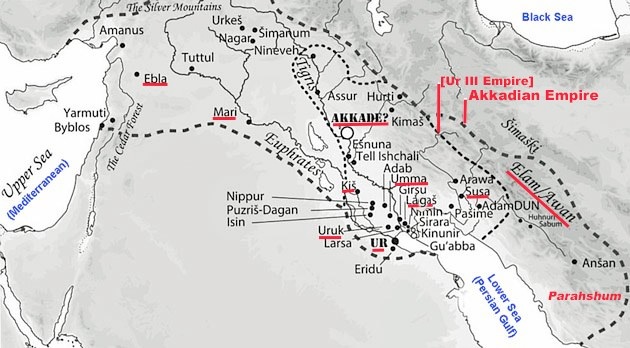
Image adapted from Piotr Steinkeller (referenced below, 2021, Map 2.1, at p. 69)
My additions: text in red and blue
As Piotr Steinkeller (referenced below, 2021, at p. 44) observed, the creation of the so-called Akkadian or Sargonic Empire by Sargon of Akkad (= Agade or Akkad):
“... was a completely novel experiment in the use of political power.”
Not least among the novel features of this ‘empire’ were the facts that:
✴the political power in question was passed down by dynastic succession over a period of about a century, from Sargon to his great grandson, Shar-kali-sharri; and
✴at the height of their power, these dynastic kings of Akkad controlled the vast territory marked out in the map above.
Nevertheless (as the sharp-eyed will have noticed) Sargon’s capital is marked on the map as ‘Akkad ?’, since no archeological remains of this much-documented city have ever been found. (It is generally agreed that it was on the Tigris, near its confluence with the Diyala river, as in the map above).
Sargon
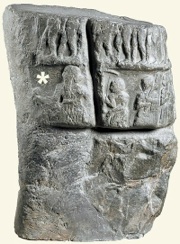
Victory stele of Sargon from Susa (now in the Musée du Louvre, Sb. 1)
Image from museum website: asterisk marks the figure of Sargon, identified by inscription
We have little contemporary epigraphic evidence from Sargon’s reign: for example, only two of his royal inscriptions survive and these are now fragmentary:
✴an inscription (RIME 2:1:1:10; CDLI, P461936, illustrated above) on the reverse of a victory stele from Susa (which was not necessarily its original location) names ‘Sargon, the king ....’; and
✴a fragmentary inscription (RIME 2:1:1:4; CDLI, P217324) on a mace head from Ur (now in the Penn Museum: CBS 14396), which describes a now-unnamed king as the ‘conqueror of Uruk and U[r]’, can probably be assigned to Sargon (as discussed below).
Apart from these inscriptions, the earliest surviving reference to Sargon is in the earliest known recension of the so-called Sumerian King List, which dates to the reign of the ‘Ur III’ king Shulgi (hereafter the USKL, transliterated at CDLI: P283804: ca. 2050 BC), which was published by Piotr Steinkeller (referenced below, 2003 - see my page on the USKL): in this inscription, after a list of about 30 Kishite rulers followed by a lacuna that probably named about 9 rulers of Uruk, we read that:
“Sargon, in Akkad, [ruled for] 40 years”, (reverse col. 1, lines 6’-7’ in the CDLI transliteration).
Unfortunately, we do not know how Sargon was introduced in the preceding (now-lost) USKL text. However, in the later Old Babylonian recensions of the Sumerian King List (hereafter the SKL), which was compiled after the fall of Ur during the period of the Isin kings and was based in part on the USKL, we read that:
“Sargon:
✴whose father was a gardener;
✴the cupbearer of (king) Ur-Zababa;
✴the king of Akkad;
✴the one who built Akkad;
was king [there]. He ruled for 56 years”, (SKL 266-271).
These later sources can be supplemented by various literary texts, the historical value of which is generally uncertain. It is therefore fortuitous that a relatively large number of Sargon’s royal inscriptions survive as copies made in the Old Babylonian period (discussed below).
Sargon’s ‘Victory’ Inscriptions
Douglas Frayne (referenced below, 1993, at p. 3) observed that:
“The Sargonic period marks the first time the Akkadian language was extensively used for royal inscriptions [in Sumer]. The majority of Sargon’s inscriptions are recorded in that language, [although] a minority are known in bilingual (Sumerian and Akkadian) versions and a handful are in Sumerian alone.”
As Andrea Seri (referenced below, Table 3.2, at p. 90) pointed out the ‘Old Akkadian’ dialect spoken in the reign of Sargon represents the earliest attestation of the Akkadian language. This is a Semitic language and, as Andrea Seri pointed out (at p. 87), we know that the the ‘East Semitic’ language that was used in texts from Ebla (in modern Syria) prior to Sargon’s reign was written using the same cuneiform script as Sumerian. Unsurprisingly then, Sumerian cuneiform was also used in Sargon’s Akkadian inscriptions.
Douglas Frayne (referenced below, 1993, at p. 7) observed that, although very few of Sargon’s inscriptions survive in their original form , a number of them are known from later Old Babylonian tablet copies (as touched on above). In this context, he drew particular attention to two large Sammeltafeln (tablets that each carried copies of a number of inscriptions) from Nippur:
✴one that is now in the Penn Museum (CBS 13972); and
✴another that is now in the Istanbul Archaeological Museums (Ni 3200).
As Naohiko Kawakami (referenced below, at p. 8) observed:
“If these two tablets had not been recovered, we would have virtually no primary evidence for Sargon's military activities.”
Douglas Frayne included 11 of these copied texts in RIME 2.1.1:
✴9 (numbers 1-3; 8-9; 11-12; and 14-15) are included in both of these Sammeltafel;
✴number 6 is only included in CBS 13972; and
✴number 7 is only included in Ni 3200.
Frayne suggested that:
“The originals of these copies may have been inscribed on triumphal steles that once stood in the courtyard of Enlil's Ekur temple in Nippur.”
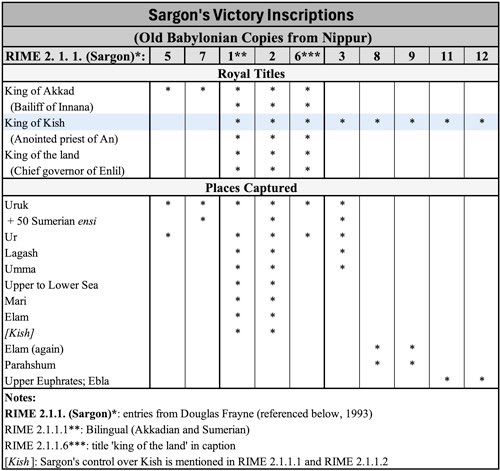
The titulary given to Sargon in these 11 inscriptions is summarised in the table above, in which the inscriptions are split into three groups, referred to in what follows as:
✴Group 1, in which he is king of Akkad (tout court);
✴Group 2, in which he is king of Akkad, king of Kish, king of the land
✴Group 3, in which he is king of Akkad (tout court)
I discuss these inscriptions in turn in the sections below.
Sargon, King of Akkad (Group 1)
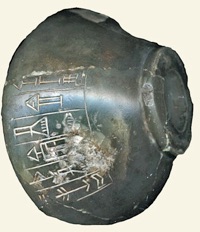
A fragmentary mace head from Ur carrying an inscription (RIME 2:1:1:4; CDLI, P217324)
now in the Penn Museum (CBS 14396): image from CDLI
Group 1 in the table above contains 2 copied inscriptions:
✴One (RIME 2.1.1.5), which is now in the Penn Museum (N 6266) reads:
“Sargon, king of Akkad, conqueror of Uruk ...”.
As discussed above, the inscription on the mace head illustrated above records that it was dedicated to a now-unknown deity by a now-unnamed king who is described as”.
“... the conqueror of Uruk and U[r]”.
In the table above (and following Douglas Frayne, referenced below, 1993, at p. 18), I have assumed that RIME 2.1.1.5 was a copy of RIME 2.1.1.4 and completed it in that basis.
✴The other (RIME 2.1.1.7 ), which, as noted above, was on the Sammeltafel CBS 13972 and is thus probably a copy of an inscription on a ‘victory’ monument at Nippur. The relevant lines (1-15)read:
“Sargon, [king of Akkad co[nquered the city] of Ur[uk and was victorious in battle]. [Further], he [personally captured [50 ensi and the [king (of Uruk).
Note that Frayne (at p. 21) completed the underlined italic text above from RIME 2.1.1.3 (see below) and, in the table above, I have completed it in that basis.
Although this body of evidence is less secure than one would wish, it is possible that, at the time of his conquest of Uruk, Sargon’s official title was simply ‘king of Akkad’.
One of the few things that we know for certain about Sargon’s early career is that he was closely associated with Akkad. As we have seen, according to the biographical note in the SKL (SKL 269-270), he was credited with having built Akkad. However, Akkad almost certainly existed before Sargon assumed its kingship because, as Walther Sallaberger and Ingo Schrakamp (referenced below, at p. 41) pointed out, an administrative document at Nippur was dated to:
“The year in which Enshakushana defeated Akkad.”
This must refer to King Enshakushana of Uruk, who is known from his own royal inscriptions (see below):
✴Walther Sallaberger and Ingo Schrakamp (referenced below, at p. 93) argued that:
“Before Sargon, Akkad was not known as a city, so this [year name] can be taken as the first indirect proof for the existence of Sargon as a contemporary of Enshakushana. Although this document does not bear a direct reference to king Sargon, prosopography demonstrates that Sargon must have ruled at Nippur not too many years later. This fact supports the impression that the reference to Akkad in the Enshakushana year date, in fact, points to a mighty ruler there, namely Sargon.”
✴However, as Piotr Steinkeller (referenced below, 2017, note 487, at p. 190) pointed out:
“Correctly, all that this [year name] proves is the existence of Akkad at the time of Enshakushana. While it does not exclude the possibility that Sargon ruled over Akkad [when Enashakushana defeated it], it in no way demonstrates it.”
Interestingly (as we shall see), nothing in the surviving inscriptions of Enshakushana allow us to either date his reign or locate his capital. However, there is no reason to doubt the relative chronology of the SKL, which lists Enshakushana of Uruk (SKL 186-7) before Lugalzagesi of Uruk (SKL 259-60), after whose reign the kingship was transferred to Sargon (SKL 266-71). In other words, we should probably assume that Enshakushana did indeed defeat Akkad and that Sargon subsequently rebuilt it as his capital (or perhaps as one of his capitals).
King of Kish (Group 3)
Group 3 in the table above contains 5 copied inscriptions:
✴The first of them appears in both CBS 13972 and Ni 3200 is thus probably a copy of an inscription on a ‘victory’ monument at Nippur. After noting that Ilaba was Sargon’s personal god, the text records that:
“Sargon, lugal kish, with nine contingents from Akkad, conquered the city of Uruk, was victorious in battle, captured 50 ensi and personally captured the king (presumably Lugalzagesi, king of Uruk)”, (RIME 2.1.1.3; CDLI, P461928, lines 3-20).
It also recorded that:
•on a subsequent occasion, ‘the two of them’ (presumably Sargon and Lugalzagesi) fought each other at Ur and Sargon was again victorious (lines 27-31); and
•Sargon was also victorious at (the now-unknown) Nagurzam; Umma; and Lagash.
This is the only known case in which Sargon used the title ‘lugal kish’ on an inscription that deals with Sargon’s victories in Sumer.
✴The next two inscriptions deal with Sargon’s campaign in the east against Elam and Parashum:
•RIME 2.1.1.8; CDLI, P461933, only on CBS 13972; and
•RIME 2.1.1.9; CDLI, P461935, on CBS 13972 and Ni 3200.
They both name Sargon, ‘lugal kish, conqueror of Elam and Parashum’ and identify various enemy leaders who were presumably depicted as captives on the original victory monuments.
✴The last two inscriptions deal with Sargon’s campaign in the area of the Upper Euphrates and against Ebla (in modern Syria) and are on both CBS 13972 and Ni 3200:
•RIME 2.1.1.11; CDLI, P461937, which is bilingual; and
•RIME 2.1.1.12; CDLI, P461938.
Although they seem to be duplicates, Douglas Fratyne *(referenced below, 1993, at p. 30) argued that they probably came from two separate originals, since one expect to find an original inscription copied twice on one Sammeltafel. In the form in which they have come down to us, they both:
•begin with the information that:
“Sargon, lugal kish, was victorious (in) 34 battles”; and
•record that Sargon:
“... bowed down to the god Dagan at Tuttul, ... [who] gave to him the Upper Land: Mari, Iarmuti, and Ebla as far as the Cedar Forest and the Silver Mountains.”
Frayne (as above) commented that:
“It is unclear why captions naming the defeated enemy leaders of Sargon's ... campaign [in Sumer] are listed at the end of [RIME 2.1.1.12].”
Taken together, these inscriptions indicate that, some time after Sargon’s defeat of Lugalzagesi, he dropped the titles ‘king of Akkad’ and ‘king of the land’, styling himself simply as ‘king of Kish’.
A substantial body of epigraphic evidence shows that Sargon’s sons, Rimush and Manishtushu (who succeeded him in turn) retained ‘king of Kish’ as the ‘official royal title. However as Nikita Artemov (referenced below, at p. 71) observed, when Naram-Sin succeeded his father, Manishtushu, he dropped this title and instead used the title ‘shar kibratim abra՚im’ (literally, king of the four quarters, apparently meaning ‘king of the world’). Indeed, as Artemov also pointed out (at p. 73):
“After Rimush and Manishtushu, the title ‘king of Kish’ disappears for more than 400 years from written records (at least from those available to us today): the next Mesopotamian ruler for whom it is attested is Ipiq-Adad II of Eshnunna, who ... turned the hitherto small city state into an important regional power ... [As surviving epigraphic evidence] shows, the logograms ‘lugal kish’ stand this time unequivocally for the Akkadian ‘shar kishshatim’ (literally ‘king of totality’, [apparently implying ‘king of the world’]).”
This brings us to the question of the meaning of the title ‘lugal kish’ at the time of Sargon, Rimush and Manishtushu. Piotr Steinkeller (referenced below, 2013, at p. 146) argued that:
“... [even] in the ED IIIb period, this title [had] served as a generic designation of a universal ruler, corresponding to the later title ‘shar kishshatim’ ...”
He added (at note 51):
“That the title meant ‘shar kishshatim’ already in Sargonic times is shown by the fact that, in the same inscriptions, :
✴lugal kish’ invariably lacks the indicator ‘ki’; whereas
✴the toponym ‘Kish’ is always written with it.”
Steinkeller’s ‘indicators’ are usually described as ‘determinatives’, which were:
✴attached to nouns to indicate that they belonged to a particular group (as in ki, which indicates that the noun in question is a place); and
✴were not pronounced in speech and therefore represented as superscripts in transliterations.
Thus, for example, in transliterations of RIME 2.1.1.2; CDLI, P461927, we read:
✴lugal akadeki (king of Akkad - lines 2-3);
✴lugal kish (king of Kish, not given the determinative ki and usually translated as ‘king of the world’ - line 6); and
✴kishki (the city of Kish - line 103).
Steinkeller argued that, although the use of determinatives was unusual in the in the ED I-II period, by the time of Sargon (and indeed from at least the ED III period), if this title had indicated nothing more than the kingship of Kish itself, it would have been written lugal kishki. He therefore concluded that, at least from the ED IIIb period, this title:
“... served as a generic designation of a universal ruler, corresponding to the later title ‘shar kishshatim’ (king of al’).”
However, Nikita Artemov (referenced below, at p. 72) argued that:
“The popular view that the Old Akkadian title ‘lugal kish’ either:
✴is to be read shar kishshatim; or
✴while being formally identical with the ED title shar kish, means shar kishshatim on the connotative plane [= by way of a pun];
is, in fact, neither provable nor plausible. The earliest attestations for kishshatum (totality) are Old Babylonian; the word occurs neither in Old Akkadian nor (what is more) in Old Assyrian sources. The main argument brought forward by Piotr Steinkeller [see above] in favour of the reading shar kishshatim for the Old Akkadian lugal Kish is .... [that], at the end of the ED period, the name of the city of Kish was always written kishki in Sumerian. However, the absence of the determinative was convincingly explained as a graphic archaism by William Hallo ([referenced below)] who pointed out that lugal kish in the Old Akkadian royal inscriptions reproduced not only the ED II/IIIa writing of the title lugal kish (without determinative) but also its sign forms; thus, [for example], the sign lugal used in the original inscriptions of Rimush;
✴resembles strikingly the sign form used in the royal inscriptions of Mesalim, [a well known king of Kish from the ED I-II period - see below]; and
✴differs from its more modern version(s) occurring ... in late ED royal inscriptions since the time of [Eanatum, ensi of Lagash, who received nam-lugal kishki (the kingship of the city of Kish) from Inanna]”, (RIME 1.9.3.5, col. vi, line 4).
In other words, Artemov argued that Sargon used the title lugal kish (without determinative) in order to present himself as a Kishite king of the stature of the ED I-II kings of Kish (such as Mesalim). I will return to this difference of view after the discussion below on the inscriptions in Group 2.
Sargon, King of Akkad, King of Kish, King of the Land (Group 2)
Group 2 in the table above contains 3 copied inscriptions:
✴RIME 2.1.1.1; CDLI, P461926, which is bilingual and appears in both CBS 13972 and Ni 3200;
✴RIME 2.1.1.2; CDLI, P461927, which appears in both CBS 13972 and Ni 3200; and
✴RIME 2.1.1.6; CDLI, P461931, which appears in both CBS 13972
They fall into two sub-groups:
✴the first two texts present very similar accounts of Sargon’s campaign in southern Mesopotamia, which culminated in his annexation of the lands over which Lugalzagesi had previously exercised hegemony, and both record that
“[He] captured Lugalzagesi, king of Uruk, in battle (and) led him off to the gate of the god Enlil in a neck stock”, (RIME 2.1.1.1, lines 23-31 and RIME 2.1.1.1, lines 25-34);
✴and the third:
• recorded that:
“Wh[en] the god Enlil rendered a verdict for (Sargon) and he conquer[ed] Uruk, he dedicated (the object carrying the original inscription) to Enlil and purified Nippur for (him)”, (lines 10-29); and
•reproduced a caption ‘Lugalzagesi, lord of Uruk and king of Ur’, which presumably accompanied an image of the captive king.
All three originals can therefore be dated to the period immediately following Sargon’s final defeat of Lugalzagesi, at which point, his ‘official title’ became:
“... king of Akkad, mashkim priest of lnanna, king of Kish, guda priest of An, lugal kalamma (king of the land) [and] ensi/ensi-gal (governor/mighty governor) of Enlil”, (see, for example, RIME 2.1.1.2; CDLI, P461927, lines 2-11).
This unusual titulary is clearly made up of alternating secular and religious titles. In what follows, I am primarily concerned with the secular title lugal kalamma (king of the land) , which (as far as we know) was only given to Sargon in these three inscriptions.
As Piotr Steinkeller (referenced below, 2017, note 337, at p. 126) observed:
“The use of ‘kalam’ as a term for southern [Mesopotamia] is documented first in late ED times, in the title lugal kalamma, which was borne by the Uruk rulers Enshakushana and Lugalzagesi.”
For this reason, I will begin by looking at the titulary of these two Sumerian kings.
Enshakushana
Douglas Frayne (referenced below, 2008) translated three of Enshakushana’s royal inscriptions:
✴an inscription that was carried by a number of stone bowls at Nippur records that they were dedicated at Nippur to ‘Enlil, king of all the lands (lugal kurkurra)’ recorded that:
“Enshakushana, lord of Sumer (en kiengi) and king of the land (lugal kalamma), ... [who] destroyed Kish and captured Enbi-Ishtar, the king of Kish. The man of Akshak and the man of Kish, when both cities had been destroyed .... [Enshakusana] dedicated [the spoils that he had taken from Akshak and Kish] ... to [the god] Enlil at Nippur”, (RIME 1:14:17:1; CDLI, P431228);
✴a related inscription, which was carried by three stone bowls dedicated to Enlil at Nippur recorded that:
“For the god Enlil, Enshakushana dedicated the property of Kish, which he had destroyed”, (RIME 1:14:17: 2; CDLI, P431229); and
✴ a foundation tablet in the Hermitage, St Petersburg, commemorates the building of a now-unknown temple by:
... Enshakushana, lord of Sumer (en kiengi) and king of the land (lugal kalamma), son of Elili ...”, (RIME 1:14:17: 3; CDLI, P431230).
Frayne also listed (at p. 429) Enshakashuna’s two surviving year names, both of which which were used on administrative documents fro Nippur:
✴“The year in which Enshakushana [variant: the man of Uruk] besieged Kish”; and
✴“The year in which Enshakushana defeated Akkad” (also mentioned above).
Thus we know that Enshakushana controlled Nippur for at least two years and that he was militarily active to the north of Nippur (at Akshak, Kish and Akkad). However, as noted above, while can reasonably accept the testimony of the SKL, which names him as a king of Uruk whose rule there pre-dated that of Lugalzagesi, we know nothing about the circumstances in which he became lord of Sumer (en kiengi) and king of the land (lugal kalamma).
Lugalzagesi
Our record of the career of Lugalzagesi begins with an inscription that commemorates his construction of a temple of Dumuzi at Umma, in which his title is:
“... ensi of Umma and lumah-priest of Nisaba, son of U-u, ensi of Umma, lumah-priest of Nisaba”, (RIME 1.12.7.1; CDLI, P431198, lines 3-8).
He is also named (as ensi of Umma) in a royal inscription of Urukagina (as lugal of Girsu), in which the latter complains that:
“The man of Umma, having sacked Lagash, has committed a sin against Ningirsu, [the city god of Lagash]. The hand that he has raised against [Ningirsu] will be cut off! [The sacrilege inflicted on Lagash] is not a sin of Urukagina, king of Girsu, [(his title after his expulsion from Lagash)]. May Nisaba, the god of Lugalzagesi, ensi of Umma, make them (the people of Umma) bear this sin on their necks”, (RIME 1.9.9.5; CDLI, P431158 col. vii, lines 11-12 - col. viii., lines 1-13).
The evidence of a large number of documents from the temple of Inanna of Zabala (near Umma) provide further information of this early phase of Lugalzagesi’s career: as Walther Sallaberger and Ingo Schrakamp (referenced below, at p. 37) observed, the year-dates of these documents (where known) fall into a time-span from 6th to the 8th year of the ensi, Lugalzagesi. As they also noted (at p. 86), these documents recorded land grants, and the known recipients included:
✴the ensi of Adab;
✴the ensi of Nippur; and
✴the lumah-priest of Uruk.
Gianni Marchesi (referenced below, 2015, at p. 148)argued that:
“At the time that these documents were drawn up, Lugalzagesi was probably still merely ... on the same level as his counterparts at Adab and Nippur. All three rulers were presumably under the hegemony of the ‘great king’ Enshakushana of Uruk.”
Interestingly, two administrative documents from Shuruppak (modern Fara) from the (earlier) ED IIIa (or Fara) period (WF 92; CDLI. P011049 and WF 94; CDLI, P011051) record that military contingents from Uruk, Adab, Nippur, Lagash, Shuruppak and Umma, which mustered at Shuruppak, came from came from kiengi. It is therefore possible the Enshakushana’s title ‘en kiengi’ reflected his hegemony over Adab, Nippur, Lagash, Shuruppak and Umma.
A later phase in Lugalzagesi’s career seems to be reflected in an administrative document from Adab, which is now in the Nies Babylonian Collection at Yale (NBC 5924, BIN 8. 26, CDLI P221549, reverse col. iii, lines 3-7), which is dated to the reigns of Meskigala, ensi of Adab and king Lugalzagesi: as Walther Sallaberger and Ingo Schrakamp (referenced below, at p. 88) pointed out, this is testimony to the fact that, at the time of this document, Meskigala recognised Lugalzagesi’s hegemony over Adab. If so, then Lugalzagesi was styled ‘king of Uruk’ by this time, and he might well have also have established hegemony of some or all of the cities that had previously recognised the hegemony of Enshakushana.
Everything we know about the last phase of Lugalzagesi’s career (before his defeat by Sargon) comes from the inscription that was carried by numerous stone bowls at Nippur: Douglas Frayne (referenced below, 2008, at pp. 433-4) listed 98 known fragments. The inscription that these bowls carried begins by recording that they were dedicated to ‘Enlil, king of all the lands (lugal kurkurra) by:
“... Lugalzagesi, king of Uruk, king of the lands (lugal kalamma), ishib priest of An, lumah priest of Nisaba, son of Bubu, the ensi of Umma, lumah priest of Nisaba ...”, (RIME 1:14:20:1; CDLI, P431232 lines 3-12).
It then defined the territory that Enlil had placed under the rule of Lugalzagesi:
“When Enlil, the king of all lands, gave to Lugalzagesi the kingship of the land (nam-luga kalamma), ... he:
✴made [the lands] ... submit to him, from east to west; [and]
✴made the roads passable for him from the Lower Sea, along the Tigris and the Euphrates, to the Upper Sea”, (RIME 1:14:20:1; CDLI, P431232, lines 36-59: see also the translation by Gàbor Zólyomi, referenced below).
Importantly, it then recorded that:
“When Enlil made [Lugalzagesi] a man without rival from east to west, ...
✴all altars in Sumer (bara bara kiengi); and
✴the rulers of all lands (ensi kurkurra) in the territory of Uruk;
determined for [Lugalzagesi] the divine gift of the greatest of exaltation”, (RIME 1:14:20:1; CDLI, P431232, lines 63-9), see also the translation by Jasmina Osterman (referenced below, at p. 54).
This last passage seems to support the view expressed by Aage Westenholz (referenced below), which was reproduced by Douglas Frayne (referenced below, 2008, at p. 8):
“The occasion for the dedication of such a large number of cups or vases is likely to have been the coronation in Nippur of L[ugalzagesi] as ‘king of the land’. Each cup could then represent one of the ensi who acknowledged his suzerainty (cf. Sargon’s remark about the 50 ensi allied with L[ugalzagesi]).”
The inscription then recorded that, as a consequence of this ‘divine gift’ that Enlil had given to Lugalzagesi:
✴“Uruk passed the days in joy, Ur raised his head high like a bull, [and] Larsa, Utu’s beloved city, made merry”; and
✴“Umma, Shara’s beloved city, lifted its great horns, ... the territory of Zabala cried out like a ewe reunited with (its) lamb [and] Kian raised its neck high”.
Tohru Maeda (referenced below, at pp. 12-3) observed that the order in which these six city-states are named is significant: they each belonged to one of two ‘so-existing circles’:
✴the ‘Uruk circle’ (Uruk, Ur and Larsa); and
✴the ‘Umma circle’ (Umma. Zabala and Kian).
He argued (at p. 13) that:
“We could easily imagine these two circles or spheres as forming a single power base of Lugalzagesi. However, I maintain that these two circles formed separate bases of Lugalzagesi's sovereign power.”
This might have been true in administrative terms: as Gianni Marchesi (referenced below, 2015, at p. 148) pointed out:
“... once [Lugalzagesi] ascended the throne of Uruk and became ‘king of the [land]’ ...., [he] entrusted the office of [ensi] of Umma to Mes’e (whom Sargon captured alongside Lugalzagesi (as evidenced, for example, by RIME 2.1.1.1; CDLI, P461926, ‘caption 2’, lines 119’-121’).
However, the fact that Lugalzagesi named himself (inter alia) as ‘ishib priest of An (the city god of Uruk), lumah priest of Nisaba (the city god of Umma) in his ‘official’ title arguably suggests that he directly ruled all six of these cities as ‘king of Uruk’.
Significance of the Title ‘King of the Land’ in the Pre-Sargonic Period
The key point for the present analysis is the significance of the title lugal kalamma (king of the land) in the decades before it was adopted by Sargon:
✴As we have seen, the stone bowls that Enshakushana dedicated at Nippur to ‘Enlil, king of all the lands (lugal kurkurra)’ after his defeat of Kish carried an inscription in which his title was ‘en kiengi and lugal kalamma’. I suggested that title ‘en kiengi’ reflected his hegemony over Adab, Nippur, Lagash, Shuruppak and Umma, which would presumably mean that lugal kalamma referred more generally to all of the territory over which he exercised (or claimed to exercise) hegemony.
✴We have also seen that the putative coronation of Lugalzagesi took place after:
“Enlil, the king of all lands, gave to Lugalzagesi the kingship of the land (nam-lugal-kalamma).”
I suggested above that Lugalzagesi directly ruled all of Uruk, Ur, Lara, Umma, Zabala and Kian as ‘king of Uruk’, which would again presumably mean that lugal kalamma referred more generally to all of the territory over which he exercised (or claimed to exercise) hegemony.
Nicholas Postgate (referenced below, at p. 171-2) argued that:
“... ‘kalam’, though never precisely defined, refers to the alluvial plain, and ‘kingship of the kalam’ implies domination of the whole south Mesopotamian world, thus encompassing both Ur in the south and Kish in the north. This [was the region that] lay in the gift of Enlil ...”
However, although we know that, before Enshakushana defeated Kish, it had its own king (Enbi-Ishtar, lugal kishki), we do not actually know whether either Enshakushana or Lugalzagesi ever:
✴exercised hegemony over Kish (although, as we shall see, Lugalzagesi seems to have been said to have done so in later Sumerian literary tradition); or
✴incorporated lugal kishki in his official titulary.
Significance of Sargon’s Title ‘King of the Land’
We can now return to the significance of this title in the context of Sargon’s Group 2 inscriptions:
“... king of Akkad, mashkim priest of lnanna, king of Kish, guda priest of An, lugal kalamma (king of the land) [and] ensi/ensi-gal (governor/mighty governor) of Enlil”, (see, for example, RIME 2.1.1.2; CDLI, P461927, lines 2-11).
As Tohru Maeda (referenced below, at p. 14) observed, in these inscriptions, Sargon’s religious and secular titles:
“... were arranged alternately, one after the other. There are no other royal inscriptions in the 3rd millennium BC using this arrangement except for the ‘Lugalzagesi inscription’”.
He is referring here to the ‘coronation’ inscription of Lugalzagesi discussed above, in which he is described as:
“... king of Uruk, king of the land, ishib priest of An, lumah-priest of Nisaba, son of U-u, ensi of Umma, lumah-priest of Nisaba”, (RIME 1.14.20.1; CDLI, P431232, lines 3-12).
Maeda argued (at p. 15) that:
“The inscriptions of Sargon and Lugalzagesi are the only ones which use this peculiar style consisting of secular and religious titles. Based on this observation, we can be certain that Sargon modelled this inscription on Lugalzagesi's.”
This hypothesis is supported by the facts that:
✴Sargon also took Lugalsagesi’s title of ensi/ensi-gal (governor/mighty governor) of Enlil (for Lugalzagesi, see RIME 1:14:20:1; CDLI, P431232 lines 15-6); and
✴(as we have seen), all three of the Group 2 inscriptions of Sargon in this group record his capture of Lugalzagesi.
Sargon’s ‘Victory’ Inscriptions: Conclusions
On the basis of the analysis above, we might reasonably assume that Sargon’s titulary evolved over time as follows:
✴immediately prior to his capture of Lugalzagesi and his purification of Nippur, he would presumably have used the title ‘king of Akkad’ (as in his Group 1 inscriptions);
✴immediately thereafter, having transformed his status by:
•capturing Kish and then Sumer;
•capturing Lugalzagesi and bringing him as ‘booty’ to Enlil at Nippur; and
•purifying Nippur;
he adopted the more imposing title ‘king of Akkad, king of Kish, king of the land’ (as in his Group 2 inscriptions, two of which include a passage that confirm that he controlled Kish at this time - see, for example RIME 2.1.1.2; CDLI, P461927,=, lines 100-8); and
✴as he achieved further military successes in the east (against Elam and Parashum) and in the upper Euphrates, he adopted the title ‘king of Kish’ (tout court), a titulary that was retained by both of his immediate successors.
As we have seen:
✴when the city of Kish is named in these inscriptions, it is given a determinative (kishki); but
✴when the title ‘king of Kish’ appears in one of them, it is written ‘lugal kish’.
We have also seen that there are at least two schools of thought as to the significance of this title: for example:
✴Piotr Steinkeller argued that, by the time of Sargon, the title ‘king of Kish’ had nothing to do with the actual city of Kish (kishki), but rather served as ‘a generic designation of a universal ruler’ (see, most recently, Piot Steinkeller, referenced below, 2017, at p. 121); while
✴Nikita Artemov (referenced below, at p. 71) found this implausible and argued instead that:
“...Sargon of Akkad adopted the title used by Mesalim and Enmeparagesi of Kish, [and, some 400 years later], the kings of Eshnunna and Shamshi-Adad I adopted the title used by Sargon, Rimush and Manishtusu, and Adad-nirari I adopted Shamshi-Adad I’s (and Sargon’s) title. Each time, the intention of the later king was not just to imitate his predecessors but to raise a claim to his ‘legacy’ as it was preserved and imagined in the collective memory. In most cases, the adoption of the ancient title followed an important military event: [in the case of Sargon, the important event in question was his victory over Lugalzagesi and the Akkadian occupation of Sumerian city-states.”
I will discuss the hypothesis of Nikita Artemov (with which I agree) in the following section. For the moment, I would just like to offer a more mundane point in its support: in my view, the secular title implied by the Group 2 inscriptions is ‘lugal Akkadki, lugal Kish [and] lugal Kalamma’, and ‘lugal Kish’ cannot mean ‘king of all/everywhere’ here because, if it had done, then the other two titles would have been otiose. In other words, it almost certainly reflected Sargon’s actual kingship of Kish (despite the lack of a determinative), and the same title in the Group 3 inscriptions presumably meant the same thing.
Sargon and the Title ‘King of Kish’
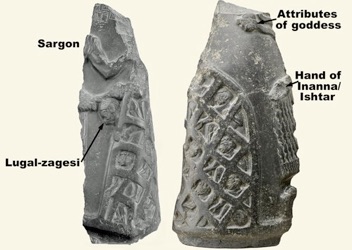
Fragment of a stele of a now-unnamed king (probably Sargon) from Susa:
now in the Musée du Louvre (Sb. 2): image from museum website
The fragmentary inscription (RIME 2.0.0.1002; CDLI, P461912) on the fragmentary stele illustrated above, which (like Sb. 1, discussed above) was found at Susa, might belong to the corpus of Sargon’s original inscriptions, albeit that he is not named in the surviving text, which was part of a curse:
“... (may the gods ...) and Ilaba (tear out) his foundations.”
As Lorenzo Nigro (referenced below, at p. 93) observed:
✴the inscription RIME 2.1.1.2; CDLI, P461927 records that, during his conquest of Uruk, Sargon captured 50 ensi with the ‘mace of Ilaba’ (see lines 16-18); and
✴the inscription RIME 2.1.1.3; CDLI, P461928 records (in the same military context) that Ilaba was Sargon’s personal god (see lines 1-2).
He argued (at pp. 85-7) that:
✴the stele originally had an elliptical base with the a single figure on each side and the net of prisoners between them (see p. 86 and Figure 2);
✴the now-fragmentary figure on the left above, who holds the net and wears a royal cloak (with the surviving part of the inscription on his shoulder - see p. 91) represented Sargon (see pp. 86-7);
✴the head protruding from the net that he is clubbing represents Lugalzagesi (see pp. 90-1); and
✴the now-fragmentary figure on the right is part of an enthroned goddess who can be identified by the mace protruding from her right shoulder as Ishtar - (see pp. 87-8),
This composition is shown more clearly in the sketch below (on the left).
The inclusion of Ilaba in this curse formula in interesting since, as Stefan Nowicki (referenced below, at p. 68) pointed out:
“... Ilaba was an unknown god in earlier times (at least in Mesopotamia) and his worship [there] was established by Sargon: ... the cult of Ilaba emerged no earlier than Sargon and it vanished immediately after the Akkadian dynasty had faded away,”
The first of the Group 3 texts begins with the information that Ilaba was Sargon’s personal god, and one of the surviving captions records a dedication:
“To the god Ilaba, mightiest of the gods : the god Enlil gave him (his) weapon(s)" (RIME 2.1.1.3; CDLI, P461928, lines 49-54).
Furthermore, in the second of his Group 2 texts, we read that:
“[Sargon] defeated Uruk and conquered 50 ensi with the mace of Ilaba ...(RIME 2.1.1.2; CDLI, P461927, lines 12-18).
Lorenzo Nigro (referenced below, at p. 93) suggested that, when Sargon captured Kish, Ilaba became identified with the city god of Kish, Zababa (which seems likely, since they were each venerated as a god of war).
The presence of Istar in the relief is similarly interesting; as Julia Asher-Greve and Joan Goodnick Westenholz (referenced below, at p. 68) observed:
“In the Old Akkadian period, Ishtar was the titulary goddess of Akkad, ... and her fortunes and characteristics were intimately linked with the political aspirations of the Sargonic rulers. Sargon and his successors actively encouraged the syncretism between Ishtar of Akkad and Inanna of Uruk in order to make the national Akkadian goddess acceptable to the Sumerians. It has been suggested that the notoriously warlike character of Ishtar was a specifically Akkadian trait. However, while it is true that Ishtar, as the city-goddess of Akkad (Ishtar-annunītum/ Ishtar the skirmisher) was indeed the ‘Mistress of Battle’, [while Inanna may initially have been a fertility goddess]. the qualities and functions of these two goddesses are essentially fused in the Old Akkadian period.”
In other words. Sargon arguably ‘argued’ in this iconography that both Zababa/Ilaba of Kish/Akkad and Inanna/Ishtar of Urur/ Akkad had transferred their patronage from Lugalzagesi to Sargon (like Enlil, who had received the captured Lugalzagesi as ‘booty’ and given Ilaba his mace).

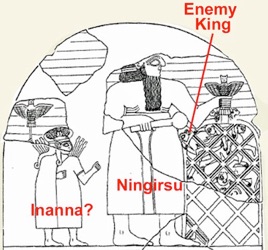
Left: sketch of the relief above, taken from Lorenzo Nigro (referenced below, Figure 1, at p. 86)
Right: sketch of a relief on the so-called ‘Stele of the Vultures’ of Eanatum, ensi of Lagash
Drawing by Elizabeth Simpson: taken from Irene Winter (referenced below, Figure 3, at p. 13)
Lorenzo Nigro (referenced below, at pp. 85-6) pointed out that the iconography of these reliefs on Sargon’s stele essentially the same as that of one of the reliefs on the so-called ‘Stele of the Vultures’ (see the sketch on the right above), which is relates to a victory of Eanatum, ensi of Lagash over his neighbour at Umma (see Sébastien Rey, referenced below, 2024, at pp. 243-58 for a recent detailed study of this stele):
in Eanatum’s relief, Ningirsu, the city-god of Lagash holds a net covering prisoners of war from Umma and uses a mace to club the protruding head of one of them (presumably the most senior); and
in Sargon’s relief, Sargon holds a net covering prisoners of war from Uruk and uses a mace (the mace of Ilaba?) to club the protruding head of Lugalzagesi; and
However, he is arguably described as the overlord of King Ur-Zababa of Kish in the so-called ‘Sumerian Sargon Legend’, which is known from two surviving fragmentary tablets (one from Uruk and the other from Nippur) that were published in 1983 by Jerrold Cooper and Wolfgang Heimpel (referenced below: see also the on-line translation by ETCSL). As these authors noted, this text survives in three segments (labelled as segments A-C in ETCSL):
✴‘segment A’ (on the obverse of the Uruk fragment) contains the beginning of the surviving text;
✴‘segment B’ (on the Nippur fragment) contains the central part of the legend; and
✴‘segment C’ (on the reverse of the Uruk fragment) contains all that we know about its ending.
In this account, Sargon, who is introduced as Ur-Zababa’s cup-bearer in segment B (at line 12), inadvertently becomes the subject of Ur-Zababa’s paranoid conviction that the gods have already chosen him (Sargon) as his successor. After an unsuccessful attempt to murder Sargon at Kish:
“King Ur-Zababa despatched Sargon, the creature of the gods, to Lugalzagesi in Uruk with a message written on clay, which was about murdering Sargon”, (B: 55-6).
Although, in the text (as it now survives), the relationship between Ur-Zababa and Lugalzagesi is not explicitly defined, the nature of the interactions between them arguably suggests that Ur-Zababa was Lugalzagesi’s vassal (see, for example, Nshan Kesecker, referenced below, at p. 87). It is worth reproducing Segment C here, in order to illustrate how little we know about the events that (allegedly) followed:
“With the wife of Lugalzagesi ... She (?) ... her femininity as a shield. Lugalzagesi would not (reply) the envoy, (and said):
‘Come now! Would he step within E-ana’s (walls)’.
Lugalzagesi did not understand, so he did not talk to the envoy. (But), as soon as he did talk to the envoy, the eyes of the prince’s son were opened. The lord (sighed) and sat in the dirt. Lugalzagesi replied to the envoy:
‘Envoy, Sargon does not yield.’
When he submits, Sargon ...”, (see Cooper and Heimpel, referenced below, at p. 77).
Cooper and Heimpel observed (at p. 68) that, in this segment:
“Lugalzagesi is questioning a messenger (presumably Ur-Zababa's from Kish) about Sargon's refusal to submit to Lugalzagesi:
✴If the composition ends with that column, there is scarcely room enough to give the messenger's response and then very summarily to relate events back in Kish and Sargon's triumph.
✴If, however, this tablet is only the first half of the composition, the second tablet would [presumably have recounted] the foretold death of Ur-Zababa, the succession of Sargon, and the battle in which Sargon finally defeated Lugalzagesi and established his hegemony over all of [Mesopotamia].”
However, this possible end to the legend is a matter of pure speculation: all we know for certain is that, in segment C:
✴Sargon refused to submit to someone (Lugalzagesi ? Ur-Zababa ?); and
✴whatever happened next, he survived the envoy’s visit to Lugalzagesi’s court.
For our purposes, the key question is whether this legend:
✴actually reflects the political situation in Kish and Uruk in the pre-Sargonic period; or
✴was an invention of the scholars at the Isin court.
Jerrold Cooper and Wolfgang Heimpel (referenced below, at p. 68) observed that the surviving text:
“... is full of grammatical and syntactic peculiarities that suggest a later Old Babylonian origin. ... But, this may just be a degenerate version of a text composed in the Ur III period; only the future discovery of more literary texts from that period and from other sites will enable us to know for certain.”
In other words, we cannot rule out the possibility that an earlier version of this tradition was available to Shulgi’s scribe, in which case it would presumably influenced the structure of the USKL (even it was not overtly referred to in its text).
However, in an Old Babylonian copy from Mari of part of the so-called ‘Legend of the Great Revolt against Naram-Sin’ (discussed and translated by Joan Goodnick Westenholz, referenced below, as entry 16a, at pp. 231-7), we read of a complaint allegedly made by Naram-Sin about the ingratitude of the Kishites when they joined this widespread rebellion against his hegemony:
“[After] my (grand)father Sargon conquered the city of Uruk, he established freedom for the Kishite (people): he had their slave marks shaved off and their shackles removed: he escorted Lugalzagesi, their despoiler, to Akkad. And (yet), ... they rebelled against me, [his grandson. ... They] assembled and raised Iphur-Kish, the man of Kish, son of Summirat-Ishtar (the lamentation priestess), to kingship”, (lines 5-9).
According to Piotr Steinkeller (referenced below, 2017, at p. 171, citing Claus Wilcke, referenced below, note at p 30 on lines ix 32 - x14), although this text belongs to an Old Babylonian version of the legend:
“... the passage [therein] describing how Sargon ... wrested Kish from Lugalzagesi’s control was part of the Old Akkadian original.”
Thus, this passage might well have been composed during or shortly after the reign of Naram-Sin, certainly suggests that Sargon’s ‘liberation’ (aka his conquest) of Kish took place immediately after his victory over Lugalzagesi.
As it happens, we know from a royal inscription of Naram-Sin (Sargon’s grandson) that Sargon had ‘liberated’ Kish from the hegemony of Lugalzagesi:
Naram-Sin (Sargon’s grandson), in his inscriptions recording his suppression of the ‘Great Rebellion’ (see below), routinely referred to the fact that the rebel cities had elevated their respective leaders to the kingship at the start of their respective rebellions (see, for example, RIME 2: 1: 4: 6; CDLI, P461982, lines 11’-13’ for the case of Iphur-Kish, the rebel king of Kish).
References
Postgate J. N., “City of Culture 2600 BC: Early Mesopotamian History and Archaeology at Abu Salabikh”, (2024) Oxford
Rey S., “The Temple of Ningirsu: the Culture of the Sacred in Mesopotamia”, (2024) University Park, PA
Artemov N. “LUGAL KIŠ and Related Matters: How Ideological are Royal Titles?”, in:
Portuese L. and Pallavidini M, (editors), “Ancient Near Eastern Weltanschauungen in Contact and in Contrast: Rethinking Ideology and Propaganda in the Ancient Near East”, (2022) Münster, at pp. 67-86
Osterman J., “From ki-en-gi to Šumerum: How Sumer was Created ?”, Radovi HSP, 54:3 (2022) at pp. 39-72
Steinkeller P., ‘The Sargonic and Ur III Empires’, in:
Bang P. F. et al. (editors), “The Oxford World History of Empire (Volume 2): The History of Empires”, (2021) New York, at pp. 43-72
Kesecker N. T., “Lugalzagesi: the First Emperor of Mesopotamia?”, Armenian Journal of Near Eastern Studies, 12:1 (2018) 76-95
Steinkeller P., “History, Texts and Art in Early Babylonia: Three Essays”, (2017) Boston and Berlin
Nowicki S., “Sargon of Akkad and his God: Comments on the Worship of the God of the Father among the Ancient Semites”, Acta Orientalia Academiae Scientiarum Hungaricae, 69:1 (2016) 63-82
Sallaberger W. and Schrakamp I., “Part I: Philological Data for a Historical Chronology of Mesopotamia in the 3rd Millennium”, in:
Sallaberger W. and Schrakamp I. (editors), “Associated Regional Chronologies for the Ancient Near East and the Eastern Mediterranean. History and Philology: Vol. 3”, (2015) Turnhout, at pp. 1-130
Asher-Greve J. M. and Goodnick Westenholz J., “Goddesses in Context: On Divine Powers, Roles, Relationships and Gender in Mesopotamian Textual and Visual Sources”, (2013) Fribourg and Göttingen
Steinkeller P., “An Archaic “Prisoner Plaque” from Kiš”, Revue d'Assyriologie et d'Archéologie Orientale, 107 (2013) 131-57
Zólyomi G., “The Vase Inscription of Lugal‐zagesi and the History of his Reign”, Notes for a seminar held at the Institute for Advanced Studies, Budapest (2013)
Seri A., “Adaptation of Cuneiform to Write Akkadian”, in:
Woods C. (editor), “Visible Language: Inventions of Writing in the Ancient Middle East and Beyond”, (2010) Chicago IL, at pp. 85-98
Frayne D. R., “The Royal Inscriptions of Mesopotamia, Vol. 1: Presargonic Period (2700-2350 BC)”, (2008) Toronto
Maeda T., “Royal Inscriptions of Lugalzagesi and Sargon” , Orient, 40 (2005) 3-30
Kawakami N., “The Northwestern Territorial Extent of Sargon's Empire of Akkad”, (2004) thesis of the University of Liverpool
Steinkeller P., “An Ur III Manuscript of the Sumerian King List”, in:
Sallaberger W. et al. (editors), “Literatur, Politik und Recht in Mesopotamien: Festschrift fur Claus Wilcke”, (2003) Wiesbaden, at pp. 267-92
Nigro L., “The Two Steles of Sargon: Iconology and Visual Propaganda at the Beginning of Royal Akkadian Relief", Iraq, (1998) 85-102
Goodnick Westenholz J., “Legends of the Kings of Akkad”, (1997) Winona Lake, IN
Wilcke C., “Amar-girids Revolte gegen Narām-Suʾen", Zeitschrift für Assyriologie und Vorderasiatische Archäologie”, 87:1 (1997) 11-32
Frayne D. R., “Sargonic and Gutian Periods (2334–2113 BC): The Royal Inscriptions of Mesopotamia. Early Periods (Volume 2)”, (1993) Toronto, Buffalo and London
Westenholz, A., “Lugalzagesi”, Reallexikon der Assyriologie und Vorderasiatischen Archäologie, 7 (1987-1990) 155-7
Winter I, J., “After the Battle Is Over: The ‘Stele of the Vultures’ and the Beginning of Historical Narrative in the Art of the Ancient Near East”, Studies in the History of Art, 16 (1985) 11-32
Cooper J. S. and Heimpel W., “The Sumerian Sargon Legend”, Journal of the American Oriental Society, 103:1 (1983) 67-82
Hallo W. W., “Early Mesopotamian Royal Titles.: A Philologic and Historical Analysis”, American Oriental Series 43, (1957), New Haven CT