Empires of Mesopotamia:
First Dynasty of Ur
Royal Seals and Sealings in the Royal Cemetery of Ur


Empires of Mesopotamia:
First Dynasty of Ur
Royal Seals and Sealings in the Royal Cemetery of Ur
King Meskalamdu (PG 1054a)
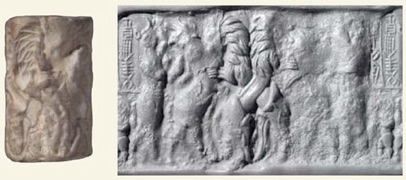
Seal of King Meskalamdu (U. 11751), with an inscription (RIME 1.13.3.1, CDLI, P247679)
From the chamber of Burial C of the mausoleum PG 1054a: now in the British Museum (exhibit BM 122536)
Image from Julian Reade (referenced below, 2003, figure 55a, at p. 103)
The seal (U. 11751) illustrated above is of particular importance because it carries an inscription (RIME 1. 13.3.1, CDLI, P247679) identifying its owner as:
‘Mes-kalam-du10 lugal’, (Meskalamdu, the king).
According to the British Museum, it is made from orange brown limestone or shell, with dark blue lapis lazuli core. The face of the seal is very degraded:
✴according to Léon Legrain (in Leonard Woolley, referenced below, 1934a, entry 55, at p. 340), the impression that it made depicts:
“Two crossed lions [attacking] two bulls. Enkidu and ‘a nude hunter in profile’ take part in the fight. Both are probably armed with daggers. There is a small nude hunter, full face with wild locks, below the cartouche [at the edges in the impression as illustrated above].”
✴according to the British Museum, the impression depicts:
“... a contest scene: bull man’ bull; crossed lions; bull-man?, and hero?. Terminal: inscription over hero.
Given the find spot (and in the absence of evidence to the contrary), it seems likely that this King Meskalamdu was the king of Ur.
We should now address the find spot of this seal:
✴it was discovered inside the ‘footprint’ of what had been a wooden box in the chamber of Burial C of the mausoleum PG 1054a; and
✴it was flanked by a pair of golden daggers (see Leonard Woolley (referenced below, 1934b, Plate 157) that lay ‘side by side’.
Unfortunately, neither of these daggers is inscribed, although we might reasonably assumed that the seal had been placed between them in the box in order to indicate that they had belonged to King Meskalamdu. However, is seems clear that the chamber in which the seal and the daggers were found was not the king’s tomb. I therefore argue in my page on the élite burials in the cemetery that PG 1054a is unlikely to have been their original location.
A’Anzu (PG 1236)
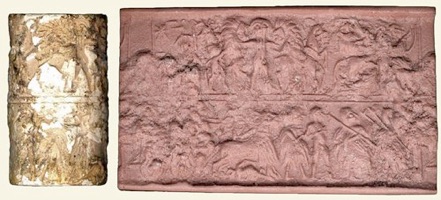
Seal of A’Anzu (U. 12461), from PG 1236: inscription (RIME 1.13.1.1. CDLI, P418046)
Now in the British Museum (exhibit BM 122538); image from the museum website
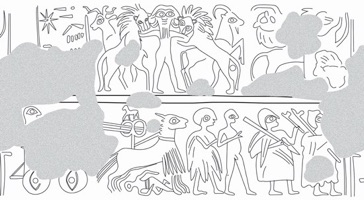
Sketch by D. Collon of the seal impression above, from Juliane Reade (referenced below, 2001, Figure 3, at p. 19)
This seal was discovered in PG 1236, which was one of only two rectangular, four-chambered graves found in the cemetery (the other one being PG 779): each of these structures (which were also physically close to each other) incorporated:
✴a long entrance chamber (A), running along the entire width of the burial;
✴two smaller, square chambers (B and C) side by side in the middle; and
✴another long chamber (D) at the end, which was probably the primary burial chamber.
Leonard Woolley (referenced below, 1934a, at p. 113) recorded that this seal was discovered in Chamber A of the grave, although this might have been an error: later in this volume, both Eric Burrows (at p. 316) and Léon Legrain (in entry 54, at p, 340) recorded the find spot as Chamber D. Fortunately, the precise find spot is not particularly important since the grave had been thoroughly looted, and many of the remaining objects in it had probably been moved from their original locations.
As the parting shot in his account of this grave, Leonard Woolley (as above) observed that this seal:
“... is a very unusual [one], with a scene of soldiers and a chariot [in the lower register]. ... It bears the inscription [A’Anzu], which may be the name of a king.”
Gianni Marchesi (referenced below, 2004, at p. 182) similarly remarked on this:
“... very unusual design in two registers:
✴[in the upper register], there are:
•a contest scene (a nude hero between two rampant lions); and
• a whirligig of lions. which resembles the whirligig of dagger-armed men that is found on the cylinder seal of King Mesanepada [see below]; and
✴in the lower register, a man is trampling an enemy with his [chariot] while some foot soldiers escort a naked prisoner, [in a scene that] immediately reminds us of the so-called ‘war side’ of the [Standard of Ur , which was found in PG 799, the other four-chambered grave in the cemetery].”
Marchesi also noted (at pp. 182-3) that the images in these seal reliefs are redolent of images associated with at least two other broadly contemporary kings:
✴the reliefs on what were then two recently-discovered seal impressions of King Ishqui-Mari from Mari (RIME 1.10. 17.2, CDLI, P418042 and RIME 1.10. 17.3, CDLI, P431184): see also Davide Nadali, referenced below, Figures 1 and 2, at pp, 195-6 and D); and Dominique Beyer (referenced below, at paragraphs 83-99).
✴those on the ‘Stele of the Vultures’ of King Eanatum of Lagash.
In other words, there is a body of iconographic evidence to support Woolley’s contention (see above) that ‘A.Anzu’:
“... may be the name of a king.
To take this further, we should first look at the inscription on the seal, which contains only a personal name: ‘a-(an)anzu2{muszen}’ (A’Anzu, followed by the ideogram ‘MUSHEN’, which indicates that Anzu is the name of a bird). Interestingly, this was almost certainly the name given to a lion-headed eagle that was depicted on Eanatum’s ‘Stele of the Vultures’ as the emblem of Ningirsu, the patron god of Lagash/Girsu. Gianni Marchesi (referenced below, 2004, note 73, at p. 183) translated it as:
“The father is (as mighty as) the thunderbird [=Anzu/ Indugud].”
Furthermore, a man called Enna-il, who was probably a king of Kish, described himself as the son of A-Anzu (see RIME 1.8.1=3.1; CDLI, P462184) and, while there is no reason to think that this A-Anzu and the owner of the seal from PG 1236 were one and the same person, this coincidence does suggest that A-Anzu could be a royal name (or nickname ?).
In fact, Gianni Marchesi (referenced below, 2004, at p. 183 ) argued against the identification of A’Anzu as a king of Ur: although he acknowledged that the iconography of the relief pointed to a royal owner, he pointed out that the lower part of the original inscription is lost, which:
“... means that the name [A’Anzu in this inscription] was likely followed by a title, written in the second case of the inscription, and that the title in question could not be lugal (king).”
As he explained (in note 172):
“LUGAL is a very long sign; if [it had been] there, its initial part would still be visible in the preserved upper part of the second case of the inscription.”
He therefore concluded that:
“No doubt the possessor of this seal had been a high-ranking personage, but he was probably neither a sovereign nor the principal occupant of PG 1236.”
I have to say that, even if A’Anzu was not a king at the time that he used this seal, he was surely the son of a king and, furthermore, of a king who could be credibly described as being as mighty as Anzu.
Unidentified Royal Lady (PG 1054b)
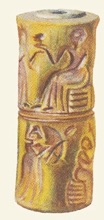
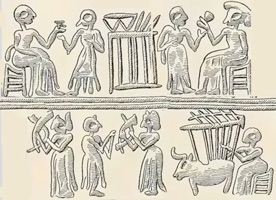
Left: ‘Gold’ seal (U. 11904) from the burial chamber of PG 1054b, location now unknown (?)
Image from Leonard Woolley (referenced below, 1934b, Plate 142)
Right: Sketch of seal impression: image from Leonard Woolley (referenced below, 1934a, Figure 23, at p. 127)
Leonard Woolley (referenced below, 1934a, at p. 106) also discovered the burial chamber PG 1054b in tact, together with the bodies of five people, one of whom was female. Her body lay at the centre of the chamber, and she had been relatively well dressed and bejewelled. In particular, he recorded that:
“[On] her breast (although it had probably slipped from her shoulder) was a gold pin with carnelian head, ... the only gold pin of this type found in the cemetery [and], almost touching the head of the pin (to which it may well have been attached by a string, as was sometimes the case with seals) was another unique object: a cylinder seal of gold (U. 11904).”
This seal is illustrated above. According to Julian Reade (referenced below, 2001, at p. 21), it is only 4 cm high and is made of gold foils with ‘shell’ caps over a core of some other material (which other authors assume to be bitumen). The impression that it makes depicts a banqueting scene in two registers:
✴in the upper register, a man and a woman, each of whom is seated, cup in hand, and attended by a servant, close to a table laden with two jars (presumably of beer) and three loaves; and
✴in the lower register, the banqueters are entertained by a musical quartet made up of:
•two female cymbalists flanking a female singer who seems to be clapping her hands; and
•a seated man who is playing a bull-shaped lyre.
Although Leonard Woolley was relatively cautious about the likely importance of this lady, in a later book (referenced below, 1954, at p. 76) he commented on:
✴her golden headdress, which suggested that she was ‘one of high rank’;
✴the long curved golden pin that fastened her cloak, ‘such as we had not seen before’;
✴the fluted and engraved tumbler of gold that was still in her hands; and
✴this golden cylinder seal, ‘the first we have ever found’.
On the basis of this evidence, he concluded that:
“... this clearly was a queen.”
Queen Pu-abum (PG 800b)
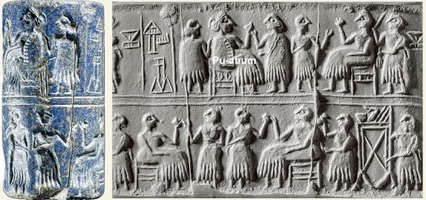
Seal of Queen Pu-abum (excavation number U. 10939), from PG 800b: inscription (RIME 1.13.3.3: CDLI, P247683)
Now in the British Museum (exhibit BM 121544); image from the website of the Morgan Library & Museum
Leonard Woolley discovered the burial chamber PG 800b in tact, albeit that its roof had collapsed. Importantly, the body of its main occupant, which was laid out on a wooden bier, was reasonably well-preserved: according to Sir Arthur Keith (in Leonard Woolley, referenced below, 1934a, at p. 400), it was the body of a female who had been about 40 years old at the time of her death. Leonard Woolley (referenced below, 1934a, at p. 84) observed that she was dressed magnificently, adding (at p. 88) that:
“Against [her] right upper arm ... were found three gold pins ... [that] probably secured [her] cloak ... With the pins were [a number of precious objects, including] three lapis lazuli cylinder seals, ... [one of which bears the name of [Pu-abum]. The cylinders were perhaps tied to the pins to make toggles for securing the cloak.”
The inscription in question (RIME 1.13.3.3: CDLI, P247683), which is in the upper register of the seal illustrated above, reads:
“Pu-abum, the queen”
It is therefore generally accepted the main occupant of the burial chamber PG 800 B was the otherwise unknown Queen Pu-abum.
According to Léon Legrain (in Leonard Woolley, 1934a, entry 16, at p. 337):
“In the upper [register, a female figure whom he identified as] the queen, attended by two female servants, raises a fluted gold tumbler, which the servant has filled from a silver jug. She sits on an elegant throne reinforced by straight rungs. Her male partner, cup in hand, seated on a similar throne between two servants, ... may perhaps be the king-priest. In the second register a remarkable sideboard is loaded with flat pieces of bread, a leg of Iamb and a jar of wine. It is reinforced by cross-pieces, and rests on four bull's legs ... One servant attends to the sideboard and three to the two male guests, who are seated, cup in hand.”
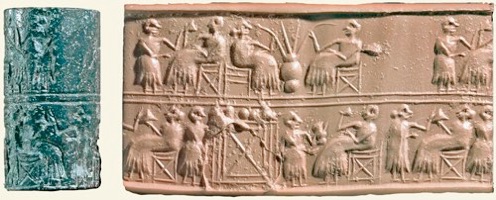
Seal of Queen Pu-abum (excavation number U. 10871), from PG 800b:
Now in the British Museum (exhibit BM 121545); image from the museum website
According to Léon Legrain (in Leonard Woolley, 1934a, entry 17, at p. 337), in the upper register of this second seal:
“... the queen and her partner are drinking through curved pipes ]straws ?] from a jar placed on a stand between them, ... [and] a guest is seated, cup in hand, attended by one servant. Below, queen and king [sic], cup in hand, are seated on either side of the cane board loaded with wine, bread, and meat. One servant attends to the board, one brings a spouted jar to the king [sic]. ”
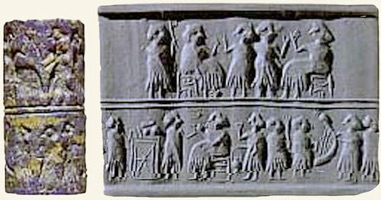
C: Seal of Queen Pu-abum (excavation number U. 10872), from PG 800b:
Now in the Penn Museum (exhibit B16728); image from the museum website
According to Léon Legrain (in Leonard Woolley, 1934a, entry 18, at p. 337), in the upper register of this third seal:
“The queen and [other ladies] are depicted] at a banquet of wine with music. [In the upper register], the queen and [a lady] are seated, cup in hand, on elegant thrones. Three maids attend to them. ... Below, the queen [or another lady] sits alone by a board loaded with food and drink. She has called for her maids, her harp-player, and her two singers. ... The player stands to play on a small semicircular harp with four strings and a round knob ... [while] the singers clap their hands in cadence.”
Abarge (PG 800a)
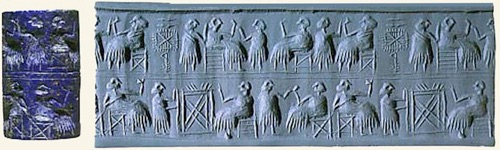
Seal of Abarge (U. 10448a), now in the Penn Museum (B16727): inscription (CDLI: P270168)
Image from the museum website
This inscribed lapis lazuli, which was found in loose soil on the floor of the death pit near the object above (at location 36), carries an inscription (CDLI: P270168) that records a personal name:
‘a-bar-gi’ (Abarge)
According to Léon Legrain (in Leonard Woolley, referenced below, 1934a, entry 19, at p. 337), the relief it carries depicts:
“... a banqueting scene in two registers:
✴Above, the [presumed hostess], attended by [two] maids, is facing a couple of guests (a man and a woman, with the latter attended by a maid]. All raise a cup, but their different seats may mark a difference in rank.
✴[Below], the scene is repeated ... [but] the three drinkers sit on either side of a board loaded with food.”
Holly Pittman (referenced below, catalogue entry 18, at pp. 78-9) observed that this scene differs from that on the inscribed seal of Queen Pu-abum (see above) in two respects:
✴both men and women take part in the banquet; and
✴no musical performance is depicted.
She also noted that we cannot be certain whether the the name Abarge is that of a man or a woman. It seems to me that the seal must have belonged to the lady who hosts the banquet, and that she was presumably called Abarge. Furthermore, as I argue in my page on èlite burials, it is tempting to see her as the lady who owned the nearby silver box, and that both were originally in the burial chamber of PG 789.
Queen Ashusikilam (PG 1050c)
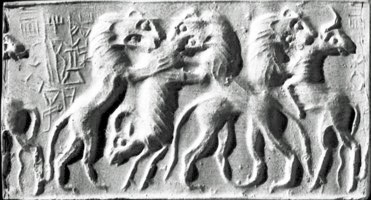
Seal of Queen Ashusikilam (U. 11825) from PG 1050: inscription (RIME 1.13.4.1; CDLI, P247682)
Now in the Penn Museum (CBS 17720): image from Leonard Woolley (referenced below, 1934b, Plate 198, no. 65)
The lapis lazuli seal (U. 11825) that made the modern impression illustrated above, which is now in the Penn Museum (CBS 17720), carries the following inscription (RIME 1.13.4.1; CDLI, P247682):
‘Akalamdu, king of Ur: Ashusikilam (is) his wife’
Although some scholars have assumed that this was the seal of King Akalamdu, Gianni Marchesi (referenced below, 2004, at p. 180) argued that:
“More probably, ... [it] simply bears a label inscription formulated in a ceremonial style, [with] the more important person ... written first). ...The owner of the seal was, of course, the last-named individual [i.e,, Ashusikilam, Akalamdu’s wife and presumably his queen]”.
It is usually assumed that:
✴the otherwise-unknown ‘Akalamdu, king of Ur’ was the older son and successor of King Meskalamdu (see, for example: Douglas Frayne, referenced below, at p. 389; and Gianni Marchesi, referenced below, 2015, at p. 144}; and
✴the seal under discussion here was that of his wife (see, for example: Douglas Frayne, referenced below, at p. 389; and Gianni Marchesi, referenced below, 2004, at p. 80).
According to Léon Legrain (in Leonard Woolley, referenced below, 1934a, entry 65, at p. 341), the image created by the seal depicts:
“Three crossed lions of royal style [attacking] an upturned ibex [on the left] and a bull.”
Thus, it seems that Queen Ashusikilam, instead off using the ‘usual’ banqueting scene on her seal, opted for a variant used by her putative father-in-law.
Uninscribed Seal (PG 1054a)
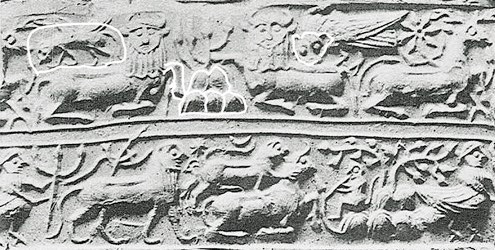
Impression produced by a seal (U. 11734) from the coffin in the chamber of Burial C in PG 1054a)
Was in the Iraq Museum: image from Leonard Woolley (Referenced below, 1934b, Plate 192), my additions in white
According to Leonard Woolley (referenced below, 1934a, at p. 100), the lapis lazuli seal that made the impression above was found:
“... [at] the waist [of the body in the wooden coffin in the chamber containing Burial C], where it must have hung from a belt ...”
According to Léon Legrain (in Leonard Woolley (referenced below, 1934a, entry 12, at p. 336):
✴in the upper register of the seal impression:
•two bisons [= man-headed bearded bulls] crouch on either side of a mound of stones, while:
•the one on the left is attacked by a winged lion;
•the one on the right is attacked by a lion-headed eagle; and
•at the extreme right, a stag crouches on the hills ‘among high grass and star-flowers’; and
✴in the lower register:
•a bull crouches at the centre crouches in front of a goat who faces away from a tree growing out of a mound of stones,
•the bull is attacked from behind by ‘a lion standing over him ... [and] a human-headed lion, strangely bearded’; and
•to the right, a ‘bird-man carries a branch, probably broken from the sacred tree’.
Seals from the Death Pit PG 1237
Body 61
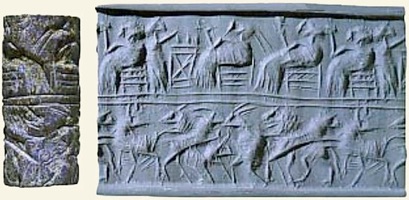
Lapis lazuli seal (U. 12380) of ‘Body 61’ in PG 1237, now in the Penn Museum (object 30-12-3);
image from the museum website
Leonard Woolley (referenced below, 1934a0 at p. 113) observed that:
“The name ‘The Great Death Pit' was given to PG 1237 for the very good reason that it consisted of a death pit and little else.”
He presumably assigned adjective ‘great’ to it because it contained the remains of 74 human bodies: six near the northeastern wall, which he assumed were male; and another 68 which he assumed (on the basis of the personal possessions found throughout this area) were those of women who lay close to each other across the rest of the pit.
Woolley listed the surviving possessions of each of these corpses at pp. 116-20. The important point in the present context is that one lady (number 61) stands out from the rest by virtue of the number and value of her possessions (listed at p. 120):
“Gold hair-ribbon, gold leaf pendant wreath, wreath of gold triple willow-leaves, wreath of gold rings set with lapis disks silver comb with inlaid flowers, gold ear-rings, two gold hair-rings, three gold flower rosettes on silver stems, 'dog-collar' of gold and lapis, necklace of gold and lapis tubular beads and carnelian rings, necklace of large gold and lapis fluted balls and carnelian rings, necklace of gold and carnelian and gold double conoids and carnelian rings, necklace of gold balls, lapis double conoids, and carnelian rings, six gold finger rings, bracelet of gold and lapis diamonds and carnelian rings, bead cuff, gold pin ... with lapis ball head, silver pin ... with lapis head, lapis cylinder seal (U. 12380) [and] silver tumbler.”
According to Léon Legrain (in Leonard Woolley, 1934a, entry 39, at p. 339):
✴in the upper register:
“... three women are seated, cup in hand [and] a maid stands by a board loaded with more cups”; and
✴in the lower register:
“... two crossed lions attack a herd of antelopes (goats ?) and put them to flight, [as is suggested by the fact that] they are jumping, kneeling and running with[their heads] turned”.
As Holly Pittman (referenced below, at p. 83) observed:
“The combination of banquet and combat scenes is unusual but not unique on cylinder seals and other artefacts, [albeit that the ] significance of the association is unknown.”
Interestingly, as Richard Zettler (referenced below, 2020, at pp. 27-8): observed, some of the possessions of ‘Body 61’ (including, notably, her three-tiered headdress) are similar to those of Pu-abum; and reasonably argued the death pit PG 1237:
“... may, in fact, be an intact royal burial of a type that Woolley did not originally recognise, in which the principle (royal) figure and his/her attendants were buried together in an open pit. Body 61, ... [which was found ] near the two ... [famous goat statues] may be [the corpse of] the principle royal burial.”
Body 60
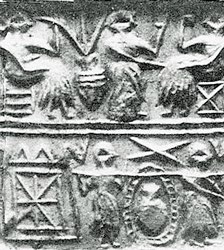
Impression made by the seal (U. 12387 ), found with Body 60: now in the Iraq Museum (IM 7270)
Image from Leonard Woolley (referenced below, 1934b, Plate 194 (23)
Leonard Woolley (referenced below, at p. 119) this seal was found with body 60. More specifically, he described the objects found by this body as follows:
“Gold ear-rings’ necklace of four rows of silver and lapis double conoid beads; silver pin ... with lapis head; lapis cylinder seal (U. 12387). [One] of the flowers broken off from [the statuette [U. 12357B - see above] lay one under the head and [another lay] by the hand of this [body].”
The relief that is carried by the seal is in two registers. According to Léon Legrain (in Leonard Woolley, 1934a, entry 23, at p. 338):
✴in the upper register, a man (on the left) and a woman (on the right) are seated on each side of wine jar, with the latter attended by one servant: the jar contains three pipes; the woman drinks from one of them; and the man raises a cup.; and
✴in the lower register, a richly loaded sideboard stands to the left, behind two servants who carry an apparently heavy jar in a net that swings from a pole across their shoulders.
Body 7
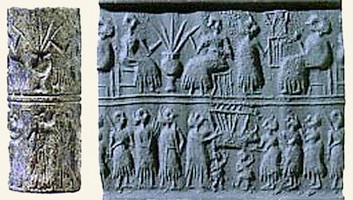
Seal (U. 12374) found under ‘Body 7’: now in the Penn Museum (30-12-2): image from the museum website
According to Leonard Woolley (referenced below, 1934a, at p. 116), this seal was found with body 7, which was one of the 6 female bodies that lay close the the lyres: more specifically, he listed the objects found with this body as:
“Gold ear-rings; 2 gold wire hair-rings; gold pins ... ; 3 gold finger-rings; a 'dog-collar' of gold and lapis; a gold and lapis double conoid bead necklace; [and a] lapis cylinder seal (U, 12374).”
The relief that is carried by the seal is in two registers. According to Léon Legrain (in Leonard Woolley, 1934a, entry 22, at p. 338), the upper register depicts three people at a banquet. More specifically, he:
✴described the two figures on the left as:
“Two men drinking] through pipes from a jar [that is] set on a stand and [contains] three extra pipes ...”; and.
✴assumed that the two figures to the right represented the hostess at the banquet (the figure at the extreme right, who holds a cup) and her maid.
He also identified an inscription between these last two figures which he transliterated as dumu-kisal. However:
✴Holly Pittman (referenced below, at p. 79) observed that it is curious that this putative inscription was placed between these two figures, where it interrupts the visual ‘narrative’; and
✴Eric Burrows (in Leonard Woolley, 1934a, note 4, at p. 316) argued that it is possible that the putative cuneiform here actually depicts two pots on a table that is held by the maid.
According to Holly Pittman (referenced below, catalogue entry 19, at pp. 79), the lower register contains an elaborate scene of dancing, singing and musical performance featuring (from the left):
✴a man carrying a staff over his shoulder;
✴2 women clapping cymbals;
✴a woman playing a lyre with a sound box in the form of a bull;
✴two diminutive figure dancing below the lyre; and
✴3 more women with cymbals who approach the lyre from the right.
Léon Legrain (as above) gave a slightly different description of the way in which the lyre is depicted: he
✴described the sound box as representing a standing bull; and
✴suggested that the two diminutive figures beneath it actually carried it (one holding its rear legs and the other its fore legs).
This would mean that it was meant to be played by a seated person, as was the case for the bull lyre depicted in the lower register of golden seal (U. 11904) from the burial chamber of PG 1054b (see above).
Seal from PG 789
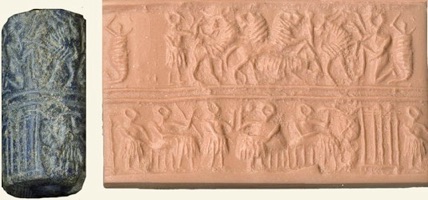
Seal of Body 30 (U. 10822b), now in the British Museum (BM 121546); image from the museum website
According to Leonard Woolley (referenced below, 1934a, at p. 66), this lapis lazuli seal was found in the death pit with Body 30, in front of the door that led to the burial chamber. The relief in the impression is in two registers: according to Léon Legrain (in Leonard Woolley, 1934a, entry 36, at p. 340):
✴the upper register contains a hunting scene in which two crossed lions attack three hairy goats (one of which has fallen to the ground) as two hunters try to catch the goats:
•one hunter (who wears a scalloped skirt ) stands on the left; and
•the other (who is nude) kneels in front of the scorpion on the right; and
✴the upper register depicts a symposium in which two seated figures,attended by two servants, raise a cup while a third drinks through a pipe from a jar in front of a sideboard with two small jars on it.
Given the position of Body 30, we cannot discount the possibility that this seal was left here by the looters of the burial chamber.
King Mesanepada
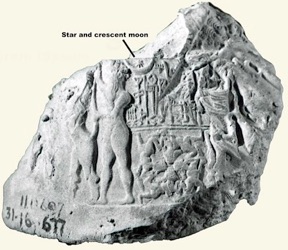
Seal of Mesanepada (U, 13607). inscription RIME 1.13.5.2; CDLI, P431204, from SIS 1
Now in the Penn Museum (Sealing 31-16-677), image from museum website
Reconstruction of the relief, from Léon Legrain (referenced below, 1936, Plate 30, number 518)
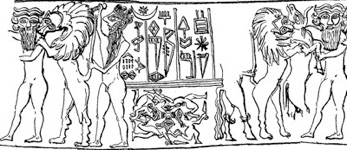
As noted above, the clay jar sealing illustrated above was found in the debris level SIS 1. The inscription (RIME 1.13.5.2; CDLI, P431204) above this last scene reads:
“Mesanepada, King of Kish, dam nu-gig (husband of the nu-gig)”.
As noted in the website Ur Online, the narrative relief carried by the seal is arranged in three parts:
✴to the left of the inscription, a lion attacks a ‘fine Gilgamesh figure’ while a naked bearded man (who wields a dagger) pulls its tail;
✴to the right of the inscription, we now see that this ‘Gilgamesh figure’, while under attack frm the lion, is also trying to wrest a goat from another lion (while another partly-lost animal holds this second lion by its tail ?); and
✴below the inscription, four small naked men are depicted on a smaller scale in a ‘swastika’ formation, as each of them points a dagger at the left heel of the man in ahead of him while reaching forward to grasp his right foot.
Note that the motifs of a ‘Gilgamesh figure’ attacked by a pair of lions and a swastika (in this case, of lions) in the seal of A’Anzu from PG 1236 (above).
Queen Nintur (SIS 1-2 and PG 755)
S!S 1-2
Lapis lazuli seal of Queen Nintur, wife of Mesanepada (U. 8981) from SIS 1-2:
inscription RIME 1.13.5.3; CDLI, P247685
Now in the Penn Museum (CBS 16852; image from Julian Reade (referenced below, 2003, at p. 103)
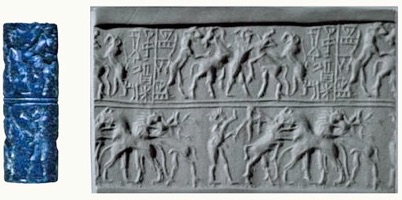
Mesanepada is also named in a seal of his wife, which was found in loose soil in SIS 1-2: this inscription (RIME 1.13.5.3; CDLI, P247685) reads:
“Nintur, the queen, the wife of Mesanepada”.
The relief carried by the seal is in two registers:
✴in the upper register, a naked hero protects bovids who are being attacked from each side by lions; and
✴in the lower register, a naked figure approaches from the left as a pair of crossed lions attacks a pair of bovids.
Fragmentary sealing of Queen Nintur (U. 13678 and U. 13686 A, B) from SIS 1-2
Inscription (RIME 1.13.5.4; CDLI, P431205), Queen Nintur
Image from Leonard Woolley (referenced below, 1934b, Plate 207, number 215
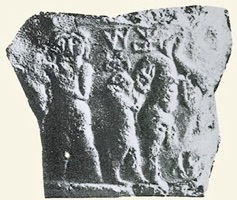
Two fragmentary clay sealings from SIS 1-2 carry an inscription (RIME 1.13.5.4; CDLI, P431205) that names ‘Nintur, the Queen’ (the same inscription as that on the copper bowl found at location 51 in PG 755, discussed above). The hero here is similar to the one depicted in the upper register of Mesamepada’s sealing from SIS 1 (above).